You have just received a bulk shipment of what you ordered as "100% premium cotton" or "luxurious silk blend." The price was competitive. The labels look perfect. But something feels... off. The handfeel is slightly too synthetic, the sheen is a bit too shiny, or it just doesn't absorb moisture like it should. You have a nagging suspicion that a cheaper fiber has been secretly blended in, or that the luxurious content you paid for was never even there. A veteran textile forensic analyst once told me, "A printed label is just a marketing promise. The fabric itself is the only source of truth. Your fingers, your eyes, and a simple flame are far more reliable than a tag that costs a penny to fake."
Spotting fake fabric composition labels is a simple, three-step forensic process that moves from a tactile audit to a visual investigation and, finally, to a definitive scientific test. The essential steps are: 1) The Handfeel and Tactile Audit (you can feel that a synthetic blend is too slick or that a fake wool lacks its natural, elastic crimp), 2) The Visual and Label Inspection (using a pick glass to examine the weave and hairiness of the yarns, and verifying the "made in" and RN numbers on the label), and 3) The Burn Test (the definitive, at-home chemical test that reveals the true fiber content through how it burns and what it smells like).
At Shanghai Fumao, we believe that a trustworthy B2B partnership is built on verifiable truth. Our rigorous incoming fabric inspection and material compliance program is designed to ensure that what is on the label matches what is in the garment. Let me teach you the simple, powerful, and accessible forensic methods that you can use right now to audit any shipment and never be fooled by a fraudulent label again.
Why Is the "Handfeel Audit" Your Most Powerful First Line of Defense?
Before you reach for a flame or a microscope, your own senses are the most powerful and immediate fraud detection tools at your disposal. Decades of shopping and wearing clothes have trained your brain to subconsciously know how natural fibers should feel and behave. A fake label often looks perfect, but the fabric's handfeel, weight, and reaction to simple physical tests will betray its true identity instantly. You just need to listen to what your fingers are telling you.
A handfeel audit is your first, immediate line of defense. Natural fibers have distinct, unforgeable tactile signatures. Real silk feels cool to the touch and warms slowly, while fake polyester silk often feels room temperature and slick. 100% cotton should feel soft and absorbent; a hidden polyester blend often feels suspiciously slick or "swishy." A simple wrinkle test is also powerful: crush the fabric in your fist. Linen and cotton will hold deep creases; polyester and nylon will spring back with few wrinkles. Your hands are a sophisticated fraud detection instrument.
A brand owner I know once caught a massive fabric fraud with a simple, physical test. She ordered "100% linen" blouses. When the sample arrived, she instinctively crushed the sleeve in her hand. The fabric barely creased. Real linen is famous for its beautiful, deep wrinkles. She immediately knew it was cut with a significant amount of synthetic fiber, despite a label that claimed "100% Linen." A lab test later confirmed her suspicion. Her simple, tactile experience saved her from a disastrous bulk order. This is the power of your own senses. This is the kind of diligence we support with our material verification processes .

What Is the Simple "Wrinkle Test" That Instantly Reveals Synthetic Blends?
Crush a section of the fabric tightly in your fist for 10-15 seconds, then release. Observe the creases. 100% natural fibers like cotton, linen, or viscose will hold pronounced, sharp wrinkles. Synthetic fibers like polyester and nylon are highly wrinkle-resistant and will spring back to a mostly smooth state. A fabric labeled "100% Cotton" that refuses to wrinkle is lying.
How to Physically Tell the Difference Between Real Wool and Acrylic?
Gently pull a few fibers from a seam. Real wool fibers are naturally crimped (wavy), elastic, and have a matte, slightly scaly texture. Hold them to the light. Acrylic fibers, which are often used to fake wool, are very straight, unnaturally even, and often have a brighter, more artificial sheen. The difference, once you look closely, is stark.
How to Perform a Visual and Label Inspection That Catches Most Frauds?
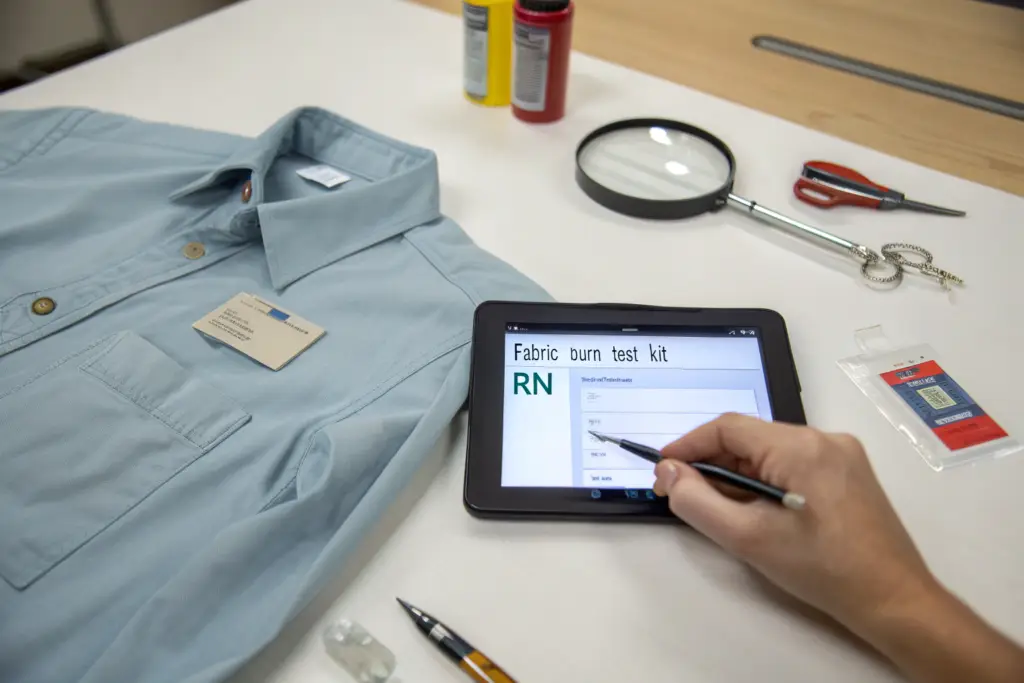
After the tactile check, the next layer of investigation is a careful, detailed visual audit of both the fabric's structure and the garment's legal labeling. A simple magnifying tool can reveal the invisible truth of the yarn's identity, while a critical eye on the legal label can uncover inconsistencies and fraudulent claims. This is a quick but powerful step that requires no special equipment other than a pick glass and a smartphone.
A visual and label inspection can catch most frauds. Use a pick glass to magnify the fabric's surface. A 100% cotton yarn will look hairy and irregular; a yarn blended with polyester will look unnaturally smooth and even. For the label, scrutinize the legal details. Under US law (FTC regulations), a label must disclose fiber content in descending order by weight, country of origin, and a Registered Identification Number (RN) or the full company name. Search the RN number on the official FTC RN database. If the number does not exist, is registered to a different company, or the "Made in" country conflicts with the RN registration, the label is likely fraudulent.
A brand we work with almost placed a large order for what was sold as a premium "Italian Wool" coating. Before committing, they performed a visual and label check. The pick glass revealed a yarn that was suspiciously smooth and lacked the natural, scaly texture of wool. The care label was also vague, and the supplier could not provide a valid RN number that matched their company. They trusted their investigation and canceled the order. A later, more formal test revealed it was a cheap acrylic-wool blend. Their simple, independent audit saved them tens of thousands of dollars. This is the power of being an informed buyer. This is the standard of our transparent material compliance .

What Is a Pick Glass and How Do You Use It to "See" Synthetic Fibers?
A pick glass is a small, folding magnifying loupe (8x-10x magnification) that costs just a few dollars. Lay the fabric flat. Place the pick glass on the surface. Look at the individual yarns. Natural fibers like cotton and wool will look somewhat rough, hairy, and irregular. Synthetic fibers like polyester and nylon will look perfectly smooth, slick, and unnaturally even. The difference is immediately visible.
How to Use the US Federal Trade Commission's (FTC) RN Database to Verify a Label?
Every RN number on a legally compliant US garment label is registered in a free, public database on the FTC's website. Go to the FTC RN Search page. Type in the RN number. The database will tell you the legal company name associated with that number. If the company name does not match the brand on the hangtag, or if the number does not exist, the label is fraudulent and the goods may be non-compliant. This is a simple, free, and powerful verification tool. This is the standard we help our private label partners comply with.
How Is the "Burn Test" the Ultimate At-Home Forensic Lab for Fibers?
The handfeel and visual checks are powerful preliminary tests. But for a definitive, scientific verification, there is a simple, at-home chemistry experiment that is the gold standard for fiber identification: the Burn Test. Every fiber type has a unique, predictable reaction to fire. It smells a specific way, it burns with a specific flame characteristic, and it leaves a specific type of residue. This test reveals the absolute truth of a fiber's chemical composition.
The burn test is the definitive forensic method for identifying fibers. By safely burning a small tuft of yarn pulled from an inside seam, you can determine the true composition. Natural cellulosic fibers (cotton, linen, viscose) burn quickly with a clean, paper-like flame and smell like burning paper or wood, leaving a fine, grey, powdery ash. Natural protein fibers (wool, silk) burn slowly, smell like burning hair, and leave a crushable, black bead. Synthetic fibers (polyester, nylon, acrylic) melt and shrink from the flame; they often burn with a chemical, acrid smell and leave a hard, plastic-like bead that cannot be crushed. This test is the ultimate reveal.
A brand owner once received a shipment of "100% Silk" dresses. She performed the burn test on a small thread from an inside seam. Instead of smelling like burning hair and leaving a crushable ash (the signature of real silk), the thread melted away from the flame and formed a hard, plastic bead. The smell was acrid and chemical. It was pure polyester, with a fake label. The burn test gave her the irrefutable proof she needed to reject the entire shipment and demand a refund. This is the power of a simple, definitive, scientific test. This is the kind of certainty we provide with our certified material supply chain .
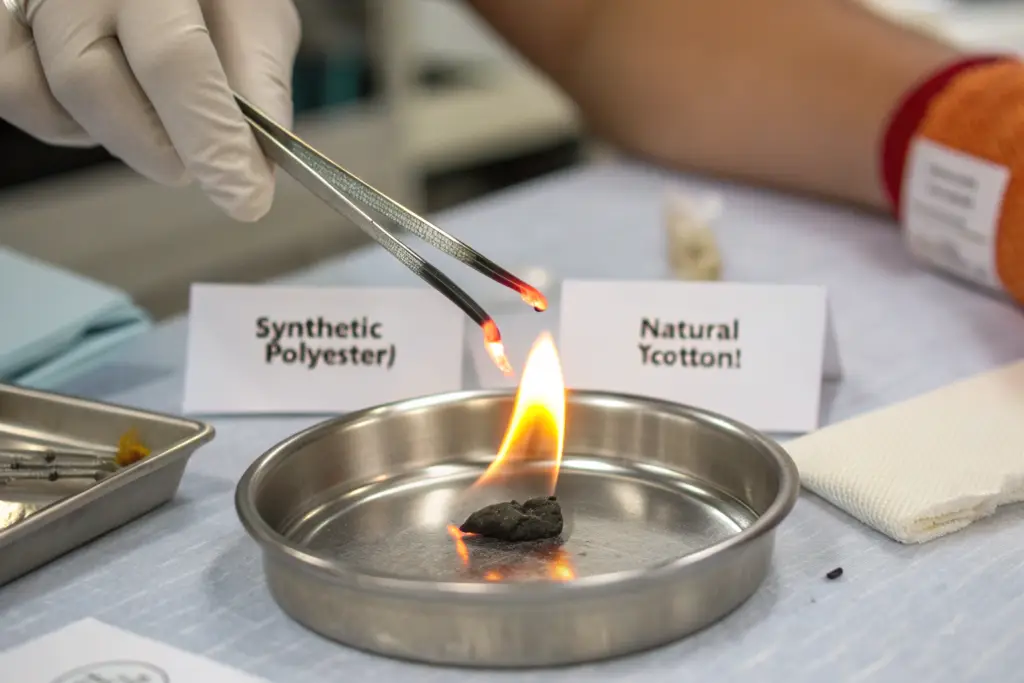
How Do Natural Plant Fibers (Cotton, Linen) Burn vs. Natural Animal Fibers (Silk, Wool)?
This is a key distinction. Plant fibers smell like burning paper or wood. Animal fibers smell like burning hair or feathers. This simple smell test is a powerful and immediate differentiator. A "100% Cotton" garment that smells like burning plastic is a fake. A "Silk" garment that smells like burning wood is likely not silk (it could be viscose, a plant-based semi-synthetic). The smell is the signature. This is a key part of our fabric forensics .
What Is the "Bead Test" on the Residue, and What Does It Tell You?
After the flame is out, examine the ash or residue. Natural fibers leave a soft, grey, powdery ash that turns to dust when you crush it between your fingers. Most synthetic fibers melt and leave a hard, dark, plastic-like bead that cannot be crushed. If the residue from your "100% Cotton" garment is a hard bead, it contains polyester or nylon. This physical residue is irrefutable evidence of the fiber's true chemical identity.
How Does Fumao's In-House Testing Lab Guarantee Your Fabric's Authenticity?
You should not have to perform burn tests in your office to trust your supply chain. A professional, trustworthy B2B manufacturing partner does this verification for you, with rigorous, scientific, and documented testing. Our in-house capabilities and our commitment to material transparency are your ultimate insurance policy against fiber fraud. We provide the verifiable, data-driven proof that what is on the label is the truth in the fabric.
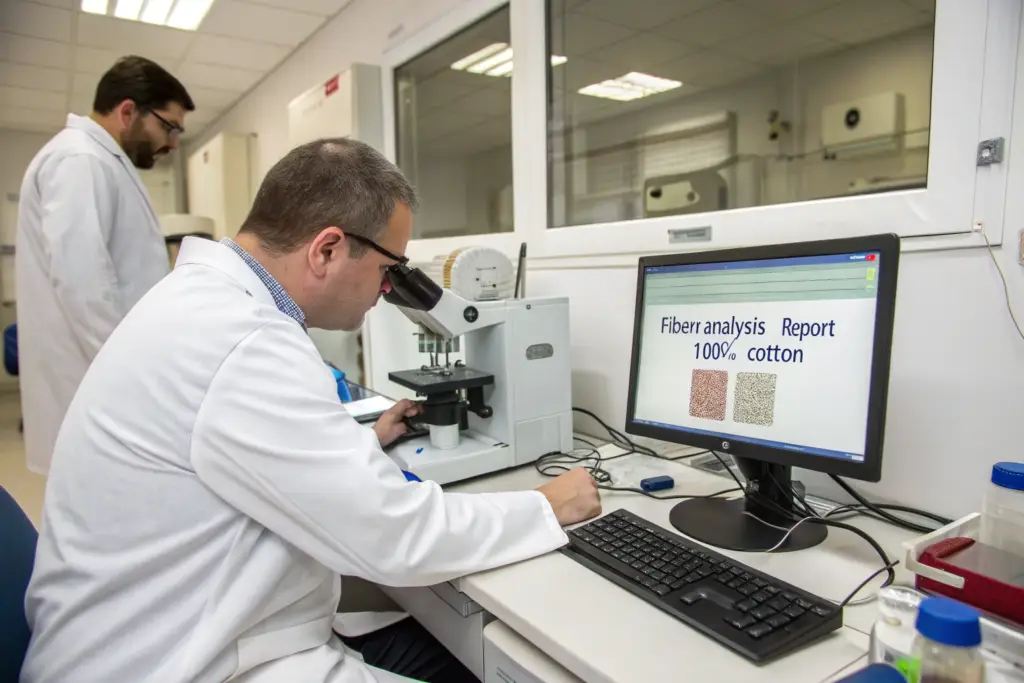
Fumao's in-house testing and rigorous supplier vetting process guarantees your fabric's authenticity. We perform our own burn tests and visual inspections on every incoming batch. For certified materials like GOTS organic cotton or GRS recycled polyester, we require and verify the Transaction Certificates (TCs) from the supplier, providing an unbroken chain of custody from the field or recycling facility to our factory. We do not just trust a label; we verify it with science and documentation, and we provide you with that proof.
A brand partner who was burned by fiber fraud in the past told us, "Your material compliance package is the most important document I receive with my order. The fact that you independently verify the fiber content and provide the certificates gives me a level of trust I've never had with any other factory. I can finally sleep at night." That is our goal. To provide the transparent, scientific, and documented assurance that your materials are exactly what you paid for. This is the foundation of a trusted B2B partnership .
What Documentation Do You Provide to Prove a Fabric's Composition?
We provide a comprehensive compliance package that can include:
- Mill's Technical Data Sheet: A detailed spec of the fabric.
- OEKO-TEX Standard 100 Certificate: Proof of chemical safety.
- GOTS or GRS Transaction Certificates (TCs): The legal chain-of-custody document for certified, sustainable materials.
- Our Own Incoming Inspection Report: Which includes the results of any internal spot-checks and audits.
We give you the paper trail to back up every claim. This is the standard of our transparent material assurance .
How Do We Handle It If a Supplier Tries to Substitute a Cheaper Material?
Our rigorous Incoming Inspection process is designed to catch it before a single cut is made. We compare the material against the approved BOM and the physical standard. If a discrepancy is found, we immediately quarantine the goods and alert the client with a detailed report. We never cut a suspect fabric into production. We are the guardians of your supply chain integrity. This is the core of our brand protection commitment.
Conclusion
Spotting a fake fabric composition label is a powerful, empowering skill. By moving from a simple tactile audit to a detailed visual and label inspection, and finally to the definitive burn test, you can independently verify the truth of any material and protect your business from one of the most common and costly frauds in the apparel industry. Your own senses, a pick glass, and a lighter are the ultimate tools of supply chain truth.
At Shanghai Fumao, we have made scientific, verifiable material integrity the bedrock of our B2B partnership. Our in-house testing, our rigorous supplier vetting, and our transparent documentation provide the absolute assurance that the fabric you design is the fabric that arrives. We take the guesswork and the risk out of material sourcing.
If you are ready to partner with a manufacturer who treats material integrity as a non-negotiable, verifiable science, let's talk. Our Business Director, Elaine, can walk you through our material compliance process. Please email Elaine at: elaine@fumaoclothing.com.