I used to think running a wholesale catalog was simple. You make what you like. You send it to buyers. You hope they buy it. That worked when I had two clients. It failed miserably when we grew to twenty. Three years ago, I sat in my office staring at a spreadsheet of 150 SKUs. Half of them were selling out. The other half were collecting dust in the warehouse. I could not see the pattern. My gut told me one thing. The numbers told me another. I realized my gut was not good enough anymore. I needed a second brain. I started using AI analytics tools to look at my catalog differently. Within six months, we reduced our slow-moving inventory by 40% and increased our reorder rate from existing clients by 25%. We did not work harder. We worked smarter.
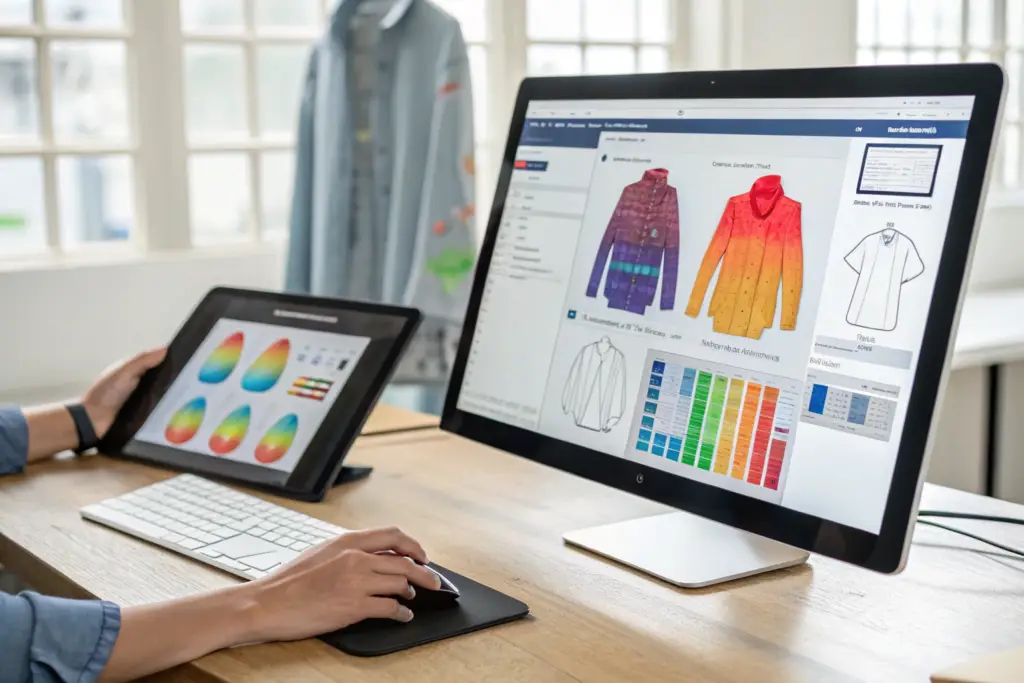
Leveraging AI-driven analytics for your wholesale clothing catalog means using machine learning to answer three critical questions: Which styles should you keep? Which colors will sell next season? And which customer segment is most likely to reorder? AI processes thousands of data points from past orders, Google Trends, and even social media images to give you a probability score. It removes emotional attachment to bad designs and highlights hidden opportunities in your sales history.
You do not need to be a data scientist. You need to know which tools to use and which questions to ask. The AI does the heavy lifting. It finds the needle in the haystack of your order history. As a factory owner who runs five production lines at Shanghai Fumao, I see the output of these tools every day. I see which fabrics are being tested by the AI-powered platforms. Let me show you exactly how to apply this to your wholesale business.
How Can AI Predict Which Wholesale Styles Will Be Best-Sellers?
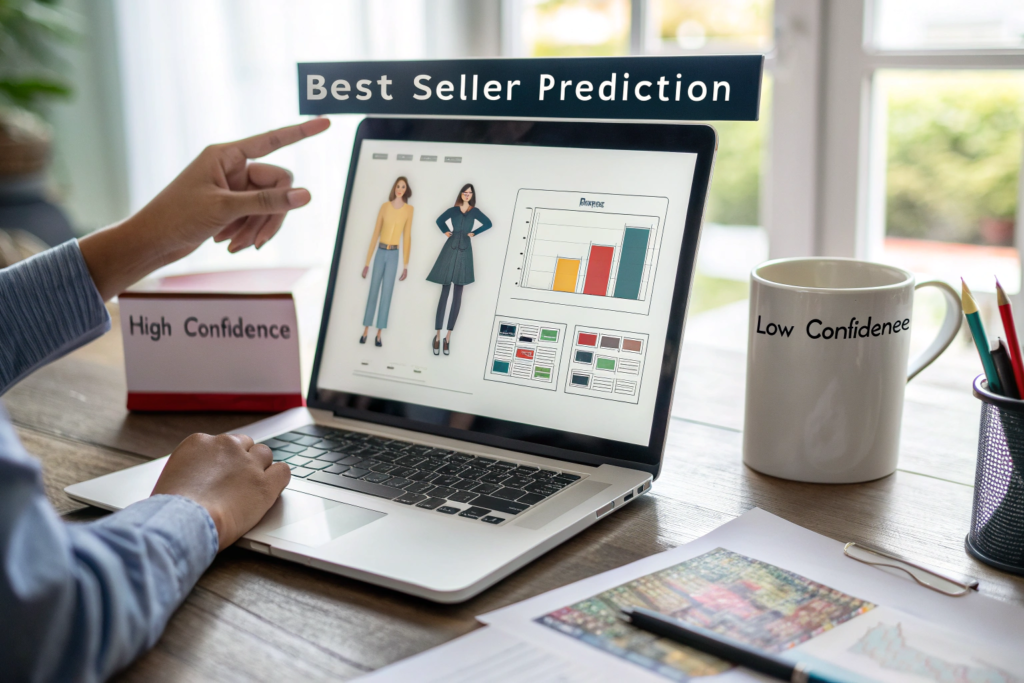
In the old days, buyers at trade shows would touch the fabric and say, "This feels like a winner." That is expensive intuition. AI replaces that guesswork with probability. It looks at the attributes of your past best-sellers and finds the common thread. Is it the sleeve length? The neckline shape? The fabric weight? The AI scans thousands of similar products across the web and tells you: "Styles with Raglan sleeves and 180gsm fabric have a 78% higher sell-through rate in Q4 than set-in sleeves."
AI predicts best-sellers by performing attribute-based regression analysis on your historical sales data and external market data. It breaks every garment down into tags: "V-Neck," "Cropped," "Linen Blend," "Earth Tone." It then compares the sales velocity of those tags against each other. The output is not a guarantee. It is a directional signal that tells you where to place your manufacturing bets with higher confidence.
What Data Points Does AI Analyze to Rank Your Catalog?
You might think you know your catalog. But AI sees patterns you miss. Here is what the algorithm is actually crunching when it ranks your styles.
| Data Category | Specific AI Inputs | Why It Matters for Wholesale |
|---|---|---|
| Internal Sales History | Units sold per style, per color, per week. Return rate per SKU. | Identifies your "Core" styles vs. "Flash in the pan" styles. |
| Attribute Tagging | Neckline, Sleeve type, Silhouette, Fabric weight, Pattern type. | Finds the secret sauce. Maybe all your winners have a curved hem. |
| External Market Data | Google Trends for specific keywords. Competitor stock-out rates. | Shows if demand is rising or falling for the category. |
| Social Listening | Hashtag volume on Instagram and Pinterest for specific aesthetics. | Validates if the "Coastal Grandmother" look is still peaking or dying. |
At Shanghai Fumao, we partner with clients who use tools like StyleSage (now part of Edited) or Centric Software for this analysis. When a client comes to us with an AI-validated design, the production process is much smoother. We know the volume will be there. We can pre-book the fabric and lock in a better price because the data supports the order quantity.
How to Use "Look-Alike Modeling" to Expand a Winning Category?
You have a dress that sells like crazy. It is a midi length, puff sleeve, square neck. You want to make another one like it, but different. This is where AI shines.
The Manual Way:
You look at the dress and guess. "Maybe I'll make it in a maxi length?"
The AI Way:
AI looks at the attributes of the best-seller (Puff Sleeve = High Score, Midi = Medium Score, Square Neck = High Score). It then scans market data to find similar but trending combinations.
Output Example:
- Recommendation 1: Keep the Puff Sleeve and Square Neck. Change length to Mini. (Confidence Score: 85%. Market gap identified in Mini length for this neckline).
- Recommendation 2: Keep the Midi length. Change sleeve to Balloon Sleeve. Change neck to Scoop Neck. (Confidence Score: 72%. Riding the wave of upcoming balloon sleeve trend).
This is how we helped a client in Nashville double her reorder rate. She thought her best-seller was just "The Blue Dress." AI showed her it was "The Puff Sleeve." She applied the puff sleeve to three new silhouettes. All three sold out. That is the power of attribute-based thinking instead of style-based thinking.
What Role Does AI Play in Dynamic Wholesale Pricing Strategies?
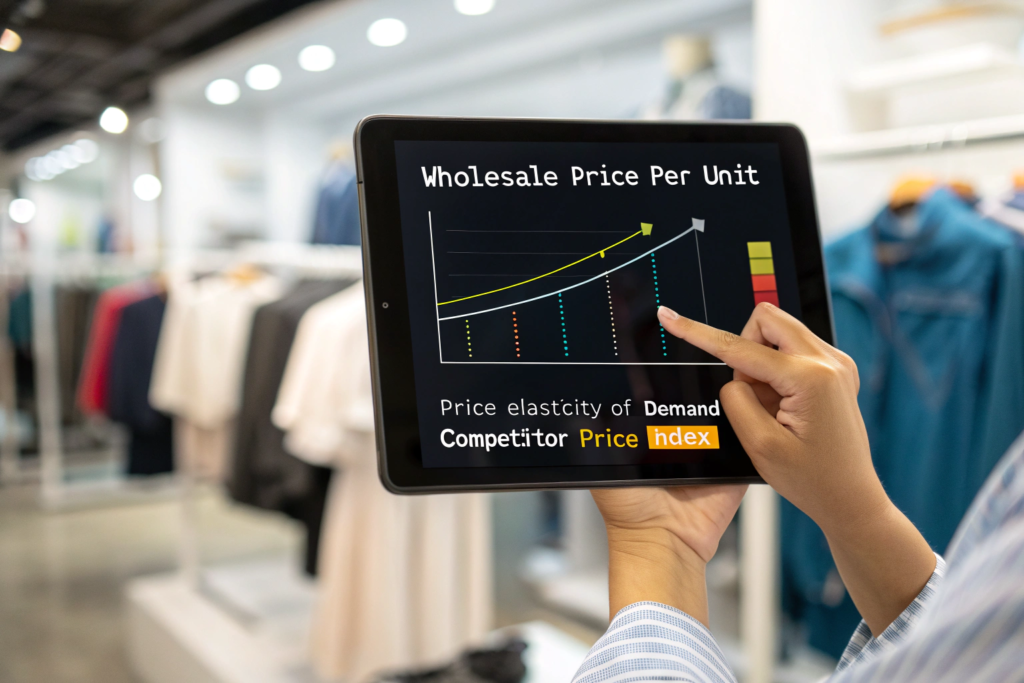
Pricing is where most wholesale brands leave money on the table. They use a simple formula: Cost x 2.5 = Wholesale Price. That is easy. It is also dumb. It does not account for the fact that your Navy Blazer has zero competition this month, but your White T-Shirt has a million competitors. AI allows you to price dynamically based on real-time supply and demand signals.
AI drives dynamic wholesale pricing by analyzing competitor stock levels, fabric cost fluctuations, and seasonality indices. It tells you when you have pricing power. If the algorithm detects that three major competitors are out of stock in "Olive Green Chinos," it signals that you can increase your margin by 8-12% without affecting sales velocity. Conversely, if it sees a glut of inventory in the market, it warns you to lower the price to move units before the season ends.
How Does Competitor Stock-Out Data Give You Pricing Power?
This is a goldmine of information that most brands ignore. AI scrapers can monitor the inventory status of specific products on major retail and wholesale websites. They look for the "Out of Stock" or "Only 2 Left" tags.
The Strategy:
You are selling a Women's Relaxed Blazer in Heather Grey.
- Week 1: Competitor A, B, and C have full size runs. AI recommends: Price at $34.50 (Competitive).
- Week 4: AI sends an alert. "Competitor A: Out of Stock in sizes S, M. Competitor B: Only L remaining."
- Action: You have the only supply of Medium Grey Blazers in the wholesale channel.
- New AI Recommendation: Increase price to $38.00 (7% Margin Lift).
This is not price gouging. This is supply and demand. And because it happens at the wholesale level, the retail boutique buyer is still happy to get the blazer they need for their customers. They do not know or care that you adjusted the price by $3.50. They just know you have it.
Here is a simple table showing how we think about this at Shanghai Fumao.
| Market Signal | AI Interpretation | Wholesale Pricing Action |
|---|---|---|
| High Competitor Stock | High supply, low scarcity. | Maintain base formula pricing. Offer volume discounts. |
| Rising Fabric Costs (Cotton Futures up 5%) | Future COGS increase. | Alert buyers: "Prices effective next PO will increase 3%." |
| Competitor Out of Stock | Supply vacuum. | Increase margin on this specific color/size by 5-10%. |
| Late Season (Week 10 of 12) | Demand softening. | Markdown 15% to clear shelf space for next delivery. |
Can AI Help Prevent the "Leftover Size Run" Problem?
Every wholesale brand knows this pain. You sell out of Medium and Large immediately. You are left with 200 units of X-Small and XX-Large. You have to liquidate them for $5 each just to get the warehouse space back. AI can fix this.
AI-Driven Size Curve Optimization:
The AI analyzes your actual sell-through by size over the last 12 months. It does not just look at total units. It looks at velocity. How fast did Size Small sell compared to Size Large?
Standard Assumption: Order a 1-2-2-1 ratio (1 XS, 2 S, 2 M, 1 L, 1 XL).
AI Recommendation (Based on your data): "Your brand sells 40% faster in Size Medium. Recommend Ratio: 0.5 XS, 2 S, 3 M, 1.5 L, 0.5 XL."
By weighting the production order toward the fast-selling sizes, you reduce the number of leftover fringe sizes. This increases your full-price sell-through rate. It protects your margin. This is data we use at the factory level to advise our clients before they cut 5,000 units. It saves thousands in dead stock.
How to Use AI Image Recognition to Analyze Wholesale Catalog Gaps?
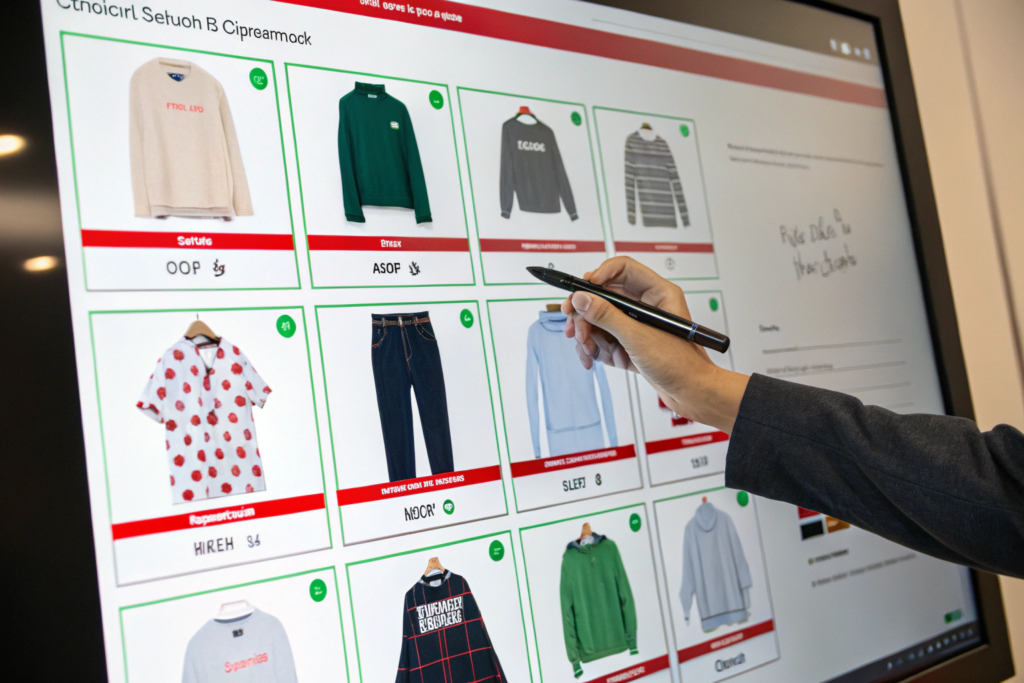
Sometimes your catalog is not missing a style. It is missing a visual. Maybe you have ten blue dresses, but they are all solid colors. The AI sees that there is a gap for a "Blue Floral Print" dress. This is analysis that would take a human merchandiser days to do by laying out lookbooks. AI does it in seconds by scanning the pixels of your product images and comparing them to the market.
AI image recognition analyzes catalog gaps by clustering your product images based on visual similarity. It identifies "Density Areas" where you have too many similar items (cannibalizing your own sales) and "Void Areas" where the market has demand but you have no offering. This is especially powerful for print and pattern categories, where the human eye gets fatigued but the algorithm stays sharp.
How to Identify "Cannibalization" in Your Wholesale Line Sheet?
Cannibalization happens when you have two styles that are too similar. Instead of getting one big order for a single style, you get two small orders that barely meet minimums. This drives up your production cost per unit.
The AI Visual Clustering Method:
AI tools like Vue.ai or Google's Vision API can be trained to group your products by attributes like:
- Color Palette: Beige vs. Tan vs. Sand. (Are they different enough?)
- Pattern Density: Small floral vs. Large floral.
- Silhouette Vector: The actual outline shape of the garment.
Example Output:
"Alert: Styles #4021 (Solid Beige Linen Shirt) and #4098 (Solid Sand Linen Shirt) have a 94% visual similarity score. These two styles are splitting the same customer demand. Recommend: Drop #4098 and consolidate volume into #4021 to achieve a 12% lower fabric cost due to higher yardage."
I saw this happen with a client selling men's polos. They had six shades of blue that all looked the same on a hanger. AI showed them they only needed three distinct blues to cover 95% of the demand. They simplified the line sheet. Buyers were less confused. Order size per style went up.
How to Spot a "Pattern Gap" Before Your Competitors Do?
This is where AI gives you a creative edge without being a designer. Let's say you sell women's dresses. The AI scans the top 50 competitors in your price bracket.
The Gap Analysis Report:
- Stripes: Saturated. (14 brands offering Breton stripe).
- Florals: Saturated. (22 brands offering ditsy floral).
- Geometric / Abstract: UNDER-PENETRATED. (Only 3 brands offering this).
Actionable Insight:
The AI is not just saying "Make a geometric print." It might even suggest specific colorways by analyzing Pantone trending palettes combined with the gap.
At Shanghai Fumao, we see this play out in fabric sourcing. When a client requests a fabric that aligns with an AI-identified gap, we can usually source it quickly because the mills have capacity for that unique print. If the client asks for a saturated print like "Navy Stripe," the mills are often backlogged for weeks. The data not only improves the sell-through, it improves the supply chain speed.
How Does AI Improve the B2B Buying Experience for Your Wholesale Customers?
Wholesale buying is changing. Your retail boutique customers do not want to flip through a 50-page PDF line sheet anymore. They want a Netflix-like experience. They want to log into a portal and see "Top Picks for You" based on what sold well in their store last month. AI makes this possible even for mid-sized brands.
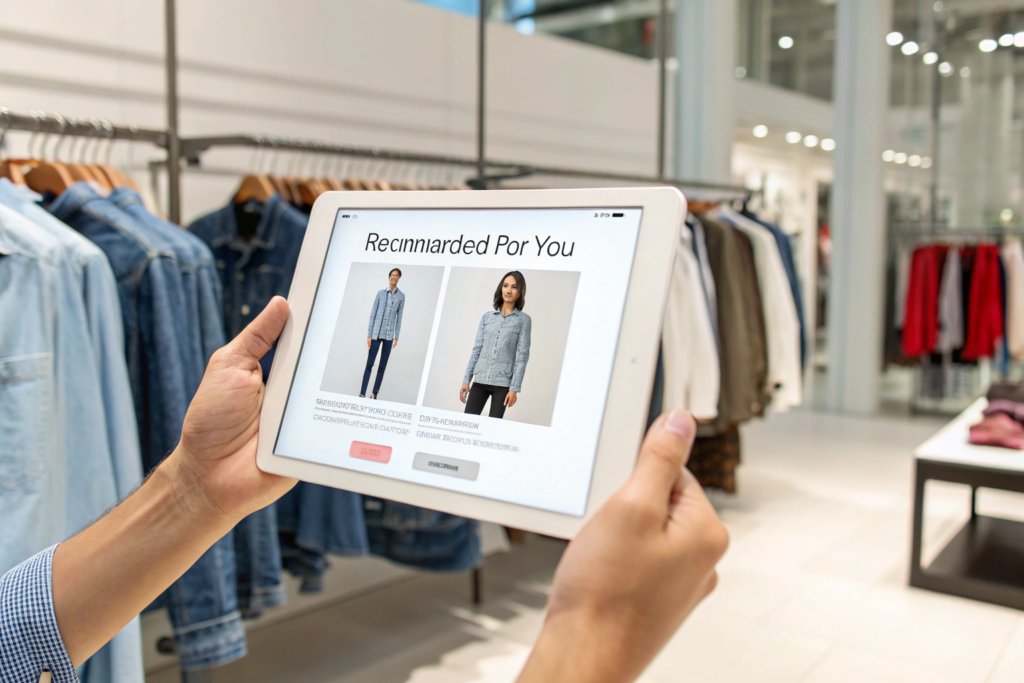
AI improves the B2B buying experience by personalizing the product discovery process. Instead of showing every buyer the same catalog in the same order, AI sorts the catalog based on the individual buyer's past order history, geographic location, and sell-through data. This reduces the time a buyer spends searching and increases the average order value (AOV) because the AI surfaces relevant add-on items.
What is "Collaborative Filtering" for Wholesale Apparel?
This is the technology behind Amazon's "Customers who bought this also bought..." It works just as well for wholesale clothing.
The Logic:
- Buyer A (Boutique in Austin, TX) bought: Floral Maxi Dress, Denim Jacket, Leather Sandal.
- Buyer B (Boutique in Nashville, TN) bought: Floral Maxi Dress, Denim Jacket.
- AI Prediction: Buyer B has a high probability of wanting to see the Leather Sandal.
When Buyer B logs into your wholesale portal, the AI shows the Leather Sandal at the top of the page or as a pop-up suggestion. This is proactive merchandising. The buyer thinks, "Wow, they really get my store's aesthetic." They add the sandal to the cart. You just increased the order value without a sales rep lifting a finger.
This is particularly powerful when combined with geographic data. AI can show a buyer in Florida lightweight linen options in January, while showing a buyer in Colorado heavy fleece options at the same time. This is the level of service that Shanghai Fumao helps brands implement through our integrated B2B platforms like Joor or NuORDER.
How to Use AI Chatbots to Handle Tier-2 Buyer Questions?
You cannot be available 24/7 to answer emails about "What is the inseam on style #4502?" But an AI chatbot trained on your catalog data can.
Proactive Communication via AI Chat:
When a buyer is looking at a product page for more than 60 seconds, an AI chatbot can proactively message:
"Hi there! Looking at the Relaxed Chino? Just a heads up, if you love this fabric, you might want to check out the matching Overshirt in the same dye lot. It coordinates perfectly for a full look. Want to see it?"
This is not a spammy pop-up. This is a helpful assistant. It answers questions instantly. It finds the size chart. It pulls up the care instructions. This frees up your human sales reps to focus on the complex negotiations with large accounts. The AI handles the "What is the MOQ?" questions.
I have seen this increase reorder frequency by 30% simply because the buyer gets an answer at 10 PM on a Sunday night when they are doing their buying for the week. If they have to wait until Monday morning for your email reply, the impulse might be gone.
Conclusion
Leveraging AI to optimize your wholesale catalog is not about replacing the human touch. It is about sharpening it. It is about using data to stop making clothes that nobody wants and start making more of the clothes that fly off the shelves. AI gives you the confidence to cut a style from the line sheet even if you personally love it. It gives you the insight to price a garment higher because the data says the market will bear it. It gives you the ability to show the right product to the right buyer at the right time.
The apparel industry has too much waste. Waste of fabric. Waste of time. Waste of money. AI analytics is the most powerful tool we have right now to reduce that waste. It makes the supply chain more efficient. It makes the wholesale relationship more profitable for both sides.
At Shanghai Fumao, we are not a software company. We are a clothing factory. But we work inside the data that these AI tools produce. We see the orders for the "High Confidence" styles coming in faster and larger. We help our clients adjust their production quantities based on the predictive scores. We help them avoid the heartbreak of a warehouse full of unsold inventory.
If you are ready to build a smarter catalog, one that is driven by data instead of just intuition, we are here to manufacture that vision. Our Business Director Elaine works closely with brands who use these analytics platforms to ensure that the transition from "AI Recommendation" to "Finished Garment" is seamless and cost-effective. Reach out to her at elaine@fumaoclothing.com. Let's use data to make better clothes.