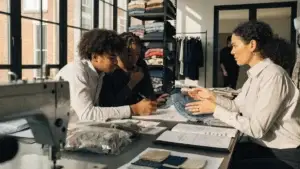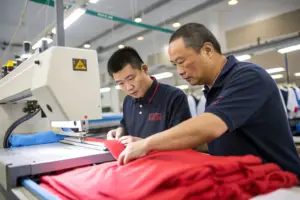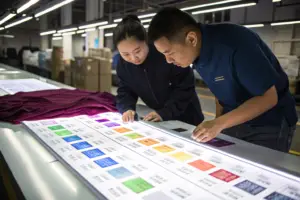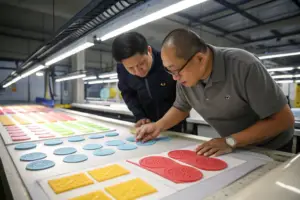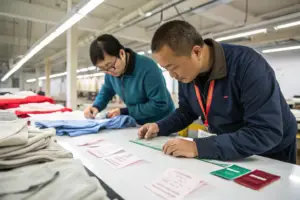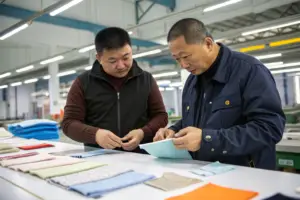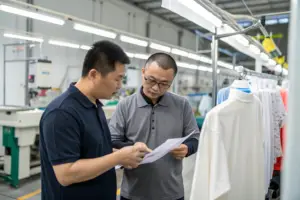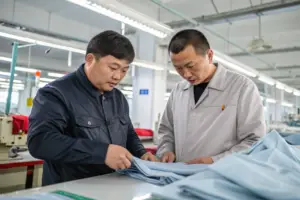
You send a detailed email to your factory contact. You ask three specific questions about the new fabric and the zipper color. Twenty-four hours later, you get a one-word reply: "Yes." You stare at the screen. Yes, what? Yes, to all three? Yes, to the fabric question only? This is the daily frustration of cross-border apparel manufacturing. It is not malice. It is a collision of language, culture, and time zones. A brand owner told me, "I spend more time deciphering emails from my factory than I do designing my collection. It's exhausting."
Avoiding communication issues with overseas suppliers requires a proactive, systemized approach. It involves: using Visual-First Communication (annotated photos and videos over long emails), establishing a Single Point of Contact (a dedicated Project Manager), confirming understanding with Written Recaps, and leveraging real-time tools like WeChat for quick clarifications while maintaining formal email for the official record.
At Shanghai Fumao, we have built our entire B2B service model around solving this exact problem. We know that inefficient communication is the #1 source of stress and hidden costs for our partners. Let me share the specific, actionable strategies that we use internally and that we teach our clients to make the 7,000-mile collaboration feel like a conversation in the next room.
Why Is Visual Communication More Effective Than Long Emails?
The biggest source of misunderstanding in global manufacturing is language. Even when both parties speak "English," the nuances of technical vocabulary are easily lost. A "slub" to you might be a "defect" to them. A "dark wash" is subjective. Emails are linear, text-based, and prone to misinterpretation. The solution is to make the communication as visual and unambiguous as possible.
Visual communication—annotated photos, short video clips, and marked-up tech pack images—transcends language barriers. A picture of a crooked seam with a red arrow pointing to the issue is universally understood. A 10-second video of a zipper catching is more effective than a 200-word description of the problem. This method reduces back-and-forth and ensures everyone is looking at the same thing.
We train all our Project Managers to communicate visually. If a client says, "The collar roll isn't quite right," we do not send an email asking for clarification. We take a high-resolution photo of the collar. We use a markup tool to draw a line showing the ideal roll, based on an inspiration image the client provided. We ask, "Do you want the roll to start here, like this?" This visual confirmation eliminates the ambiguity of words like "roll," "drape," and "hand." This is how we achieve efficient communication across cultures. This approach is supported by best practices in cross-cultural business communication.
How Should You Annotate a Photo for Effective Feedback?
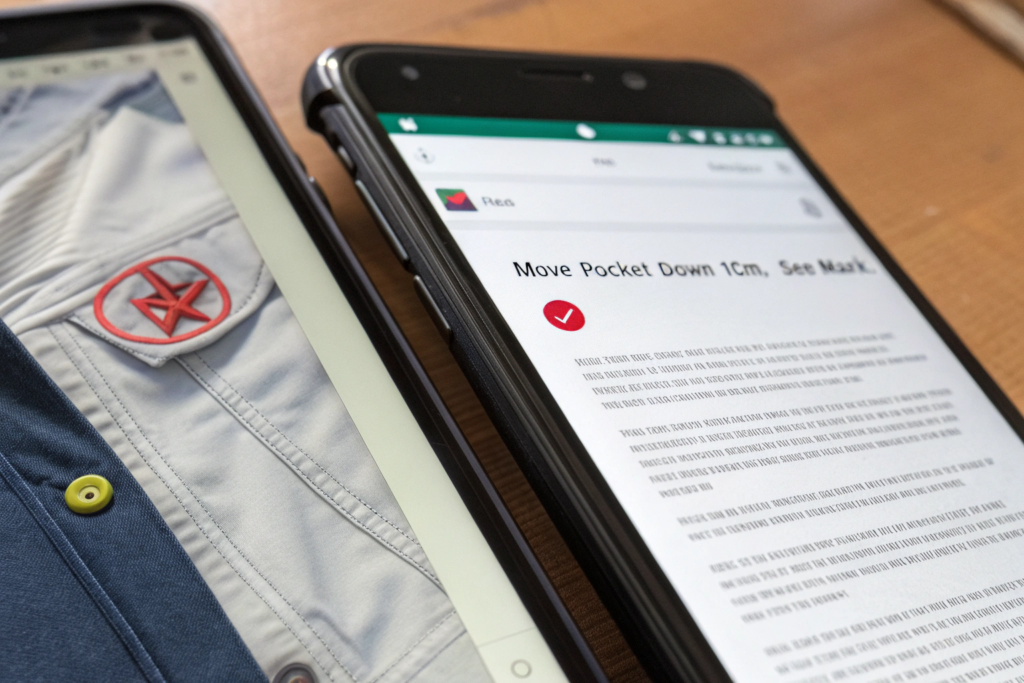
Do not just send a photo. Mark it up. Use the built-in editing tools on your phone or computer.
- Circle the area in question.
- Draw an arrow pointing to the specific issue.
- Add text directly on the image: "Pocket too low. Move up 1cm."
- Use a virtual measuring tape: If you are checking a measurement, include a photo of the garment with a physical ruler laid against the relevant Point of Measure (POM).
This turns a subjective observation into an objective, actionable instruction. It saves days of back-and-forth clarification emails. This is the single most impactful change you can make to your communication workflow.
What Role Do Short Video Clips Play in Remote Production?
Video is essential for conveying movement and drape. A static photo cannot show you how a dress flows when a model walks or how a fabric stretches during activity. We regularly send 10-15 second video clips via WeChat. These clips show a fit model walking in a sample, or a close-up of a zipper being operated, or a stretch test being performed on a printed fabric. This real-time, moving visual provides a level of insight that is almost as good as being in the room. It is a cornerstone of our transparent manufacturing approach.
How Does a Dedicated Project Manager Solve the "Who Do I Ask?" Problem?
One of the biggest frustrations for brand owners is not knowing who to talk to. Do you email the salesperson? The pattern maker? The shipping guy? Emails get lost, forwarded to the wrong person, or ignored. This is the "black hole" of factory communication. The solution is a Single Point of Contact (SPOC) .
A dedicated Project Manager acts as your single point of contact and internal advocate. They are responsible for translating your needs to the pattern room, the cutting floor, the sewing line, and the logistics team. You only need to email one person. They are accountable for getting you answers and ensuring your instructions are executed correctly.
At Fumao, every B2B partner is assigned a dedicated Project Manager. This person is not a salesperson who disappears after the PO is signed. They are an operations specialist who owns your project from start to finish. They know your brand's specific quality quirks and preferences. When you email your Project Manager with a question, they do not just forward the email. They walk to the pattern room or the cutting table, get the answer, and reply to you with clarity. This single role is the most effective tool we have for eliminating inefficient communication and building trust.

What Is the Difference Between a Sales Rep and a Project Manager?
This is a critical distinction. A Sales Representative is focused on acquiring new Purchase Orders. Their job is largely done once the deposit is paid. Their performance is measured by new business won. A Project Manager is focused on fulfilling the Purchase Order perfectly. Their performance is measured by on-time delivery, quality assurance scores, and client satisfaction. They are your advocate inside the factory. Understanding this difference is key to knowing who to talk to at different stages of the manufacturing process.
How Does the Project Manager Translate "Designer Speak" to "Factory Floor Speak"?
You might say, "I want this dress to feel effortless and drapey." That is designer speak. The Project Manager translates that into factory floor speak: "Use the 120 GSM Tencel Twill. Cut on the bias. Use a baby hem." They bridge the gap between creative vision and technical execution. This translation function is one of the most valuable, yet invisible, services a professional clothing manufacturer provides.
Why Are Written Recaps Essential After Every Conversation?
You have a great, productive video call with your Project Manager. You discuss three changes. You hang up, feeling confident. Two weeks later, the next sample arrives. Two of the three changes were made. The third was forgotten or misunderstood. Without a written record, it is your word against theirs. This is a recipe for frustration and delay.
The "Recap Email" is a non-negotiable discipline. After every significant conversation—a video call, a long WeChat exchange—send a brief, bulleted summary email. Start with: "Just to confirm our discussion..." This creates a shared, written record of decisions and action items. It prevents misunderstandings and provides a reference point if memory fails.
I cannot overstate the importance of this simple habit. It takes 90 seconds to write a recap email. It can save three weeks of delay and hundreds of dollars in rework. We encourage our clients to do this, and our Project Managers are trained to do it from their side as well. This mutual commitment to documentation is a hallmark of a professional B2B relationship. It de-risks the entire product development process.
What Should a Good Recap Email Include?
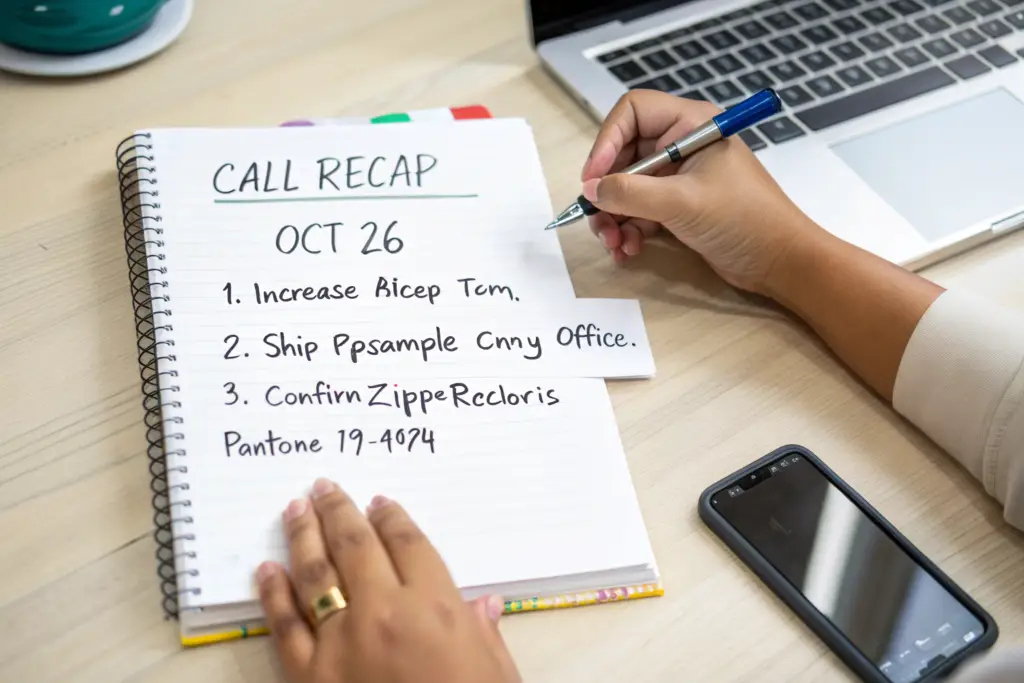
Keep it short and scannable. Use bullet points. Include:
- Specific Decisions: "PP Sample approved for bulk. No further changes."
- Action Items: "Client to provide new care label artwork by Friday." "Factory to ship TOP sample by Monday Oct 30."
- Clarifications: "Confirming: The thread color will match the body fabric, not the contrast trim."
This written trail protects both parties and ensures everyone is working from the same, latest set of instructions.
How to Use WeChat for Quick Updates and Email for Formal Approvals?
We use a hybrid communication model. WeChat is our tool for real-time, informal updates. "Here's a photo of the cutting table. Your fabric looks great." "Quick question: Is the button placement 3cm or 3.5cm from the edge?" It is fast and reduces friction. Email is our tool for formal approvals and official records. "Attached is the final spec sheet for your sign-off." "This email confirms the revised ship date of November 15." This hybrid approach leverages the speed of instant messaging while maintaining the rigor of formal documentation for critical milestones. This is how we manage communication effectively across time zones.
How to Bridge the Cultural Gap in Manufacturing Feedback?
Communication is not just about language. It is about culture. The way feedback is given and received varies greatly between Western and Asian business cultures. A direct, critical comment that is normal in New York or London ("This stitching is unacceptable. It needs to be redone.") can be perceived as harsh and disrespectful in a culture that values saving face and indirect communication. This cultural friction can damage relationships and slow down problem-solving.
Bridging the cultural gap requires a shift to collaborative, objective language. Instead of "This is wrong," frame feedback as "Let's look at this together" or "We need to adjust this to meet the standard." Focus on the objective spec, not the person. "The spec calls for a 1/4" hem. This measures 1/2". Let's get it to 1/4"." This depersonalizes the issue and makes it a shared technical challenge.
I recall a new brand owner who was very direct in her feedback. She sent an email that said, "The sample is a mess. The sizing is completely off." Our team was taken aback. It felt like an attack on their skill. Our Project Manager gently guided her. "I understand your frustration. To help the pattern team fix this quickly, can you send the specific POMs that are off, with the target vs. actual measurements?" She did. The issue was resolved quickly. The next time, she led with the data. The relationship was preserved, and the work got done faster. This is the art of effective cross-cultural collaboration.

How to Deliver Critical Feedback Constructively?
Use the "Observation-Impact-Request" framework.
- Observation: "I noticed on the PP sample, the topstitching on the collar is 3/8" from the edge." (State the fact).
- Impact: "The spec calls for 1/4". This difference changes the look of the collar." (State the objective impact).
- Request: "For bulk, can we please ensure the stitching is exactly 1/4" from the edge, as per the spec?" (Make a clear, non-blaming request).
This framework is clear, professional, and respectful. It focuses on the solution, not the blame.
What Are the Best Times to Schedule Calls Across Time Zones?
This is a simple logistical step that shows respect. Do not expect a factory Project Manager in Shanghai to take a call at 10:00 PM their time. Use a tool like World Time Buddy to find a mutually convenient window. The best overlap for US-China communication is typically early morning US time (7:00-9:00 AM ET / 4:00-6:00 AM PT), which is evening in China (7:00-9:00 PM) . Our Project Managers often work a split shift to accommodate these windows. Scheduling calls during the overlap shows you value their time and fosters a more collaborative B2B partnership.
Conclusion
Effective communication with an overseas clothing supplier is not a magical gift. It is a learnable skill and a disciplined system. It is about shifting from vague, text-heavy emails to precise, visual collaboration. It is about leveraging a dedicated Project Manager as your single source of truth. It is about the simple, powerful habit of the recap email. And it is about navigating cultural differences with respect and objectivity.
At Shanghai Fumao, we have built our entire B2B service model around these principles. We do not just wait for clear instructions; we actively work to create a communication environment where clarity is the default. We see ourselves as an extension of your team, and we know that smooth, efficient communication is the foundation upon which great clothes and great brands are built.
If you are tired of communication breakdowns and are looking for a clothing manufacturer who prioritizes clarity and collaboration, let's talk. Our Business Director, Elaine, can explain how our Project Management model ensures a smooth and transparent partnership. Please email Elaine at: elaine@fumaoclothing.com.