You hold a pair of shorts from a brand you admire. The fabric feels substantial. The stitching is perfectly straight. The fit is exactly right. You wonder how this product came to be. Not the design, but the physical object. The rolls of fabric. The cutting tables. The rows of sewing machines. The hands that assembled each piece. The eyes that inspected every seam. The journey from a bale of cotton to a finished garment in a shopping bag. You are a brand owner. You want your shorts to have this quality. You want your customer to pick up your product and feel the same confidence. But you do not know what happens inside a factory that produces at this level. You only see the result. This article pulls back the curtain.
At Shanghai Fumao Clothing, we craft classical types of shorts for global brands through an integrated, five-phase production system: strategic material sourcing from certified mills, precision cutting using automated Gerber technology, structured sewing lines with specialized workstations, rigorous multi-gate quality control, and careful finishing and packing. Every pair of shorts passes through over forty individual operations, each performed by a skilled operator, each checked against a written specification. The result is a garment that meets the fit, durability, and aesthetic standards of demanding brands in the United States, Europe, and beyond. We do not just sew fabric. We engineer products that build brand reputations.
I am the owner of Shanghai Fumao. I have built this factory over years to serve brands that refuse to compromise on quality. I have walked every inch of our production floor thousands of times. I know every machine, every process, every QC checkpoint. This article is a tour of our operation. It explains exactly how we make a classic short, from the moment the fabric arrives to the moment the carton is sealed. After reading it, you will understand what happens inside a professional garment factory and what to look for in a manufacturing partner.
How Does Strategic Fabric Sourcing Build the Foundation of a Quality Short?
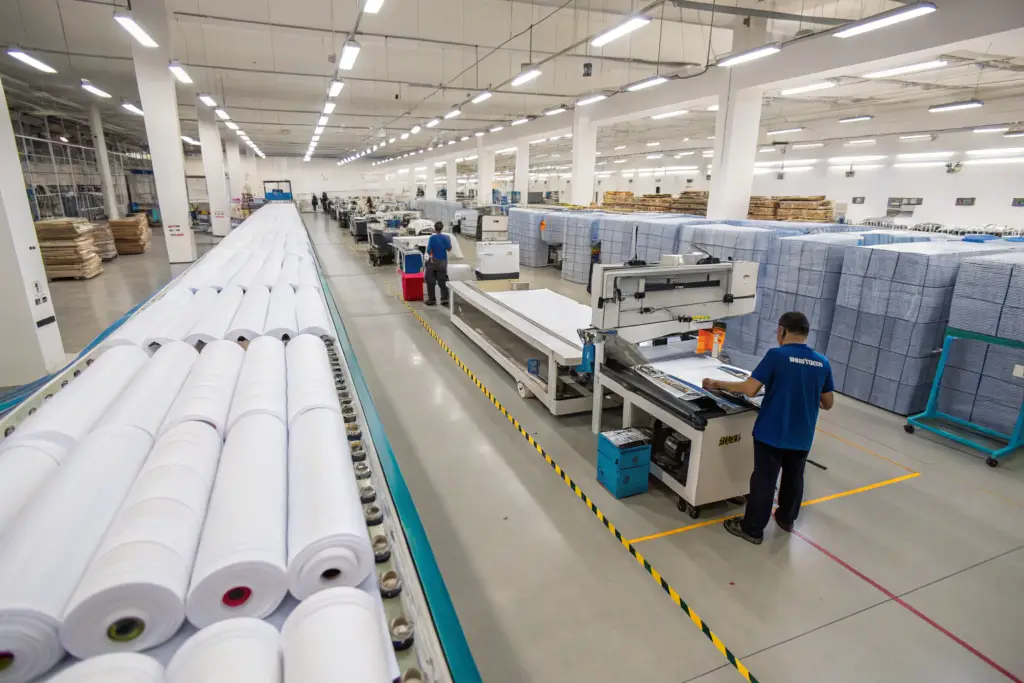
The short begins long before the sewing machine. It begins in the fabric mill. The quality of the raw material determines the ceiling of the finished product. A factory can cut and sew perfectly. If the fabric is poor, the short will be poor. This is why we invest heavily in our fabric sourcing relationships and our incoming material inspection. We do not buy fabric from anonymous traders. We buy from named mills with documented quality systems.
I personally visit our key fabric mills at least twice a year. I walk their weaving floors. I check their yarn inventory. I review their quality control lab. I have built relationships with mill owners over a decade. When I place an order for 5,000 meters of 280 GSM cotton twill, I know exactly which mill is weaving it, which cotton bales are being used, and what finishing processes will be applied. This vertical transparency is rare. Many factories buy fabric on the open market, taking whatever is available at the lowest price. That is cheaper in the short term. It is disastrous for consistent quality. Our fabric sourcing strategy is built for brands that need the same fabric, roll after roll, order after order.
Fabric sourcing is not just about price. It is about consistency, performance, and documentation. A professional factory has a formal incoming inspection process for every fabric roll. Let's look at how we qualify a fabric and what happens when it arrives at our door.
What Criteria Do We Use to Select and Audit Our Fabric Mills?
We select fabric mills based on five criteria. Quality consistency, verified by reviewing their internal QC records and their defect rate per 100 meters. Production capacity, verified by visiting their weaving floor and confirming they can handle our volume without outsourcing. Ethical compliance, verified by requiring a valid BSCI or equivalent social audit report. Environmental management, verified by checking their wastewater treatment system and chemical management certifications. Financial stability, verified by trade references and years in business.
Before we approve a new mill, we place a small trial order. We test the fabric extensively in our own lab. We check the weight, the weave density, the yarn count, the color fastness, and the shrinkage. We sew sample shorts and wash them ten times. Only if the fabric passes every test do we add the mill to our approved supplier list. The textile mill audit checklist we use is based on international standards. This rigorous selection process eliminates fabric problems before they can affect a client's order.
How Does Our Incoming Fabric Inspection Process Catch Defects Before Cutting?
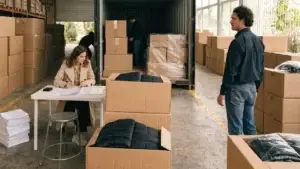
When a fabric roll arrives at our warehouse, it goes directly to the inspection station. Our QC team uses a fabric inspection machine with a lighted panel. The fabric is unrolled and passed over the light. The inspector examines every meter. Defects, holes, stains, weaving flaws, color shading, are marked with a sticker. The roll is graded using the 4-point system, the American standard for fabric inspection. A roll that scores above a certain threshold of defect points per 100 meters is rejected and returned to the mill.
The inspector also cuts a swatch from the beginning, middle, and end of each roll. These swatches are tested for weight using a GSM cutter and digital scale, for color consistency using a lightbox under multiple light sources, and for shrinkage using a standard wash test per AATCC 135. The results are recorded on the roll's inspection card. A roll that passes all tests is moved to the approved fabric inventory. A roll that fails any test is quarantined. The fabric inspection 4-point system is our standard. This process ensures that only conforming fabric reaches the cutting table. No surprises. No excuses.
What Role Does Precision Cutting Play in Consistent Fit and Sizing?
Fit consistency starts at the cutting table. If the cut panels are inconsistent, no amount of skilled sewing can fix the fit. A panel cut slightly off-grain will twist. A panel cut slightly larger on one side will produce an asymmetrical garment. Manual cutting with hand-held rotary cutters introduces human variation. Automated cutting eliminates it. This is why we invested in computerized cutting technology.
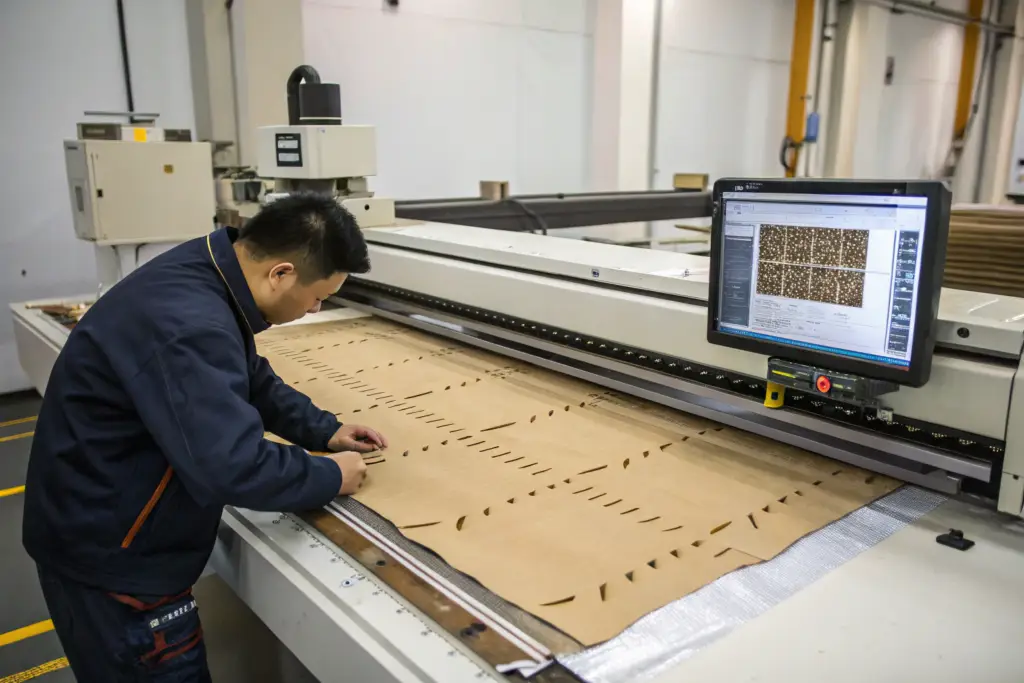
I made the decision to purchase our Gerber automated cutting system five years ago. It was a significant capital investment. It paid for itself within two years through reduced fabric waste and eliminated size inconsistency returns. The machine cuts with a tolerance of 0.1 millimeters. Every size medium front panel is identical to every other size medium front panel. The automated cutting in garment manufacturing technology ensures that the pattern maker's intent is executed perfectly, piece after piece. For brands that sell online, where fit consistency directly impacts return rates, automated cutting is not a luxury. It is a necessity.
The cutting process involves more than the machine. The fabric must be properly relaxed and spread. The pattern markers must be optimized for efficiency. The cut panels must be numbered and bundled correctly for the sewing line. Let's walk through the entire cutting workflow.
Why Do We Use Automated Gerber Cutting for Large Brand Orders?
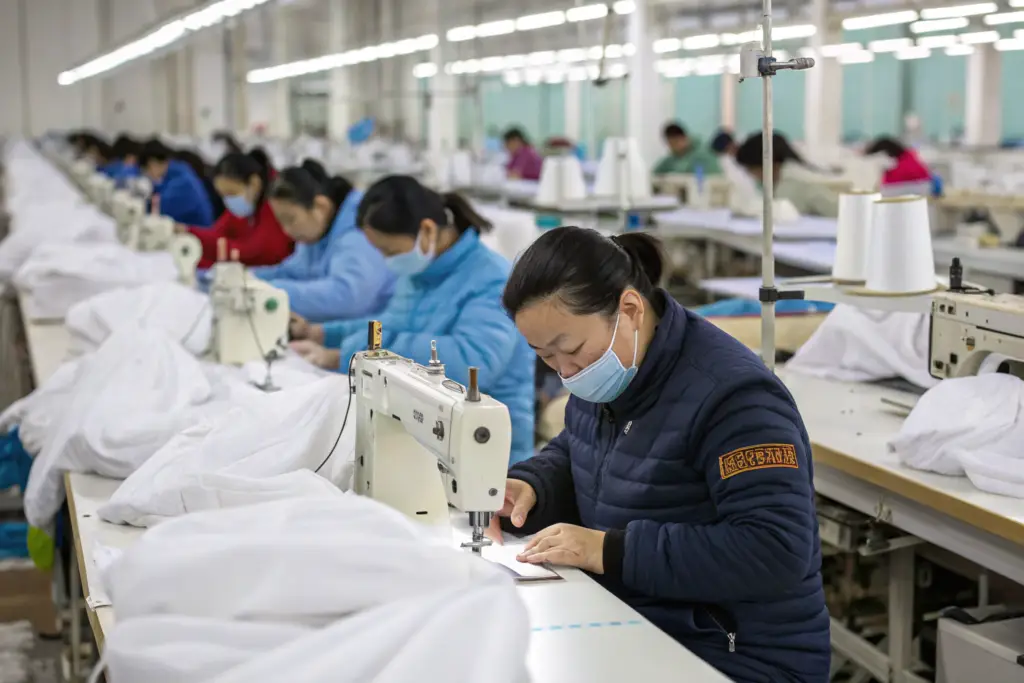
The Gerber system uses a digital pattern file created by our CAD pattern maker. The file contains every pattern piece, graded for every size. The system nests the pieces on a digital marker, arranging them to minimize fabric waste. The marker is sent to the cutting machine. The fabric is spread on the cutting table in multiple layers, up to 50 layers for a heavy twill. The machine head moves across the fabric, cutting each piece with a reciprocating blade or a laser. The cut is clean, precise, and identical across all layers.
For large brand orders of 1,000 pieces and above, automated cutting delivers unmatched consistency. The tolerance is 0.1mm. Manual cutting tolerance is 2-3mm. That difference is visible in the finished garment. A manually cut short may measure slightly differently on the left and right leg. An automatically cut short is symmetrical. The Gerber cutter precision specifications explain the technology. We use automated cutting for all our bulk brand orders. It is the foundation of our fit consistency promise.
How Do We Relax and Prepare Fabric Before Cutting to Prevent Shrinkage?
Fabric is under tension when it is woven and rolled. If cut immediately, the fabric will relax and shrink later, after the garment is sewn. This causes fit inconsistency. We relax all fabric before cutting. The fabric rolls are unrolled and left to rest in the cutting room for 24 to 48 hours. The fabric is allowed to contract to its natural state. The temperature and humidity of the cutting room are controlled to standard conditions.
For fabrics that are prone to shrinkage, such as linen or loosely woven cotton, we pre-wash or sanforize the fabric at the roll level before cutting. This pre-shrinks the fabric so that residual shrinkage is under 2%. The fabric relaxation and pre-shrinking process is a critical but invisible step. A factory that skips this step produces shorts that shrink unpredictably after the customer's first wash. We do not skip steps. The fabric is prepared properly. The cut panels are stable. The finished short fits correctly, and stays fitting correctly.
How Are Our Sewing Lines Structured for Efficiency and Specialization?
The sewing line is the heart of the factory. This is where the cut panels become a garment. The organization of the sewing line determines the quality, the speed, and the cost of production. A disorganized line is chaos. Defects multiply. Time is wasted. An organized line is a flow. Each operator performs their specialized task. The garment moves smoothly from station to station. Quality is checked at each handoff. Efficiency is high. Defects are caught early.
Our five production lines are organized using a progressive bundle system. Each line has about 25 to 30 workstations. Each workstation is equipped with the specific machine type needed for that operation. A lockstitch machine for straight seams. An overlock machine for edge finishing. A feed-off-the-arm machine for inseams. A buttonhole machine. A button attachment machine. A bar tack machine. The operator at each station is trained in that specific operation. They perform it hundreds of times per day. They become an expert. This specialization is the key to quality and speed. The progressive bundle system in garment manufacturing is an industry standard for a reason. It works.
A classic short goes through approximately 40 individual sewing operations. Each operation has a standard time and a quality standard. The line supervisor balances the work across the stations to ensure a smooth flow. Let's look at how we handle the most critical operations.
What Specialized Machines Ensure Perfect Waistbands, Zippers, and Hems?
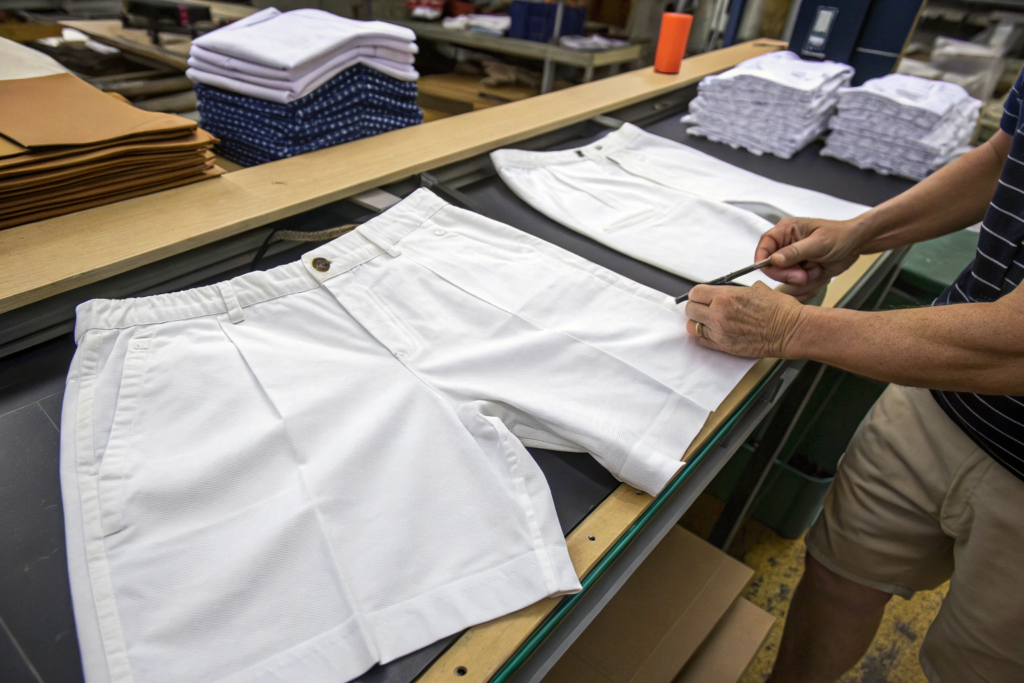
The waistband is attached with a specialized lockstitch machine equipped with a folder attachment. The folder automatically turns the waistband fabric to the correct width, ensuring a perfectly even waistband every time. The zipper fly is set with a programmable Juki machine. The machine is programmed to sew the exact stitch pattern around the zipper. The operator positions the fabric. The machine executes the stitch. The result is a fly that is perfectly symmetrical, with the stitch line exactly 3mm from the zipper teeth. No human hand can match this consistency.
The hem is finished with a hemming machine equipped with a special folder. The fabric edge is automatically turned under twice and topstitched. The hem width is perfectly uniform around the entire leg opening. The belt loops are attached with a bar tack machine. The bar tack is a dense, reinforced stitch that secures the belt loop to the waistband with immense strength. A hand-sewn bar tack is inconsistent. A machine bar tack is perfect. The specialized sewing machines for garment production guide explains the different machine types. We invest in the right machine for each operation. The machine ensures quality. The operator ensures flow.
How Does Our Inline Quality Control System Work During Sewing?
Inline QC means quality is checked during the sewing process, not just at the end. Our QC inspectors walk the sewing line every two hours. They pull garments randomly from the line. They check the stitch quality, the seam alignment, and the attachment of components. If they find a defect, they identify the workstation where it occurred. The defect is corrected immediately. The operator is coached. The problem does not repeat.
This inline system catches defects when they are small and cheap to fix. A misaligned pocket caught after ten pieces is a quick correction. A misaligned pocket caught after 500 pieces is a disaster. The inline quality control in garment manufacturing is a core principle of our ISO 9001 quality management system. It requires discipline, but it delivers results. Our defect rate on the sewing line is consistently below 1%. That is the power of catching problems early.
What Finishing, Pressing, and Packing Steps Complete the Manufacturing Process?
The shorts are sewn. But they are not ready to ship. They must be trimmed, inspected, pressed, folded, tagged, and packed. This finishing process is what the customer sees when they open the box. A short with loose threads, a wrinkled appearance, or sloppy folding feels cheap, even if the construction is perfect. The finishing stage is the presentation stage. It is where the product is prepared for its retail moment.
Our finishing department is as organized as our sewing lines. Each short passes through a sequence of finishing stations. Thread trimming. Final inspection. Pressing. Folding. Tagging. Packing. Each station has a quality standard. The garment finishing and packing process is documented and audited. The goal is that every short in every carton looks and feels identical to the approved pre-production sample.
How Do We Press, Fold, and Package Shorts for a Premium Unboxing Experience?
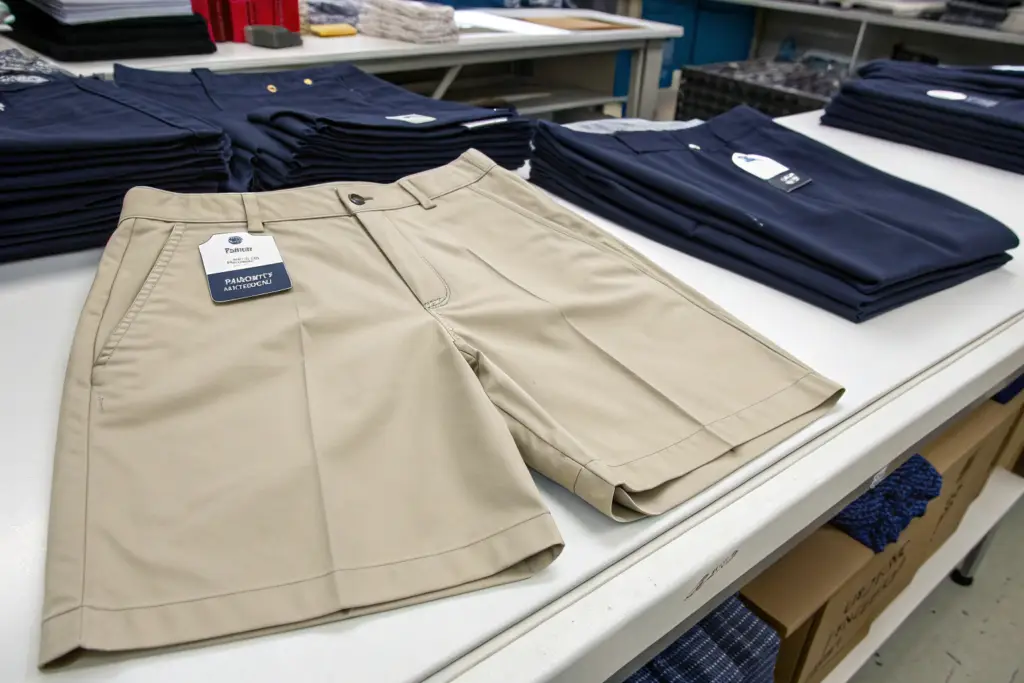
Pressing is done on a buck press, a specialized machine for pressing trousers and shorts. The short is placed on the buck. Steam and pressure are applied. The creases, if specified, are set. The fabric is smoothed. The short emerges crisp and flat. For a soft, casual finish, we use a gentle steam tunnel instead of a press. The folding is done by hand, with tissue paper inserted between the folds to prevent creasing during shipping.
The folded short is placed in a polybag to protect it from moisture and dirt during transit. The polybag is sealed. The brand's hang tag is attached. The inner care label is visible. The packaged short is placed in an export carton. The carton is labeled with the PO number, style number, color, size breakdown, and quantity. The carton is sealed and banded. The premium garment packaging standards ensure the product arrives at the retailer or the customer's door in pristine condition. The unboxing experience is part of the brand's quality promise.
What Is Our Final Random Inspection Protocol Before Shipment?
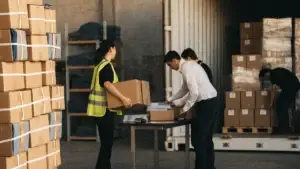
Before any carton is loaded onto a truck, our QC team performs a final random inspection. This is the last quality gate. The inspector uses the AQL 2.5 sampling standard. For a 2,000-piece order, 125 pieces are pulled from random cartons. Each piece is inspected on a light table. The inspector checks for visual defects, measurement accuracy, and functional issues. They operate every zipper. They pull every button. They check every pocket. They compare the shorts to the approved pre-production sample and the measurement specification sheet.
If the number of defective pieces exceeds the AQL limit, the entire lot fails. The lot is re-inspected 100% by our team. The defects are corrected. The lot is then re-inspected. Only after passing the AQL inspection are the cartons released for shipping. The inspection report is documented and shared with the client. The AQL final inspection process is the industry standard. We apply it rigorously. We also welcome our clients' third-party inspectors to perform their own AQL inspection. We have nothing to hide.
Conclusion
Crafting a classic short for a global brand is a complex, multi-stage industrial process. It begins with strategic fabric sourcing from audited, certified mills. The fabric is rigorously inspected before it reaches the cutting table. Precision automated cutting ensures every panel is identical, laying the foundation for consistent fit. Structured sewing lines with specialized machines and skilled operators assemble the shorts with efficiency and quality, checked continuously by inline QC inspectors. The finishing process trims, presses, folds, and packages each short to a premium standard. A final AQL inspection provides the statistical confidence that the shipment meets the specification.
This system is not a secret. It is a disciplined application of industrial engineering and quality management. It requires investment in machinery, training, and systems. It requires a culture of quality that starts with the factory owner and extends to every operator. It requires a commitment to transparency, providing clients with inspection reports, test data, and open access to the production floor. This is how Shanghai Fumao operates. This is how we have earned the trust of global brands.
If you are a brand owner looking for a manufacturing partner who treats your product with the care and precision described in this article, I invite you to contact us. We will provide a video walkthrough of our production floor. We will share our quality control manual and sample inspection reports. We will develop a sampling program based on your designs. Contact our Business Director, Elaine, at elaine@fumaoclothing.com. Let us show you, firsthand, how we craft shorts that build brands.