Last May, a brand owner from Atlanta stood in her warehouse and stared at 2,000 units of a beautiful, feather-light crinkle nylon anorak. The coats were perfect. The quality was flawless. The selling season had started. But the coats had arrived by sea freight to save $800 on shipping, and the three-week ocean transit plus the four-day customs clearance meant she missed the peak Memorial Day weekend sales window. Her customers had moved on to the next trend. The coats that should have sold at $98 full price eventually cleared at $49. The shipping decision, made five weeks earlier with the best intentions, had halved her revenue. The best shipping method is not the cheapest one. It is the one that delivers your coats to the right place at the right time at a cost that preserves your margin. For lightweight women's outerwear, the answer shifts depending on urgency, volume, and destination.
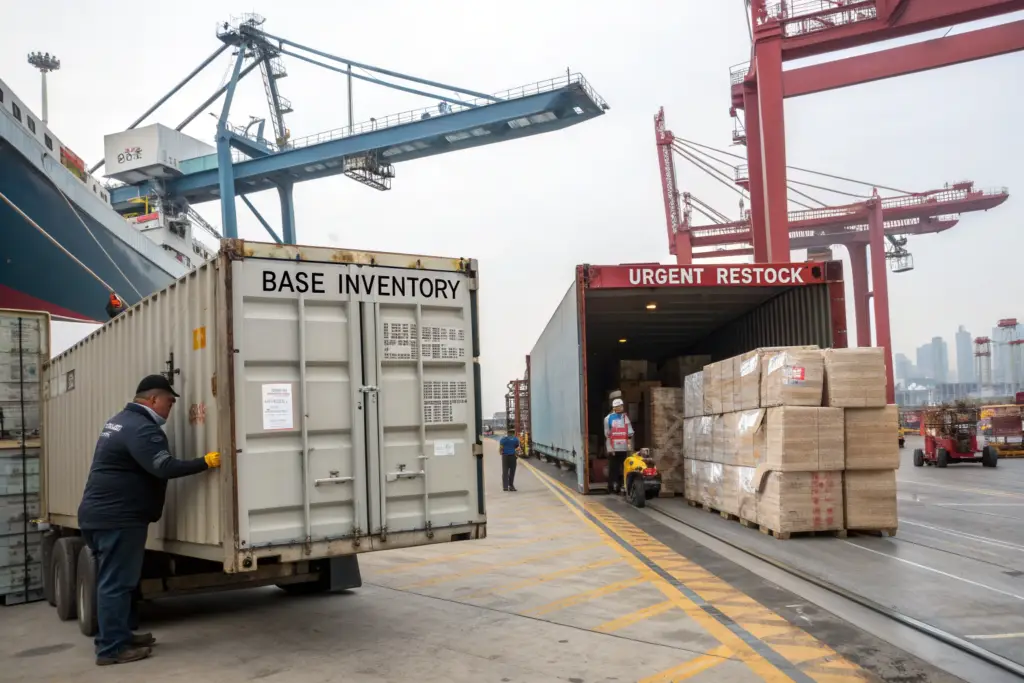
The best shipping method for lightweight women's outerwear is a split strategy that combines sea freight for the base inventory and air express for the urgent restocks. A standard 40-foot container by sea from Shanghai to Los Angeles delivers your core summer coat program at the lowest cost per unit, typically $0.30 to $0.60 per coat. An air express courier service like DHL or FedEx delivers 200 to 500 units in 3 to 5 days at a cost of $3.00 to $5.00 per coat. The split captures the margin of the full container while providing the speed to never stock out. At Shanghai Fumao, we manage this split logistics for our DDP clients, ensuring the sea freight arrives before the planned launch date and the air freight arrives exactly when the reorder demand spikes.
You cannot make this decision in a spreadsheet alone. The numbers matter, but so does the physics of your product. Lightweight outerwear has unique shipping characteristics. The coats are bulky relative to their weight. The cartons cube out before they weigh out. The shipping method must be matched to the product density, the selling calendar, and the cash flow realities of your brand. I will walk you through each option with real numbers and real trade-offs.
When Is Sea Freight The Clear Winner For Summer Coat Shipping?
Sea freight is the workhorse of the garment industry. It moves over 90% of the world's apparel. For a planned seasonal launch, where you have a known delivery window and a known quantity, sea freight is almost always the foundation of your logistics strategy. The cost advantage is overwhelming. The transit time is predictable within a range. The infrastructure is mature. The reason sea freight fails is not because of the inherent transit time. It fails because the factory misses the booking window, or the forwarder chooses the cheapest, slowest vessel, or the buyer does not account for the customs clearance time on the destination end.
Sea freight is the clear winner when you have a confirmed delivery window that is at least 28 days after the ex-factory date, your order volume is above 500 units, and your coats are not responding to a viral trend spike that will fade in two weeks. A 40-foot container from Shanghai to the US West Coast costs between $2,500 and $5,000 in a normal market and carries between 8,000 and 14,000 lightweight coats depending on the packing density. At the midpoint of 10,000 coats and $3,500 freight, the cost per unit is $0.35. No other shipping method comes close to that unit economics for a full-season inventory placement.
Sea freight is a planning tool, not an emergency tool. Use it for your planned volume. Do not use it for your restock volume unless your restock cycle is 8 weeks or longer.
How Do You Choose Between LCL And FCL For A Summer Coat Shipment?
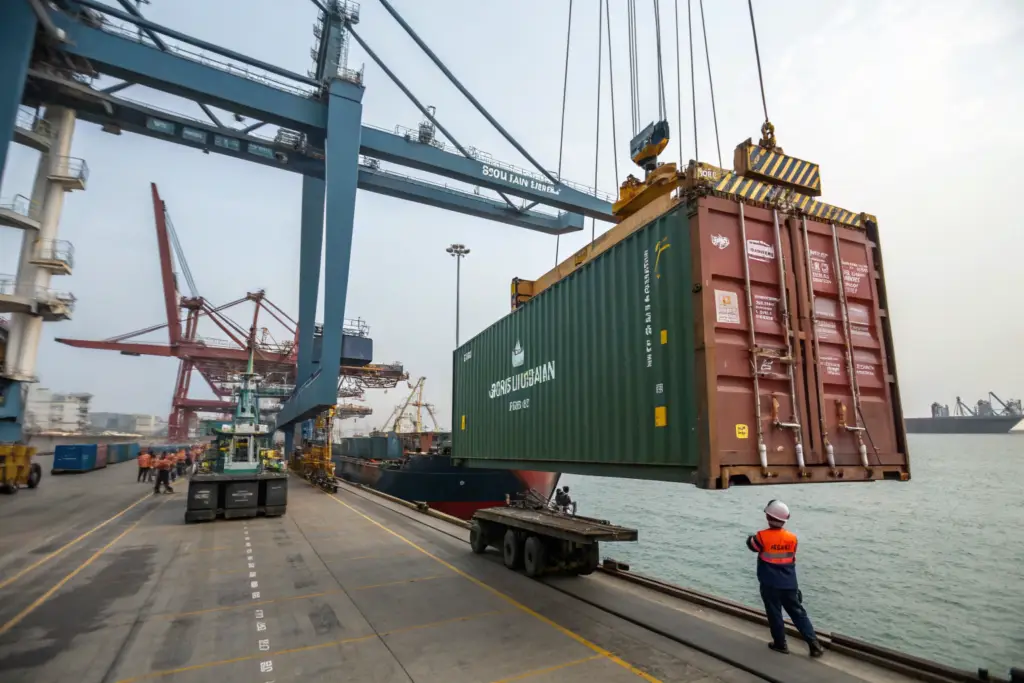
LCL stands for Less than Container Load. FCL stands for Full Container Load. The choice between them is a volume breakpoint calculation. LCL means you share a container with other importers. You pay only for the space you use. FCL means you rent the entire container. You pay for the entire box, regardless of how full it is.
The breakpoint where FCL becomes cheaper than LCL is roughly 15 cubic meters. An LCL shipment is charged by the cubic meter or by the weight, whichever yields higher revenue for the forwarder. A typical rate is $150 to $250 per cubic meter. If your summer coat cartons occupy 15 cubic meters, the LCL cost is approximately $2,250 to $3,750. A 20-foot container, which holds approximately 28 cubic meters, costs $2,000 to $3,500 on the same route. At 15 cubic meters, the FCL is roughly the same price as the LCL, but you get the entire container. You can pack it to the door with no additional cost. The decision is not just about price. LCL shipments are handled more times. They are consolidated at the origin warehouse, deconsolidated at the destination CFS, the Container Freight Station. Each handling event increases the risk of damage, loss, and delay. A carton of delicate summer coats with a soft finish is vulnerable to abrasion from the cartons of other importers stacked against it. For shipments over 10 cubic meters, I recommend FCL even if the price is slightly higher. The security and speed advantage is worth it. An FCL container is sealed at the factory and not opened until it reaches the destination warehouse or a Customs exam site. The LCL vs FCL shipping guide confirms that FCL is also faster at the destination because it does not need to wait for the deconsolidation process. The container is pulled off the vessel and available for pickup within 1 to 2 days, whereas an LCL shipment can add 3 to 5 days for the CFS to sort and release the individual shipments.
What Is The Typical Sea Freight Transit Time From Shanghai To Major US Ports?
Transit time is a range, not a fixed number. The vessel schedule shows a sailing date and an arrival date. The actual transit is affected by weather, port congestion, canal delays, and the vessel's speed. You should plan for the typical range, not the best-case scenario.
From Shanghai to Los Angeles or Long Beach, the US West Coast gateway, the transit time is 12 to 16 days. This is the fastest ocean route from China to the US. From Shanghai to Seattle or Oakland, add 2 to 3 days. From Shanghai to the US East Coast ports like New York, Norfolk, or Savannah via the Panama Canal, the transit time is 28 to 35 days. The West Coast ports are closer, but they have historically had more congestion and labor disruptions. The East Coast ports are farther but often more stable. The choice of destination port should be driven by the proximity to your warehouse, not just the transit time. A coat that arrives in Los Angeles in 14 days but then spends 5 days on a truck to your warehouse in New Jersey has a total transit time of 19 days, compared to 30 days for a direct vessel to New York. The drayage distance matters as much as the ocean transit. When you are planning your summer coat launch, work backwards from the date you need the goods in your warehouse. Subtract the ocean transit, the destination handling time of 3 to 5 days, and the factory's buffer of 3 to 5 days after the ex-factory date. This gives you the latest acceptable ex-factory date. If that date is before the factory's promised delivery date, you need to either negotiate an earlier production slot or switch to air freight for a portion of the order. The ocean freight transit time calculator tools available online give you vessel-specific schedules. Use them. Do not rely on a forwarder's verbal estimate.
Why Is Air Express The Strategic Choice For A Viral Summer Coat Restock?
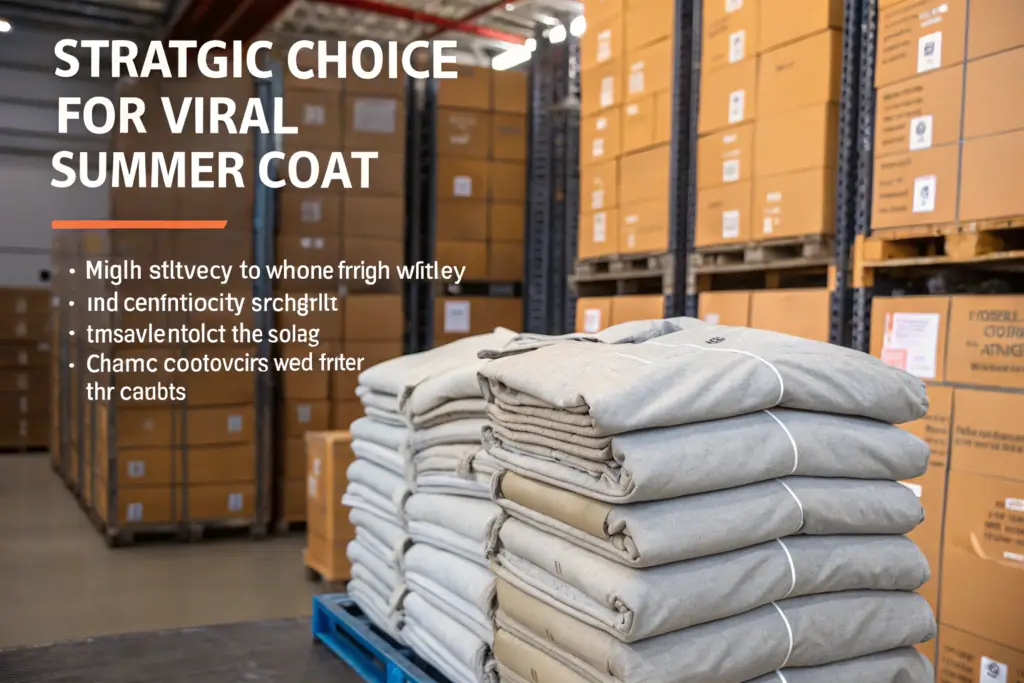
Viral trends are the jackpot of the summer season. A coat that catches fire on social media can sell 3,000 units in a week when the original forecast was 500 units for the entire season. This demand spike is a gift, but only if you have inventory to capture it. Sea freight cannot respond to a viral spike in time. The 30-day transit window is an eternity in the 72-hour news cycle of a trending product. Air express is the only logistics mode that can chase a trend in real time.
Air express is the strategic choice for a viral summer coat restock because it compresses the total lead time from factory floor to customer doorstep into 5 to 7 days. The economics of air freight make sense when the gross margin per unit is high enough to absorb the additional logistics cost and still deliver a profit. A lightweight summer coat with a $14 FOB, a $5 air freight cost, and a $78 retail price generates a gross margin that comfortably covers the air premium. The alternative, running out of stock and watching the algorithm bury your listing, has a cost that is not measured in freight dollars but in lost brand momentum and search ranking.
Air freight is not an extravagance. It is a margin protection tool for high-velocity products. The brand that restocks by air captures the peak of the demand curve at full retail price. The brand that restocks by sea captures the tail end of the curve at markdown prices. The air freight premium pays for itself in the price integrity of the product.
What Is The Real Cost Per Unit Of Air Freight For Lightweight Coats?
The advertised air freight rate is not the real cost. The real cost is the total air freight invoice divided by the number of units shipped. This number includes the base rate, the fuel surcharge, the security surcharge, and the volumetric weight adjustment.
Lightweight coats are the worst-case scenario for volumetric weight pricing. A carton of 20 nylon anoraks might have an actual weight of 8 kg but a volumetric weight of 19 kg, as I explained in the previous article. The air freight charge is calculated on 19 kg, not 8 kg. If the air freight rate is $5.00 per kg, the carton costs $95 to ship. The cost per coat is $4.75. This is why the per-unit air freight cost for lightweight outerwear is often higher than the brand owner expects. The coats are air. They occupy space without weighing much. The way to reduce this cost is to compress the coats. Vacuum packing reduces the carton volume by 30% to 50%, which directly reduces the volumetric weight by the same percentage. A vacuum-packed carton of summer coats ships for $50 instead of $95. The coats recover fully within a day of opening. The only downside is that the coats arrive with deep creases that require steaming before they can be sold. If the brand is selling direct-to-consumer, the customer does the steaming. If the brand is selling wholesale, the retailer expects the goods to arrive floor-ready. This is a trade-off the brand must make. The air freight cost calculator tools from major forwarders allow you to input your carton dimensions and weight to get an instant volumetric quote. Always input the dimensions, not just the weight. The weight quote is a fiction for lightweight outerwear.
How Do You Decide Between Consolidated Air Freight And Express Courier?
Consolidated air freight and express courier are two different air transport models. Consolidated air freight, also called air cargo, is when a freight forwarder combines your shipment with other shippers' cargo onto a commercial airline pallet. The shipment moves airport to airport. You are responsible for clearing customs and arranging the final delivery. Express courier, like DHL, FedEx, or UPS, is a door-to-door service. The courier picks up from the factory, handles the customs clearance, and delivers to your warehouse.
Consolidated air freight is cheaper per kilogram. The base rate might be $2.50 to $3.50 per kg compared to $5.00 to $7.00 per kg for express courier. But the total cost includes the destination handling, the customs clearance fee, the bond, and the last-mile trucking. When you add these costs, the gap narrows. Express courier also clears customs faster. The courier companies have their own dedicated customs clearance teams and their own bonded facilities. A DHL shipment from Shanghai clears US Customs in hours. A consolidated air freight shipment can sit in a general cargo terminal for 1 to 3 days waiting for clearance. For urgent restocks under 300 units, express courier is almost always the better choice. The speed advantage of the courier's integrated network outweighs the cost saving of the consolidated model. For restocks of 500 to 1,000 units, consolidated air freight starts to make economic sense, provided you have a customs broker who can clear the shipment quickly. The express courier vs air freight comparison comes down to volume, urgency, and your internal logistics capability. If you do not have a customs broker on retainer, do not attempt consolidated air freight for an urgent restock. The learning curve will cost you the time advantage.
What Makes Rail Freight An Emerging Option For US-Bound Summer Shipments?
Rail freight is the middle child of international logistics. It is faster than sea freight. It is cheaper than air freight. It has been a major corridor between China and Europe for over a decade, and it is emerging as a viable option for the US market via a China-Europe rail leg followed by a transatlantic sea leg, or via direct ocean-rail intermodal routes through Canadian or Mexican ports. The economics are compelling for a specific type of shipment.
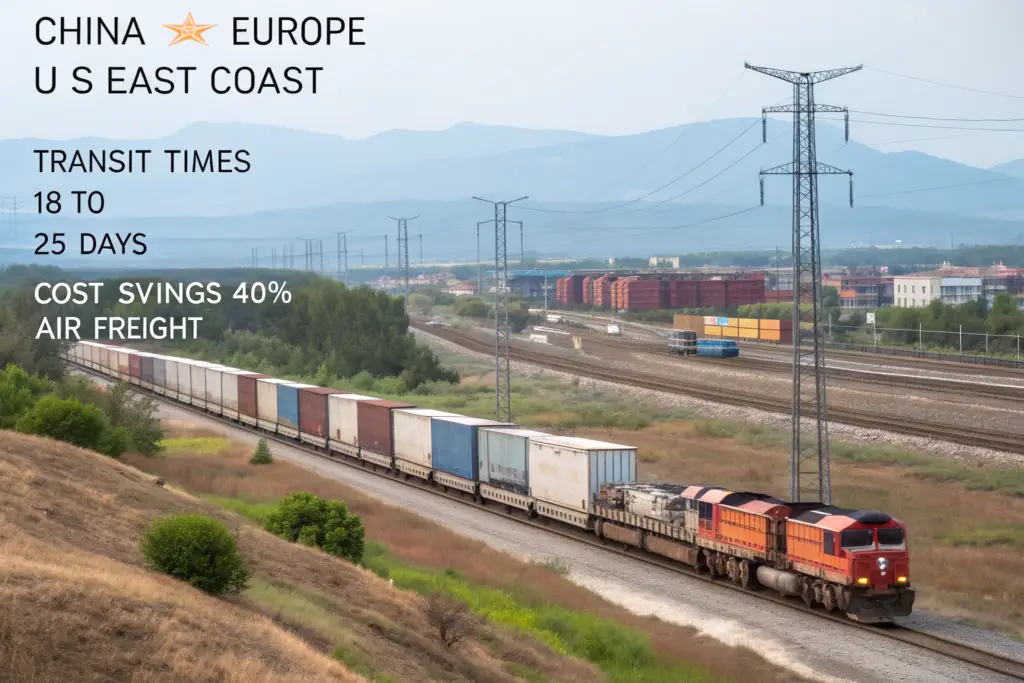
Rail freight is an emerging option for US-bound summer shipments when the transit time requirement is 18 to 25 days, which is too slow for air freight but faster than the 30 to 40 days of a full sea freight journey to the US East Coast. A China-Europe rail shipment to a European port, followed by a short sea leg to the US East Coast, can deliver goods in about 22 days at a cost roughly 40% lower than air freight. The environmental impact of rail is also significantly lower than air, which is a growing factor for brands with sustainability commitments.
Rail is not a replacement for sea freight on the West Coast, where the ocean transit is already 12 to 16 days. It is an alternative for East Coast deliveries where the all-water route through Panama is long. It is also a hedge against port congestion. When Los Angeles is gridlocked, a rail route through Canada or Mexico can bypass the bottleneck entirely.
How Does The China-Europe-US Rail And Sea Combination Work?
The route sounds like a geography puzzle, but it is a well-established logistics corridor. A container of summer coats leaves Shanghai by rail, traveling through Kazakhstan, Russia, and Belarus to a European rail terminal, most commonly Duisburg in Germany or Malaszewicze in Poland. The rail transit takes 12 to 14 days. The container is then transloaded onto a short-sea vessel that sails from a European port, like Rotterdam or Hamburg, to a US East Coast port, like New York or Savannah. This sea leg takes 8 to 10 days. The total transit time is 20 to 24 days, plus terminal handling at both ends.
The cost is the arithmetic average of the two modes. Rail is more expensive than sea but cheaper than air. The short-sea leg is standard sea freight. The combined cost typically lands at 60% to 70% of the equivalent air freight cost. A 40-foot container on this route might cost $8,000 to $10,000, compared to $3,500 for an all-water sea route and $25,000 for an equivalent air freight pallet. This price point opens up a new logistics tier for brands that need faster-than-ocean delivery on full-container volumes but cannot justify the air freight expense. The China-Europe rail-sea route is also less susceptible to the Panama Canal drought restrictions that have slowed all-water transit times in recent years. The China-Europe rail freight service is operated by major forwarders who manage the entire multimodal journey under a single bill of lading. The complexity is hidden from the shipper. You book one shipment, pay one rate, and receive the goods at your US warehouse 22 days later. For a summer coat launch on the East Coast, where every day of inventory availability matters, this 22-day option is a strategic tool that did not exist a decade ago.
When Is Intermodal Shipping Through Canada Or Mexico A Smarter Route?
The US port system has a single point of failure: the West Coast. When labor negotiations, congestion, or weather shut down Los Angeles and Long Beach, the entire nation's supply chain backs up. Intermodal shipping through Canada or Mexico creates a bypass valve.
The Canadian route lands a container at the Port of Vancouver or Prince Rupert, both of which are closer to Asia than any US West Coast port. The container is then loaded onto a Canadian Pacific or Canadian National Railway train and transits to a US Midwest or East Coast destination under a rail bond. The transit time from Shanghai to Chicago via Vancouver is roughly 18 to 20 days. This is faster than shipping to Los Angeles and trucking to Chicago because the rail network from the Pacific Northwest is highly efficient. The Mexican route lands a container at the Port of Lazaro Cardenas or Manzanillo, which are less congested than Los Angeles, and the container moves by rail to the US border. The transit time is longer, about 22 to 26 days to a Texas or Midwest distribution center, but the port costs are lower and the congestion risk is minimal. These intermodal routes are not for everyone. They require a freight forwarder with specific expertise in cross-border rail. The paperwork for a bonded transit through Canada or Mexico is more complex than a direct US entry. But for a brand that has been burned by a West Coast port strike during the summer shipping peak, the Canadian intermodal route is a risk mitigation tool worth paying a small premium for. The intermodal freight transport solutions are expanding rapidly as the global logistics industry diversifies away from over-reliance on a single chokepoint port complex.
How Does The Packing Method Influence Which Shipping Mode You Choose?
The shipping mode and the packing method are not independent decisions. They are two halves of the same logistics equation. The way you fold, bag, and carton your summer coats determines the freight cost for every mode and, in some cases, dictates which mode is even viable. A coat packed for sea freight in a standard carton is not optimally packed for air freight. A coat designed for vacuum packing is not floor-ready on arrival. The packing method must be chosen in concert with the shipping mode.
The packing method influences the shipping mode by altering the dimensional weight for air freight and the carton utilization for sea freight. A coat that folds flat into a compact rectangle maximizes sea freight carton density and minimizes air freight volumetric weight. A coat with a structured collar that must be packed in a fixed shape sacrifices efficiency in both modes. At Shanghai Fumao, we design the packing configuration during the product development phase. We test different folding methods and carton sizes to find the configuration that delivers the maximum units per container and the minimum volumetric weight per carton, without damaging the coat's appearance on unpacking.
The packing method is a cost engineering exercise. A 10% improvement in carton density on a 10,000-unit sea freight order saves $350. A 10% reduction in carton volume on a 500-unit air freight order saves $500. These savings flow directly to the bottom line. The time to engineer the pack is before the sample is approved, not after the goods are produced.
What Is The Best Folding Configuration For Sea Freight Cartons Of Summer Coats?
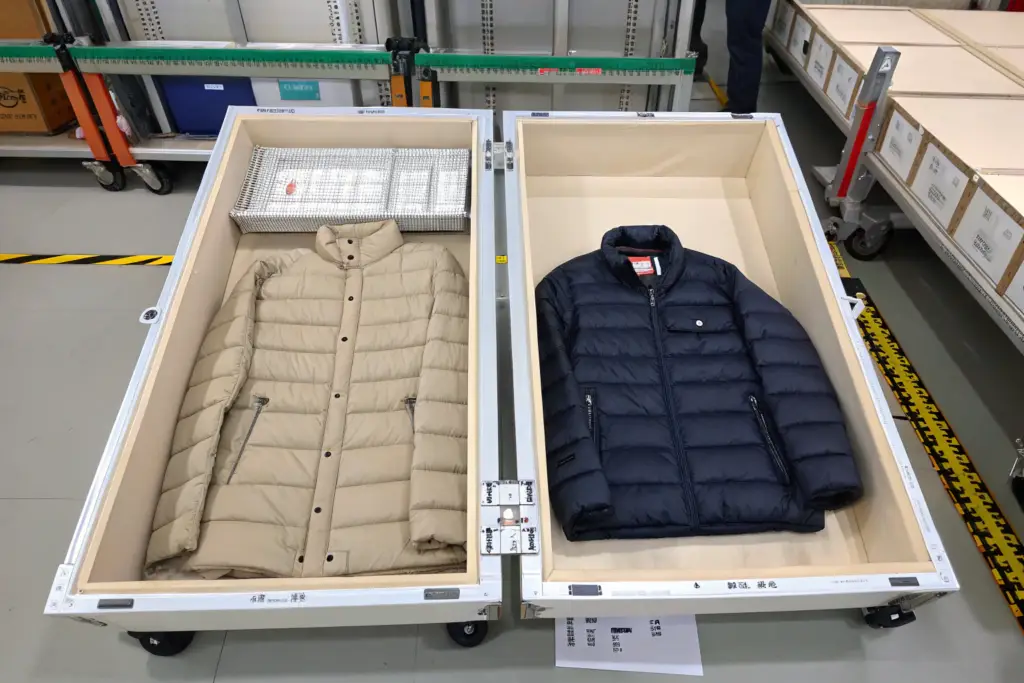
The goal of a sea freight folding configuration is to create a flat, dense rectangle that fills the carton with minimal wasted air. A summer coat is not a t-shirt. It has collar points, sleeve heads, and shoulder seams that create irregular thickness. The folding must neutralize these irregularities.
The standard industry method for a lightweight unlined summer blazer is the "shirt fold" modified for the coat length. The coat is laid face down. The sleeves are folded across the back at an angle so the sleeve heads rest flat against the back panel. The collar is turned down. The coat is folded in half lengthwise, and then in half or thirds crosswise to fit the carton dimension. The key is to use a folding board, a rigid plastic template that ensures every coat is folded to the exact same dimensions. A coat folded inconsistently creates a carton with uneven density, which wastes space and can cause the carton to bulge or collapse when stacked. For a structured summer coat with light shoulder pads, we use a tissue paper insert inside the shoulder to prevent the pad from being crushed and creased during the 30-day transit. The tissue dissolves the pressure point without adding significant bulk. For a delicate fabric like a cupro or silk blend, we fold the coat inside a polybag and gently press the air out before sealing. This "semi-vacuum" technique reduces volume by 10% without creating the deep creases of a full vacuum pack. The garment packing methods for export are a balance between density and presentation. The brand must decide whether the coat will be unpacked and re-steamed by the retailer or by the end customer. That decision determines how aggressively you can compress the product.
Why Is Vacuum Packing A Game Changer For Air Freight But Risky For Some Fabrics?
Vacuum packing removes the air from the polybag, compressing the coat to a fraction of its natural volume. The effect on air freight costs is dramatic. A standard carton of 20 summer coats that occupies 0.096 cubic meters can be vacuum packed to occupy 0.050 cubic meters, a 48% reduction. The volumetric weight drops proportionally, and the air freight invoice drops by nearly half. For a 500-unit air express restock, that is a saving of $1,000 to $1,500 on a single shipment.
The risk is fabric memory. Some fabrics recover perfectly from vacuum compression. Nylon and polyester microfibers bounce back within hours of being released from the bag. Cotton and linen blends recover more slowly but accept steaming well. The fabrics that do not recover are those with a delicate surface finish. A sandwashed silk charmeuse will retain the crease lines from the folds permanently because the sandwashing process has already abraded the fiber surface. A coated fabric, like a polyurethane-bonded raincoat, can develop permanent adhesion lines where the coated surfaces were pressed together under vacuum. A heavily embellished coat with sequins or beading will have the embellishments pressed into the fabric, creating a textured imprint that cannot be removed. For these sensitive fabrics, we do not vacuum pack. We use the semi-vacuum technique or a flat-pack method with tissue interleaving. The vacuum packing for clothing shipping is a powerful tool, but it is not universal. The factory must know which fabrics can tolerate it and which cannot. A brand that requests vacuum packing without understanding the fabric limitations will receive a shipment of permanently creased, unsellable coats.
Conclusion
There is no single best shipping method for lightweight women's outerwear. There is a best shipping strategy for your specific product, your specific volume, your specific destination, and your specific selling calendar. The strategy combines modes and methods. Sea freight for the planned base inventory. Air express for the urgent restocks. Rail intermodal as a hedge against port congestion. Vacuum packing for the air freight units, flat packing for the sea freight units. The strategy is documented before the season begins. The forwarder is selected. The rates are locked. The packing is tested.
The shipping method is not an afterthought to be decided when the goods are ready. It is a strategic decision that should be made during the product development phase, alongside the fabric selection and the costing. Because a coat that costs $14 FOB and $4.75 to air freight is a different business proposition than a coat that costs $14 FOB and $0.35 to sea freight. Both are viable. Both can be profitable. But they require different retail pricing, different margin structures, and different inventory strategies.
At Shanghai Fumao, we do not let our brand partners figure this out alone. We advise on the packing configuration during sampling. We quote sea, air, and DDP options side by side so the brand can see the landed cost implications of each mode before committing to a production volume. We manage the split shipments, the vacuum packing, and the customs clearance so the brand owner focuses on selling, not on logistics.
If you are planning your lightweight summer outerwear line for the upcoming season and want a logistics partner who thinks about shipping as part of the product strategy, reach out to our Business Director, Elaine, at elaine@fumaoclothing.com. Send her your preliminary order quantities and your delivery deadlines. She will return a logistics plan that shows you exactly how each batch of coats will ship, what it will cost, and when it will arrive at your warehouse. Because the best shipping method is the one that gets your coats to your customer at the right moment, at the right price, and in the right condition.