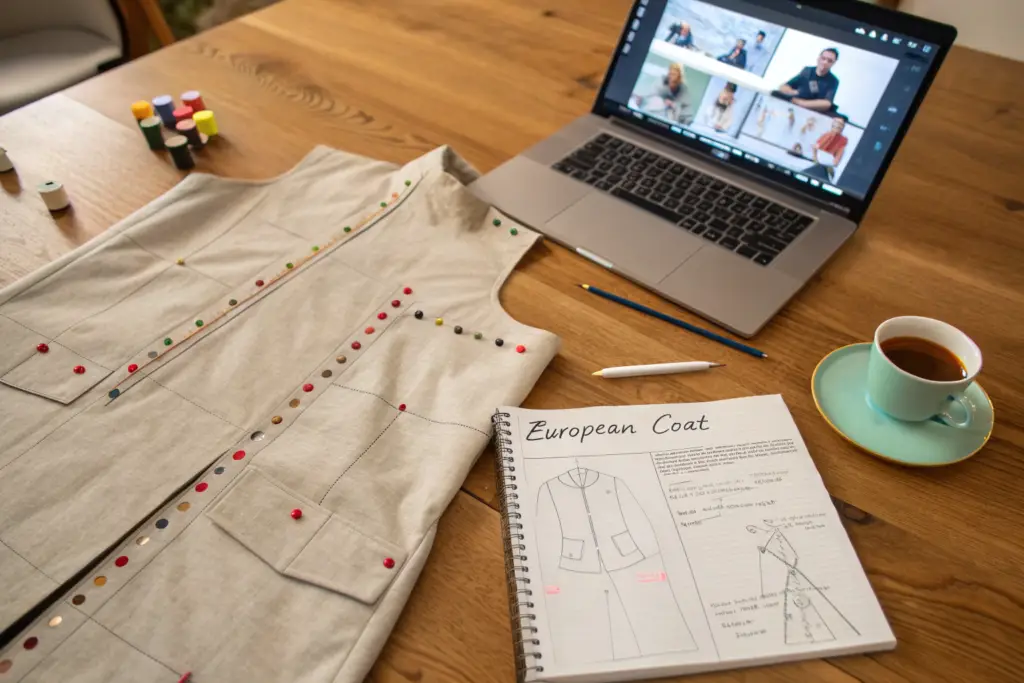
A brand director from Amsterdam visited our showroom last March with a specific problem. Her label had built a loyal following in the Netherlands, Belgium, and Germany with a signature oversized wrap coat. The coat was a bestseller. But her wholesale accounts in Milan and Paris were pushing back. The Italian buyers said the silhouette was "too oversized—our customer wants shape." The French buyers said the shoulders were "too dropped—our customer wants a defined shoulder line." The coat that worked in Northern Europe was not working in Southern and Western Europe. She could not afford to develop three completely different coats. She asked me if there was a way to customize the core silhouette for different regional preferences without starting from scratch.
European brands can customize women's coat silhouettes by modifying five key pattern points—shoulder pitch and width, waist definition and belt placement, hem length and sweep, sleeve circumference and length, and lapel width and collar shape—on a shared base pattern, allowing regional fit preferences to be satisfied without the cost and lead time of developing entirely new patterns for each market.
The European coat market is not a monolith. A coat that sells in Stockholm, where the aesthetic is minimalist and oversized, will not necessarily sell in Rome, where the aesthetic favors a defined waist and a structured shoulder. A coat that works in London, where layering is essential, may feel too roomy in Paris, where the customer prefers a closer fit. The brands that succeed across multiple European markets are the brands that understand regional silhouette preferences and build the flexibility to accommodate them into their production planning. At Shanghai Fumao, we manufacture coats for European brands across the Nordic, Central European, and Mediterranean markets. I have seen the fit comments, the return data, and the pattern adjustments that differentiate a Berlin bestseller from a Milan bestseller. Let me walk you through the specific customization points and how to manage them efficiently.
What Regional Fit Preferences Distinguish Northern, Central, and Southern European Markets?
The single biggest mistake a brand makes when expanding across European markets is assuming a bestseller in one region will automatically work in another. The European customer's coat preferences are shaped by climate, culture, and local fashion history. A Swede who cycles to work in February needs a coat with generous arm movement and room for heavy layers. An Italian who walks from her apartment to her office in Milan needs a coat that looks sharp over a light knit and tailored trousers. The same base silhouette can work in both markets, but the fit points must be adjusted.
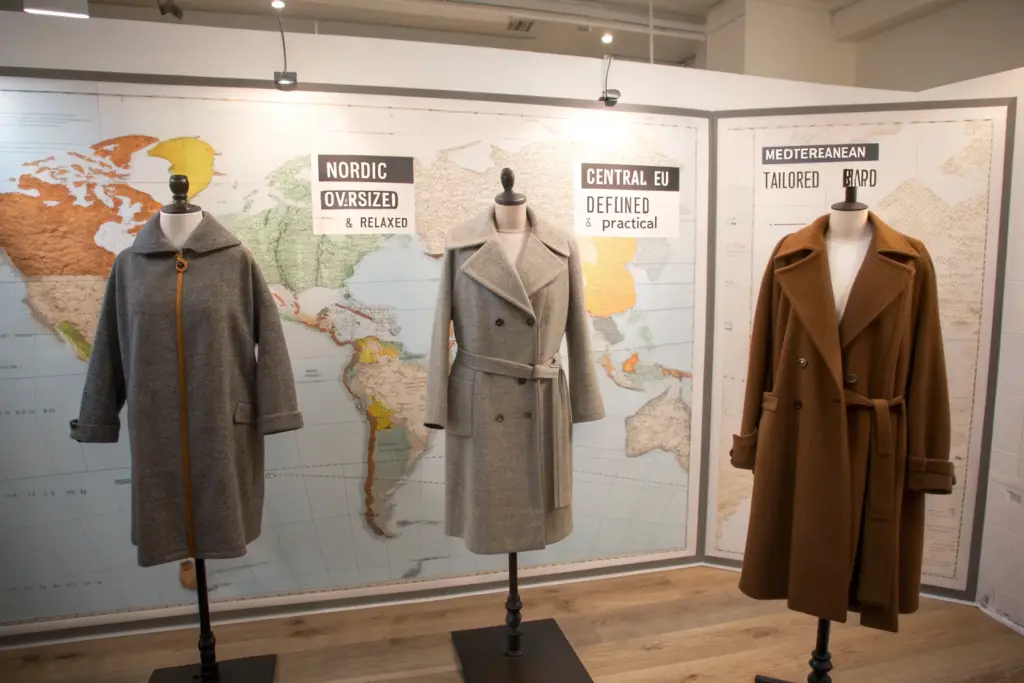
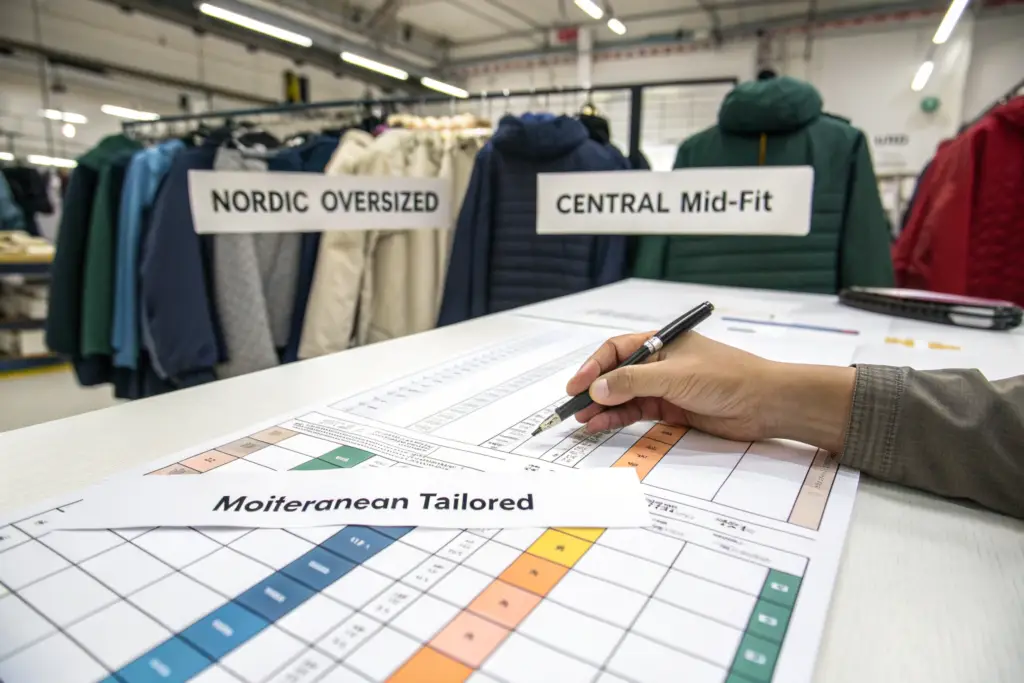
Northern European markets favor oversized, relaxed silhouettes with dropped shoulders, generous upper-body ease for heavy layering, and longer lengths reaching mid-calf. Central European markets prefer a balanced, semi-fitted silhouette with a defined but not tight waist and practical mid-lengths. Southern European markets demand a more tailored silhouette with a structured shoulder, a cinched waist, a shorter length falling at or above the knee, and a closer overall fit that works over lighter layers.
A brand we manufacture for launched their signature wrap coat across six European countries with a single fit specification. The coat was designed for the Nordic customer: oversized, dropped shoulder, generous sweep, 120cm center back length. The coat sold well in Stockholm, Copenhagen, and Hamburg. It sold poorly in Milan and Barcelona. The returns from Southern Europe cited "too big," "too long," "too shapeless." The brand could see the problem in the data but did not know how to fix it without creating a separate coat. We developed a Southern European variant using the same base pattern with four adjustments: the shoulder was raised by 1.5 centimeters, the waist was cinched by 3 centimeters through a shortened belt, the hem was shortened to 105 centimeters, and the sleeve circumference was reduced. The variant used the same fabric, the same lining, the same trim. The FOB was identical. The sell-through in Southern Europe improved dramatically the following season.
What Shoulder and Upper Body Adjustments Differentiate the Regional Markets?
The shoulder is the first point of regional differentiation. The Nordic customer prefers a dropped shoulder that allows layering of a chunky knit underneath. The shoulder seam sits 3 to 5 centimeters below the natural shoulder point. The upper arm and bicep circumference is generous. The Southern European customer prefers a set-in shoulder that sits at or near the natural shoulder point. The shoulder seam is clean and defined. The upper arm is closer to the body. The difference is approximately 2 to 3 centimeters in shoulder drop and a corresponding adjustment to the sleeve cap. The Central European customer sits in the middle: a slightly dropped shoulder, approximately 1 to 2 centimeters below the natural point, with moderate upper-body ease. These adjustments can be made on the same base pattern by shifting the shoulder point and adjusting the armhole and sleeve cap accordingly.
How Do Hem Length Preferences Vary Across European Regions?
Length is the second major point of differentiation. The Nordic customer prefers a longer coat, typically 115 to 125 centimeters from center back, falling to mid-calf or below. The length provides warmth and a dramatic silhouette that works with the region's minimalist aesthetic. The Southern European customer prefers a shorter coat, typically 95 to 105 centimeters, falling at or just below the knee. The shorter length feels more practical in milder climates and reads as more tailored. The Central European customer prefers a mid-length, 105 to 115 centimeters. The length adjustment is the simplest pattern modification—it is a straight hem adjustment that does not affect the upper body fit. The brand that wants to serve multiple regions should consider a "regular" and "petite" length option, or a "Nordic" and "Mediterranean" length option, within the same silhouette.
What Customization Options Exist Beyond Regional Fit Adjustments?
Regional fit adjustments are one layer of customization. Brand-specific aesthetic customization is another. A minimalist Scandinavian brand wants a coat with no visible branding, tonal buttons, and a hidden closure. A heritage-inspired British brand wants contrasting horn buttons, a prominent collar, and a traditional check lining. A fashion-forward Parisian brand wants an oversized lapel, dramatic proportions, and unexpected color combinations. All three brands may be building on the same wrap coat base pattern, but the design details make each coat unmistakably theirs.
Beyond regional fit, European brands customize coat silhouettes through collar and lapel design variations, closure and button selection, belt and waist treatment options, lining fabric and color choices, pocket design and placement, and the addition or removal of design details like back vents, cuff straps, and epaulettes, with each choice affecting the coat's aesthetic identity without requiring a new base pattern.
A premium brand we manufacture for in the UK uses our standard wrap coat base pattern but customizes it with a contrasting check wool lining, genuine horn buttons with a visible grain, a deep back vent for ease of movement, and a slightly wider lapel that frames the face. The same base pattern, produced for a Scandinavian brand, has a tonal self-fabric lining, hidden matte buttons, no back vent, and a narrower, cleaner lapel. The two coats share 80% of their pattern DNA but look and feel like completely different products. The customization is in the details, not in the fundamental silhouette.
How Do Collar and Lapel Variations Define a Brand's Aesthetic?
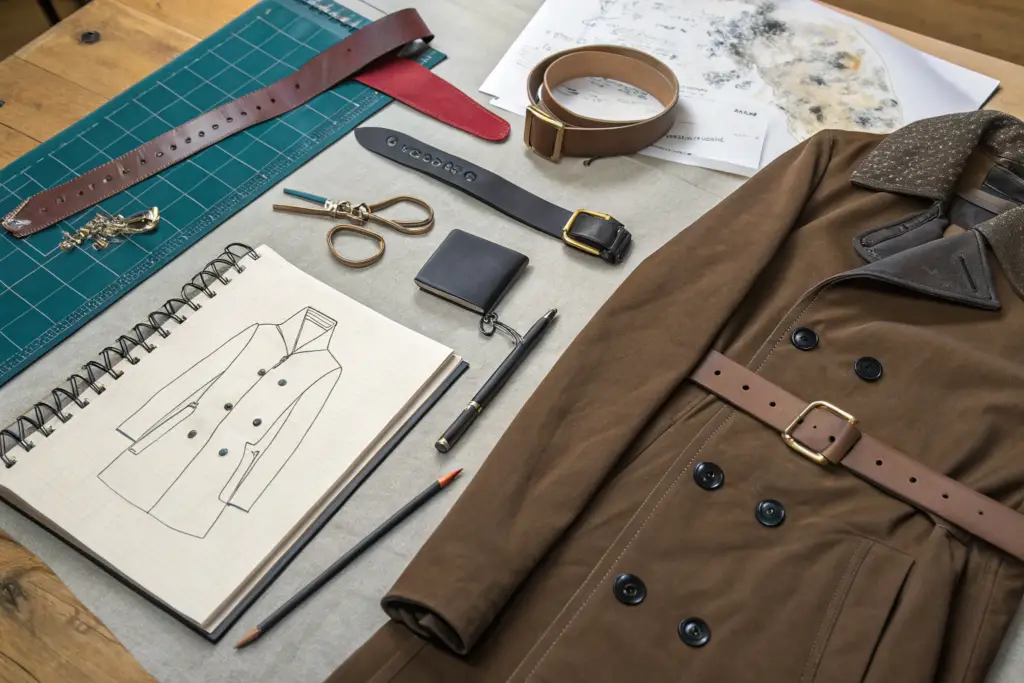
The collar is the coat's face. It frames the wearer's face. It is the first detail the customer sees in a product image. A shawl collar—a continuous, curved fold of fabric without a notch or peak—communicates softness, elegance, and comfort. It is the standard collar for the wrap coat. A notched lapel—a collar with a distinct notch where the collar meets the lapel, borrowed from men's suiting—communicates structure, tailoring, and authority. It is the standard for the tailored overcoat. A stand-up collar or a mandarin collar communicates modernity, minimalism, and an architectural aesthetic. The brand's choice of collar is a brand identity decision as much as a design decision. The factory can produce multiple collar options from the same base body pattern, allowing the brand to offer variations or to differentiate between markets.
What Role Do Lining and Interior Details Play in Brand Differentiation?
The lining is the coat's hidden luxury. The customer sees the exterior first. She sees the lining second—when she tries the coat on, when she hangs it, when she takes it off. A beautiful lining creates a moment of delight that reinforces the brand's quality perception. A branded lining—a custom-printed viscose or cupro with the brand's logo or a signature pattern—is a premium customization that elevates the perceived value of the coat. The lining color can contrast with the shell for a pop of color or match the shell for a tonal look. Interior details like a hidden security pocket, an embroidered brand label, or a contrast piping on the internal seams add layers of quality perception. These interior customizations do not change the coat's external appearance, but they change the customer's emotional experience of owning the coat.
How Should European Brands Manage the Sampling and Production of Customized Silhouettes?
Managing multiple regional variants of the same coat silhouette is a logistical challenge. Each variant requires a separate pre-production sample, a separate fit approval, and potentially a separate cutting marker. The brand that approaches this without a plan will drown in sampling delays, miscommunication, and production errors. The brand that approaches this with a structured process can manage the complexity efficiently and capture the revenue from multiple markets without multiplying the production cost.
Efficient management of customized silhouettes requires the brand to finalize the base pattern first, then develop regional variants as graded adjustments from the approved base, consolidate fabric and trim ordering across all variants to maintain volume pricing, and stagger sample approvals so the factory can produce and ship samples for multiple variants in parallel rather than sequentially.
A brand we manufacture for manages three regional variants of their bestselling wrap coat. They finalize the Nordic base pattern in April. They develop the Central and Mediterranean variants as pattern adjustments in May. They order fabric for all three variants as a single consolidated purchase order, securing the volume pricing on the wool coating. They receive samples for all three variants in June and approve them simultaneously. Bulk production for all three variants runs in July and August on the same production line. The consolidated approach means the factory treats the three variants as a single production program with three sub-styles. The efficiency of consolidated fabric purchasing and shared production scheduling keeps the FOB costs aligned across the variants.
What Information Must the Tech Pack Include for Each Variant?
Each variant requires its own measurement specification sheet, even if the differences from the base pattern are small. The tech pack for the Nordic variant lists the dropped shoulder measurement, the generous bicep circumference, the longer center back length, and the oversized sweep. The tech pack for the Mediterranean variant lists the raised shoulder point, the reduced bicep, the shorter length, and the closer sweep. The tech pack for the Central variant lists the intermediate measurements. Each tech pack references the same base pattern number and notes the specific adjustments. The fabric, trim, and construction detail pages are shared across all variants. The measurement page is variant-specific. This documentation structure allows the factory's pattern maker to work efficiently from a shared base with clearly specified modifications.
How Should Brands Communicate Fit Feedback Across Regional Markets?
Fit feedback from multiple markets must be consolidated and translated into specific pattern adjustments. The brand's production manager should collect fit comments from each regional sales team or wholesale account, identify the common themes, and translate the subjective feedback into objective measurement changes. "The coat feels too big" is not useful feedback. "The chest circumference needs to be reduced by 3 centimeters and the shoulder point raised by 1.5 centimeters based on customer return data from the Milan boutique" is useful feedback. The consolidated feedback should be sent to the factory as a single document with clear, measured instructions. The brand should avoid sending raw, unedited feedback from multiple sources directly to the factory. The factory's pattern maker needs clarity, not volume. The brand's production manager is the translator between the regional markets and the factory floor.
Conclusion
European brands can customize women's coat silhouettes efficiently by understanding the specific fit points that differentiate regional markets—shoulder pitch, waist definition, hem length, and sleeve volume—and by managing those adjustments as graded variants of a shared base pattern rather than as entirely separate products. The Nordic market wants oversized, dropped-shoulder, longer coats. The Mediterranean market wants tailored, structured-shoulder, shorter coats. The Central European market wants a balanced middle ground. The brand that offers variants of its core silhouettes for these different preferences can serve multiple markets without multiplying its development costs.
Beyond regional fit, the brand's aesthetic identity is expressed through the collar design, the button selection, the lining fabric, the pocket style, and the presence or absence of design details like vents and epaulettes. These customizations do not require new base patterns. They are trim and detail selections that the factory can accommodate within the existing production framework.
The key to managing this complexity is structured documentation, consolidated fabric and trim purchasing, and a production calendar that treats the regional variants as a single program with sub-styles. The brand that masters this approach can sell coats profitably from Stockholm to Naples without carrying twelve different coat styles in inventory.
If your European brand is planning to customize coat silhouettes for multiple regional markets, we can help you manage the pattern adjustments, sampling process, and consolidated production. At Shanghai Fumao, we manufacture coats for brands across the Nordic, Central European, and Mediterranean markets and understand the specific fit requirements of each region. Contact our Business Director, Elaine, at elaine@fumaoclothing.com to discuss your regional customization needs and receive a sample of our work with European brand partners. Let's build coats that fit every market you serve.