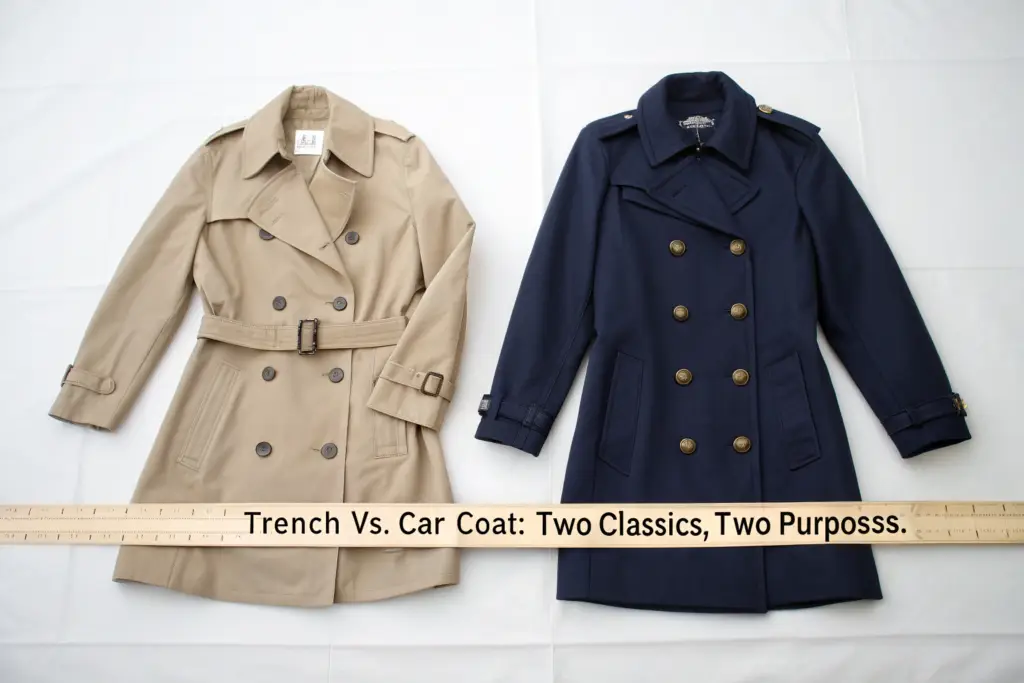
A brand owner I work with called me last September, genuinely confused. She was preparing her Fall line sheet and her sales team was giving her conflicting feedback. One wholesale account wanted more "car coats" because their customers found trenches too complicated. Another account wanted more "trench coats" because their customers wanted the classic look. Her designer had submitted a single coat—a knee-length, belted, single-breasted style—and called it both a "trench" and a "car coat" in different presentations. The brand owner asked me, "Is there actually a difference, or are these just two names for the same coat?" I told her the names refer to two distinct coat archetypes with different lengths, different details, different histories, and different customer use cases. Calling a car coat a trench coat is not just imprecise. It confuses the customer and leads to returns from buyers who expected one thing and received another.
The trench coat is a knee-length or longer, double-breasted, belted coat with military-derived details including epaulettes, storm flaps, and cuff straps, designed for rain protection and formal versatility, while the car coat is a hip-length or mid-thigh, single-breasted, unbelted coat with minimal, clean details, designed for ease of movement and casual-to-smart-casual wear, originally engineered for the practical needs of automobile drivers.
These two coat archetypes are often confused because both are classic, both are typically made from cotton gabardine or wool, and both occupy the transitional outerwear category. But they serve different customers, different occasions, and different functional needs. A brand that offers both with clear differentiation has two strong SKUs. A brand that offers a hybrid that satisfies neither customer has a return problem. At Shanghai Fumao, we manufacture both silhouettes for US brands, and I have seen the customer feedback data that proves the distinction matters. Let me walk you through exactly what separates these two classics and how to get both right.
What Are the Historical Origins and Design DNA of Each Coat?
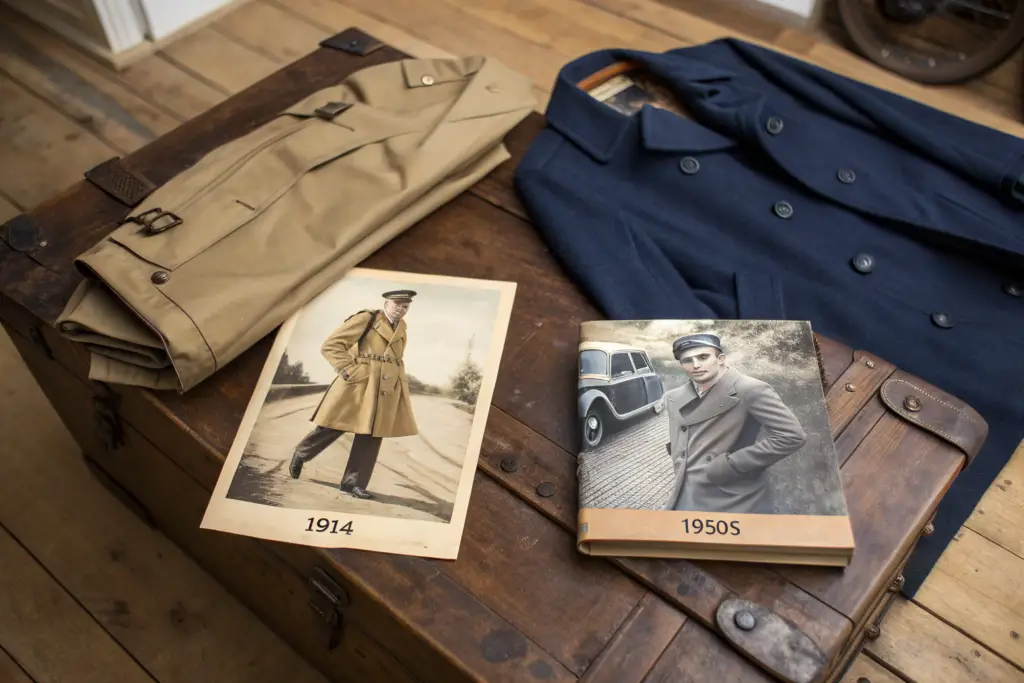
A coat's design details are not arbitrary. They are fossils of the coat's original function. The trench coat was born in the trenches of World War I, designed by Thomas Burberry and Aquascutum for British officers. Every detail served a purpose. The epaulettes held rank insignia. The storm flap on the chest shed rain. The D-ring belt held equipment. The cuff straps tightened the sleeves against wind and water. The length fell below the knee to protect the legs from mud. The double-breasted front provided an extra layer of warmth and wind protection. These details remain on modern trench coats not because they are still functional for the average customer, but because they are the design language of the garment. They signal "trench coat" to the consumer.
The trench coat's design DNA is military and formal, defined by its double-breasted front, belted waist, epaulettes, storm flaps, cuff straps, and knee-length or longer silhouette, while the car coat's design DNA is automotive and practical, defined by its single-breasted front, absence of a belt, minimal or no military details, and hip-length silhouette designed to allow freedom of movement behind a steering wheel and ease of entry and exit from a vehicle.
The car coat emerged from a completely different context. In the 1950s and 1960s, as automobile ownership expanded, drivers needed a coat that was warm but not restrictive. A long trench coat bunched up in the driver's seat, interfered with the pedals, and was uncomfortable to wear while driving. The car coat was designed shorter—hip-length or mid-thigh—so it did not interfere with sitting. It was single-breasted with a simple button front, so it could be easily opened and closed while seated. It had no belt to bunch up behind the back. It had no epaulettes or storm flaps because it was not a military garment. It was a civilian coat, designed for the daily practicalities of getting in and out of a car. The design was clean, minimal, and functional.
Why Do the Design Details of Each Coat Matter to the Customer?
The customer who buys a trench coat expects the details. She expects the epaulettes, the storm flap, the belt, the cuff straps. If the coat is missing these elements, she may not consciously notice, but she will feel the coat is "not a real trench." The details are the category code. A coat labeled "trench coat" on a product page that lacks the belt and the epaulettes will generate returns from customers who expected the classic design. The customer who buys a car coat has the opposite expectation. She does not want the military details. She wants a clean, simple coat that is easy to throw on and go. Epaulettes and a belt on a car coat feel fussy and over-designed to her. The design details are not just aesthetic. They are the promise the product name makes to the customer. The details must match the name.
How Does the Length Difference Impact the Wearability and Customer Perception?
Length is the single most important functional difference. A trench coat falls below the knee—typically mid-calf on the current oversized silhouettes, or just below the knee on classic fits. This length provides more leg coverage and warmth. It reads as more formal, more dramatic, more intentional. A car coat falls at the hip or mid-thigh. This length provides less coverage but more freedom of movement. It reads as more casual, more practical, more effortless. The customer who commutes by car or public transit, who is in and out of seats all day, who wants a coat she can leave on indoors, will prefer the car coat length. The customer who walks to work, who wants a coat that makes a statement, who is dressing for an occasion, will prefer the trench coat length. The length determines the coat's functional role in the customer's wardrobe.
How Do the Fit and Construction Differences Affect Sourcing Decisions?
From a manufacturing perspective, the trench coat and the car coat are different products with different cost structures, different production timelines, and different quality control requirements. The brand that treats them as interchangeable from a sourcing standpoint will either overpay for the car coat or under-spec the trench coat. The differences in construction complexity directly impact the FOB cost and the appropriate factory selection.
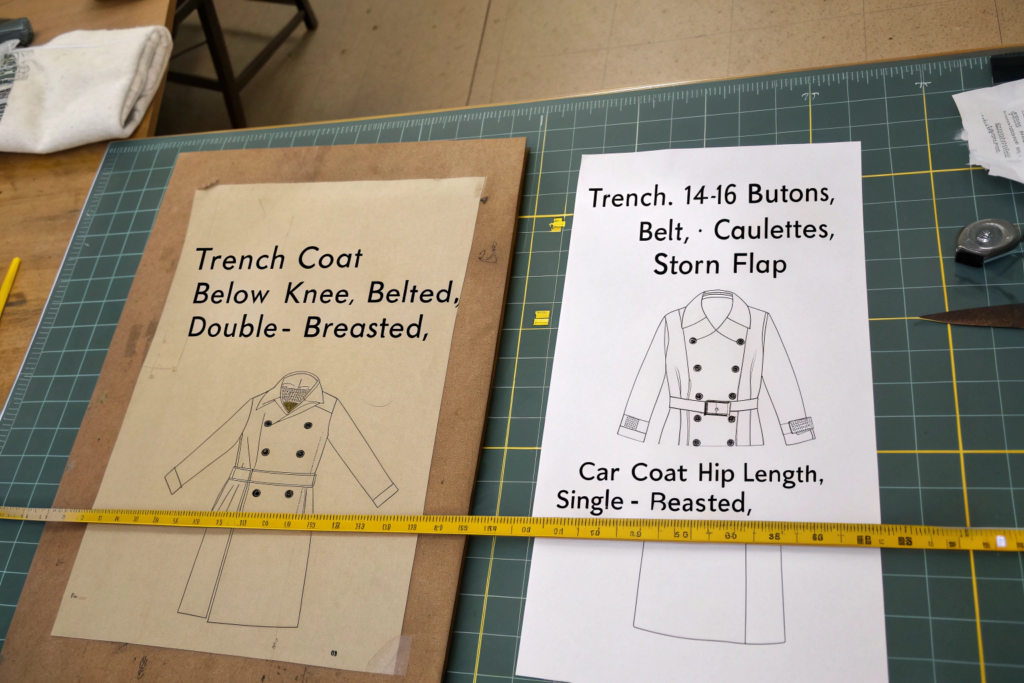
The trench coat has approximately 40-60% more construction operations than a car coat due to the buttonholes on the double-breasted front, the belt and buckle assembly, the epaulettes, the storm flaps, and the cuff straps, resulting in a higher FOB and a longer production lead time, while the car coat's simpler construction keeps the FOB lower and the production timeline shorter.
A brand we manufacture for produces both a trench coat and a car coat. The trench coat FOB is $48. The car coat FOB, in the same water-resistant cotton gabardine, is $34. The $14 difference is almost entirely labor. The trench coat requires eight buttonholes and eight buttons on the double-breasted front, plus buttons on the epaulettes, the cuff straps, and the belt buckle. Each buttonhole requires a specialized machine and a skilled operator. The car coat requires four or five buttons and buttonholes on a single-breasted front. No epaulettes. No cuff straps. No belt. The difference in labor hours is significant, and the brand must account for it in the pricing structure.
| Construction Element | Trench Coat | Car Coat |
|---|---|---|
| Front Closure | Double-breasted, 8-10 buttons | Single-breasted, 4-5 buttons |
| Belt | Yes, with D-ring or buckle | No belt |
| Epaulettes | Yes, with button | No |
| Storm Flap | Yes, front and back | No |
| Cuff Straps | Yes, with buckle or button | No |
| Typical Length | 42-48 inches from shoulder | 28-34 inches from shoulder |
| Lining | Full lining, often with removable liner | Full or half lining |
| Approximate Labor Hours | 3.5-5 hours | 2-3 hours |
| Typical FOB Range | $38-$65 | $28-$45 |
Why Does the Trench Coat Require More Skilled Labor for Construction?
The trench coat's design details require specialized operations. The buttonhole on the double-breasted front must be precisely positioned so the coat hangs correctly when buttoned. A misaligned buttonhole causes the front panels to pull or gap. The belt must be constructed with a reinforced buckle attachment that can withstand the tension of cinching. The epaulettes must be attached symmetrically and must lie flat on the shoulder without curling. The storm flap must be aligned with the center front and must be stitched without puckering on the visible exterior. Each of these operations requires a skilled operator with specific experience in tailored outerwear. A factory that primarily produces casual jackets will struggle with the precision these details demand. The brand sourcing a trench coat should verify that the factory has a dedicated tailored outerwear line with experienced operators. The labor skill requirement is part of what makes a quality trench coat more expensive to produce.
How Does the Simpler Construction of the Car Coat Affect Quality Expectations?
The car coat's simplicity is its quality advantage. With fewer construction operations, there are fewer opportunities for defects. The quality focus shifts from the complexity of the details to the quality of the fundamentals: the fabric, the stitching, the collar roll, the button attachment. A car coat with a beautiful fabric, clean topstitching, and a well-set collar will look premium even without the military details. The brand should not try to add complexity to the car coat to "elevate" it. The car coat's value proposition is its simplicity. Adding unnecessary details increases cost without increasing perceived value. The customer who wants a car coat wants it simple. The brand that respects this will produce a better product at a better margin.
How Should Brands Position and Differentiate These Coats in Their Assortment?
A brand that offers both a trench coat and a car coat must position them clearly and differently. If the two coats are marketed with similar imagery, similar language, and similar price points, they will cannibalize each other. The customer will be confused, and one of the coats will sell at the expense of the other. Clear differentiation protects both SKUs and expands the brand's total addressable outerwear market.
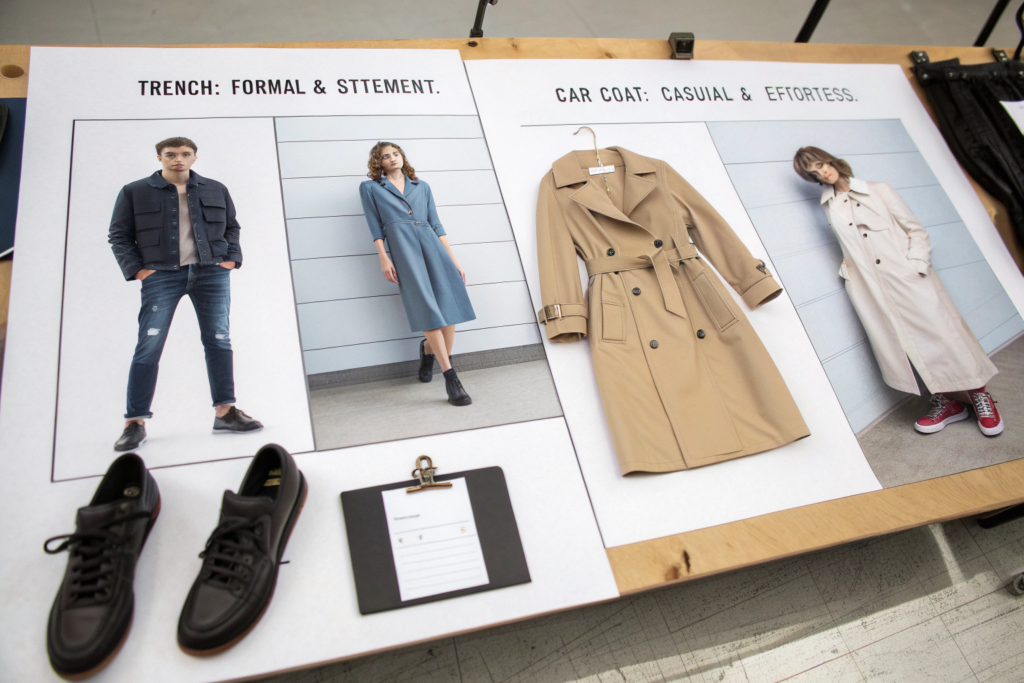
The trench coat should be positioned as the statement, occasion, and formal coat—marketed with belted, styled imagery over dresses and tailored trousers, with copy emphasizing the heritage, the craftsmanship, and the dramatic silhouette. The car coat should be positioned as the everyday, effortless, practical coat—marketed with open, relaxed imagery over jeans and sweaters, with copy emphasizing the ease, the simplicity, and the throw-on-and-go functionality.
A brand we manufacture for initially marketed their trench coat and car coat on the same product page, under the same category heading of "Classic Coats." The trench outsold the car coat three to one, but the car coat had a high return rate. Customers were buying the car coat expecting the trench coat's details. We separated the products into distinct categories. The trench coat was listed under "Statement Outerwear" and styled with dresses and boots. The car coat was listed under "Everyday Outerwear" and styled with jeans and sneakers. The car coat's sell-through improved, and its return rate dropped. The clear positioning helped the customer self-select into the right product.
What Customer Profiles Does Each Coat Serve?
The trench coat customer is looking for a coat that makes a statement. She wants the heritage details. She wants the dramatic length. She is dressing for the office, for dinners, for events. She is willing to invest in a more expensive coat and expects the full set of classic features. The car coat customer is looking for a coat that makes her life easier. She wants a simple, clean coat she can grab on her way out the door. She is dressing for errands, for casual lunches, for travel. She values ease and simplicity over statement and heritage. These two customers may be the same woman on different days. She may own both a trench coat and a car coat. But when she is shopping for a trench coat, she wants the trench coat experience. When she is shopping for a car coat, she wants the car coat experience.
How Should the Price Points Be Differentiated?
The trench coat should be priced higher than the car coat. The price difference reflects the difference in construction complexity and material usage. A $48 FOB trench coat and a $34 FOB car coat, both using a standard 3x markup to wholesale, would result in a $144 wholesale trench and a $102 wholesale car coat. At a 2.5x retail markup, the trench retails at approximately $360, and the car coat retails at approximately $255. The price gap is significant and justified. The brand should communicate the value difference through the product description. The trench coat description should mention the hand-finished details, the belt construction, the heritage design. The car coat description should mention the clean simplicity and the everyday ease. The customer who understands why the trench costs more is more likely to accept the price and less likely to return the product.
Conclusion
The trench coat and the car coat are not two names for the same garment. They are two distinct archetypes with different histories, different design languages, different construction requirements, and different customer use cases. The trench coat is a military-derived, detail-rich, knee-length or longer statement coat designed for formal versatility and rain protection. The car coat is an automotive-derived, detail-minimal, hip-length practical coat designed for ease of movement and everyday wear. Confusing the two on a product page, in a line sheet, or in a wholesale presentation confuses the customer and leads to mismatched expectations and returns.
A brand that offers both silhouettes with clear differentiation, appropriate pricing, and distinct marketing positioning serves two different customer needs and captures both the statement coat budget and the everyday coat budget. A brand that offers a muddy hybrid that is neither a true trench nor a true car coat satisfies neither customer and loses the sale to a competitor who got the archetype right.
If your brand is developing a trench coat, a car coat, or both, we can help you cost-engineer each silhouette to the correct specification. At Shanghai Fumao, we manufacture both archetypes with the construction detail, fabric sourcing, and quality standards that match each coat's distinct requirements. Contact our Business Director, Elaine, at elaine@fumaoclothing.com to request our trench coat and car coat spec sheets, fabric swatch kits, and sample costings. Let's build both coats the right way, so your customer gets exactly what the name promises.