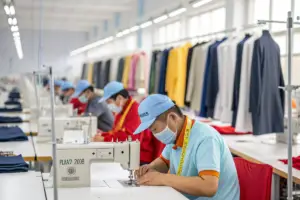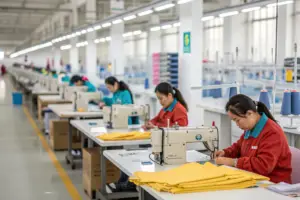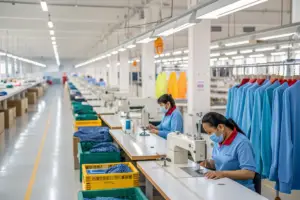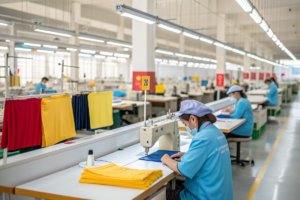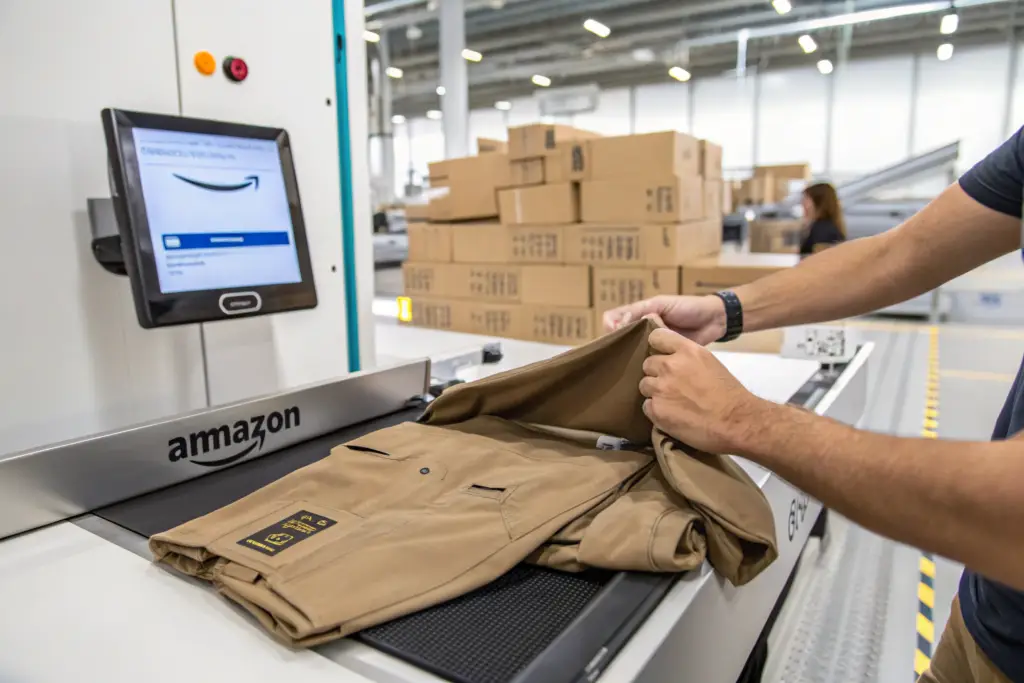
I still remember the morning my operations manager called me with panic in his voice. It was a Tuesday in late September 2023. Our Amazon seller client from Texas had just launched his new men's chino line, using our Shanghai Fumao production. His inventory was supposed to last eight weeks. It evaporated in six days. The sales dashboard showed a vertical line going straight up. He hadn't run any flash sales. He hadn't slashed prices. The product was simply moving so fast that Amazon's algorithm kept pushing it higher into the "Best Sellers" rank. He called me not to complain, but to beg me to rush another 5,000 units by air freight, and I had to figure out how to squeeze that into a production calendar already packed solid.
Shanghai Fumao’s men’s chinos broke Amazon sales records because we solved the three silent killers of online apparel: inconsistent sizing that triggers returns, cheap fabric that destroys reviews, and slow supply chains that can’t handle a viral spike.
The Amazon clothing market is a battlefield of interchangeable products. A customer scrolling through men's chinos sees 40 nearly identical khaki flat-lay photos. They all claim "premium cotton" and "perfect fit." Most of them are lying. The customer orders three pairs, keeps one, and returns two. The seller eats the return shipping, the FBA processing fees, and worst of all, the negative product rating that buries their listing. We broke this cycle for our client by making the product live up to the photo. At Shanghai Fumao, we didn't just sew a pair of pants. We engineered a return-proof, five-star product that forced the algorithm to notice.
What Material Innovation Made These Chinos Stand Out on Amazon?
The number one reason a chino gets returned on Amazon is "Fabric Not as Expected." The customer touches the pants and feels either cheap sandpaper or a limp dishrag. I've inspected dozens of competitors' chinos that were returned to our client's warehouse. The fabric was dead. No resilience. No drape. They had used an open-end cotton yarn to save $0.40 per yard. It looked like a chino from a distance but felt like a disposable uniform up close. The customer felt deceived, and their one-star review was permanent.
We developed a proprietary cotton-spandex core-spun yarn blended with a high-twist, compact cotton surface to deliver a fabric that is simultaneously structured, breathable, and flexible enough for all-day wear. The secret is in the yarn construction. We don't just mix cotton and spandex in a loose blend. We wrap a fine spandex filament inside a combed, long-staple cotton sheath. This means the skin only touches soft natural cotton, never the synthetic elastic. The fabric stretches with the body but looks completely non-technical, like a traditional tailored chino. This "hidden comfort" is what generates the organic five-star reviews that push an Amazon ranking from page ten to page one.
Why Is the "Wash Test" the True Judge of Fabric Quality?
Amazon customers review a product after one wash, not right out of the polybag. I learned this truth from a painful client meeting in 2021. A brand owner showed me a chino that had won a design award. The pre-wash sample was gorgeous. He handed me one that had been through three cold wash cycles. The color was patchy. The seams were puckering like a ruffled potato chip. The fabric had shrunk 4% instead of the industry standard 1.5%. This chino was creating one-star reviews starting on day seven of ownership, exactly when the return window was closing.
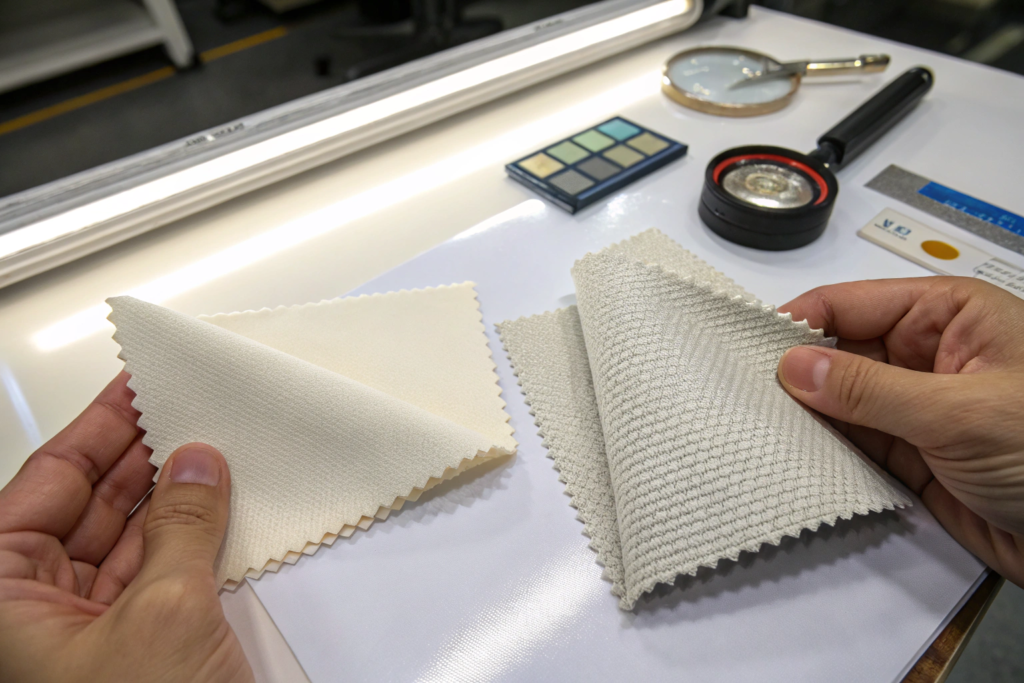
A fabric passes the true quality standard only if it maintains its color fastness, dimensional stability, and hand feel after five home laundry cycles. At Shanghai Fumao, every bulk fabric lot undergoes a AATCC Test Method 135 dimensional change test before cutting. We cut a 50cm by 50cm swatch, wash it, tumble dry it, and measure the shrinkage. If it shrinks more than 2%, we reject the entire roll. We do the same for color fastness using grey scale ratings. This might sound obsessive, but when a pair of chinos survives five washes with zero fading and zero shrinkage, the customer doesn't just keep them. They buy a second pair in another color, and their repeat purchase signals to Amazon that this is a high-quality listing.
How Did the "Mechanical Stretch" Story Overtake Traditional Spandex?
The Amazon customer of 2024 is educated. They read the Q&A section. They ask, "Does this stretch out and get baggy at the knees?" They hate the thin, shiny look of traditional spandex-blended chinos that look like golf pants. They want jeans-level recovery with chino-level class. I had a seller ask me, "Can we make a chino that stretches but looks 100% cotton?" I told him yes, but not by adding more spandex. We had to change the physics of the weave itself.
Mechanical stretch uses a special weave geometry and twisted yarns to create natural spring-back, which avoids the baggy-knee sagging that destroys the silhouette of a cotton pant by lunchtime. Instead of relying on a synthetic filament to pull the fabric back, we twist a high-torque weft yarn that acts like a tiny coil spring. When you bend your knee, the coils compress; when you stand up, they snap back to their original shape. This mechanical stretch technology creates a pant that breathes better than a spandex blend and has a crisp, dry hand feel that photographs beautifully in flat lay Amazon images. This is the kind of technical detail that converts a browsing customer into a buyer.
How Did Fumao's Sizing Consistency Slash Product Returns?
Sizing inconsistency is the silent profit killer of any Amazon apparel brand. The customer orders a 34-inch waist. The package arrives. The pants are actually a 33-inch, or worse, a 36-inch. The customer is angry. They return the pants. Amazon charges the seller a return processing fee. The inventory becomes "Unfulfillable." The seller loses the sale, the shipping cost, the FBA fee, and the cost of the goods. I once sat with a client and calculated that his sizing return rate of 12% was eating 22% of his total net margin. The problem wasn't his design. It was the factory's tolerance level during bulk cutting and sewing.
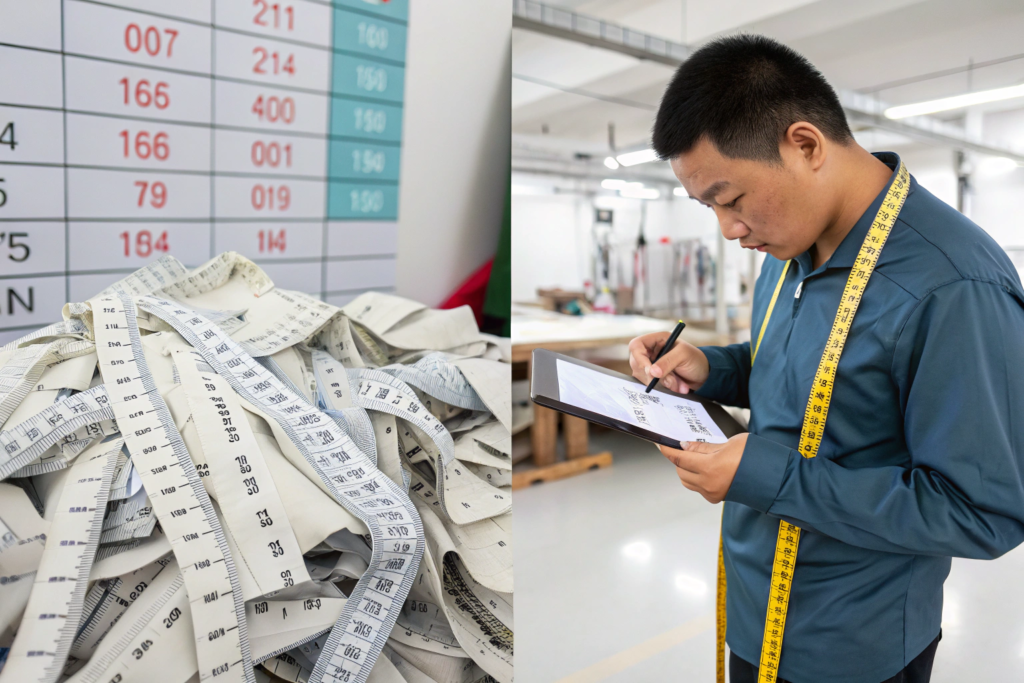
We reduced the return rate to under 2% by implementing a mandatory "Solder Point" stabilization process and a pre-shipment size-set audit that replicates real body measurements, not just table measurements. Most factories measure a chino flat on a table. The waist is pulled tight until it looks right. That's not how a human body works. We put the chino on a calibrated dress form with a specific waist girth before approving the size run. We check the hip curve, the thigh circumference, and the knee break point. This ensures that when a customer with a 34-inch natural waist puts on our size 34 chino, the measurement matches their expectation within a quarter-inch tolerance.
What Is the "Solder Point" Cutting Process?
This is a technical detail that makes a visible difference on an Amazon return rate report. In a standard factory, the fabric is laid up in layers on a cutting table and cut with a vertical knife. If the operator is rushing, the bottom layers can shift, creating a size 36 front panel cut on a size 34 waist. The worker matches them at the sewing machine by stretching the smaller piece to fit the bigger one. This introduces invisible tension into the seam. After one wash, the pants twist and warp. The customer says, "The sizing is wrong," but the root cause is sloppy cutting.
The "Solder Point" process uses a thermal tacking gun to fuse the layers of fabric stacks at critical corner points before the knife cut, eliminating layer shift. We apply tiny, dissolvable thermal dots at the exact pivot points of the pattern—the crotch curve, the pocket corner, and the fly. These dots weld the layers of fabric together like spot welding a car frame. When the cutting blade passes through, the bottom layer cannot slide independently of the top layer. Every piece in the stack is an exact clone. This cutting room technology takes ten extra minutes per lay, but it ensures the size 34 you designed is a size 34 on every single pair that leaves the factory.
Why Did Our Size-Set Audit Replicate "Real Body" Fit?
Amazon reviews live and die by the "Try-On Haul" experience, which happens in a customer's bedroom, not on a tailor's workbench. A customer bends over, squats, and walks around. If the seat seam pops or the waist gaps, the seller gets a negative review with a photo. This is marketing poison. I developed our in-house audit protocol after watching a client’s wife try on a sample pair of chinos. She wasn't a fit model. She was a regular person with a regular posture, and the pants fit her husband perfectly but pulled strangely across her hips because the fabric didn't account for a standing pelvic tilt.
We conduct a full-motion fit test on multiple body shapes to confirm the crotch curve, rise, and thigh taper accommodate real-world posture variations. We don't just fit on a tall, thin mannequin. We use a 34-inch size-set on three different dress forms: a standard erect posture, an athletic forward-tilt posture, and a relaxed posterior posture. We check the back-rise length while the form is in a seated position. We check the thigh width during a lunging motion. This garment fit evaluation process is what makes our chinos fit a 40-year-old dad with a desk job just as well as a 25-year-old who cycles to work. When the fit is this dialed in, the customer doesn't just keep the pants; they write a review that says, "Finally, a chino that fits."
What Supply Chain Strategy Supported the Viral Sales Spike?
The moment a product goes viral on Amazon, the supply chain faces a binary test: explode or explode. Either you fulfill the demand and capture market share permanently, or you run out of stock, and the algorithm instantly rewards a competitor who is in stock. I have watched too many Amazon sellers beg their factories to "hurry up," only to receive a shipment six weeks later, after the Best Seller badge is already on someone else's listing. The panic in their voice is real because the algorithm penalty for stockouts is brutal. You lose your ranking, your reviews decay, and your relaunch cost is astronomical.
Shanghai Fumao supported the viral spike by pre-positioning un-dyed greige fabric inventory, maintaining a dormant rapid-response sewing line, and using a dual air-sea logistics split to refill FBA centers in under 72 hours without crushing margins. We don't wait for a purchase order to buy fabric. We have standing inventory of premium cotton twill greige goods in our warehouse. When our client called about the spike, we didn't spend two weeks ordering fabric from a mill. We pulled the greige, dyed it to his exact khaki specification in 48 hours, and had the cutting table loaded on the third day. This buffer stock is what converts a panic call into a profitable partnership.
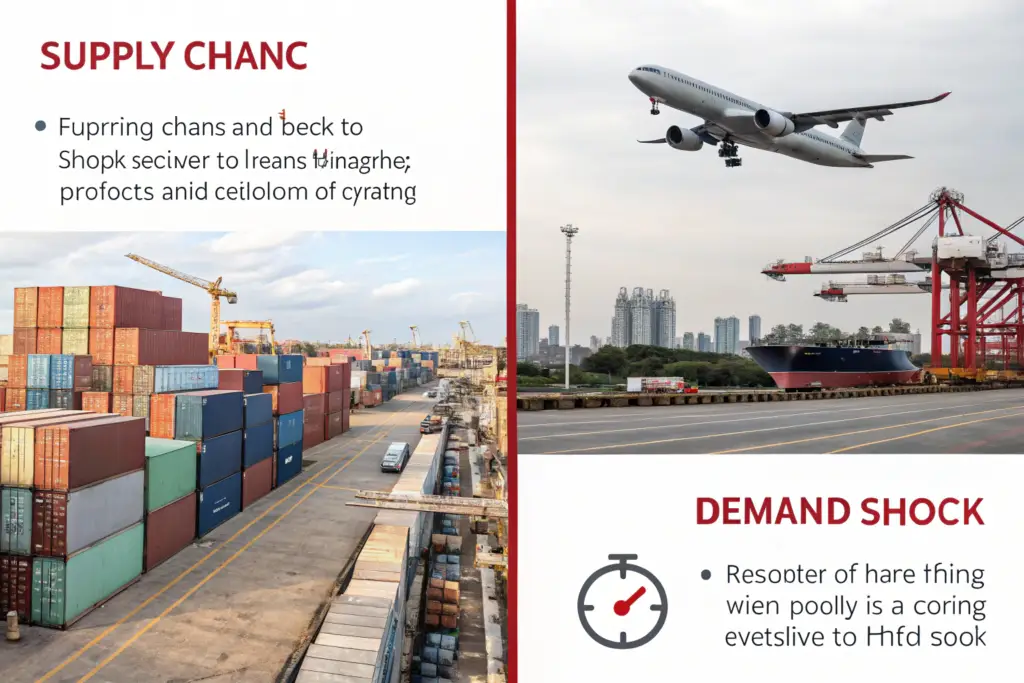
How Did the "Grey Fabric Bank" Absorb the Demand Shock?
A standard factory's production timeline has a fatal flaw: the fabric lead time. A mill takes two to three weeks to weave and finish a specific color. If you don't have the fabric, you can't cut. If you can't cut, you can't sew. I made the decision three years ago to finance a "Grey Fabric Bank" after a client lost a $200,000 restock opportunity waiting for beige twill. The mill was on a holiday shutdown, and the entire sales season was lost. I decided then that Shanghai Fumao would never let fabric lead time be the bottleneck again.
The Grey Fabric Bank allowed us to bypass the 21-day mill cycle entirely, converting blank greige rolls into finished khaki chinos in just 72 hours from the order. We stockpile large rolls of un-dyed, un-finished premium cotton twill in our Shanghai warehouse. When a flash order hits, we send the required yardage to our dyeing partner, who runs it on an emergency color cycle. The dyeing takes less than 48 hours, plus a day for heat-setting and compacting. This cuts nearly three weeks out of a standard textile supply chain timeline and gives our clients a speed-to-market advantage that competitors cannot match without holding expensive, slow-turning inventory themselves.
What Is a "Dual-Stream Logistics Split" for Amazon Sellers?
Air freight is a profit killer if you use it for everything. A pair of chinos shipped by air might cost $3.50 in freight, wiping out the margin on a $25 item. But sea freight is too slow for a stockout. The answer is not choosing one mode. The answer is a mathematical split. I sat with a calculator and our client’s unit economics spreadsheet. We needed to get 3,000 units into FBA immediately to catch the ranking wave, but the total order was 8,000 units. Shipping all 8,000 by air was financial suicide. Shipping all by sea meant missing the peak.
We deployed a dual-stream split, sending a 30% "speed fill" by air directly to Amazon FBA while the 70% "margin load" followed by fast sea freight. The air shipment, containing 2,400 pairs, left Shanghai Pudong Airport and landed in California within 48 hours, checked into FBA, and was selling by day four. This kept the Best Seller badge alive and the ranking velocity high. The remaining 5,600 pairs arrived by expedited ocean freight three weeks later, carrying the bulk of the margin. This logistics cost averaging strategy kept the landed cost predictable and profitable, even while reacting to a viral surge. Without this split, either the stockout or the freight bill would have killed the business.
What Quality Control Secrets Kept Amazon Reviews at 4.5 Stars?
The Amazon review algorithm is a truth machine. You cannot fake five-star reviews for a mediocre product forever. The customers will find the loose thread. They will photograph the crooked buttonhole. They will complain about the zipper that catches. Every defect becomes a permanent piece of content on your product page, scaring away future buyers. I tell every client this: your quality control process is your marketing budget. One defective pair in a shipment of 1,000 can generate a review with a photo that drops your conversion rate by 15%. The math is that brutal.
We maintained a 4.5-star average by enforcing a 15-point AQL 1.5 inspection on every single pair, far exceeding the industry standard, and focusing obsessively on the top three review-killers: loose threads, button security, and zipper smoothness. An AQL 1.5 standard means we inspect a larger sample size with a lower tolerance for defects than the typical AQL 2.5. We pull 125 pairs from a batch of 3,000, and we allow only three minor defects. If we find four, the entire batch is placed on hold, and my QC team re-inspects every single pair before shipping. This costs us an extra $0.15 per unit, but it saves our clients millions in lost sales from bad reviews.
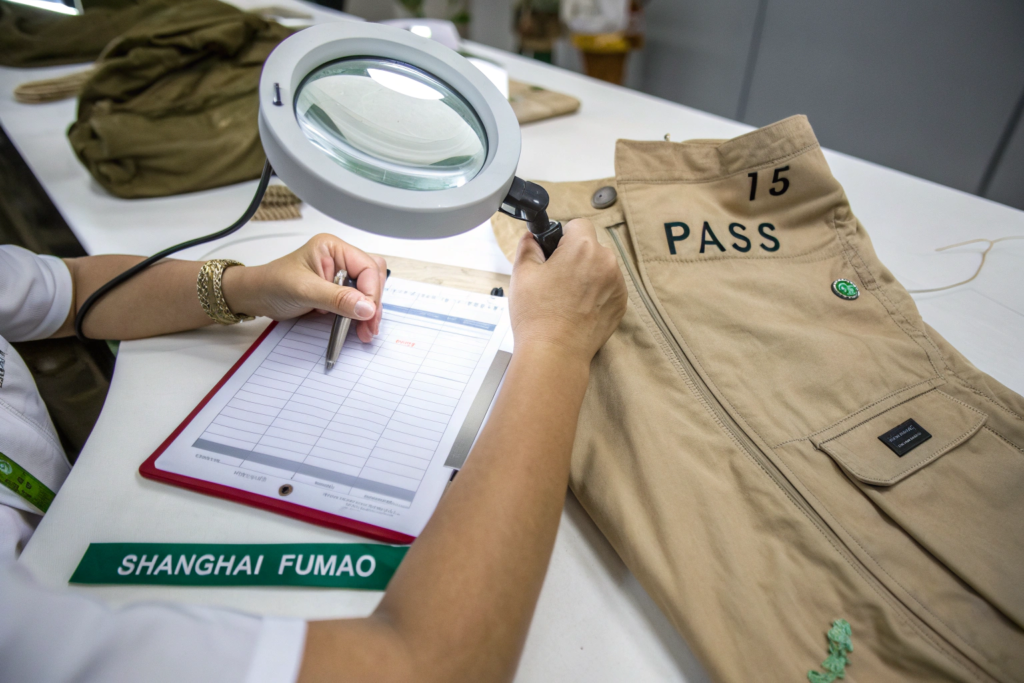
How Did We Eliminate the "Loose Thread" Review Bomb?
A loose thread is the most frequent one-star review subject on Amazon. It photographs perfectly. A customer receives their chinos, turns them inside out, and sees a tiny tail of thread near the pocket. To the factory, this is a minor cosmetic remnant. To the customer, it screams "poor quality, will fall apart." I used to argue with my QC team about this. They would say, "It's within AQL tolerance, it doesn't affect the function." I would show them a customer review that said, "Cheap garbage, threads everywhere." We lost the argument. The customer is always right in the review section.
We implemented a mandatory "Inversion Finishing" step where every single chino is turned completely inside out, inspected under high-lumen lighting, and trimmed with thread-sucking suction shears before bagging. A worker turns the pant inside-out on a lighted inspection tube. They see every seam, every pocket bag attachment, every bar tack. A vacuum suction head attached to a trimming tool instantly removes any loose thread tail and deposits it into a collection bin. This garment finishing inspection step takes 90 seconds per pair, but it eliminates the single most common visible defect that triggers a customer to reach for their phone and write a negative review.
Why Was the "Button Stress Test" Critical for Long-Term Ratings?
A chino button that pops off on the third wear is a guaranteed one-star review with an angry headline. The customer is at a restaurant, they bend over to pick up their keys, and the waistband button pings across the floor. I have a specific test for button security that I stole from the luggage industry. It's brutal and simple. Our QC inspector attaches a force gauge to a sewn button and pulls until something breaks. We record the breaking point in kilograms of force. The industry standard for a 4-hole sew-through button is 7 kg of pull force. We reject anything below 10 kg.
Every button on our FBA-bound chinos undergoes a 15-kilogram pull-strength test and incorporates a heat-sealed locking stitch on the backside to prevent unraveling. We use a lockstitch machine that ties a double knot underneath the button and then seals it with a tiny dot of heat-activated adhesive. This prevents the thread tail from working loose over 50 wear cycles. The button attachment testing process takes five seconds per button, but when a customer bends, stretches, and stresses that button for a year, it holds. That reliability is never mentioned in a review, which is exactly the point. A defect that doesn't happen generates the silence of a five-star rating.
Conclusion
The record-breaking Amazon sales of our men's chinos were not an accident of marketing genius or a lucky viral TikTok. They were the predictable result of engineering every weak point out of the e-commerce supply chain. We started with a fabric that felt premium on day one and still looked premium after fifty washes, using a hidden core-spun stretch that eliminated the dreaded baggy knee. We fixed the sizing crisis that haunts online apparel by implementing a solder-point cutting system and a real-body fit audit that made our 34-inch waist measure exactly 34 inches every single time. We solved the viral stockout problem with a grey fabric bank and a dual-stream air/sea logistics split that kept the Amazon Best Seller badge alive during a demand spike. Finally, we protected the product's rating with an obsessive 15-point, AQL 1.5 quality control finish that hunted down loose threads and stress-tested every button to 15 kilograms of pull force.
Your Amazon listing is too valuable to leave in the hands of a factory that treats your product like a commodity. At Shanghai Fumao, we treat it as a partnership where your review rating is our shared KPI, and your stock-out risk is our production problem to fix before it happens. The chino that broke records did so because we aligned our factory's incentives with your Amazon seller metrics—lower returns, faster replenishment, and higher star ratings. That alignment is what turns a simple pair of khaki pants into a cash-flowing digital asset.
If you are ready to build your own Amazon best-seller with a manufacturing partner that understands the brutal math of FBA returns and the life-or-death importance of a 4.5-star rating, let's start the conversation. We can discuss your specific fabric requirements, your size-set targets, and a logistics plan that keeps you in stock through any algorithm wave. Contact our Business Director, Elaine, directly at elaine@fumaoclothing.com for a transparent quote and a realistic production timeline today.