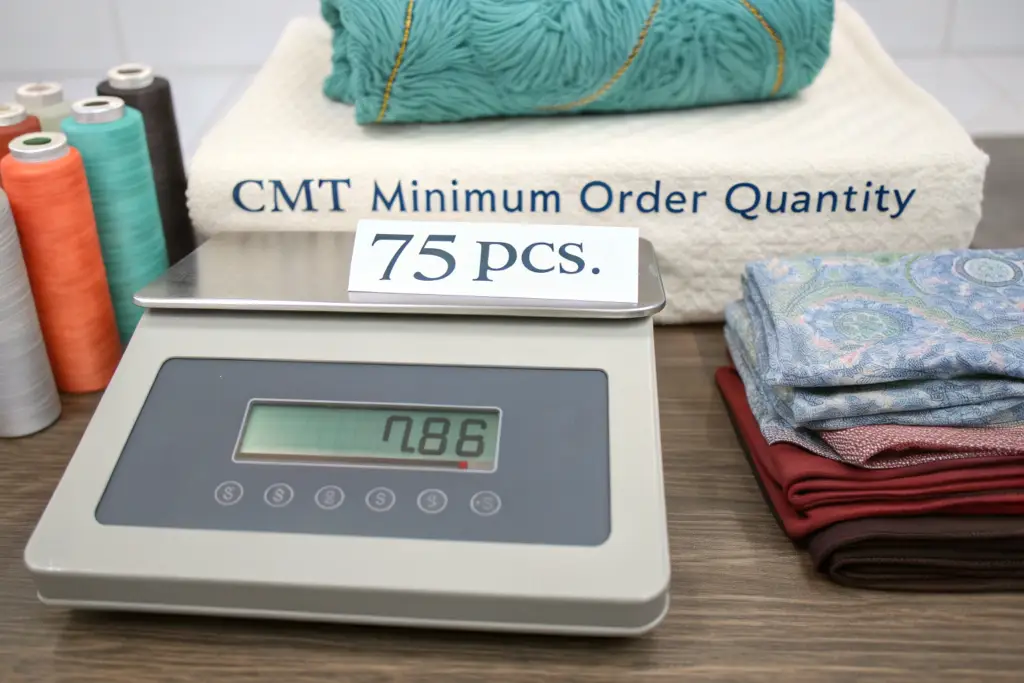
You have sourced the perfect fabric for your first capsule collection—maybe a stunning deadstock print or a premium GOTS organic cotton. You have your custom buttons. You are ready to launch your brand, but you only need 75 units of each style. You contact factories about their CMT (Cut, Make, Trim) services. You brace yourself for the dreaded "MOQ 500 units" response. But you are hoping CMT might be different. A brand owner told me, "I thought CMT was my ticket to small-batch production. But I was still scared of the MOQ conversation. I didn't know what to expect."
The Minimum Order Quantity (MOQ) for CMT services is fundamentally different from Full-Package MOQs. Because you are supplying the fabric and trims, the factory's MOQ is driven almost entirely by their internal production line setup, not by fabric mill minimums. A flexible CMT factory with Modular Production Cells can profitably handle runs as low as 50-100 units per style. The primary constraint is no longer the factory's minimum, but the minimums of your own fabric and trim suppliers.
At Shanghai Fumao, we have built our CMT services specifically to support small-batch, high-quality production. Our flexible production lines make low-MOQ CMT a reality. Let me explain exactly what drives CMT MOQs, what you can realistically expect, and how we work with B2B partners to make beautiful, small-batch manufacturing an accessible and profitable strategy.
What Is a Realistic MOQ for CMT Sewing at a Flexible Factory?
The most common question we get from new brands is, "What's the smallest number of units you'll make for me?" The answer depends entirely on the factory's production model. A factory with only long, high-speed assembly lines will have a high CMT MOQ (often 300-500 units) because it is not economically viable for them to set up those lines for a tiny batch. A flexible factory, however, has a different answer.
A realistic MOQ for CMT sewing at a flexible factory like Fumao is 50-100 units per style. This is possible because we utilize Modular Production Cells—small, agile teams designed for quick changeovers and efficient small-batch production. These cells are not penalized by low volumes. The exact MOQ can vary slightly based on the complexity of the garment, but 50-75 units is a common and comfortable minimum for our modular lines.
I recall a brand founder who was thrilled when we told her we could do a CMT run of 60 units for her complex women's wear blouse. Other factories had quoted her MOQs of 300+. She was able to launch her collection with minimal inventory risk, test her designs in the market, and use the profits to fund a larger second run. She told us, "You made my dream possible. I couldn't have started my brand without a low MOQ partner like you." This is the power of a factory built for flexible, low-MOQ CMT .
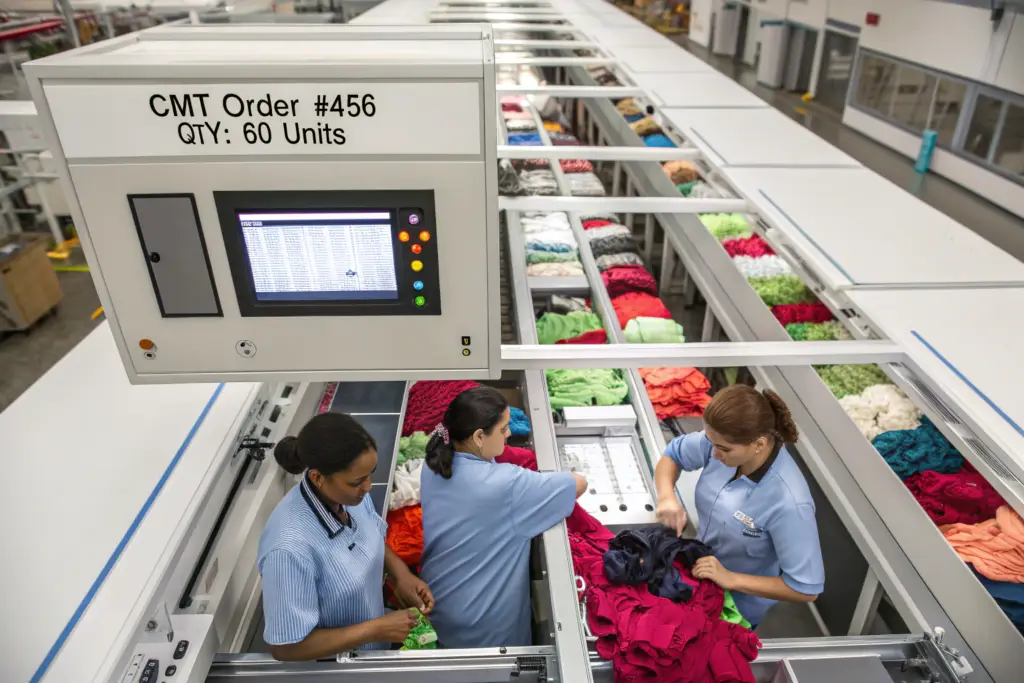
Why Can Modular Cells Handle Such Small Batches Profitably?
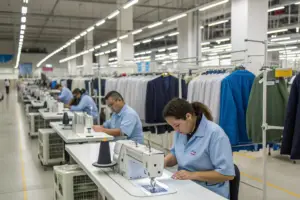
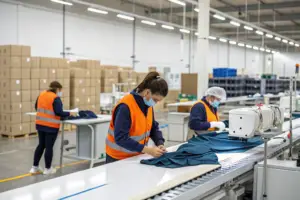
Unlike a long, sequential assembly line that is penalized by frequent stops and changeovers, a Modular Cell is a self-contained unit. A small team of multi-skilled sewers handles a garment from start to finish. They can switch from one style to another in under an hour. The setup cost is minimal. This allows them to profitably run small batches without the efficiency losses that cripple a traditional line. This is the physical engine of our small-batch CMT services .
Does Garment Complexity Impact the Minimum CMT Order Quantity?
Yes, it can. A very simple style, like a basic t-shirt, might have an even lower MOQ, as low as 50 units. A highly complex garment with many pieces, like a tailored blazer or a coat, might have a slightly higher MOQ, perhaps 75-100 units, because the setup and training for the sewing team is more involved. We always provide a specific MOQ for your project during the quoting phase. This is part of our transparent CMT quoting process.
How Do Your Own Fabric and Trim MOQs Impact the Total CMT Order?
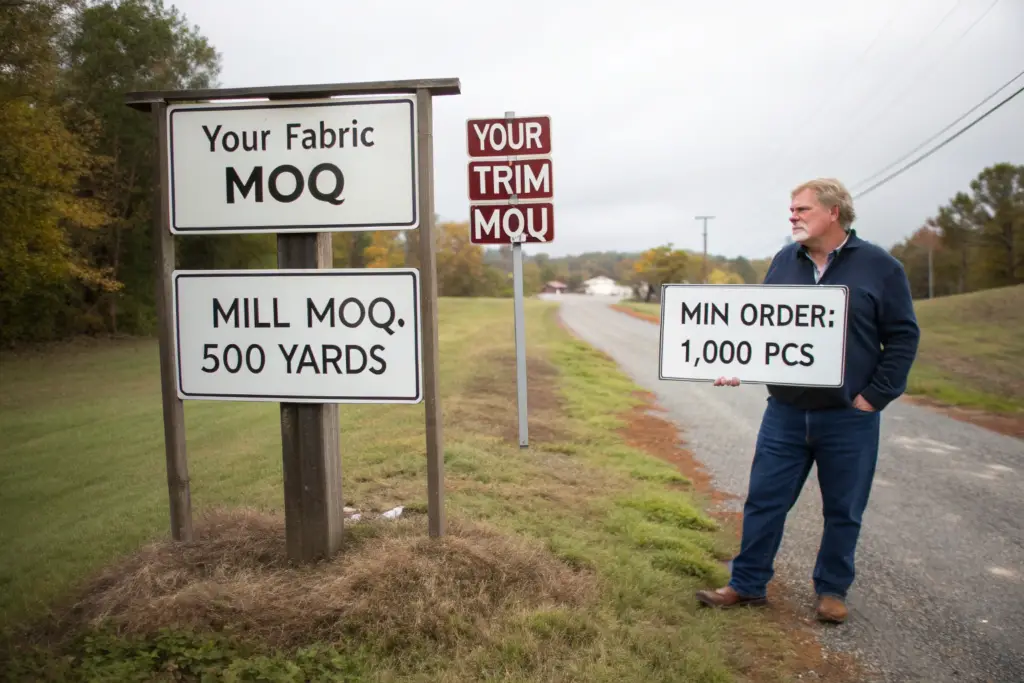
While a flexible factory can sew a small batch, your ability to actually supply a small batch is often the real limiting factor. You must source the fabric and trims. And mills and trim suppliers have their own MOQs, which are often much higher than the factory's sewing minimum. This is the most common frustration for new CMT brands. The key is to understand this and find creative ways to work around it.
The total CMT order quantity is often dictated by the MOQs of your fabric and trim suppliers, not the factory. A mill may require a 300-yard minimum for a custom color, which might force a higher finished-garment MOQ than the factory's 50-unit sewing minimum. The smart strategy is to source "stock" fabrics (which have no minimums) or to find specialty suppliers (like deadstock jobbers) that cater to small-batch designers. This decouples your material sourcing from high-volume constraints.
A brand I mentor was frustrated that her CMT MOQ with us was effectively 250 units, even though we could sew 60. The reason? The beautiful custom-milled wool she wanted required a 150-yard minimum, which translated to about 250 jackets. She did not need 250 jackets. We helped her find a stunning, similar wool from a deadstock supplier with only 40 yards available. She was able to do her 60-unit CMT run. She learned that in CMT, you must be as creative with your material sourcing as you are with your designs. This is the reality of the CMT supply chain .
What Are the Best Material Strategies for Keeping Your CMT MOQ Low?
The most effective strategies are:
- Use "Stock" Fabrics: Choose from a mill's or a factory's library of in-stock, core fabrics. No custom dyeing means no minimums.
- Source Deadstock: Buy leftover, high-quality fabric from jobbers. Unique, sustainable, and available in small quantities.
- Use Digital Printing: For custom prints, digital printing has no screen setup fees and can be done on very short yardage.
Mastering these sourcing strategies is the key to unlocking true small-batch CMT. This is a key part of the guidance we provide to our emerging brand partners .
How Can You Manage the MOQs for Custom Trims Like Labels and Buttons?
Custom trims also have minimums. A custom woven label might have an MOQ of 300-500 pieces. A custom-engraved button might have an MOQ of 1,000 pieces. The strategy is to buy the minimum and use the extras for future orders. For a 60-unit CMT run, you will have leftover labels and buttons. This is an upfront cost, but it is an investment in your brand's identity that will be used over time. We help our clients plan for this.
Can You Combine Styles and Colors to Meet a Factory's CMT Minimum?
One of the most common and effective ways to meet a factory's CMT minimum is through aggregation. You do not need to order 75 units of a single color. You can combine multiple colors, and sometimes even similar styles, to reach the total quantity needed to make the production run efficient for the factory. This is a standard and accepted practice.
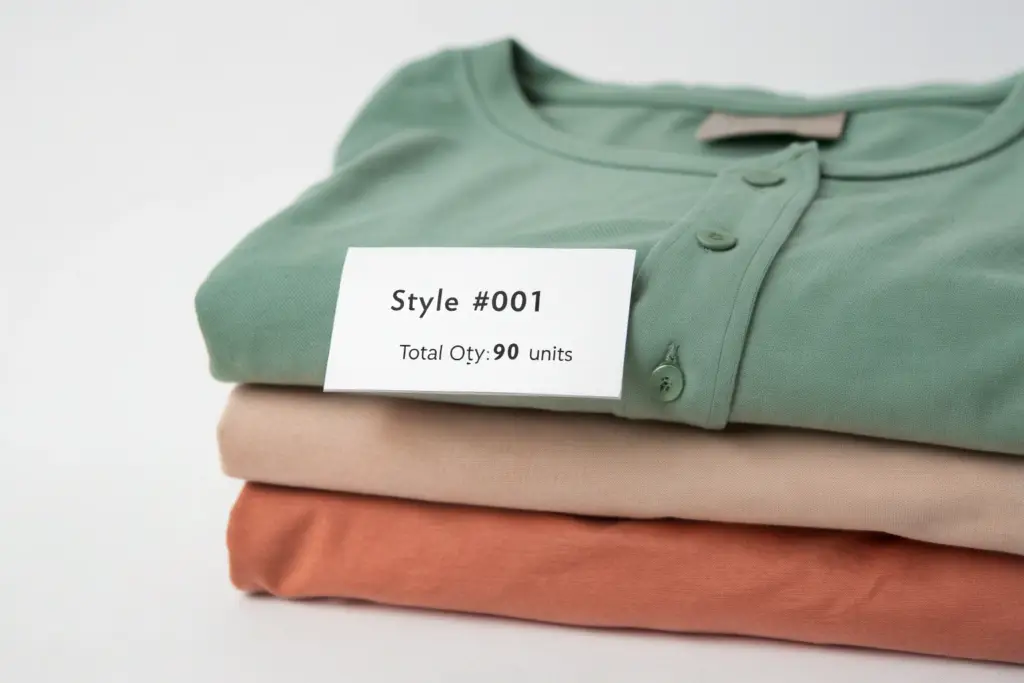
Yes, you can almost always combine colors and sizes within a single style to meet the factory's CMT minimum. For example, an MOQ of 75 units for a dress style could be split into 25 units in Color A, 30 units in Color B, and 20 units in Color C. This allows you to offer a small, curated color palette to your customers while still reaching the production minimum. Combining across very similar styles (e.g., two different sleeve variations on the same body) is sometimes possible but requires discussion.
A brand we work with launches every new collection using this strategy. For her signature blouse, she orders a total of 90 CMT units: 40 in Natural, 30 in a soft Sage Green, and 20 in a beautiful Terracotta. She hits our modular cell's MOQ, offers her customers variety, and minimizes her risk on any single color. This is a smart, proven approach to building a small-batch CMT collection .
Does Combining Sizes Help Meet the CMT Minimum?
Yes, absolutely. The factory's MOQ is for the total units of a specific style. How you break that down across a size curve (e.g., XS, S, M, L, XL) is entirely up to you. We work with you to create a size breakdown that makes sense for your target customer and helps you reach the total MOQ.
Is It Possible to Combine Different Styles to Reach an MOQ?
This is more complex. Combining two completely different styles (e.g., a blouse and a pair of pants) does not help meet the MOQ, as they require different patterns, setups, and sewing lines. However, sometimes you can combine very similar styles that share the same core body pattern but have a minor variation (e.g., a dress with a short sleeve and a dress with a long sleeve). This is a conversation to have with your Project Manager. This is the kind of flexible thinking we encourage in our CMT partnerships .
How Does Fumao's Flexible Model Support Brands with Low-Volume CMT Needs?
We understand that for many of our B2B partners, especially those just starting out, a low MOQ is not a "nice to have"—it is essential to their survival. We have intentionally built our factory and our service model to be the partner that makes low-volume CMT a viable, profitable, and enjoyable reality. We do not just tolerate small orders; we welcome them as the foundation of many long-term partnerships.
Fumao's flexible model supports low-volume CMT brands by providing dedicated Modular Production Cells for small batches, offering expert guidance on navigating fabric and trim MOQs, and treating every 50-unit order with the same care, transparency, and professionalism as a 5,000-unit order. We are the launchpad for emerging, design-focused brands.
A founder who launched her first 50-unit CMT collection with us recently told me, "I was prepared for the factory to treat my tiny order like an annoyance. But you treated me like I was your most important client. The weekly updates, the care with my fabric... it made me feel like a real brand. You gave me the confidence to grow." That is our goal. To provide the flexible, supportive manufacturing platform that allows creative entrepreneurs to bring their visions to life, regardless of order size. This is the heart of our partnership with emerging brands .

Do You Have a Dedicated Production Cell for Small-Batch CMT Orders?
Yes. We have specific Modular Production Cells that are designated for small-batch and rare style production. These cells are staffed by our most versatile and experienced sewers, who are adept at handling the unique challenges of low-volume, high-variety work. They are the dedicated engine of our small-batch CMT services .
How Does Our Project Management Support a Brand Doing Their First 50-Unit Run?
Your dedicated Project Manager is your guide. They provide a clear, step-by-step timeline. They send proactive weekly updates with photos, so you always know the status of your small batch. They answer your questions with patience and expertise. They make the complex process of remote CMT manufacturing feel manageable and transparent. This level of support is crucial for a first-time founder. This is the value of our full-service CMT support .
Conclusion
The Minimum Order Quantity for CMT services is not a fixed, intimidating barrier. With the right flexible manufacturing partner, it is a manageable and often surprisingly low number—typically 50-100 units per style. The real key to unlocking small-batch CMT is to pair a flexible factory with smart, creative material sourcing strategies.
At Shanghai Fumao, we are built to be that flexible partner. Our modular production lines, our expertise in navigating the material supply chain, and our supportive Project Management are all designed to make low-MOQ CMT a reality for emerging and design-focused brands. We are the platform that allows you to launch with precision and scale with confidence.
If you are ready to explore the possibilities of small-batch CMT for your brand, let's talk. Our Business Director, Elaine, can discuss a realistic MOQ for your specific project and guide you through the process.