You made the switch to Vietnam five years ago. Everyone was doing it. The trade war tariffs were scaring buyers away from China. The fashion magazines were calling Vietnam the new denim hub. The labor costs were lower. The initial samples looked good. The first few orders went smoothly. Then the problems started. The factory that quoted you a great FOB price added a surcharge for fabric that was not in stock. The lead time that was supposed to be 45 days stretched to 70 days because the mill was backed up. The communication, which was fine during the sampling phase, became slow and confusing during bulk production. You started to wonder if the savings were real after you factored in the air freight you had to pay to catch up to your selling window. You are not alone. I am hearing this story from more and more American buyers who are quietly moving their denim shorts production back to China.
You should consider switching from Vietnamese to Chinese denim shorts suppliers if three factors are hurting your business. First, if you are experiencing longer-than-promised lead times because Vietnamese mills have limited capacity and long queues. Second, if the total landed cost, including logistics inefficiencies and hidden surcharges, is no longer significantly lower than a Chinese DDP quote. Third, if you need complex washes, custom hardware, or sustainable certifications that require a supply chain depth that Vietnam's denim industry has not yet fully developed.
I run Shanghai Fumao, a Chinese denim factory. I compete with Vietnamese factories for your business. I am not a neutral observer. But I have also spent fifteen years in this industry, and I understand the cost structures, the supply chains, and the trade-offs better than most. In this article, I will give you a factual comparison of the two sourcing destinations for denim shorts. I will cover the real cost differences, not just the FOB prices. I will explain the supply chain and lead time differences. I will compare the technical and sustainability capabilities. And I will tell you what kinds of orders are still better suited for Vietnam. My goal is not to convince every buyer to switch. My goal is to give you the information you need to make the right decision for your specific brand.
What Is the Real Cost Comparison Between Vietnamese and Chinese Denim Shorts?
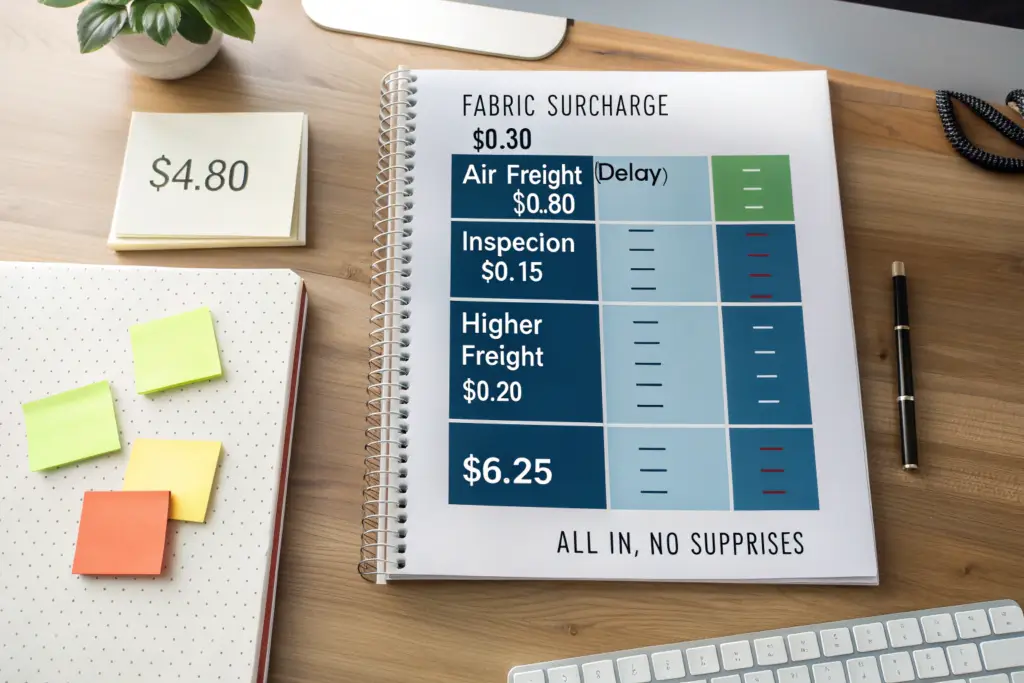
The FOB price is the most misleading number in apparel sourcing. A Vietnamese factory quotes you $4.80 FOB for a basic denim short. A Chinese factory quotes you $5.50 FOB for the same specification. You think you are saving $0.70 per unit. You are not. You are deferring costs that will show up later, on different invoices, from different parties, and those costs will eat up the difference and more.
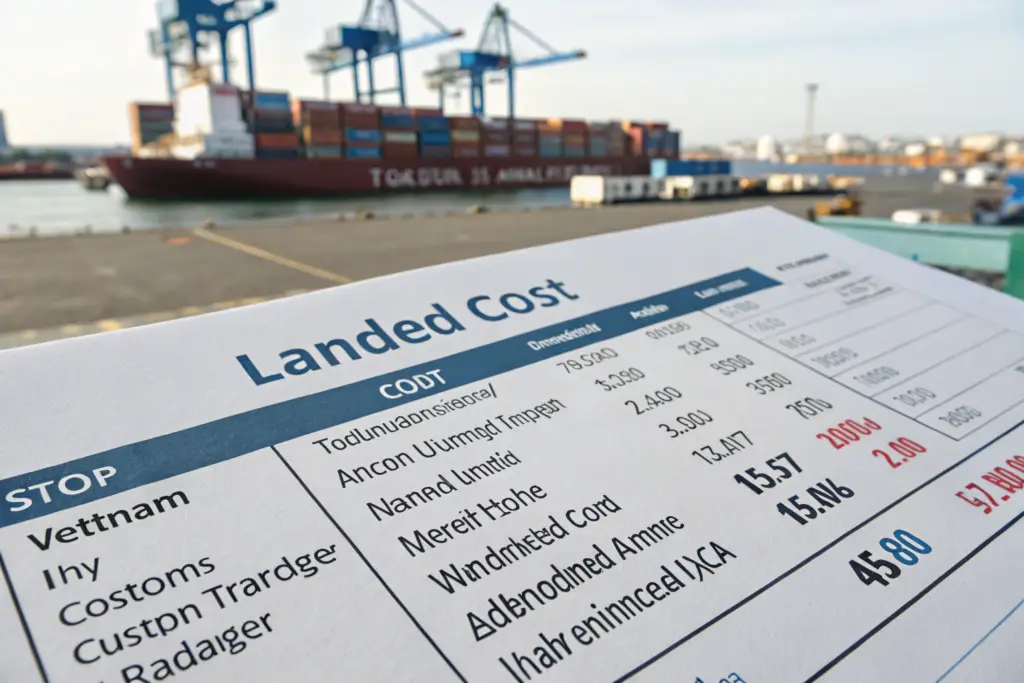
The total landed cost is the only number that matters. Total landed cost is the sum of the FOB price, the ocean or air freight, the marine insurance, the U.S. customs duty, the customs bond, the brokerage, the port handling, and the inland trucking to your warehouse. When you calculate the total landed cost, the gap between Vietnam and China narrows significantly. And when you factor in the hidden costs, the air freight you pay when the factory misses the ship date, the surcharge for a fabric upgrade the factory did not tell you about, the cost of a third-party inspection because you do not trust the factory's internal QC, the landed cost equation can actually flip. The Vietnamese option can become more expensive.
Let me break down the cost comparison with real numbers and explain where the hidden costs come from.
How Do FOB Prices Compare, and Why Is That Comparison Misleading?
A basic denim short, 10.5 oz, enzyme wash, YKK zipper, standard five-pocket style, currently costs approximately $4.50 to $5.50 FOB from Vietnam. The same specification from a mid-tier Chinese factory costs approximately $5.20 to $6.20 FOB. The FOB price difference is $0.70 to $1.00. Vietnam appears cheaper.
But this comparison ignores three realities. First, the fabric cost in Vietnam is often higher than in China because Vietnam imports a significant portion of its denim fabric from China. A Vietnamese factory buying Chinese denim fabric pays the fabric cost plus shipping and import duty. The FOB price they quote you may not fully reflect that fabric cost if they quoted you before confirming fabric availability. When the fabric price comes in higher, they will ask for a surcharge. This happens frequently. Second, the hardware cost in Vietnam is higher. YKK has factories in both countries, but the range of stock available in Vietnam is narrower. Custom hardware almost always comes from China or Taiwan, adding shipping and lead time. Third, the productivity in Vietnamese factories is lower on complex styles. A Chinese sewing line that has been making denim for twenty years will produce a washed, distressed short with 28 minutes of labor. A Vietnamese line that is newer to complex denim may take 35 or 40 minutes. The labor cost per hour is lower in Vietnam, but the labor cost per unit is not always lower if the productivity is lower. The Vietnam vs China garment manufacturing costs comparison is complex and product-specific. The FOB price is a starting point, not an ending point.
What Hidden Logistics Costs Make Vietnamese Sourcing More Expensive?
Vietnam's logistics infrastructure is less developed than China's for containerized garment exports. The port of Ho Chi Minh City is smaller than Shanghai or Ningbo. The sailing frequency to the U.S. West Coast is lower. The transit time is longer. A container from Shanghai to Los Angeles takes 12 to 15 days. A container from Ho Chi Minh City to Los Angeles takes 16 to 20 days. The longer transit time means higher inventory carrying cost and less flexibility to respond to in-season reorders.
The port congestion in Ho Chi Minh City has been more severe than in Shanghai in recent years. When congestion hits, containers wait for vessel space. Demurrage charges accumulate. The buyer pays these under FOB terms. The freight cost from Vietnam to the U.S. is also higher on a per-container basis because there are fewer vessels and less competition among carriers. A 40-foot container from Shanghai to LA costs approximately $3,500 to $5,000. From Ho Chi Minh City, it costs $4,000 to $6,000. The difference per unit, assuming 25,000 shorts per container, is $0.02 to $0.04. Not huge, but it adds to the total.
The customs clearance risk is also different. The U.S. has a trade agreement with Vietnam, but it does not cover all product categories. Denim shorts are subject to the standard MFN duty rate of 16.6%, same as China. There is no duty advantage for Vietnamese denim. However, U.S. Customs has increased scrutiny of Vietnamese shipments in recent years due to concerns about Chinese transshipment, where Chinese goods are routed through Vietnam to evade China-specific tariffs. If your Vietnamese supplier cannot provide a complete, verifiable supply chain documentation, your shipment could be detained for investigation. That delay is expensive. The Vietnam logistics and freight environment is improving, but it has not caught up to China's scale and efficiency.
How Do Lead Times and Supply Chain Depth Differ Between the Two Countries?
Lead time is not just a number on a production schedule. It is the difference between having inventory for the peak selling season and having inventory for the clearance rack. A four-week delay on a summer denim short order means the shorts arrive in July instead of June. Your retail partners have already moved on to back-to-school merchandise. You are marking down your summer inventory before it even hits the floor. The cost of a missed selling window dwarfs any FOB price saving.
China's denim supply chain is the deepest and most integrated in the world. The cotton is grown in Xinjiang. The yarn is spun in Shandong. The fabric is woven and dyed in Guangdong or Zhejiang. The zippers come from YKK in Suzhou. The buttons come from hardware factories in Wenzhou. The washing enzymes come from chemical companies in Shanghai. All of these suppliers are within a 200-mile radius of each other. A truck can pick up fabric from the mill in the morning and deliver it to the cutting table in the afternoon. Vietnam's denim supply chain is growing, but it is not yet deep. Many components are imported from China, which adds transit time, customs clearance time, and uncertainty.
Let me compare the fabric lead times, the production agility, and the overall supply chain reliability.
Why Is Fabric Availability Faster and More Reliable in China?
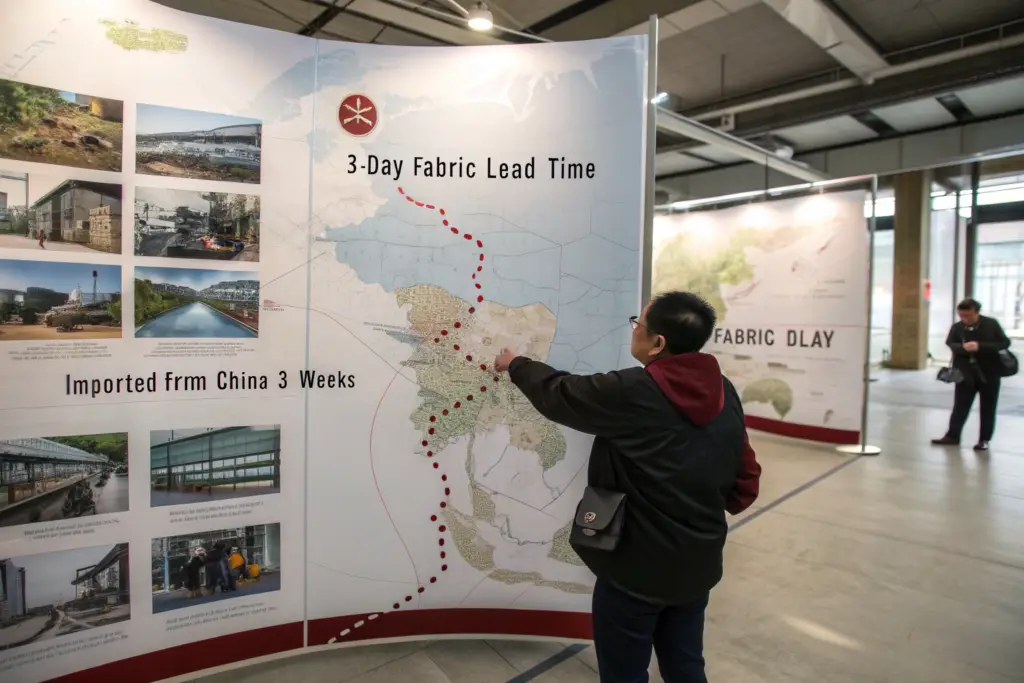
The denim mills in China, particularly in Guangdong's Xintang region, which produces a significant portion of the world's denim, operate at a massive scale. They weave millions of yards per month. They stock greige fabric for common specifications. A standard 10.5 oz 3/1 twill with 1% spandex is available essentially off the shelf from multiple mills. If we need 5,000 yards, we can have it in our cutting room within three days.
Vietnam has denim mills. Several major ones, in fact, operated by international players. But the range of stock specifications is narrower. If you need a specific weight, a specific stretch percentage, a specific shade of indigo, the mill may need to produce it to order. That adds two to three weeks to the fabric lead time. If the specification is unusual, the mill may not be able to produce it at all in Vietnam, and the fabric will be imported from China, adding three to four weeks and import duties. The result is that the fabric lead time for a denim short program in Vietnam is often three to five weeks, compared to one to three weeks in China. This difference extends the total order lead time and reduces flexibility. A brand that wants to test a new wash with a small quantity of fabric can do so in China in a matter of days. In Vietnam, the same test might take a month. The China denim supply chain depth is a structural advantage that Vietnam is working to replicate but has not yet matched.
How Does Production Agility Compare for Rush Orders or Design Changes?
Agility is the ability to respond quickly to changes. A brand sees that a particular wash is selling out on their website. They want to convert the next 2,000 pieces of their order from a medium wash to a light wash. They call the factory. In China, we can make that change at the wash stage. The shorts are cut and sewn but not yet washed. We redirect them to the light wash recipe. The change adds zero time. In Vietnam, the wash house might be a separate facility, not integrated into the garment factory. Changing the wash specification requires re-scheduling with the laundry, which might have other clients' orders in the queue. The change adds three to five days, or is simply refused.
The same applies to design changes. A brand wants to add a leather patch to the back waistband. In China, our hardware sourcing manager calls the patch supplier, who is two hours away by truck, and arranges a sample batch in 48 hours. In Vietnam, the patch supplier is likely in China. The sample batch takes a week to arrive by courier. The production addition takes longer to coordinate. The garment manufacturing cluster in China, where fabric mills, trim suppliers, wash houses, and sewing factories are all co-located, enables a level of agility that a geographically distributed supply chain cannot match. This agility is a cost advantage that does not appear on a price quote, but it saves brands from missing trends and from overproducing the wrong styles. The garment supply chain agility is increasingly important in a market driven by social media trends and rapid shifts in consumer preference.
Which Country Offers Better Technical Capabilities for Premium Denim?
A basic five-pocket denim short with a rinse wash can be made in dozens of countries. A premium denim short with a complex vintage wash, laser detailing, custom hardware, selvedge fabric, and sustainable certifications requires a supply chain with deep technical capabilities. This is where China's advantage is most pronounced.
Denim washing is a specialized chemical and mechanical process. Creating a specific vintage fade requires knowledge of enzyme concentrations, ozone cycle times, potassium permanganate spray techniques, and hand-sanding methods. The wash technicians who have this knowledge are concentrated in a few global denim hubs. China's Xintang region is one of them. Turkey's denim cluster around Istanbul is another. Japan's Okayama region is a third. Vietnam is developing this expertise, but the depth of experienced wash technicians is shallower. When a brand wants a wash that exactly matches a reference image, the probability of getting it right on the first sample is higher in China.
Let me compare the wash and finishing capabilities, the hardware and trim ecosystem, and the sustainable manufacturing infrastructure.
Where Are Complex Wash Techniques More Readily Available?
China has been the world's largest producer of denim garments for over two decades. In that time, a deep pool of wash technicians has developed. These technicians have worked with every type of wash. Enzyme stone. Acid wash. Bleach splatter. Ozone fade. Laser etching. Potassium permanganate hand-spray. Resin bake for 3D creasing. They know how to combine these techniques to create a specific look. They know what chemicals to use, at what concentrations, for what duration, on what fabric weight. This knowledge is tacit. It is learned through years of hands-on work. It cannot be replicated by reading a manual.
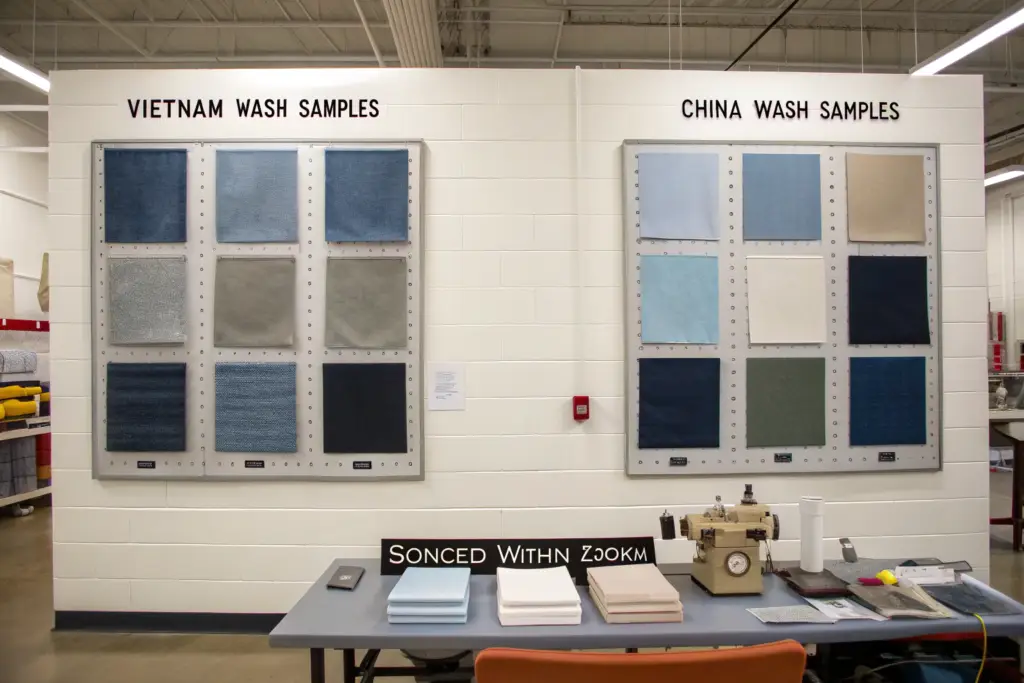
Vietnam's denim industry is younger. The wash houses are newer. The technicians are still building their experience base. For a standard enzyme wash or a basic bleach wash, Vietnamese wash houses produce good results. For a complex vintage fade with multiple techniques layered together, the success rate on the first sample is lower. The development process takes more rounds. Each round adds time and shipping cost. A brand developing a complex wash in Vietnam should budget for three to four sampling rounds and an extended development timeline. The same development in China might take two rounds. The denim wash technology expertise is concentrated in the long-established denim manufacturing clusters. China's cluster has been building expertise since the 1990s.
Is the Hardware and Trim Sourcing Ecosystem Stronger in China?
The hardware on a premium denim short, the buttons, rivets, zippers, leather patches, is a significant part of the product's perceived quality. China is the world's largest producer of garment hardware. The city of Wenzhou in Zhejiang province alone has thousands of factories producing buttons, rivets, zipper pullers, and metal accessories. YKK's largest manufacturing base is in Suzhou. The proximity of these suppliers to garment factories means custom hardware can be developed, sampled, and produced faster.
Vietnam has a growing hardware industry, but for custom, high-quality hardware, many Vietnamese factories still source from China. This adds lead time and communication layers. The Vietnamese factory sends the design to a Chinese hardware supplier. The supplier makes a mold sample and ships it to Vietnam. The factory sends it to the brand for approval. The brand sends feedback. The feedback goes back to China. Each round of this triangle takes a week. In China, the same process takes two days because the hardware supplier is a few hours away by courier.
The same applies to leather patches, woven labels, and embroidered badges. The trim ecosystem in China is unmatched in its variety, quality, and speed. For a brand that wants to differentiate through custom branding, the China advantage is significant. The garment trim and accessories supply chain in China benefits from decades of industrial clustering. Vietnam's cluster is growing but is not yet self-sufficient for high-end, customized components.
When Might Vietnamese Sourcing Still Be the Better Choice?
I am not here to tell you that China is always better. That would be dishonest. There are specific scenarios where Vietnamese sourcing is the superior option. A good sourcing decision matches the product requirements to the country's industrial strengths. For some products, Vietnam's strengths align better.
If your product is a basic, unwashed or lightly washed denim short with no complex finishing, no custom hardware, and a simple solid color, Vietnam's lower labor costs can give you a genuine cost advantage. The simpler the product, the less the supply chain depth matters. If your brand is a large retailer with an established vendor compliance program, dedicated logistics teams, and long production timelines, you can manage the logistics inefficiencies and the longer lead times. Your scale and your internal capabilities offset the disadvantages. If your brand sells primarily in the European Union, Vietnam benefits from the EU-Vietnam Free Trade Agreement, which eliminates duties on many garment categories. The duty savings on an EU-bound order can be significant enough to outweigh other disadvantages. This is not relevant for the U.S. market, where both China and Vietnam face the same 16.6% duty rate for denim shorts.
Let me be specific about the scenarios where Vietnam remains the right choice so you can make a clear-eyed decision.
For What Kind of Denim Orders Does Vietnam Have an Advantage?
Vietnam has an advantage for high-volume, low-complexity orders. Orders over 10,000 units of a single style. Basic five-pocket shorts. Simple rinse or enzyme wash. Standard YKK zipper. No custom hardware beyond a woven label. This type of order benefits from Vietnam's lower direct labor cost and does not require the deep supply chain capabilities that China excels at.
Vietnam also has an advantage for brands that have invested in their own compliance and quality management infrastructure in the country. If you have a dedicated sourcing office in Ho Chi Minh City, established relationships with specific mills and factories, and a logistics team that manages freight and customs in-house, you have already absorbed the fixed costs of operating in Vietnam. For you, the marginal cost of adding a new denim program is lower in Vietnam than switching to China and building new relationships from scratch.
Finally, Vietnam has an advantage for brands with strong sustainability stories that rely on renewable energy. Vietnam's electricity grid has a higher percentage of hydropower and solar than China's grid. If your brand's carbon accounting assigns value to the factory's energy source, a Vietnamese factory may offer a lower carbon footprint per garment, all else being equal. This is a niche consideration but a real one for sustainability-leading brands. The Vietnam garment industry advantages are real and should be part of a balanced sourcing strategy.
What Should You Consider Before Making the Switch Back to China?
Switching suppliers is costly. You have invested time and money in qualifying your Vietnamese suppliers. You have established relationships. You have approved samples and locked wash recipes. Moving those programs to a new Chinese supplier requires re-sampling, re-approving, and re-building trust. This is a multi-month process with a financial cost. The switching cost must be weighed against the ongoing costs of staying with a supplier that is not performing.
Before making the switch, audit your current Vietnamese supplier's actual performance over the past twelve months. What was the average lead time versus the promised lead time? What was the defect rate on incoming inspection? How many air freight shipments did you pay for due to production delays? What was the actual total landed cost per unit, including all logistics and quality costs? Compare these numbers to a detailed quote from a Chinese supplier. The quote must be more than an FOB price. It must be a DDP landed cost with a guaranteed delivery date, a confirmed fabric specification, and a clear penalty for delays. Only when you have both sets of numbers in hand can you make a rational comparison.
Also, consider the tariff risk. The U.S. political environment around Chinese imports is volatile. Additional tariffs on Chinese apparel are a possibility. If you are risk-averse to tariff changes, maintaining a dual-country sourcing strategy, some volume in Vietnam, some in China, is a prudent hedge. Do not put all your eggs in one basket. The sourcing diversification strategy is standard practice among large brands. China offers the best combination of speed, quality, and supply chain depth for premium denim shorts. Vietnam offers lower labor costs and trade agreement advantages for basic products and the EU market. The smart buyer uses both.
Conclusion
The choice between Vietnamese and Chinese denim shorts suppliers is not a binary one. It depends on your product, your brand, your volume, and your market. For high-volume, basic denim shorts where the lowest direct labor cost is the primary driver, Vietnam remains a strong option, particularly if you have an established presence there or if you sell into the EU. For premium denim shorts with complex washes, custom hardware, specific sustainable certifications, or tight delivery timelines, China's deep, integrated supply chain offers advantages that Vietnam cannot yet match.
The FOB price comparison is a trap. Vietnam's FOB price looks lower, but the total landed cost, after fabric surcharges, logistics inefficiencies, longer lead times, and quality management overhead, is often closer than the headline numbers suggest. When you factor in the cost of a missed selling window, the equation can flip entirely. A short that costs $0.50 more per unit but arrives on time for the summer season generates far more profit than a short that costs $0.50 less but arrives in August.
I run a Chinese denim factory. I believe in Chinese manufacturing. But I also believe that a smart buyer evaluates the full picture. Total landed cost. Supply chain reliability. Technical capability. Logistics simplicity. Regulatory risk. If you are currently sourcing from Vietnam and are frustrated with lead times, hidden costs, or quality consistency, I invite you to make the comparison. Contact our Business Director, Elaine. She will prepare a DDP landed cost quote for your specific denim short specification, delivered to your U.S. warehouse. She can also provide a sample pair of our standard shorts so you can compare the quality directly. Her email is elaine@fumaoclothing.com. The right sourcing decision is the one that maximizes your profit over the full product lifecycle, not the one that minimizes the FOB price on a purchase order. At Shanghai Fumao, we compete on the full lifecycle.