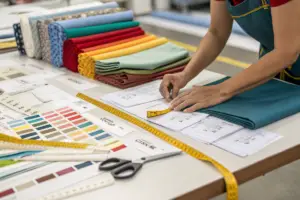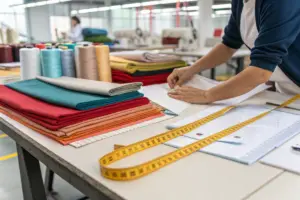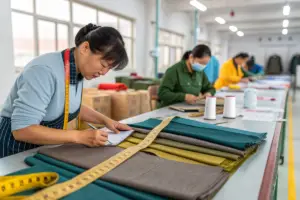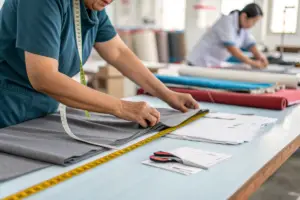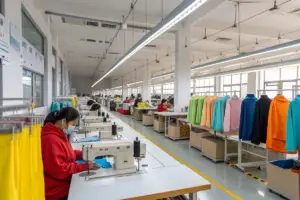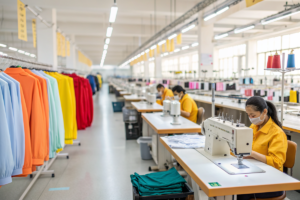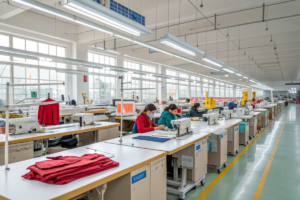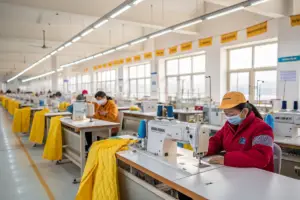
You pull a new pair of denim shorts out of the polybag. The fabric feels substantial. The stitching looks straight. The zipper opens and closes smoothly. You wear them three times. You wash them twice. The zipper starts to stick. The hem begins to fray. The color fades to an ugly, patchy blue. The shorts that felt like quality on day one feel like junk on day ten. This is the durability gap. The gap between how a garment performs on the inspection table and how it performs in real life. Most factories do not test for this gap. They check the shorts once, at the end of the line, and ship them. What happens after that is your problem.
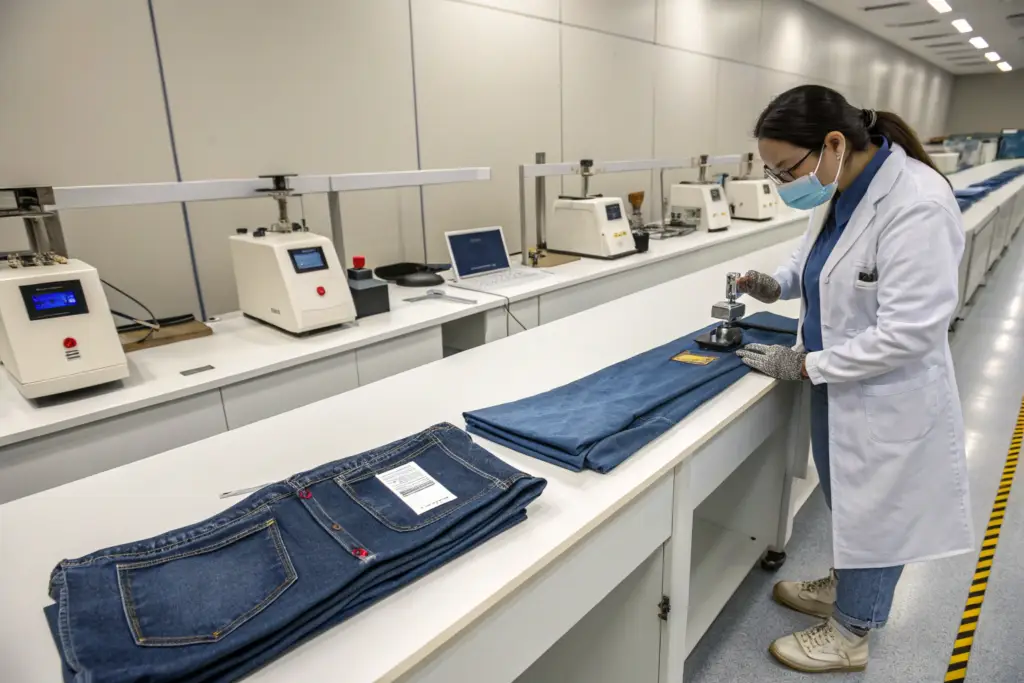
Shanghai Fumao tests the durability of its denim shorts through five standardized test methods, all performed in our in-house laboratory. We measure fabric tensile strength and tear strength on a universal testing machine. We test zipper endurance on a reciprocating machine to 5,000 cycles. We assess color fastness to crocking and washing using AATCC standard methods. We evaluate seam strength and seam slippage under load. And we conduct a full five-cycle home laundry test on finished garments to verify dimensional stability, stitch integrity, and overall appearance retention.
I run Shanghai Fumao. I invested in a testing laboratory because I was tired of guessing. A buyer would email me six months after delivery. The shorts were falling apart. The fabric was tearing at the pocket corner. The zipper was failing. I had no data to prove we made them right. The mill blamed the laundry. The laundry blamed the sewing. I was stuck in the middle. The lab changed that. Now I have data. I can tell you, before your order ships, exactly how many pounds of force it takes to tear the fabric, exactly how many times you can unzip the fly before the slider fails, and exactly how much the waistband will shrink after five washes. Data replaces excuses. That is what this article is about.
What Fabric Strength Tests Do We Perform on Every Denim Lot?
Fabric is the foundation. If the fabric is weak, nothing else matters. You can sew the straightest seams in the world. You can install the best YKK zipper. If the denim itself tears under normal wear, the shorts are garbage. Fabric strength is not visible to the naked eye. Two rolls of denim can look identical. One tears at 25 pounds of force. The other tears at 45 pounds. You cannot see the difference. You can only measure it.
We measure fabric strength on every denim lot before it goes to the cutting table. Every lot. Not a sample of lots. Not when we have time. Every single lot. If a lot fails the strength test, it is rejected. It does not matter if the production schedule is tight. It does not matter if the mill offers a discount. A weak fabric becomes a weak short becomes a customer complaint becomes a lost client. The math is simple. The test takes ten minutes. The cost of skipping the test is a damaged reputation that takes years to rebuild.
Let me explain the two specific strength tests we run and the numbers we require.
How Do We Measure Tensile Strength and What Is Our Minimum Standard?
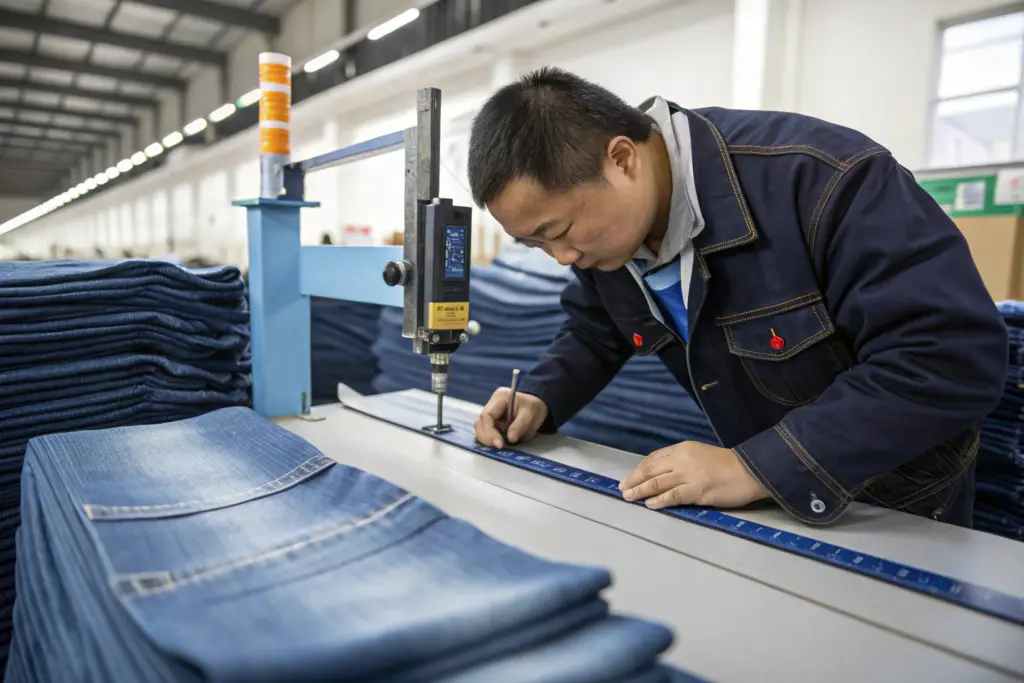
Tensile strength measures the force required to pull a fabric apart until it breaks. The test is performed on a universal testing machine, also called a tensile tester. We cut a strip of denim fabric, 50 millimeters wide and 200 millimeters long, in the warp direction, which is the vertical direction of the fabric along the length of the roll. The strip is clamped between two jaws. The machine pulls the jaws apart at a constant speed of 300 millimeters per minute. The force increases until the fabric ruptures. The machine records the maximum force in Newtons.
We test three specimens from each lot and average the results. Our minimum standard for 10.5 oz denim is 350 Newtons in the warp direction. For 12 oz denim, the minimum is 420 Newtons. For 8 oz lightweight denim, the minimum is 250 Newtons. If the average falls below the minimum, the lot is rejected. If one specimen falls significantly below the average, we test three more specimens from different sections of the roll. If the re-test confirms a weak spot, the lot is rejected. The test follows the ASTM D5034 standard for grab breaking strength and elongation of textile fabrics. The ASTM D5034 tensile testing standard is the internationally recognized method. Our minimums are set based on our experience with denim shorts. A short with a warp tensile strength below 350 Newtons will tear at the knee or the seat under normal wear within a few months. A short above 400 Newtons will last for years.
What Tear Strength Threshold Indicates Resistance to Rips at Stress Points?
Tensile strength measures the force to break an intact fabric. Tear strength measures the force required to propagate a tear that has already started. In a pair of shorts, tears start at stress points. The pocket corner, where the bar tack secures the pocket to the front panel. The crotch seam, where four panels meet and take tension when the wearer sits down. The belt loop attachment, where a finger can catch and pull.
The tear strength test uses the same universal testing machine but a different specimen preparation and a different test method. We use the ASTM D1424 Elmendorf tear method. A rectangular specimen is cut. A small slit is made in the center to initiate a tear. The specimen is clamped in the Elmendorf apparatus, which uses a falling pendulum to tear the fabric. The machine measures the energy absorbed during the tear in Newtons. Our minimum standard for 10.5 oz denim is 25 Newtons in the warp direction. For 12 oz denim, 30 Newtons. Tear strength is often the more critical metric for denim shorts because shorts experience snagging and catching more than they experience pure tensile loading. A short with adequate tensile strength but poor tear strength will develop rips at the pocket corners and the hem. We learned this the hard way. A batch of shorts we made in 2019 had good tensile strength but marginal tear strength. The returns were all for the same failure. The front pocket tore away from the panel at the bar tack. We traced the problem to a fabric lot with low tear strength, adjusted our incoming standard, and have not had that failure mode since. The ASTM D1424 tear testing standard defines the method. Our threshold is based on field data from our own products.
How Do We Test the Durability of Zippers and Hardware?
A broken zipper is the most common reason a pair of shorts is thrown away. The fabric is fine. The fit is great. The color is still rich. But the zipper slider is jammed at the bottom, or the teeth are separating, or the auto-lock does not lock. The shorts are unwearable. The customer is furious. The one-star review is posted.
Zipper failure is almost entirely preventable. It is a function of the zipper quality, the installation method, and the testing, or lack thereof, performed before shipment. We test every incoming batch of zippers and every finished short's zipper function. The testing is not complicated. It is a machine that opens and closes the zipper and counts the cycles. What matters is that the test is actually done, and that the pass threshold is high enough to represent years of use, not just a few weeks.
Let me explain the specific tests we run on zippers and hardware attachments.
What Does Our 5,000-Cycle Zipper Test Simulate?
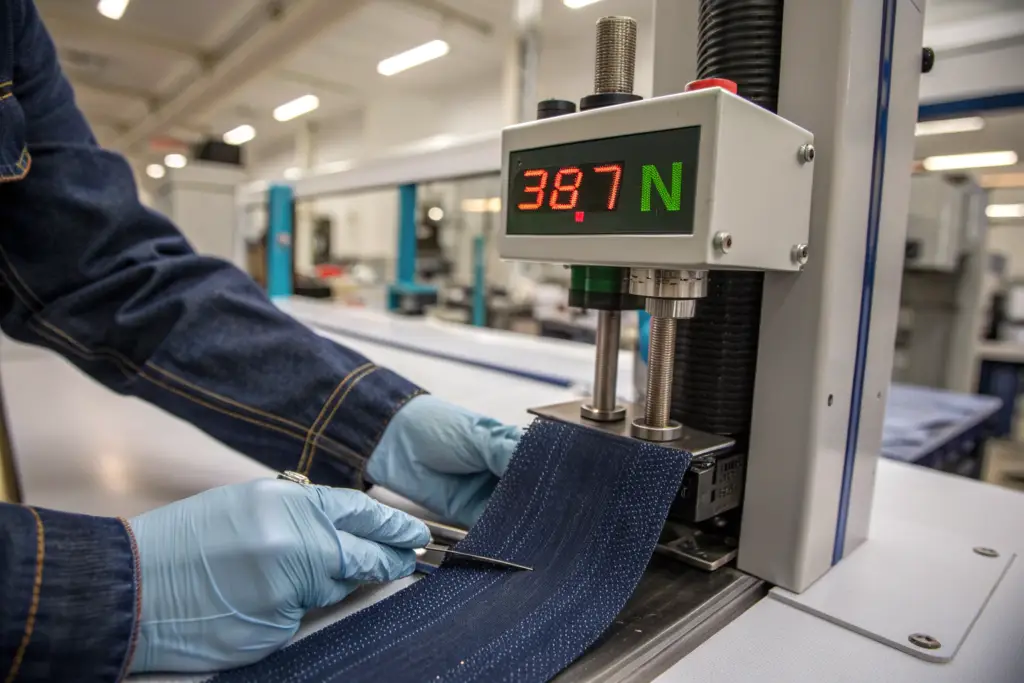
A zipper cycle is one complete open-and-close sequence. The zipper slider travels from the bottom stop to the top stop and back down. The average person zips and unzips their shorts maybe two to four times per day. Over a year, that is 700 to 1,500 cycles. Over three years, it is 2,000 to 4,500 cycles. The industry standard zipper durability test, defined by ASTM D2061, is 500 cycles. We test to 5,000 cycles.
We use a reciprocating zipper tester. The machine grips the zipper tape on both sides and mechanically moves the slider up and down at a controlled speed. The machine counts the cycles. The test runs until 5,000 cycles are completed or until the zipper fails. A failure is defined as the slider jamming and refusing to move, the teeth separating under load and the zipper opening spontaneously, the slider body cracking or breaking, or the auto-lock mechanism failing to hold the slider in place. If the zipper completes 5,000 cycles without failure, it passes. If it fails before 5,000 cycles, the batch is rejected. We test a sample of 10 zippers from each incoming batch. The sample size is small because zipper manufacturing is a high-precision, automated process, and the failure rate within a batch is consistent. The 5,000-cycle threshold is our internal standard. We adopted it because the 500-cycle ASTM standard is too low. A zipper that fails at 600 cycles might pass the industry standard but will fail for the customer in their second year of ownership. The ASTM D2061 zipper testing standard defines the method. Our threshold represents our commitment to building shorts that outlast the fashion cycle.
How Do We Test Button and Rivet Attachment Strength?
A button that pops off the waistband is a catastrophic failure. The short cannot be closed. The customer cannot wear it. The button failure is almost always an attachment failure, not a button breakage. The shank of the button, which is the metal stem that attaches to the fabric, pulls through the denim because the attachment was not properly clinched.
We test button attachment strength using a pull-force gauge. A sample of five shorts is taken from each production batch. The waistband is clamped to a fixed surface. The pull-force gauge is attached to the button. The gauge pulls the button perpendicular to the fabric surface at a constant speed. The force at which the button detaches is recorded. Our minimum standard is 20 pounds of force, which is approximately 89 Newtons. The industry standard in many U.S. retail specifications is 15 pounds. We use 20 pounds because denim is a heavy fabric that experiences higher stress at the waistband closure, especially when the wearer sits down. A marginal button attachment that passes at 16 pounds might fail in the field when the waistband is under tension. For rivets, the test is similar. The rivet is pulled from the fabric. The minimum is 15 pounds. Rivet failure is less catastrophic than button failure, a missing pocket rivet does not make the short unwearable, but it is a quality defect that a customer will notice. We also test the snap fasteners on cargo pockets or waistband closures using the same method. The button pull test standard, ASTM D7142, defines the method. Our thresholds are set above the industry norms because we want our hardware to be a reason the customer trusts the brand, not a reason they return the product.
What Wash and Color Fastness Tests Guarantee Long-Term Appearance?
Durability is not just about physical failure. It is also about appearance retention. A short that does not rip but fades to an ugly, blotchy color after five washes has failed the customer just as surely as a short with a broken zipper. The customer stops wearing it. It sits in the back of the closet. The brand's reputation for quality diminishes.
Color fastness testing measures how well the fabric retains its color when subjected to washing, rubbing, and light exposure. These tests simulate the conditions the shorts will encounter in the customer's life. The washing machine. The friction of sitting on a rough surface. The sunlight on a summer day. We test every dye lot for color fastness before cutting. If a lot does not meet our standards, it is either re-treated with a fixing agent or rejected. We do not ship shorts that will bleed indigo onto a white couch or fade to a sickly green after one wash.
Let me explain the three color fastness tests we run and the standards we enforce.
How Does the Crocking Test Predict Indigo Transfer to Other Surfaces?
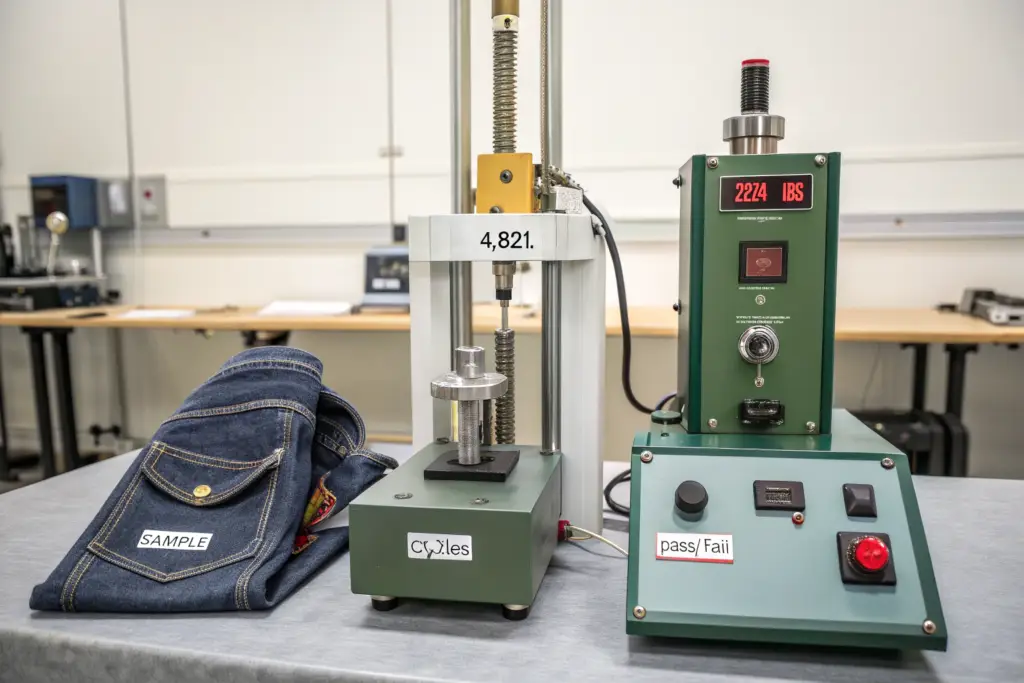
Crocking is the transfer of dye from the fabric surface to another surface by rubbing. Dry crocking simulates the dye transfer that occurs when the shorts rub against a dry surface, like a white t-shirt tucked into the waistband. Wet crocking simulates the transfer that occurs when the shorts are damp and rub against a surface, like a white car seat on a humid day.
We test crocking according to AATCC Test Method 8. A white test cloth is rubbed against the denim sample under a controlled pressure of 9 Newtons on a Crockmeter machine. The rubbing finger moves back and forth ten times. For dry crocking, the test cloth is dry. For wet crocking, the test cloth is wetted to 65% moisture pickup. After the test, the amount of color transferred to the white cloth is compared to the AATCC Chromatic Transference Scale, a gray scale from 1 to 5, where 5 is no color transfer and 1 is heavy color transfer. Our minimum standard is Grade 4 for dry crocking and Grade 3.5 for wet crocking. A wet crocking grade of 3.5 means there is visible, light color transfer, which is normal and acceptable for indigo denim. A grade of 3.0 or below means heavy transfer, which will result in customer complaints about stained furniture and clothing. The AATCC 8 crocking test is the global standard. We run this test on every dye lot. Indigo is inherently prone to crocking because the dye sits on the surface of the yarn. The test ensures that our fixation process, a cationic binder applied after dyeing, is working correctly.
What Accelerated Laundering Test Simulates Years of Home Washing?
The home laundry test simulates multiple wash cycles in a short period. We use AATCC Test Method 61, which is an accelerated laundering test. A sample of the denim fabric is placed in a stainless steel canister with a standard detergent solution, a multifiber test strip that contains strips of different fiber types, and steel balls that provide mechanical agitation. The canister is sealed and rotated in a heated water bath at 40 degrees Celsius for 45 minutes. This one cycle simulates approximately five home laundry cycles.
After the test, we evaluate three things. The color change of the denim sample, compared to the original unwashed sample using the gray scale. The color staining on the multifiber strip, which indicates whether the indigo is bleeding onto other fabrics in the wash. And the dimensional change, which is the shrinkage. We measure the sample before and after the test and calculate the percentage change. Our standards are a minimum Grade 4 for color change, meaning minimal fading, a minimum Grade 4 for staining, meaning minimal transfer to other fibers, and a maximum 2% dimensional change in both warp and weft directions. The AATCC 61 accelerated laundering test is a harsh test. It compresses months of washing into 45 minutes. A fabric that passes this test will retain its appearance through dozens of real home washes. We run this test on the first production batch of every new denim specification and periodically on ongoing production to ensure consistency.
How Do We Test the Seams and Construction for Long-Term Wear?
The fabric can be strong. The zipper can be durable. The color can be fast. But if the seams come apart, the short fails. Seam failure is insidious because it often happens gradually. The stitching does not snap all at once. The seam slowly opens under repeated stress. The thread abrades and weakens. The fabric yarns slip along the stitch line, creating a gap. The customer notices the gap one day and realizes the shorts are falling apart.
Seam testing evaluates the strength of the sewn assembly, not just the fabric or the thread individually. A seam is a system. The fabric, the thread, the stitch type, and the stitch density all contribute to the seam's performance. We test the critical seams of our denim shorts. The inseam. The outseam. The seat seam. The pocket attachment. These are the seams that bear load during wear. If they fail, the short fails.
Let me explain the specific seam tests we perform and the failure modes we are trying to prevent.
What Is the Seam Slippage Test and Why Does It Matter?
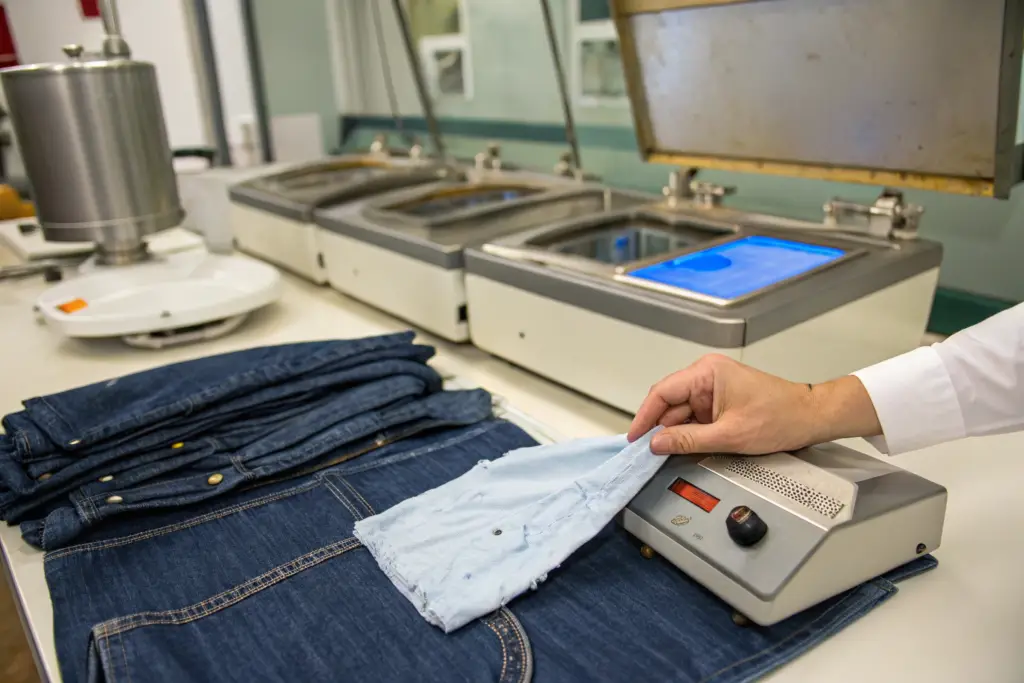
Seam slippage is the tendency of the fabric yarns to slide apart along a stitch line when a load is applied perpendicular to the seam. The thread does not break. The fabric does not tear. The yarns simply separate, creating an unsightly gap at the seam. This is a common failure mode at the seat seam of denim shorts, where the fabric is under tension when the wearer sits down.
We test seam slippage according to ASTM D434, using the fixed seam opening method. A sewn specimen is prepared with a standard seam, a 3/8 inch seam allowance with a lockstitch at 10 to 12 stitches per inch. The specimen is clamped in the tensile testing machine with the seam perpendicular to the direction of pull. A load of 10 pounds is applied. The seam opening, the gap between the two fabric edges, is measured. The load is increased to 25 pounds and the opening is measured again. Our standard is a maximum seam opening of 1 millimeter at 10 pounds and 2 millimeters at 25 pounds. If the opening exceeds these limits, the seam construction is inadequate. The solution may be a higher stitch density, a different stitch type, such as a safety stitch instead of a lockstitch for the inseam, or a fabric with better yarn cohesion. Seam slippage is often overlooked in garment testing because it is not a catastrophic failure. But it is a quality failure that makes the shorts look old and worn out prematurely. The ASTM D434 seam slippage standard has been replaced by ASTM D1683, which we now use for our current testing. The principle is the same. Measure the gap. Enforce a limit.
How Do We Test the Strength of Critical Seams Like the Inseam and Seat?
For critical load-bearing seams, we test the seam breaking strength. This test measures the force required to rupture the seam, either by thread breakage, fabric tear, or seam slippage exceeding a defined limit. The test specimen is prepared with the specific seam construction used in production. The specimen is pulled in the tensile tester at 300 millimeters per minute until failure.
We test the inseam, the outseam, and the seat seam. The inseam must withstand a minimum of 200 Newtons before failure. The seat seam must withstand 250 Newtons. These values are based on the expected loads during wear, with a safety factor. A person sitting down generates significant tension across the seat seam. A person squatting or climbing stairs generates tension across the inseam. If the seam breaks during these normal activities, the short has failed. We also test the pocket bag attachment seam. The front pocket bears the weight of a phone, keys, and a wallet. The seam attaching the pocket bag to the front panel must withstand 150 Newtons. Pocket bag seam failure is a common complaint in denim shorts. The stitching unravels and items fall through. We use a bar tack at the top and bottom of the pocket opening to reinforce the attachment, and we test the bar tack strength as part of the seam test. The ASTM D1683 seam testing standard defines the methods for both seam slippage and seam breaking strength. Our internal standards are derived from this method with thresholds based on our product performance data.
Conclusion
Durability is not a claim. It is a measurement. We measure the tensile strength of our denim fabric on a universal testing machine and reject any lot that falls below 350 Newtons. We measure the tear strength with an Elmendorf apparatus and reject anything below 25 Newtons. We cycle our zippers 5,000 times on a reciprocating machine, ten times the industry standard, and reject any batch that fails early. We test our buttons to 20 pounds of pull force. We rub our denim with a Crockmeter to verify that the indigo will not transfer to a white couch. We wash our samples in an accelerated launderometer to verify that the color will not fade and the fabric will not shrink beyond 2%. We pull our seams apart to verify that the stitching will not unravel and the fabric will not gap open at the seat.
These tests are performed in our own laboratory, with our own equipment, by our own technicians. We do not outsource durability testing to a third-party lab because we need the data quickly, before cutting, not two weeks later when the production is already underway. The lab is an investment that pays for itself in reduced returns, reduced complaints, and increased repeat orders. A client who receives a shipment of shorts that do not rip, do not shrink, and do not bleed is a client who places another order. A client who receives a shipment of shorts that fail in the field is a client who never calls again.
If you want to see our test data for the specific denim specification you are considering, ask. Our Business Director, Elaine, can provide a sample test report from a recent lot. She can also give you a video tour of our laboratory so you can see the equipment and the testing process in action. Her email is elaine@fumaoclothing.com. Durability is not an opinion. It is a number. At Shanghai Fumao, we know our numbers. We are happy to share them.