"Sustainable denim" has become a marketing phrase. Every brand claims it. Every factory claims it. You see the words "eco-friendly" and "green manufacturing" on too many websites to count. But when you ask a factory for their wastewater test results, they go silent. When you ask for the organic cotton transaction certificate, they send a blurry PDF with a different company's name. When you ask about the working conditions in their laundry, they change the subject. You start to wonder if sustainable denim sourcing from China is even real, or if it is just a story factories tell to win orders from Western brands.
Yes, sustainable denim sourcing is possible with Shanghai Fumao. We offer four verifiable sustainability pathways. First, we source GOTS-certified organic cotton denim from audited mills. Second, our wash house operates ozone and enzyme finishing systems that reduce water consumption by up to 60% compared to traditional stone washing. Third, our wastewater treatment and chemical management are verified through the ZDHC Gateway platform with publicly accessible test results. Fourth, our factory's social compliance is audited to BSCI and SMETA standards with valid, unannounced audit reports available for client review.
I run Shanghai Fumao. I am not an environmental activist. I am a factory owner who realized ten years ago that the old way of making denim, dumping chemical-laden wastewater into the river, burning coal for steam, ignoring worker safety, was not just wrong. It was bad business. The brands that pay a premium for quality were starting to demand proof of sustainability. The regulations were tightening. The cost of water and energy was rising. Sustainability was not a marketing choice. It was a survival strategy. In this article, I will explain exactly what sustainable denim means in our factory. I will show you the certifications, the test data, and the processes. I will also tell you what we do not do and where we are still improving. No greenwashing. Just the facts.
What Does "Sustainable Denim" Actually Mean in a Factory Context?
The word "sustainable" has been stretched so thin it is almost meaningless. A factory that switches from plastic hangers to recycled paper hangtags calls itself sustainable. A factory that installs one solar panel on its roof and takes a photo calls itself sustainable. These are token gestures. They do not change the environmental impact of making denim shorts.
Real sustainability in denim manufacturing addresses the three big impacts. Water. Chemicals. Carbon. Denim is a thirsty product. A conventional pair of denim shorts consumes an estimated 2,000 to 3,000 liters of water across the cotton growing, fabric production, and garment washing stages. The indigo dyeing process uses sodium hydrosulfite and other reducing agents that end up in wastewater. The stone washing process, which gives denim its worn-in look, uses pumice stones that generate sludge and consume water for rinsing. The energy for heating wash water and running machinery typically comes from coal-fired power, at least in many manufacturing regions. A genuinely sustainable denim factory tackles these impacts systematically. It measures them. It reduces them. It verifies the reduction with third-party data. Anything less is marketing.
Let me define the specific sustainability practices we have implemented and, just as importantly, the practices we have not yet achieved.
What Specific Sustainable Practices Have We Implemented?
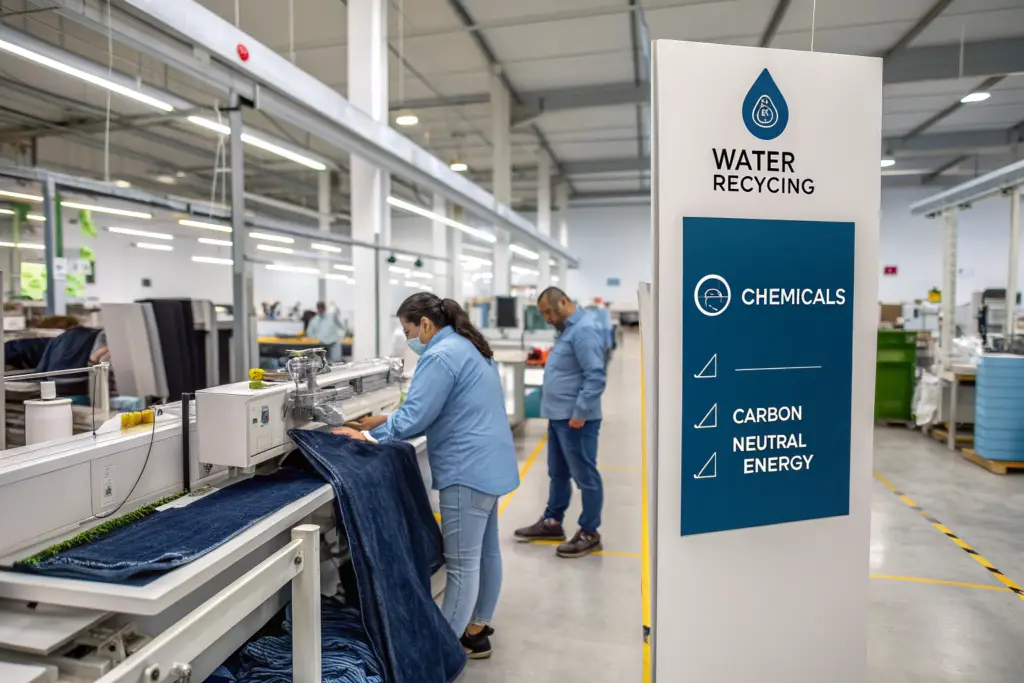
Our sustainability efforts focus on three areas where a garment factory has direct control. Fabric sourcing, garment washing, and chemical management.
For fabric sourcing, we offer GOTS-certified organic cotton denim from a partner mill in China. Organic cotton is grown without synthetic pesticides or fertilizers. The GOTS certification covers the entire processing chain, from ginning to spinning to weaving to finishing, ensuring that no harmful chemicals are used at any stage. The certification is verified by an independent third party, Control Union or Ecocert. We can provide the scope certificate and the transaction certificate for each organic order. For conventional cotton, we source from mills that participate in the Better Cotton Initiative, which promotes improved water stewardship and reduced chemical use in conventional cotton farming.
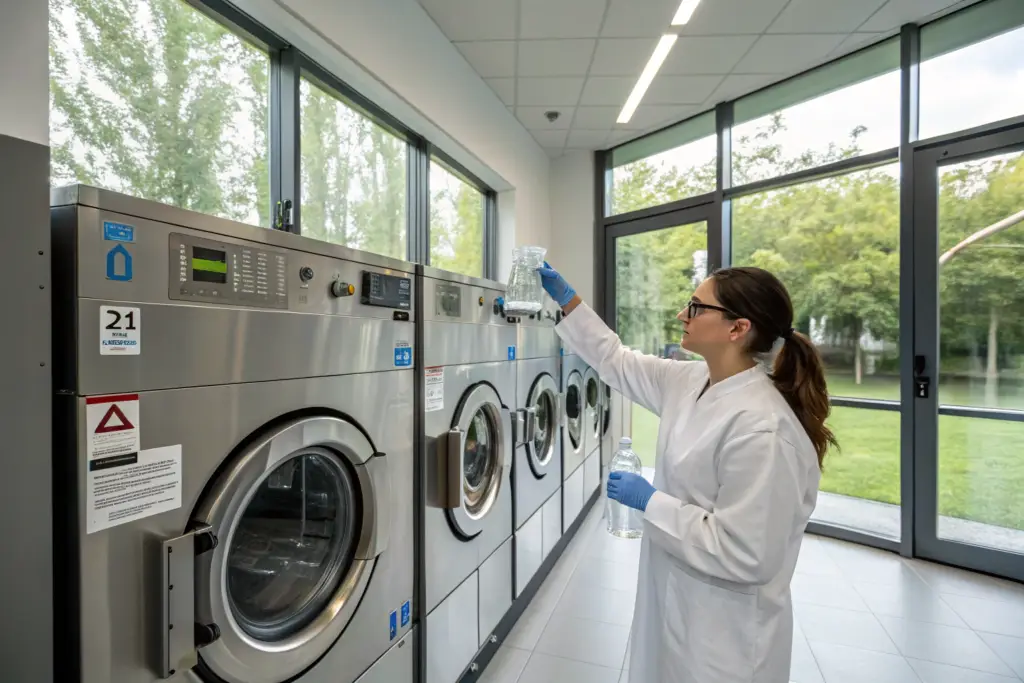
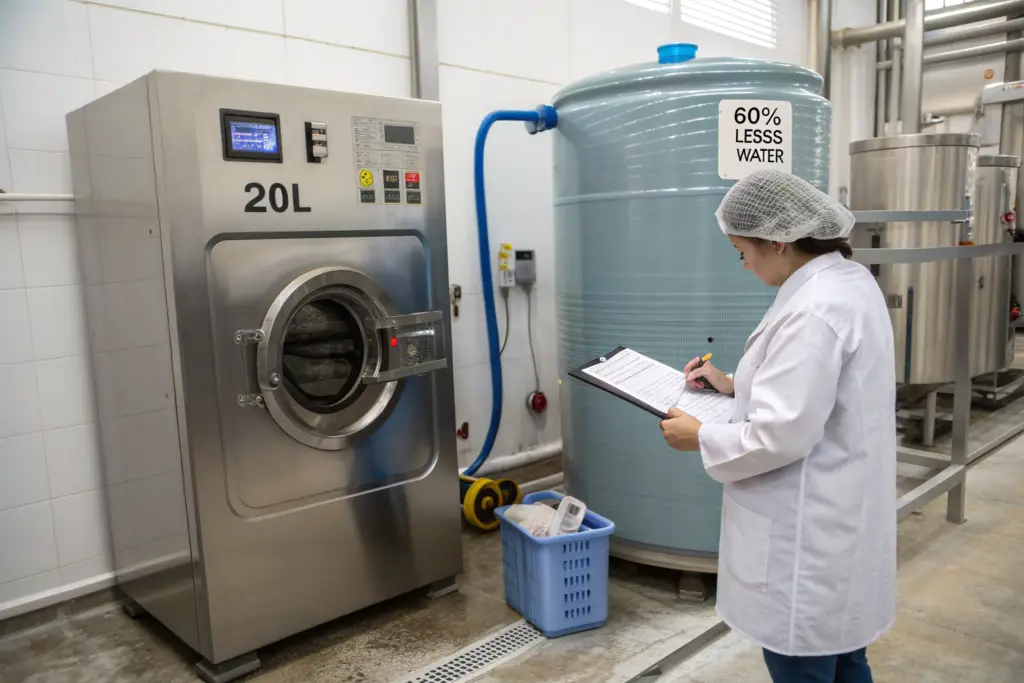
For garment washing, we converted our wash house from traditional stone washing and potassium permanganate spraying to enzyme washing and ozone finishing. Enzymes are biological catalysts that break down the surface cellulose of the denim, creating a soft hand feel and a faded appearance without the need for pumice stones. Ozone is a gas that oxidizes the indigo dye, lightening the color without water. An ozone wash cycle uses 60% less water than a traditional stone wash and generates no sludge. The water that is used in our wash house is treated in our on-site effluent treatment plant before discharge.
For chemical management, we maintain a ZDHC Gateway account. The ZDHC Manufacturing Restricted Substances List bans hazardous chemicals from textile production. We upload our wastewater test results to the ZDHC Gateway, where they are publicly accessible. The tests measure pH, chemical oxygen demand, heavy metals, and other parameters against the ZDHC Foundational Level requirements. Our results consistently show compliance. The ZDHC Roadmap to Zero program is the leading chemical management framework for the textile industry.
What Sustainability Claims Do We Not Make?
Transparency means admitting what you do not do. We do not claim to be carbon neutral. Our factory uses electricity from the grid, which in China is still predominantly coal-fired. We have not yet invested in on-site solar generation, though we are evaluating it. We do not claim to be a zero-discharge facility. Our treated wastewater meets regulatory and ZDHC standards, but it is still discharged, not fully recycled in a closed loop. We do not claim that every product we make is sustainable. Our standard denim shorts use conventional cotton and a standard enzyme wash, which is less impactful than stone washing but not organic.
We are on a journey. The journey started with wastewater treatment and chemical compliance. It continued with the conversion to ozone and enzyme finishing. The next steps are renewable energy, closed-loop water recycling, and increased organic cotton sourcing. A factory that claims to have solved every sustainability challenge is lying. A factory that can show you the specific changes it has made, the data that proves those changes, and a roadmap for further improvement is being honest. That is the kind of factory we try to be. The sustainable apparel manufacturing standards from Textile Exchange provide a framework for measuring and communicating real progress.
What Certifications Verify Our Sustainable Denim Practices?
Certifications are the bridge between a factory's claims and a brand's trust. A brand cannot visit every factory they source from. They rely on independent third-party auditors to verify that the factory is doing what it says. A certification without an audit is a logo. A certification with a valid, recent audit report is evidence.
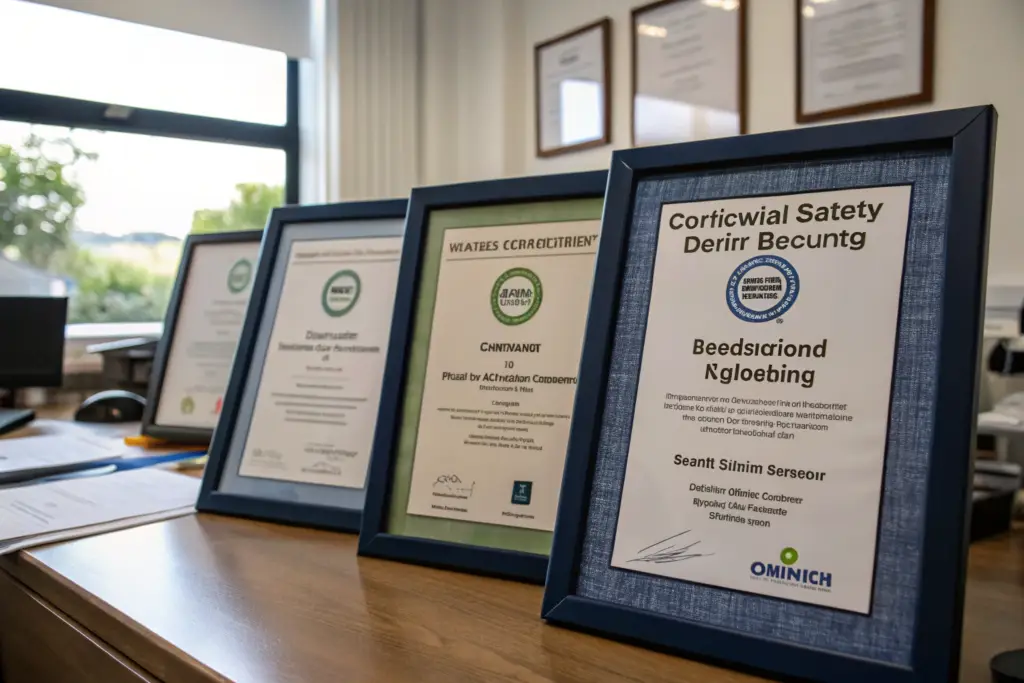
We hold four certifications that are relevant to sustainable denim sourcing. Each one covers a different aspect. Product safety. Organic content. Chemical management. Social compliance. Together, they provide a reasonably complete picture of our environmental and social performance. Each certification has a certificate number or a report reference that can be independently verified. We encourage buyers to verify them. A factory that resists verification is a factory that is hiding something.
Let me explain each certification, what it covers, how it is verified, and how you can check it yourself.
How Does OEKO-TEX Standard 100 Certification Ensure Product Safety?
OEKO-TEX Standard 100 is a product safety certification. It tests textiles for harmful substances, including formaldehyde, heavy metals, pesticides, and carcinogenic dyes. The testing is conducted by independent OEKO-TEX partner institutes. The certification must be renewed annually.
Our denim fabric is certified to OEKO-TEX Standard 100 Class I. Class I is the strictest level, meaning the product is certified safe for babies and toddlers. We chose this level to ensure our products meet the highest safety standard, regardless of the end consumer. The certificate covers the denim shell fabric, the pocket lining, the sewing thread, the labels, and the hardware coatings. You can verify the certificate yourself. We provide the certificate number. You enter it on the OEKO-TEX Label Check website. The database returns the certificate holder's name, the certified product categories, and the expiry date. If the information matches our claims, the certificate is valid. This certification is relevant to sustainability because it ensures the chemicals used in production do not remain on the finished product at harmful levels. It is a consumer safety certification, but it also indicates good chemical management upstream. The OEKO-TEX label check portal is public and free to use.
What Does a Valid GOTS Certificate Prove About Our Organic Supply Chain?
GOTS, the Global Organic Textile Standard, is the leading standard for organic textiles. It covers both the organic origin of the fiber and the environmental and social criteria of the processing stages. A GOTS-certified product must contain a minimum of 70% organic fibers. The "Organic" label requires a minimum of 95%.
Our factory is GOTS-certified for the sewing and finishing of organic cotton denim shorts. This means we have passed an audit that verifies we can process organic textiles without contamination from conventional textiles. Our chemical inputs, dyes, and auxiliaries, are approved under the GOTS positive list. Our wastewater treatment meets GOTS requirements. Our social criteria meet GOTS requirements, which are aligned with International Labour Organization standards. When we produce a GOTS-certified order, we source the fabric from a GOTS-certified mill. The transaction certificate flows from the mill to us. We issue a transaction certificate to the brand. This chain of custody documentation proves that the organic claim is valid from the cotton farm to the finished short. The GOTS certificate can be verified on the GOTS public database. Enter our company name and you will see our certification status and scope. The GOTS certification database is the definitive source for verifying organic textile claims.
How Does the ZDHC Gateway Prove Our Wastewater Compliance?
The ZDHC Gateway is a digital platform where textile manufacturers upload their wastewater test results. The tests are conducted by ZDHC-approved laboratories. The results are compared against the ZDHC Wastewater Guidelines, which define limits for conventional parameters like pH and chemical oxygen demand, heavy metals like cadmium and lead, and priority hazardous chemicals.
Our wash house tests its wastewater twice a year, which is the ZDHC requirement for a facility of our size. The samples are taken by an external laboratory and analyzed according to ZDHC protocols. The results are uploaded to the Gateway, where they are visible to any brand that sources from us. The results show whether we are in compliance with the Foundational Level, the minimum requirement, or the Progressive Level, a higher standard. Our most recent results show Foundational Level compliance. We are working toward Progressive Level. The ZDHC Gateway is not a certification with a pass-fail logo. It is a transparency platform. It shows the actual test data. A brand can see our numbers and judge for themselves. The ZDHC Gateway platform is the most credible source of chemical management data in the textile industry because it relies on measured results, not self-declarations.
How Do Our Wash Processes Reduce Environmental Impact?
The wash process is where a pair of denim shorts gains its character. It is also where the largest environmental impact occurs at the garment manufacturing stage. Traditional denim washing uses pumice stones, potassium permanganate, and large volumes of water. The stones abrade the fabric surface. The potassium permanganate bleaches the indigo. The process generates stone sludge, chemical-laden wastewater, and a significant carbon footprint from heating water and tumbling heavy stones.
We phased out traditional stone washing from our main production lines five years ago. The decision was partly environmental, partly economic. Pumice stones are heavy. They increase the weight of each wash load, which increases energy consumption. They generate sludge that clogs drains and requires costly disposal. They damage the washing machines, increasing maintenance costs. The switch to enzyme washing and ozone finishing reduced our water consumption, our energy consumption, and our chemical discharge, while also producing a better, more consistent wash quality. Sustainability and quality improvement went hand in hand.
Let me explain the specific technologies we use and the measured impact of switching to these methods.

What Is the Difference Between Enzyme Washing and Traditional Stone Washing?
Stone washing uses pumice stones as the abrasive agent. The stones are added to the washing machine with the denim shorts. As the machine tumbles, the stones beat against the fabric, abrading the surface and removing indigo. The process takes 45 to 60 minutes. After washing, the stones must be separated from the garments. The stones break down into a fine sludge that must be collected and disposed of. The garments must be rinsed multiple times to remove the stone dust.
Enzyme washing uses cellulase enzymes instead of stones. Enzymes are proteins that catalyze a chemical reaction. Cellulase enzymes break down the cellulose on the surface of the cotton fiber, releasing the indigo dye that is bound to the surface cellulose. The process takes 20 to 40 minutes. There are no stones to add or remove. There is no stone sludge. The fabric surface is abraded more gently and more evenly. The water consumption for the wash cycle is about 30% lower because fewer rinses are needed. The energy consumption is lower because the wash cycle is shorter and there are no heavy stones to tumble. The enzyme solution is biodegradable and can be treated in the effluent plant. The enzyme washing technology is well-established in the denim industry. The transition from stone to enzyme is one of the most impactful sustainability improvements a denim factory can make.
How Does Ozone Washing Reduce Water and Chemical Usage?
Ozone washing is a newer technology that reduces water consumption even further than enzyme washing. Ozone, O3, is a gas. It is generated on-site from oxygen using an ozone generator. The gas is pumped into a sealed washing machine containing the denim shorts. The ozone oxidizes the indigo dye, lightening the color. The process uses no water during the bleaching phase. A small amount of water is used for a subsequent rinse to remove the oxidized dye residue.
The water savings are substantial. A traditional stone wash can consume 40 to 60 liters of water per kilogram of denim. An enzyme wash reduces this to 25 to 40 liters. An ozone wash reduces it to 15 to 20 liters. The chemical savings are also significant. Ozone replaces potassium permanganate, a strong oxidizing agent that is hazardous to workers and requires careful neutralization before discharge. Ozone itself decomposes back into oxygen after the treatment, leaving no chemical residue. The energy consumption is higher for ozone generation than for stone or enzyme washing, but the total energy balance, including the energy saved by eliminating hot water for stone washing and the energy saved in wastewater treatment, is generally favorable. We installed our first ozone machine in 2022 and expanded our ozone capacity in 2024 to handle our increasing volume of premium wash shorts. The Jeanologia ozone wash technology is a leading solution for sustainable denim finishing. Our machines are from a Chinese manufacturer that licensed similar technology.
How Can a Brand Verify Our Sustainability Claims Before Ordering?
A sustainability claim without verification is marketing. Verification means independent evidence. Independent evidence means data from a third party that is not paid to say nice things. The brand does the checking, or the brand hires someone to do the checking. The factory cooperates fully or it does not. The difference between a genuinely sustainable factory and a greenwashing factory is not what they say on their website. It is how they respond when you ask for proof.
I welcome verification. It is the only way a skeptical buyer can distinguish my factory from the thousands of factories making unfounded claims. I have built a documentation system that makes verification easy. Ask me for the OEKO-TEX certificate. I send the number. You check it. Ask me for the ZDHC wastewater report. I send the PDF. You read the numbers. Ask me for a live video tour of the wash house. I walk you to the ozone machine and show you the effluent treatment plant. Ask me anything. If I cannot answer, I will say so. That is the deal.
Let me explain the specific verification methods available to a brand before placing an order.
What Documentation Can We Provide Before You Place an Order?
We provide a standard sustainability documentation package to all prospective clients. The package includes our OEKO-TEX Standard 100 certificate with the certificate number and verification link. Our GOTS scope certificate if the inquiry is for organic production. Our most recent ZDHC wastewater test report with the laboratory name, test date, and parameter results. Our BSCI or SMETA social compliance audit report, including the full findings and corrective action plan. Our factory license and business registration, which verifies our legal existence and manufacturing scope. And a video tour of our wash house, effluent treatment plant, and production lines.
We provide this package before a purchase order is signed. We do not require a deposit first. The documentation is part of our sales process because we know that a buyer who asks for it is a buyer who is serious about sustainability and has the budget to pay for it. A brand that does not ask for any documentation is a brand that is probably shopping on price alone. They will not value our sustainability investments. The documentation package separates the two types of buyers quickly. The supplier sustainability verification process is a standard part of responsible sourcing. We have organized our documentation to make it efficient for both parties.
Can You Commission a Third-Party Audit of Our Sustainable Practices?
Yes. We encourage it. Third-party audits are the highest form of verification because the auditor is paid by the brand, not the factory. The auditor has no incentive to issue a favorable report. The auditor's job is to find problems.
We have accommodated audits from SGS, Bureau Veritas, QIMA, and UL Solutions. The audit scope can be social compliance, environmental management, chemical management, or all three. We provide the auditor with access to all areas of the factory, all documents, and all personnel. We do not restrict the auditor's movements. We do not coach workers on what to say. We do not hide documents. The auditor interviews workers privately. The auditor takes wastewater samples. The auditor reviews payroll records against time cards. The audit report is issued to the brand, not to us, although we usually receive a copy. If the audit finds non-conformities, we address them with a corrective action plan. The brand can then decide whether the non-conformities are acceptable or require resolution before an order is placed. The third-party factory audit process is the most rigorous due diligence a brand can perform. A factory that welcomes unannounced third-party audits is a factory that is confident in its operations.
Conclusion
Sustainable denim sourcing is possible with Shanghai Fumao. It is not a slogan. It is a set of specific, verifiable practices. We source GOTS-certified organic cotton denim from audited mills. We wash our shorts with enzymes and ozone, not pumice stones and potassium permanganate. We treat our wastewater and upload the test results to the ZDHC Gateway. Our product safety is certified to OEKO-TEX Standard 100 Class I. Our social compliance is audited to BSCI and SMETA standards. Our documentation is provided before you place an order. Our factory is open to your third-party auditor.
We are not perfect. We have not achieved carbon neutrality. We have not closed the loop on water recycling. Our organic cotton orders are still a minority of our total production, limited by customer demand and the higher cost of organic fabric. We are a factory in transition, like most of the industry. The difference is that we are transparent about where we are and where we are going. A brand that wants to make genuine sustainability claims about their denim shorts needs a factory that can provide the data to back those claims up. We can provide that data.
If your brand is looking for a denim shorts manufacturer that takes sustainability seriously enough to measure it, verify it, and share the data openly, contact our Business Director, Elaine. She will send you our sustainability documentation package and arrange a video tour of our wash house and treatment plant. She can also connect you with a current client who has audited our facility and can share their experience. Her email is elaine@fumaoclothing.com. Sustainable denim is not a destination. It is a direction. At Shanghai Fumao, we are moving in that direction. You can verify that claim yourself. That is the whole point.