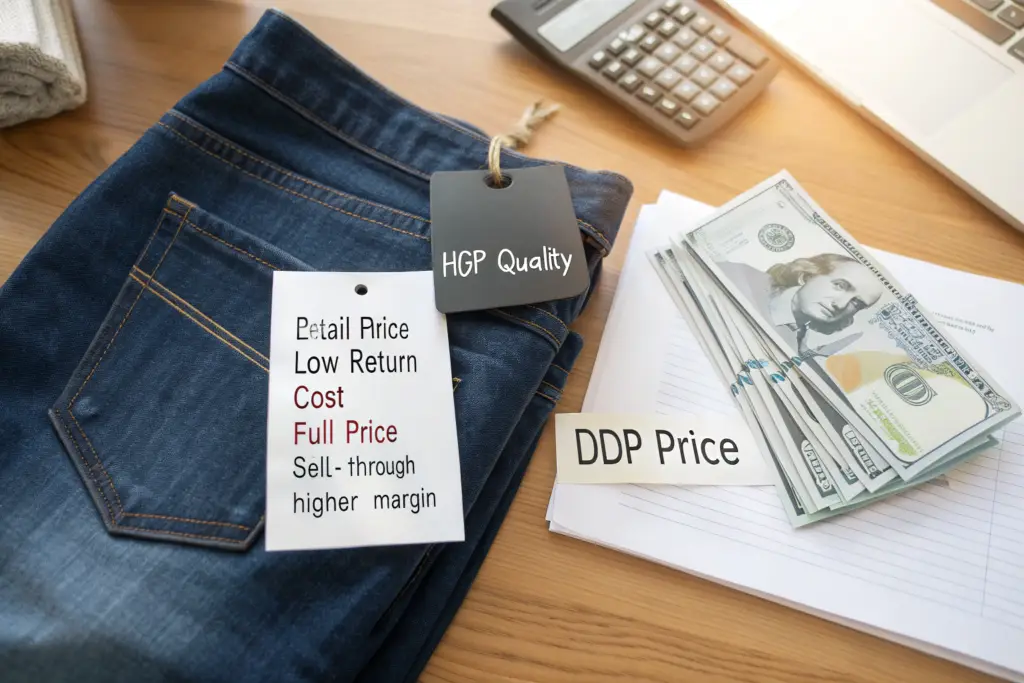
You have a choice to make every time you place an order. Buy the cheapest shorts you can find and squeeze out a few extra percentage points of margin on paper. Or buy higher-quality shorts that cost more upfront but deliver higher margins over the full product lifecycle. The first choice looks smart in a spreadsheet. The second choice is smart in reality. I have watched too many brands chase the lowest unit cost and end up with lower profits. They do not account for the returns. They do not account for the discounting. They do not account for the lost repeat customers. They see a $5.00 FOB price and think they are winning. Then the landed cost comes in at $7.80 after freight, duties, and a surprise customs exam fee. Then the returns come in at 6% because the zippers are failing. Then the discounting starts because the shorts arrived late and missed the peak selling window. The margin they calculated on the purchase order never materialized in the bank account.
You maximize margins with Shanghai Fumao's denim shorts by focusing on four margin levers that go beyond the unit cost. First, you reduce your return rate to below 2% by using durable YKK zippers, ring-spun denim that does not tear, and wash processes that do not bleed or fade unexpectedly. Second, you increase your full-price sell-through by receiving shipments on time with our milestone-tracked production and DDP logistics. Third, you command a higher retail price by offering verifiable quality features, OEKO-TEX certification, selvedge options, and complex custom washes that justify a premium. Fourth, you reduce your operational overhead by consolidating your supply chain with one factory that handles design, production, quality, and logistics, rather than coordinating four different vendors.
I run Shanghai Fumao. I know that every dollar you spend on manufacturing is a dollar you cannot spend on marketing, design, or profit. My job is to make sure those dollars generate the highest possible return. In this article, I will show you the math of margins, not with vague promises, but with specific examples, specific cost savings, and specific revenue uplifts that our clients have achieved. Quality is not an expense. It is an investment. This article explains the return on that investment.
How Does Reducing Return Rates Increase Your Net Profit?
Returns are the silent margin killer. A pair of shorts sold for $48 with a gross margin of 60% generates $28.80 in gross profit. If that pair is returned, you lose the entire $28.80. You also pay the return shipping, typically $5 to $7. You pay the processing cost of inspecting and repackaging the return, another $2 to $3. If the shorts cannot be resold as new, you discount them to recover some cost, losing even more margin. A single return can wipe out the profit from three or four sold units.
The average return rate for online apparel is 20% to 30%, depending on the category. For denim shorts, fit issues and quality defects are the top two reasons for returns. Fit issues are addressed through consistent sizing and clear size guides. Quality defects are addressed through the durability testing and quality control systems I described in previous articles. A brand that reduces its return rate from 8% to 2% through better product quality adds six percentage points of net profit to every order. On a 3,000-unit order at $48 retail, that is an additional $8,640 of profit that does not show up on the factory's price quote. It shows up in the bank account.
Let me show you the math and the specific quality features that drive lower return rates.
What Is the Math Behind Return Rate Reduction and Margin Gain?
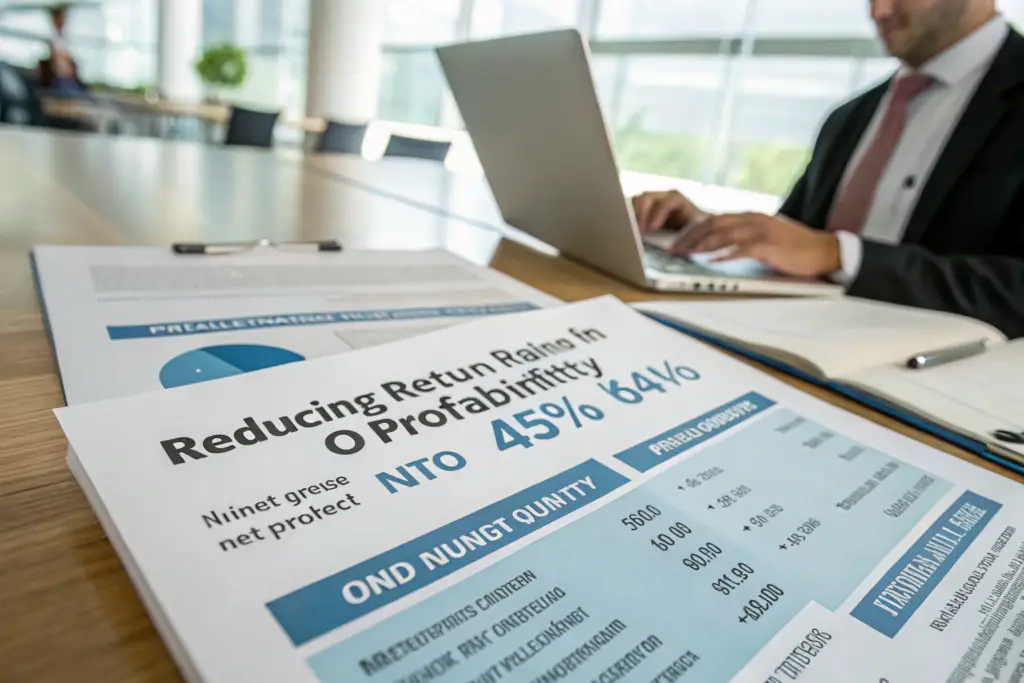
Let me walk through a real example from a client who switched to our denim shorts from a lower-cost Vietnamese supplier in 2025. The brand sells direct-to-consumer online. Average retail price is $52. Gross margin before returns is 62%, or $32.24 per unit.
With the previous supplier, the brand's return rate for denim shorts was 7.5%. The top return reasons were zipper failure, fabric tearing at the pocket corner, and color bleeding after washing. The cost per return, including shipping, processing, and discounting the returned product, averaged $9.50. On 3,000 units sold, 225 units were returned. The total return cost was $2,137. The net margin after returns was $94,583 on $156,000 in revenue, or 60.6%.
After switching to our shorts, with YKK zippers tested to 5,000 cycles, ring-spun denim with a tensile strength above 350 Newtons, and OEKO-TEX certified color fastness, the return rate dropped to 1.8%. On 3,000 units, 54 units were returned. The total return cost was $513. The net margin after returns was $96,207, an increase of $1,624. That is an additional $0.54 of profit per unit ordered, achieved without raising the retail price by a single dollar. The apparel return rate reduction strategies are well-documented in e-commerce literature. The most effective strategy is to sell a product that does not fail.
What Specific Quality Features Directly Reduce Return Reasons?
Every return has a root cause. The root cause is usually a specific component or process failure. Eliminate the failure, eliminate the return. I will list the specific quality features we build into our denim shorts that directly address the most common return reasons.
Zipper failure is the number one defect-related return reason for denim shorts. We use YKK or SBS zippers and test every incoming batch to 5,000 cycles on a reciprocating machine. This eliminates the early-life zipper failures that generate returns within the first month of wear. Fabric tearing at stress points, the pocket corner, the crotch, the belt loop, is the number two return reason. Our fabric tensile and tear strength testing, with minimum thresholds of 350 Newtons tensile and 25 Newtons tear, eliminates weak fabric that tears under normal wear.
Color bleeding and fading are the number three return reason. Our AATCC crocking test, with a minimum Grade 4 dry and Grade 3.5 wet, ensures the indigo will not transfer onto furniture or other clothing. Our AATCC 61 accelerated laundering test ensures the color will not fade excessively or unevenly. Dimensional change, shrinkage, is the number four return reason. Our AATCC 135 shrinkage test, with a maximum 2% shrinkage and a pattern adjustment to compensate, ensures the shorts will still fit after washing. The denim quality and returns correlation is strong. Invest in quality components and testing. The return rate drops. The margin rises. The math is simple.
How Does Full-Price Sell-Through Increase with Reliable Delivery?
You do not just lose margin on returned products. You also lose margin on products that arrive late. A denim short that lands in your warehouse on May 1st can be sold at full price through June and July. The same short that lands on July 15th due to production and shipping delays misses half the summer season. You mark it down by 30% to clear the inventory. That 30% markdown comes directly out of your gross margin.
Reliable delivery is a margin lever. When your factory ships on time, you sell more units at full price. When your factory is late, you sell more units at a discount. The margin difference between full-price and markdown sales is enormous. A $52 short sold at 30% off generates $36.40 in revenue instead of $52.00. The gross margin drops from 62% to 45%. You need to sell 37% more units at the discounted price to generate the same total profit. Reliable delivery is not just about avoiding frustration. It is about protecting your pricing power.
Let me explain how our production and logistics systems protect your selling window.
How Much Margin Is Lost When Shipments Miss the Peak Selling Season?
Let me quantify the cost of a delay. A brand orders 3,000 denim shorts for summer delivery. The planned ship date is March 15th, arriving at the U.S. warehouse by April 10th, on sale by May 1st. The factory is late. The shorts ship April 10th, arrive May 15th, and are on sale by June 1st. The brand has lost the entire month of May, which is a prime buying month for summer shorts.
The brand planned to sell 1,500 units at full price ($52) in May and June, and the remaining 1,500 at a 20% discount ($41.60) in July and August. With the delayed arrival, the brand sells 800 units at full price in June and must discount the remaining 2,200 units more steeply, 35% off ($33.80), to clear inventory before the fall season. The revenue difference is $17,780. The gross profit difference, assuming the same cost of goods sold, is roughly the same. The brand lost nearly $18,000 in profit from a four-week delay. That is $6.00 per unit ordered. More than the entire FOB price difference between a reliable Chinese factory and a cheaper but less reliable Vietnamese factory.
Our milestone-tracked production schedule and DDP shipping model are designed to protect your delivery date. We book vessel space in advance. We pre-clear customs while the ship is in transit. We provide a real-time tracking dashboard. When we commit to a delivery date, we have the systems to meet it. The inventory seasonality and markdown cost analysis shows that late deliveries are one of the largest avoidable costs in apparel retail.
How Does Our Milestone Tracking and DDP Shipping Protect Your Timeline?
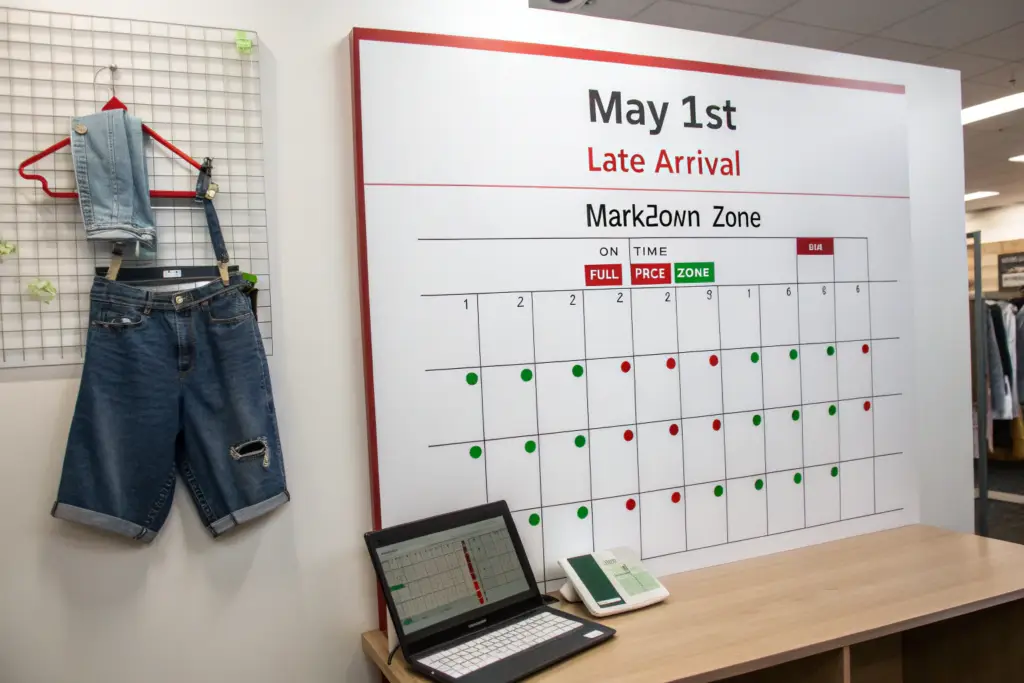
A single ship date on a contract is a hope. A milestone schedule with six tracked dates is a plan. When you order from us, you receive a link to a production tracking board. The board shows the completion status of each milestone. Fabric in-house. Cutting complete. Sewing complete. Wash complete. Packing complete. Container departed. If a milestone is delayed, you see it immediately. You can adjust your marketing calendar or your retail buyer communication before the delay becomes a crisis.
The DDP shipping model protects your timeline at the logistics stage. Under FOB terms, your responsibility begins when the goods leave our factory. If the container is delayed at the port, you pay the demurrage and you absorb the selling time loss. Under DDP, our responsibility continues until the goods are at your warehouse door. We pay the demurrage. We absorb the delay cost. We are incentivized to choose reliable carriers, file accurate customs paperwork, and resolve port issues quickly. Our financial interest aligns with yours. The shorts arriving on time is good for your margin and good for ours.
The combination of milestone tracking and DDP logistics means you can plan your inventory with confidence. You can schedule your marketing campaigns. You can promise delivery dates to your wholesale accounts. That confidence translates into full-price sales. The supply chain reliability and retail margin connection is direct. Reliable supply chains support full-price selling. Unreliable supply chains force markdowns.
How Can Premium Features Command a Higher Retail Price?
Quality costs more to make. It also sells for more. A denim short with a unique vintage wash, a selvedge outseam, a leather patch, and an OEKO-TEX certification is not the same product as a basic rinse-washed short from a commodity factory. The customer perceives the difference. They are willing to pay for it. Premium features do not just add cost. They add perceived value that exceeds the cost, increasing your gross margin per unit.
The key is to invest in features that the customer can see, touch, and understand. A YKK zipper is a visible quality signal. A selvedge outseam with a red ID stripe is a conversation piece. A leather patch with a debossed logo communicates craftsmanship. A hangtag that tells the sustainability story, the organic cotton, the ozone wash, the ZDHC compliance, justifies a higher price to the conscious consumer. These features are not random upgrades. They are a coordinated brand-building strategy that moves your shorts from the commodity category to the premium category.
Let me give you specific examples of premium features that have generated price premiums for our clients.
What Design and Wash Upgrades Justify a Higher Retail Price Point?
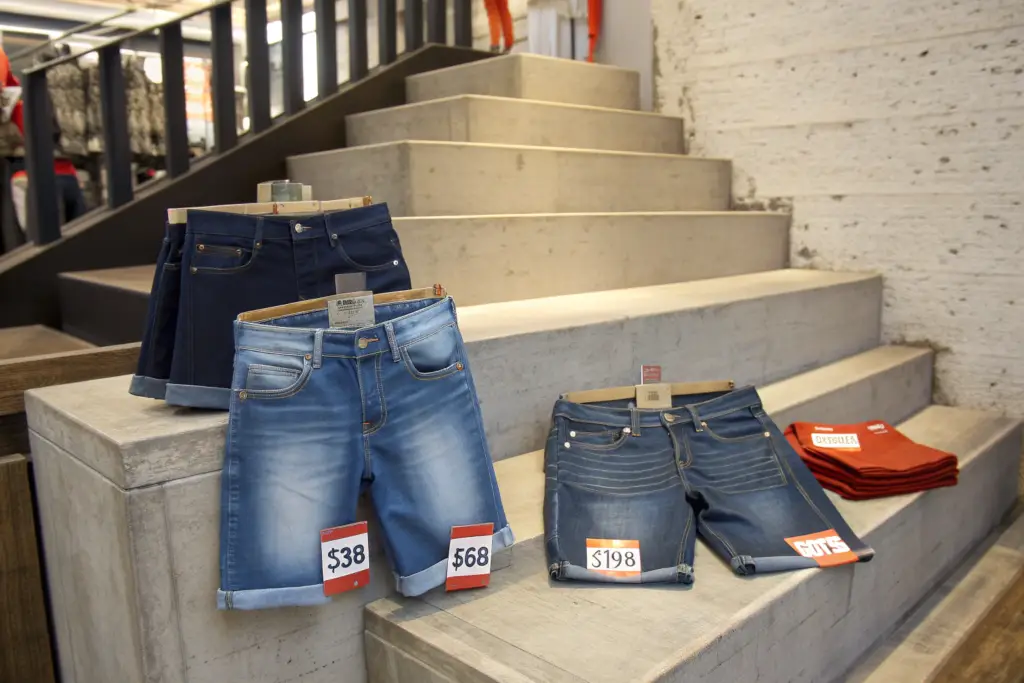
A basic enzyme-washed denim short in a standard indigo blue might retail for $38 to $48. A short with a complex, multi-step wash, a vintage fade with whiskering, a unique ozone sky effect, or a hand-sprayed pattern, can retail for $58 to $78. The wash cost difference is $0.50 to $1.50 per unit. The retail price uplift is $20 to $30. The additional gross profit per unit is $10 to $15. On a 3,000-unit order, that is $30,000 to $45,000 in additional gross profit, for an investment of $1,500 to $4,500 in additional wash cost.
A selvedge denim short with a chainstitch hem and Japanese fabric can retail for $150 to $250. The ex-factory cost is $15 to $20, compared to $5 to $7 for a standard short. The retail price is triple. The gross profit per unit is $60 to $100, compared to $20 to $30 for a standard short. The selvedge customer is a niche, but they are a high-margin niche. They value craftsmanship and authenticity. They are not comparison shopping on price.
Custom hardware is another premium lever. A pair of shorts with a standard YKK zipper and generic button communicates quality competence. A pair with a custom-engraved brass button, a branded zipper puller, and a leather patch with a foil-stamped logo communicates brand identity. The hardware upgrade costs $0.30 to $0.60 per unit. The brand perception upgrade supports a $5 to $10 retail price increase. The denim premiumization strategies are well-established in the fashion industry. The customer pays for visible, tangible quality signals.
How Do Sustainability Certifications Enable Better Pricing and Brand Loyalty?
Sustainability certifications are not just a cost of doing business. They are a marketing asset. A denim short with an OEKO-TEX Standard 100 hangtag, a GOTS organic cotton label, or a ZDHC clean chemistry story can command a price premium of 10% to 25% from sustainability-conscious consumers. This segment is growing, particularly in the U.S. coastal markets and in Northern Europe.
The cost of these certifications is largely fixed. We hold the OEKO-TEX and ZDHC certifications as a factory. The incremental cost to the brand of using certified materials is the organic cotton fabric premium, which adds $0.50 to $1.50 per unit. The retail price premium can be $5 to $15. The margin gain is substantial. Beyond the price premium, sustainability certifications reduce the risk of regulatory non-compliance. A REACH violation or a CPSIA failure can result in fines, recalls, and reputational damage. The cost of a single recall dwarfs the cost of sourcing certified materials. Sustainability is a margin protection strategy as well as a margin enhancement strategy.
The sustainable fashion consumer pricing data shows that consumers are increasingly willing to pay more for verified sustainable products. The key word is "verified." A generic "eco-friendly" claim is not enough. The OEKO-TEX or GOTS label, with a certificate number that can be checked online, provides the verification that supports the price premium.
How Can Supply Chain Consolidation Reduce Your Operational Costs?
Every supplier you manage costs you time. Time spent emailing the fabric mill. Time spent calling the freight forwarder. Time spent reviewing the inspection report from the third-party lab. Time is money. If you are a small or medium brand, your time is one of your most constrained resources. Every hour you spend managing logistics is an hour you do not spend on design, marketing, or sales.
Consolidating your denim shorts supply chain with a single, full-service factory reduces your operational overhead. One point of contact. One contract. One invoice. One responsible party. The fabric sourcing, the cutting, the sewing, the washing, the quality control, the export packing, the ocean freight, the customs clearance, and the inland trucking all flow through us. You are freed from the logistics coordination role. You can focus on building your brand.
Let me quantify the time and cost savings from supply chain consolidation.
How Much Time and Money Do You Save with a Single Full-Service Supplier?
Let me estimate the management time required for a denim short program using a fragmented supply chain versus our consolidated model. In the fragmented model, you coordinate with a fabric supplier, a garment factory, a separate wash house, a hardware supplier, a freight forwarder, a customs broker, and a third-party inspection company. That is seven relationships to manage. Each one requires emails, calls, purchase orders, and problem resolution.
I estimate the management time at 5 to 10 hours per week during an active production cycle. Over a 12-week production cycle, that is 60 to 120 hours. If your time is valued at $75 per hour, the cost is $4,500 to $9,000 per production cycle. This does not include the cost of mistakes made due to miscommunication between suppliers. The fabric is late, so the sewing is delayed, so the wash house is idle, so the ship date is missed. Each mistake generates cost and stress.
In our consolidated model, you communicate with one person, Elaine, your dedicated merchandiser. She manages the internal coordination with our fabric sourcing, production, wash, and logistics teams. You spend 1 to 2 hours per week on the program. Over 12 weeks, that is 12 to 24 hours. The cost is $900 to $1,800. The time savings alone are $3,600 to $7,200 per production cycle. That is $1.20 to $2.40 per unit on a 3,000-unit order. The supply chain consolidation benefits are well-documented. Fewer suppliers mean lower transaction costs, fewer errors, and faster problem resolution.
Why Does DDP Logistics Remove the Hidden Administrative Burden?
Under FOB terms, you are the logistics coordinator. You arrange freight. You arrange insurance. You arrange customs clearance. You arrange trucking. Each of these steps involves comparing quotes, setting up accounts, and managing documents. For a brand doing a few containers a year, this is a significant administrative task that requires specialized knowledge.
Under our DDP terms, we handle all of it. You receive one commercial invoice with one price per unit. You do not set up a freight account. You do not hire a customs broker. You do not negotiate with a trucking company. You do not learn the HTS code for cotton denim shorts. We handle it. The administrative burden reduction is substantial. It is the difference between importing being a core competency of your business and importing being a simple purchase order.
The DDP model also reduces the financial risk of logistics cost overruns. When freight rates spike, which they do periodically, the FOB buyer pays the increase. The DDP buyer pays the contracted price. We absorb the freight market risk. For a small brand, this predictability is valuable. You can set your retail prices and your marketing budget with confidence, knowing your landed cost is fixed. The DDP logistics simplification is not just a cost issue. It is a mental bandwidth issue. Freeing your mind from logistics allows you to focus on growth.
Conclusion
Maximizing margins with high-quality denim shorts is not about squeezing the factory for the lowest possible unit price. It is about understanding the full profit equation. The unit cost is one variable. The return rate is another. The full-price sell-through rate is another. The retail price point is another. The operational overhead is another. When you optimize all five variables, the margin picture transforms.
Our denim shorts cost more than the cheapest alternatives. That is a fact. But our return rate is below 2%. Our on-time delivery rate protects your full-price selling window. Our premium wash and selvedge options support retail prices that are $20 to $150 higher than basic shorts. Our consolidated supply chain and DDP logistics save you thousands of dollars in management time and eliminate logistics risk. The net margin, the money you actually keep, is higher with our shorts than with the cheap alternative that looks like a bargain on the purchase order.
A brand owner in Miami switched his entire denim short program to us in 2025. His unit cost increased by $1.80. His retail price increased by $12. His return rate dropped from 6% to 1.5%. His late delivery rate dropped from 20% to zero. His net profit on the denim short category increased by 28% year over year. That is the margin math that matters. Not the FOB price. The net profit.
If you want to run the margin numbers for your specific brand and your specific product specification, contact our Business Director, Elaine. She can prepare a detailed cost breakdown, a quality specification sheet, and a DDP landed cost quote. She can also connect you with existing clients who can share their margin improvement data. Her email is elaine@fumaoclothing.com. Quality is an investment. At Shanghai Fumao, we deliver the return on that investment.