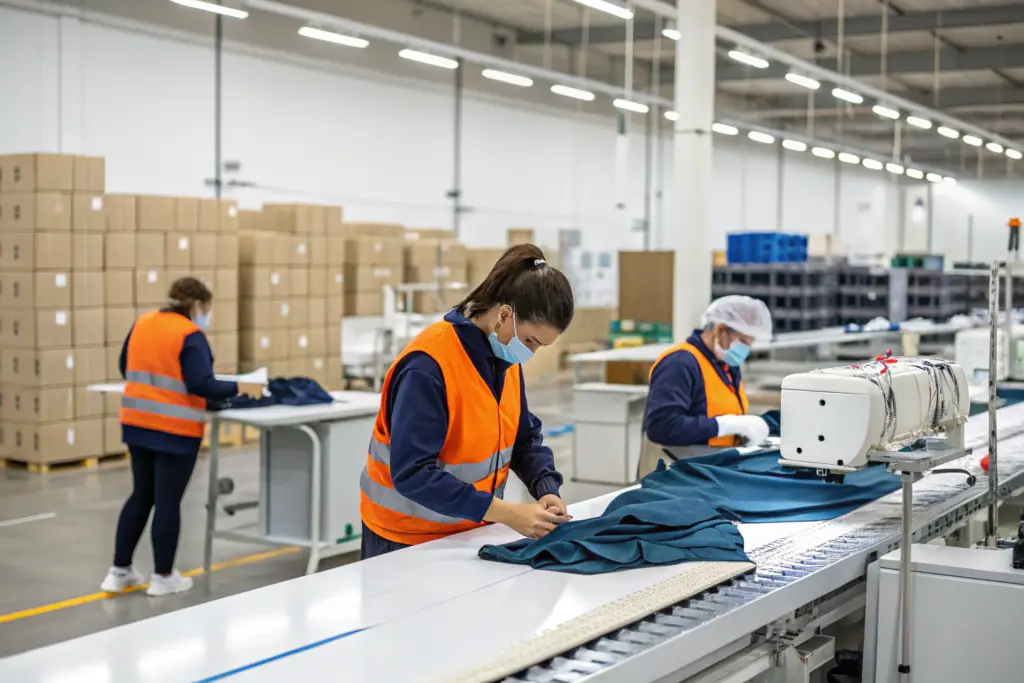
A missed selling season is not an inconvenience. It is a financial catastrophe. You spend months designing a collection. You invest in fabric, sampling, marketing. You line up wholesale accounts or plan your e-commerce launch. The selling window opens. Your customers are ready to buy. But your inventory is not there. It is sitting in a container at the port. It is stuck on a delayed vessel. It is still on the sewing line because the factory overbooked their capacity. The window closes. Your customers buy from your competitor. Your wholesale accounts cancel their orders. Your inventory arrives just in time for the clearance rack. You lose not just the margin. You lose the entire season's investment. I have watched this happen to brands. It is brutal. It is also largely preventable.
Shanghai Fumao denim shorts are a safe bet for protecting your selling seasons because our entire operational model is designed around deadline reliability. We stock greige fabric for our core denim specifications, eliminating the 2-4 week mill lead time that causes most initial delays. We operate a capacity booking system that prevents overbooking, so your production slot is reserved and protected. We track every order against six production milestones with a shared digital dashboard, so delays are visible and fixable within days, not weeks. And we ship DDP with pre-cleared customs, which removes the post-production logistics variables that cause port delays.
I run Shanghai Fumao. I know that a late delivery is not just a production failure. It is a breach of trust. My clients plan their entire year around delivery dates. A summer short that arrives in August is not just late. It is worthless. I rebuilt our production system specifically to prevent that outcome. In this article, I will show you the four specific systems we use to protect your selling season. These are not promises. They are operational processes you can verify.
How Does Fabric Pre-Stocking Prevent the Most Common Cause of Delays?
The most common reason a denim short order is delayed is not the sewing. It is not the washing. It is not the shipping. It is the fabric. The garment factory accepts your order. They promise a 45-day lead time. What they do not tell you is that the denim mill needs 21 days to produce the fabric. The 45-day clock has not started. It will not start until the fabric arrives. You are already three weeks behind schedule on day one.
This happens because most factories operate on a Just-In-Time fabric purchasing model. They do not stock fabric. They order fabric from the mill after you place your order. This minimizes their working capital. It maximizes your delay risk. If the mill is busy, your fabric waits in a queue. If the mill has a yarn shortage, your fabric is delayed further. The factory cannot control this. They can only pass the delay on to you.
We operate differently. We stock greige fabric, undyed, unfinished denim straight off the loom, for the four denim specifications that account for the majority of our denim short orders. When you place an order for one of these specifications, we pull the fabric from our warehouse, not from a mill queue. The fabric lead time is zero days. The production clock starts immediately.
Let me explain our greige inventory strategy and how it compresses your lead time.
What Is Our Greige Inventory Strategy for Popular Denim Weights?
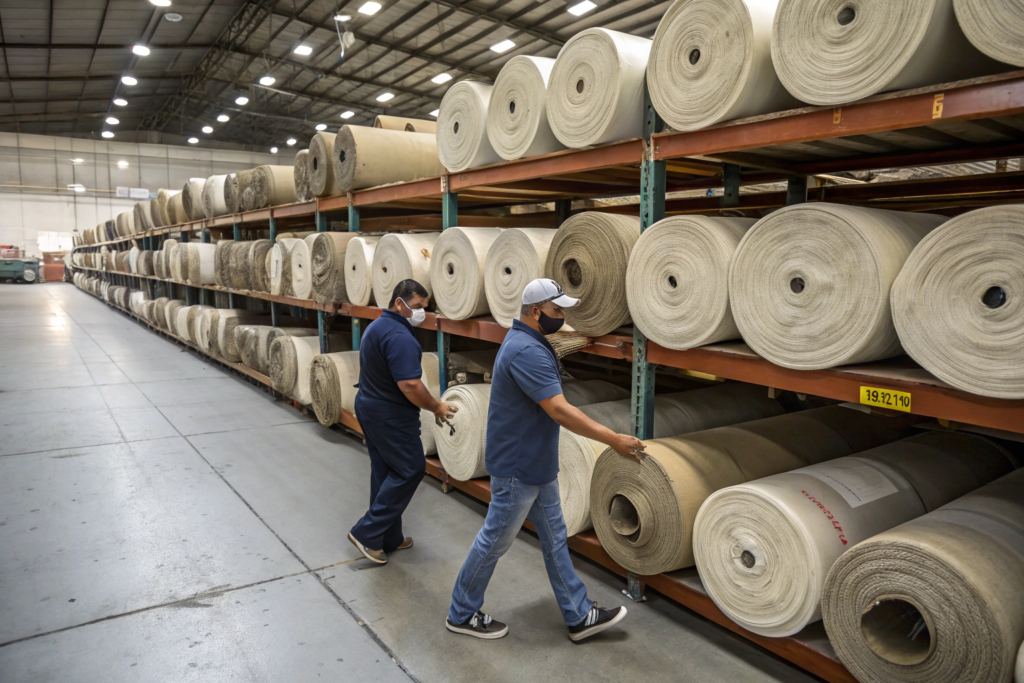
Greige fabric is denim fabric in its raw, unfinished state. It is woven but not dyed, not sanforized, not finished. It is a creamy, off-white color. Greige fabric is dimensionally stable and can be stored for extended periods without degradation, provided the warehouse is climate-controlled.
We stock four greige specifications. A 10.5 oz 3/1 right-hand twill, 99% cotton 1% spandex, in a standard width. This is our most popular specification, used for the majority of our premium and standard shorts. A 12 oz rigid 3/1 twill, 100% cotton, for clients who want a heavier, more structured short. An 8 oz lightweight 3/1 twill, for summer-weight shorts. And a 10.5 oz super-stretch twill with 2% spandex, for clients who want a higher stretch content.
At any given time, our greige warehouse holds between 30,000 and 50,000 yards of fabric across these four specifications. When your order is confirmed, we issue the greige to our finishing partner for dyeing, sanforization, and finishing. The finished fabric returns to our cutting room in 5 to 7 days. The total fabric lead time is one week instead of the three to five weeks it would take if we ordered finished fabric from the mill after receiving your purchase order. This two to four-week compression of the fabric lead time is often the difference between hitting your selling season and missing it. The greige fabric inventory strategy is an investment in working capital that most small factories cannot afford. We made that investment because we prioritize delivery reliability.
How Does Fabric Pre-Stocking Compress the Total Production Timeline?
A standard denim short production timeline, from order confirmation to ex-factory shipment, is typically 45 to 60 days when the fabric is ordered after the purchase order. The breakdown is fabric production, 21 days. Sample approval, 7 days. Cutting and sewing, 14 days. Washing and finishing, 7 days. Inspection and packing, 3 days. The total is 52 days, assuming no delays. A single delay at any stage pushes the ship date past 60 days.
With our pre-stocked greige fabric, the fabric production step is eliminated for the four core specifications. The timeline compresses to fabric finishing, 7 days. Sample approval, 7 days, which can often overlap with fabric finishing. Cutting and sewing, 14 days. Washing and finishing, 7 days. Inspection and packing, 3 days. The total is 38 days. That is a 14-day reduction in the production timeline. For a brand that places an order in March for a May delivery, those 14 days are the difference between having inventory for Memorial Day weekend and missing it.
For repeat orders of a previously approved style, the timeline compresses further. The sample approval step is eliminated. The total ex-factory timeline is 30 to 35 days. A brand that sells through their initial order faster than expected can place a reorder and receive it within five to six weeks door-to-door under DDP. This agility to respond to in-season demand is a margin protector. You capture the sales you would otherwise lose to stock-outs. The fast fashion supply chain agility principles apply here. Speed protects revenue.
How Does Capacity Booking Prevent Production Bottlenecks?
Fabric is the first bottleneck. Factory capacity is the second. A factory has a finite number of sewing lines and a finite number of hours per day. If the factory accepts more orders than it can physically produce, some orders will be delayed. The factory knows which orders will be delayed. They just do not tell the affected buyers until the last possible moment. The buyers whose orders are on time are happy. The buyers whose orders are delayed are told the fabric was late, or there was a holiday, or a machine broke down. The real reason is overbooking. The factory gambled that they could squeeze in one more order, and they lost.
We do not gamble with capacity. We use a capacity booking system. Each production line has a finite number of slots per week. A slot is reserved for a specific client order. When the slots are full, we stop accepting orders for that period. We tell the client honestly that the earliest available slot is in a later week. This honesty sometimes loses us an order in the short term. The client wants an April delivery and our earliest slot is May. They go to another factory that promises April. But that other factory is overbooked. The April delivery becomes a June delivery. The client learns a lesson. The next season, they come back to us and book a slot in advance.
Let me explain how our capacity booking system works and how you can secure your production slot.
What Is a Capacity Booking Model and How Does It Guarantee Your Slot?
A capacity booking model is similar to an airline seat reservation. The airplane has a fixed number of seats. When the seats are sold, the flight is full. A passenger who tries to buy a ticket after the flight is full is told the flight is full. They are not sold a ticket and then bumped at the gate.
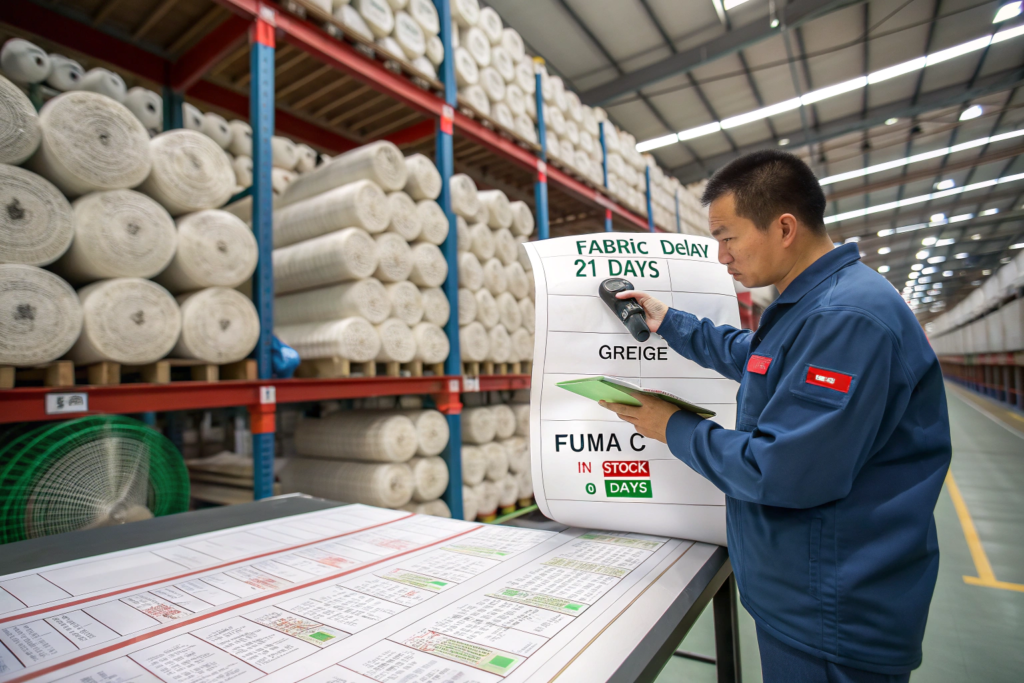
Our five production lines are the airplane. Each line can produce approximately 5,000 denim shorts per week. The total monthly capacity is approximately 20,000 to 25,000 units for denim shorts, depending on style complexity. We maintain a capacity calendar that shows the available slots for each line, each week, for the next six months. When a client confirms an order, we allocate the required number of weeks on a specific line. That allocation is documented in the purchase order. The line is reserved for that client's order during those weeks. We do not overbook.
If a new client requests a slot that is already booked, we offer the next available slot. We do not accept the order and hope a slot opens up. This system requires discipline. It means turning away revenue when we are full. But it protects the delivery dates of the clients who have already booked. Their orders are not delayed because we squeezed in another order. Their trust is worth more than the short-term revenue of an overbooked line. The capacity planning and scheduling methodology is a core concept in lean manufacturing. We apply it rigorously.
How Does Our Production Scheduling Board Provide Transparency?
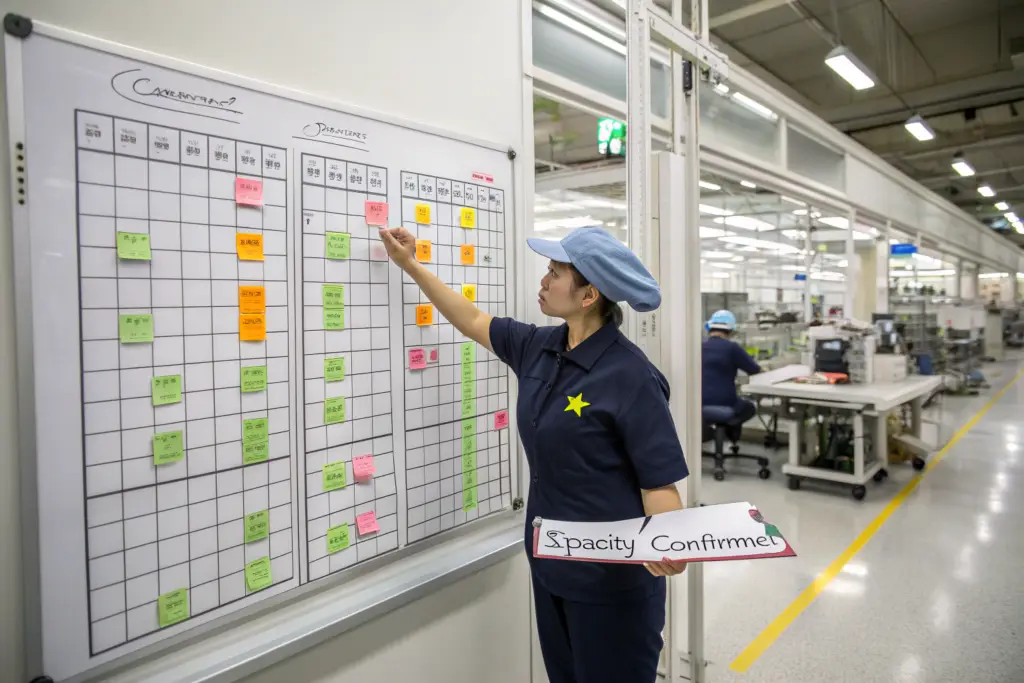
The capacity calendar is an internal planning tool. The production scheduling board is the visual, real-time representation of that calendar. It is a large magnetic whiteboard on the wall of our production office, visible to anyone who walks through. Each column represents a week. Each row represents a production line. Each colored magnetic card represents a client order. The card shows the client name, the style number, the quantity, and the planned ship date.
This board is not hidden in a manager's office. It is on the wall, in public view. Our production team, our quality team, and our merchandisers all see it every day. If a card is in the wrong place, someone will notice and ask why. The board creates accountability. It also provides transparency to clients. When a client is on a video call with us, we walk to the board and show them their card. They can see their order in the context of the overall production schedule. They can see that their line is allocated to them and not shared with other orders.
The board is updated daily based on the previous day's production output. If an order is falling behind, the card is flagged with a yellow sticker. The production manager is required to report the cause of the delay and the recovery plan at the daily morning meeting. The recovery plan might involve shifting float operators to that line or authorizing overtime. The point is that the delay is visible and action is taken when the delay is one day, not one week. The visual management in manufacturing principle is that visible problems get solved. Hidden problems grow.
How Does Milestone Tracking Catch Delays Before They Compound?
A delay of one day is easy to fix. A delay of one week is hard. A delay of one month is a catastrophe. The difference between a one-day delay and a one-month delay is not the severity of the original problem. It is how quickly the problem was noticed and addressed. A factory that only reports progress when the buyer sends an email is a factory that allows one-day delays to become one-week delays. The problem is not discovered until the buyer asks, and the buyer only asks when the ship date is approaching and they have not heard anything.
Milestone tracking is the antidote. Instead of a single ship date on a purchase order, the production timeline is broken into six discrete stages. Each stage has a planned completion date. Progress against each date is tracked and reported. If a stage is late, the delay is visible immediately. The next stages can be adjusted. The final ship date can be protected. The delay is contained.
Let me explain the six milestones we track and how our digital dashboard keeps you informed.
What Are the Six Production Milestones We Track for Every Order?
We break every denim short order into six milestones. Milestone One is Fabric In-House and Inspected. The greige fabric has been finished, returned to our factory, and passed our incoming fabric inspection. This milestone confirms the raw material is ready. Milestone Two is Cutting Complete. The fabric has been spread, cut into panels, and bundled with bundle tickets for the sewing line. Milestone Three is Sewing 50% Complete and 100% Complete. We split sewing into two checkpoints because it is the longest phase. The 50% checkpoint allows a mid-course correction if the sewing is progressing slower than planned. Milestone Four is Wash Complete. The shorts have been washed, dried, and pressed. The wash approval sample has been checked against the standard. Milestone Five is Final Inspection Passed. The AQL final inspection has been completed and the lot has passed. The shorts are packed into export cartons. Milestone Six is Container Loaded and Departed. The container has been loaded, sealed, and the vessel has departed the port of Shanghai. For DDP orders, this milestone extends to Delivery Confirmed at your warehouse.
Each milestone has a planned date in the production contract. The tolerance is plus or minus one working day for internal milestones. If a milestone is missed by more than the tolerance, a formal variance report is generated. The production manager must explain the cause and present a recovery plan to bring the subsequent milestones back on schedule. The production milestone tracking system is a standard project management discipline applied to garment manufacturing.
How Does Our Digital Dashboard Give You Real-Time Visibility?
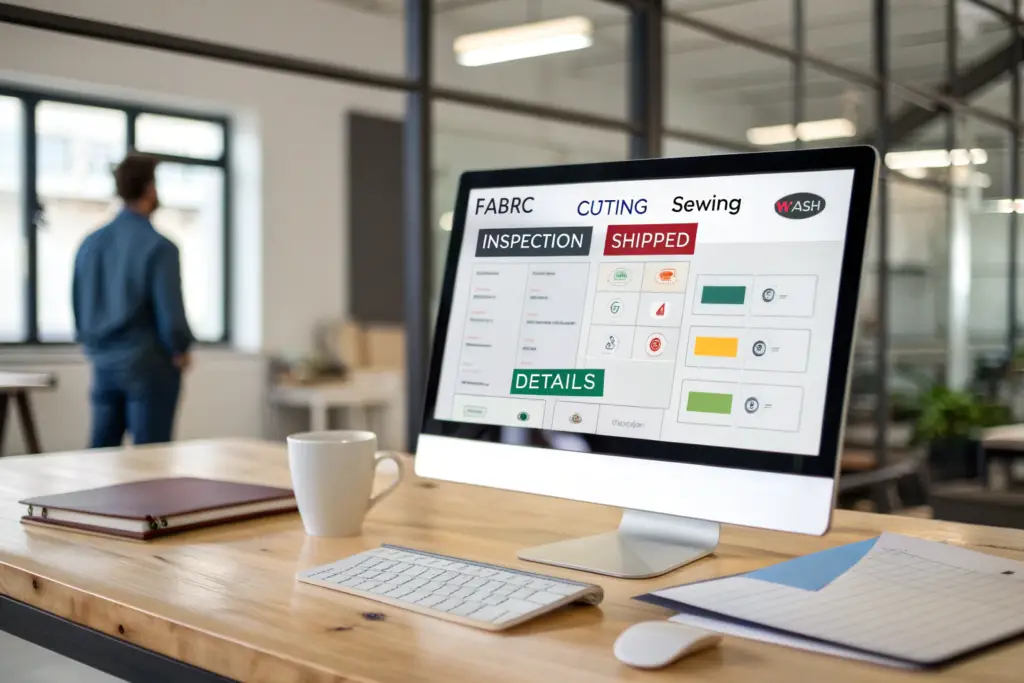
You do not need to send an email to ask about your order status. You have a link to a digital tracking dashboard. The dashboard is a Trello-style kanban board customized for your purchase order. Each milestone is a column. Your order is a card that moves from column to column as each milestone is completed.
The card is moved by the floor supervisor, who scans a barcode on the bundle ticket at the completion of each stage. The movement is automatic and timestamped. You can log in at any time, from any device, and see exactly where your order is. The card is in the "Sewing" column. It shows "65% Complete" based on the number of pieces that have passed the in-line inspection. You do not need to interpret a vague email. You see the data.
If a milestone is late, the card turns yellow. If it is critically late, it turns red. You see the color change the moment it happens. You can message your merchandiser directly through the dashboard. "I see cutting is showing red. What is the issue?" The merchandiser replies with the cause and the recovery plan. The conversation is focused on the specific problem, not on the general anxiety of "where is my order." This transparency has eliminated the status update email from our client relationships. The digital production tracking tools we use are simple but effective. The value is not the software. It is the discipline of updating it in real-time.
How Does DDP Shipping Remove the Final Risk of Season-Ending Delays?
The shorts are finished. They are packed. They are loaded into a container. The production team celebrates. They met their deadline. Then the container sits at the port for five days waiting for a vessel. Then the vessel is delayed by a storm. Then the container arrives at the destination port and is selected for a customs exam. Then the trucking company does not have a chassis available. The shorts that left the factory on time arrive at your warehouse three weeks late. The production team's celebration was premature. The logistics phase is the final mile, and it is where many on-time orders become late deliveries.
DDP shipping is our solution to this final-mile problem. Under FOB terms, the factory's responsibility ends when the container crosses the ship's rail. Everything that happens after that is your problem. Under DDP terms, our responsibility continues until the container is at your warehouse door. Every logistics delay is our problem. This alignment of responsibility changes our behavior. We do not just care about the production completion date. We care about the delivery date.
Let me explain how DDP shipping works and how it protects your selling season.
What Does DDP Shipping Mean for Your Delivery Certainty?
DDP stands for Delivered Duty Paid. Under this Incoterm, we handle every step of the logistics chain. We book the ocean freight under our contract with the carrier. We pay the freight charges. We insure the cargo at 110% of the invoice value. We clear U.S. Customs through our licensed broker. We pay the import duties and fees. We arrange the inland trucking from the port to your warehouse. You receive one invoice with one price per unit, delivered.
The key benefit for delivery certainty is that we have more control and more incentive than you do. We ship containers every week. We have negotiated service levels with our carriers. We know which shipping lines have the best on-time performance on the Shanghai to Los Angeles route. We know how to file customs entries so they clear without delay. We have a trucking dispatcher who tracks the container from vessel arrival to final delivery. If a problem occurs, we have the relationships and the knowledge to resolve it quickly.
Under FOB, you would be managing this process yourself, with a freight forwarder you use twice a year. You lack the volume to demand priority service. You lack the daily experience to troubleshoot problems. The result is a higher probability of logistics delays. DDP transfers the logistics risk to the party best equipped to manage it. The DDP Incoterms delivery reliability benefit is that the seller is financially motivated to deliver on time. Every day of delay costs us money in storage fees and tied-up working capital.
How Does Pre-Clearance of U.S. Customs Prevent Port Delays?
Customs clearance is the biggest variable in the logistics timeline. A container can clear customs in one day or in two weeks. The difference depends on the accuracy of the paperwork and whether the entry is filed before the vessel arrives.
We pre-clear customs on every DDP shipment. While the vessel is in transit, typically three to five days before arrival, our customs broker files the Entry Summary with U.S. Customs and Border Protection. The entry includes the commercial invoice, the packing list, the bill of lading, and the manufacturer's documentation. The duties are paid from our broker's account. By the time the vessel docks, Customs has already reviewed and conditionally released the shipment.
The container can move directly from the terminal to a truck without waiting for a customs review, unless it is selected for a random physical exam. Even for an exam, pre-clearance reduces the wait time because the documentation review is already complete. The container goes straight to the exam lane instead of waiting for both document review and physical inspection. This pre-clearance process saves two to five days on average compared to filing the entry after vessel arrival. For a seasonal product, two to five days is a meaningful portion of the selling window. The U.S. customs pre-clearance process is a standard practice for high-volume importers. We apply it to every DDP shipment.
Conclusion
A missed selling season is not a natural disaster. It is a supply chain failure that can be prevented. At Shanghai Fumao, we prevent it with four systems. Fabric pre-stocking eliminates the two to four-week mill lead time that causes most initial delays. Our greige inventory for core denim specifications means your production starts when your order is confirmed, not when the mill finishes weaving. Capacity booking prevents overbooking. Your production slot is reserved and protected. We turn away orders when we are full rather than gamble with your delivery date. Milestone tracking catches delays when they are one day, not one week. Our digital dashboard gives you real-time visibility into every stage of production, so you never need to send a "where is my order" email. DDP shipping with pre-cleared customs removes the final logistics variables. We own the delivery until the shorts are at your warehouse door.
These systems cost money to operate. The greige inventory ties up working capital. The capacity booking system means turning away revenue during peak seasons. The milestone tracking requires disciplined management. The DDP shipping requires logistics expertise and customs broker relationships. But the cost of these systems is trivial compared to the cost of a missed selling season. A single season of denim shorts that arrives too late for summer can wipe out the profit from three seasons of on-time delivery.
If your brand has experienced a delayed shipment that damaged your season, or if you are planning your first denim short launch and are terrified of missing your window, we should talk. Contact our Business Director, Elaine. She can show you our current capacity availability, a sample milestone contract, and a live view of our production tracking dashboard. She can also provide a DDP delivery timeline with specific dates for your order size and destination. Her email is elaine@fumaoclothing.com. Your selling season is too valuable to gamble on a factory that hopes to deliver on time. At Shanghai Fumao, we have the systems to guarantee it.