You open the first carton from your private label order. You pull out the first garment. This is the moment of truth. Your heart races a little. You check the collar. It looks good. You check the stitching. It seems okay. You hold it up. The color is beautiful. You breathe a sigh of relief. Then you open the second carton. And the third. You start to find inconsistencies. A loose thread here. A button slightly off-center there. A size Medium that fits more like a Small. This is the silent killer of brand reputation. This is why quality control is not a single checkpoint; it is a continuous process.
Ensuring quality control in private label clothing production requires a multi-layered, proactive system: Pre-Production Material Inspection (verifying fabric and trims before cutting), In-Line Production Audits (catching defects during the sewing process), and Final AQL Statistical Sampling (ensuring the bulk shipment meets the agreed-upon defect tolerance).
At Shanghai Fumao, we know that the quality of the final product is the only thing your customer remembers. It is the foundation of B2B trust. You are not on the factory floor. You are 7,000 miles away. You need a partner with a rigorous, transparent system that acts as your eyes and hands. Let me walk you through the exact protocols we use to protect your brand and ensure that every carton you open contains a product you are proud to sell.
What Are the Critical Quality Checkpoints Before Bulk Cutting?
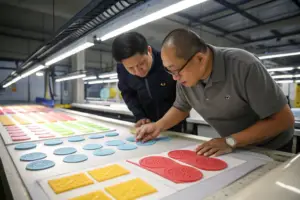
Quality control does not start when the sewing machine starts. It starts the moment the fabric and trims arrive in our warehouse. A beautiful design sewn with flawed materials is a defective product. The "Pre-Production" phase is where we prevent problems from ever reaching the cutting table.
Critical pre-production checkpoints include: 100% Fabric Inspection (checking every roll for weaving defects, stains, and shade consistency), Trim and Component Verification (ensuring buttons, zippers, and labels match the approved BOM and are free of defects), and Shrinkage and Colorfastness Testing on a sample cut from the bulk fabric roll.
I recall a private label order for a women's wear silk blouse. The client had sourced a beautiful, expensive silk charmeuse. Our inspection team found a subtle but consistent "barre" mark (a faint horizontal stripe) across several rolls from a specific dye lot. It was invisible under warm light but obvious under our daylight inspection lamps. We immediately quarantined the affected rolls and notified the client. We were able to return the defective yardage to the mill for a credit before a single panel was cut. If we had skipped this step, we would have produced 500 blouses with a subtle but unacceptable flaw. This is the value of rigorous incoming inspection.
How Do We Inspect and Approve the Bulk Fabric?
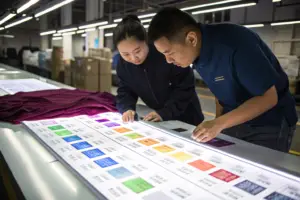
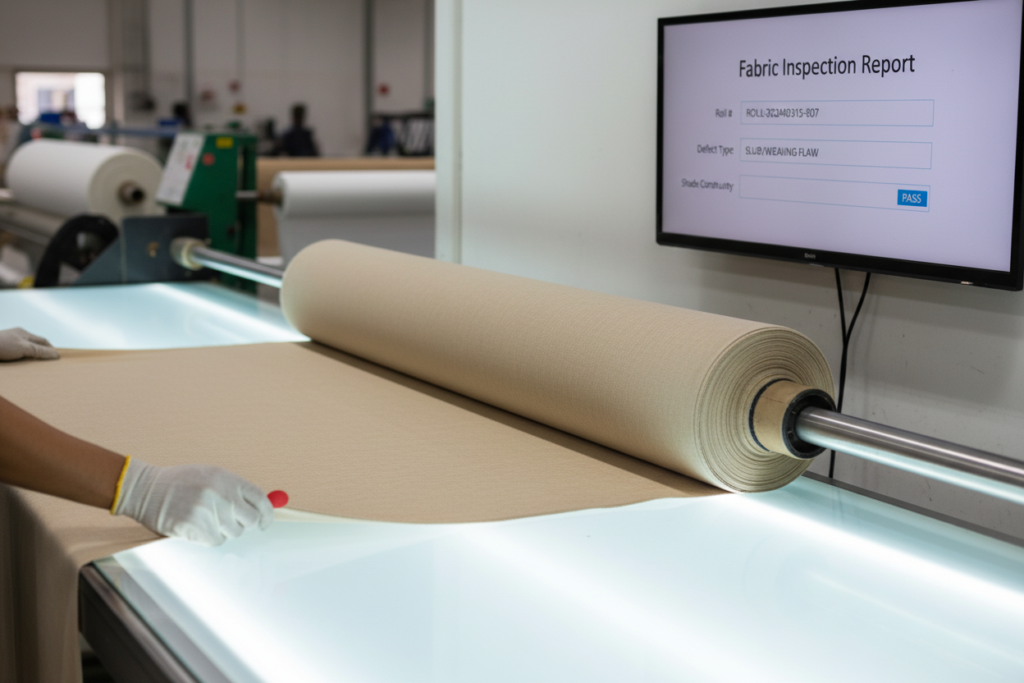
We use a motorized inspection machine with a backlit panel. As the fabric unrolls, an inspector examines it under bright, standardized lighting (D65). They are looking for:
- Weaving Defects: Holes, slubs, missing yarns.
- Dyeing Defects: Color streaks, uneven saturation, shade variation from selvage to selvage.
- Print Defects: Misregistration, color bleeds, screen marks.
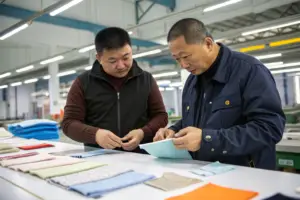
Every roll is assigned a grade. We compare the shade of the roll to the approved lab dip standard under the lightbox. Rolls that pass are released to the cutting room. Rolls that fail are quarantined. This process ensures fabric consistency across the entire production run.
What Is the "Shade Banding" Process and Why Is It Crucial?
Even within a single dye lot, there can be micro-variations in color from roll to roll. This is normal. The problem arises when a garment is cut from two rolls with slightly different shades—the left sleeve is a hair darker than the right body.
Our cutting team performs Shade Banding. We group the rolls into "light," "medium," and "dark" bands. We then cut all the parts for a single garment from the same shade band. We also ensure that all units of a specific size and color are cut from the same band. This prevents the "patchwork" effect and ensures color matching that meets top quality standards.
How Does In-Line Production Auditing Prevent Mass Defects?
Traditional quality control waits until the end of the line. The goods are made, packed, and then inspected. If a problem is found, it is a disaster. You either ship defective goods or you delay the shipment by weeks to rework them. In-Line Auditing flips this model on its head.
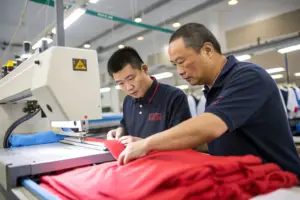
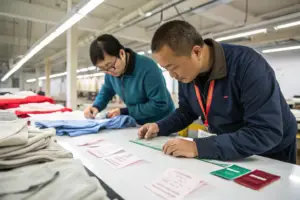
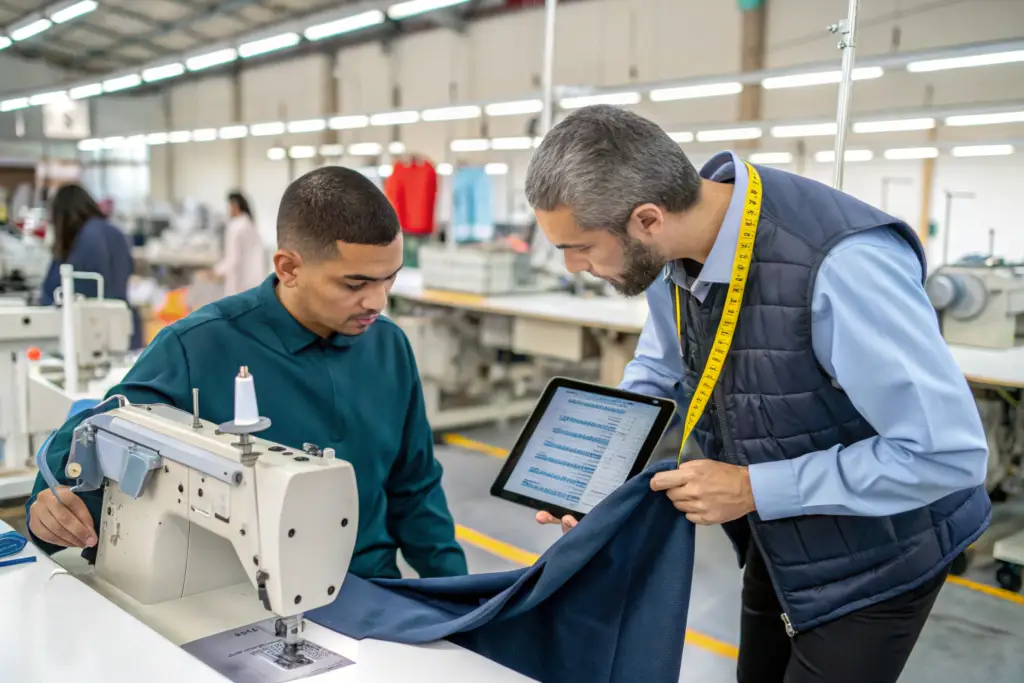
In-line auditing involves a QC inspector walking the production floor continuously during the sewing process. They pull random samples from the bundles and inspect them against the Sealed Sample and spec sheet. If they find a recurring defect, they stop the line immediately to correct the root cause, preventing hundreds of defective units from being produced.
I recall a men's wear shirt order where the in-line inspector noticed the collar points on the first 20 units were slightly blunted, not sharp like the Sealed Sample. She stopped the line. The issue was traced to a worn folder on the collar turning machine. The folder was replaced in 15 minutes. The next 2,000 shirts had perfect, sharp collar points. Without in-line inspection, we would have made 2,000 defective shirts, and the problem would only have been caught at the final audit. This is how we ensure reliable delivery of top quality.
What Are the Most Common In-Line Defects We Catch?
Our QC team is trained to spot specific, recurring issues:
- Skipped Stitches: The needle misses the fabric, leaving a weak seam.
- Puckering: The seam is wavy and gathered, usually due to incorrect thread tension.
- Uneven Hems: The hem width varies, indicating operator error or a missing guide.
- Incorrect Label Placement: The label is crooked or too high/low.
- Needle Cuts: The needle has damaged the fabric fibers, which will turn into a hole after washing.
Catching these issues early saves thousands of dollars in repairs and prevents the customer from receiving a flawed garment.
How Do We Use the "Sealed Sample" During In-Line Audits?
The Sealed Sample is not locked in a cabinet. It is on the factory floor. The in-line inspector carries the Sealed Sample with them (or has a high-res photo on a tablet). When they check a production unit, they do a Side-by-Side Comparison. They check the collar roll, the pocket shape, and the seam finish against the approved standard. This is the ultimate defense against sample vs bulk quality drift. The operators know that the standard is right there, watching them. It reinforces the expectation of consistency.
What Is AQL and How Is It Applied to Private Label Orders?
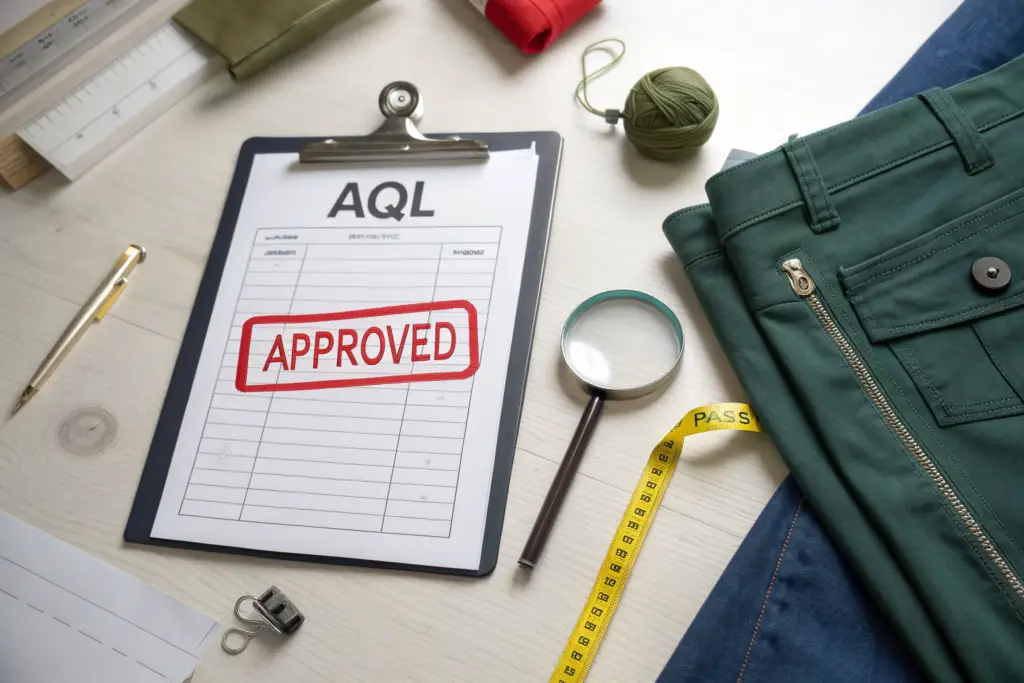
At the end of production, when the goods are 100% finished and packed, we conduct the final Pre-Shipment Inspection (PSI) . This is the statistical gate that determines if the shipment is released or held. The tool we use is the AQL (Acceptable Quality Limit) standard. This is the global language of garment quality.
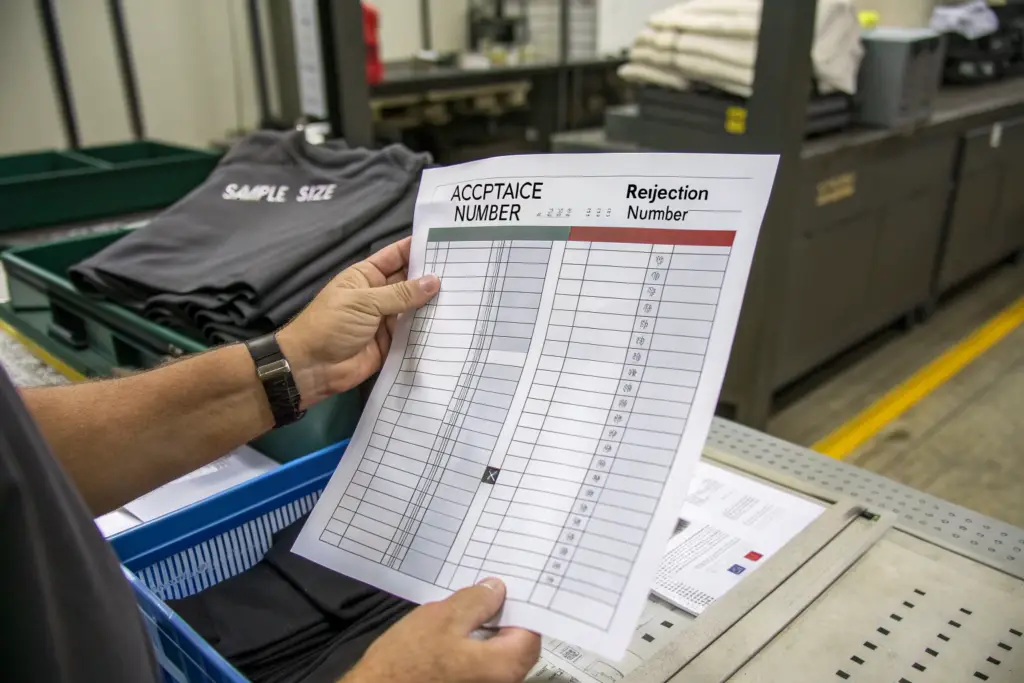
AQL is a statistical sampling method. Instead of inspecting 10,000 units one by one, we inspect a random, statistically significant sample. Based on the number of defects found in the sample, we determine if the entire lot meets the agreed-upon quality level. For private label apparel, the industry standard is AQL 2.5 for major defects.
For our B2B clients, we typically conduct an AQL 2.5, Level II inspection. This means, for an order of 10,000 units, we inspect a sample of 200 units. The lot passes if we find 7 or fewer major defects and 10 or fewer minor defects. If the lot fails, we do not ship. We perform a 100% inspection of the entire order, rework the defects, and then re-inspect. This is a rigorous, objective standard that protects our clients from receiving substandard apparel.
What Is the Difference Between a Major and Minor Defect?
This is a critical distinction in AQL sampling. Our inspectors are rigorously trained on this classification.
- Major Defect: A flaw that makes the garment unsellable at full price or results in a customer return. Examples: A hole, a broken zipper, a significant stain, a seam that is coming open, a missing button, a size label that is wrong.
- Minor Defect: A flaw that is noticeable but does not prevent the garment from being sold or worn. Examples: A loose thread, a slight wrinkle, a slight misalignment of a hangtag.
We are strict on major defects. We know that a single major defect that reaches a customer can result in a negative review and a costly return. Our goal is always zero major defects in the AQL sample.
Can Clients Request a Stricter AQL Standard?
Yes. For premium brands with a high retail price point, we can agree to an AQL 1.5 or even AQL 1.0 standard. This requires us to inspect a larger sample size and reject lots with fewer defects. This tighter standard often comes with a small Quality Surcharge (1-3%) because it requires more labor for inspection and rework. This is a business decision that some large company buyers make to protect their ultra-premium positioning. We are flexible and transparent about these options.
How Do We Ensure Consistent Fit and Sizing Across Production Runs?
You can have perfect fabric and perfect stitching, but if the size Medium fits like a Small, you will have a flood of returns. Consistent sizing is one of the most challenging aspects of apparel manufacturing. It relies on disciplined pattern grading and accurate cutting and sewing.
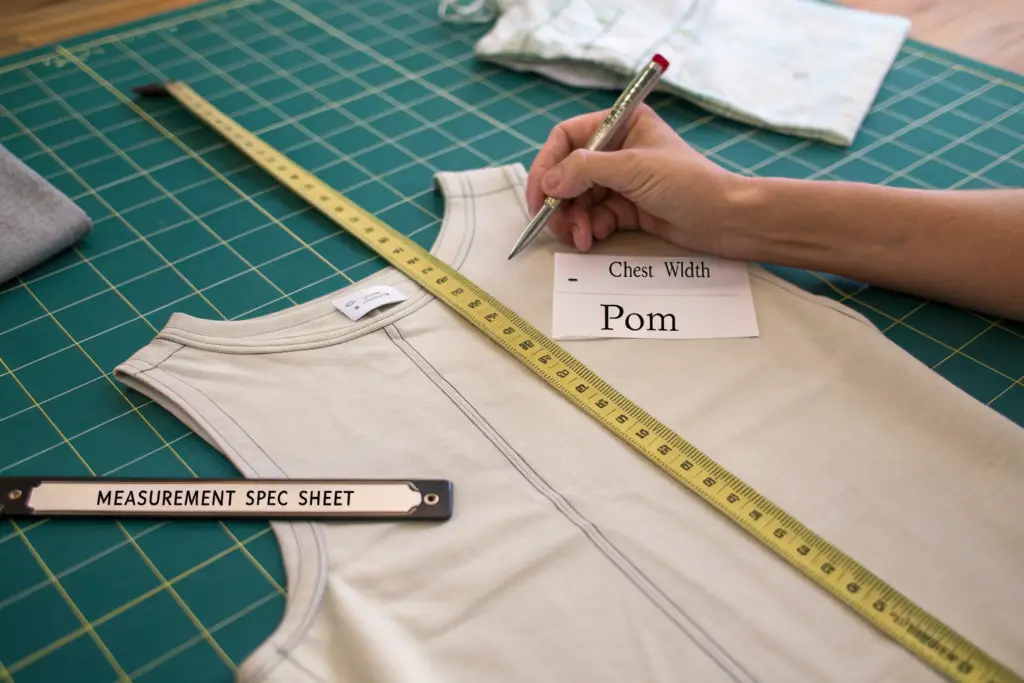
Consistent fit is ensured through: Pre-Production Measurement of the sample against the graded spec sheet, In-Line Measurement Spot Checks during bulk sewing, and Post-Production Measurement of the AQL sample. We use calibrated metal measuring tapes and measure every critical Point of Measure (POM).
During bulk production, our QC team pulls 5 units per size per day from the sewing line. They measure the key POMs: Chest, Length, Sleeve, Shoulder. They record the measurements. If they see a trend—for example, the chest measurement is creeping up by 1/4 inch—they immediately investigate the cutting and sewing processes. Has the fabric relaxed? Is the operator stretching the seam? This proactive monitoring prevents size drift, ensuring that a Medium your customer buys this season fits exactly like the Medium they bought last season. This consistency is the hallmark of a professional private label clothing manufacturer.
How Do We Account for Fabric Shrinkage in the Pattern?
All fabrics shrink to some degree, especially natural fibers like cotton. If you do not account for this in the pattern, the size Large will become a Medium after the first wash.
We perform a Shrinkage Test on the bulk fabric before cutting. We cut a square of fabric, measure it, wash and dry it according to the care label, and then measure it again. We calculate the percentage of shrinkage (e.g., 3% in length). Our pattern maker then digitally scales up the pattern by that percentage. This ensures that after the customer washes the garment, it shrinks to the intended size spec. This is a critical technical step that separates amateur manufacturing from professional clothing production.
What Happens If a Batch of Garments Fails the Measurement Audit?
If the AQL sample shows a systemic measurement issue (e.g., all the Size Large shirts are 1 inch too short), we fail the lot. We do not ship. We conduct a root cause analysis. Was the pattern graded incorrectly? Was the fabric spread under too much tension during cutting? Was the hem folded too deep?
Depending on the severity, the solution might be to rework the specific operation (e.g., let down the hem) or, in extreme cases, re-cut the affected parts. This is a painful and expensive process for the factory, which is why we are so rigorous with our pre-production and in-line checks. We want to catch the error on the first unit, not the 5,000th.
Conclusion
Ensuring quality control in private label clothing production is not about hoping for the best. It is about engineering a system that prevents errors, catches them early when they do occur, and provides objective, verifiable proof of quality before the goods leave the factory. It is a discipline that requires investment in trained personnel, calibrated equipment, and a culture of accountability.
At Shanghai Fumao, our quality control system is the backbone of our B2B promise. It is how we protect your brand from the hidden costs of returns and the reputational damage of inconsistent products. From the moment your fabric arrives to the moment the carton is sealed, every step is monitored, measured, and documented. We are not just making clothes. We are building trust, one perfectly sewn seam at a time.
If you are looking for a private label partner who treats your quality standards as non-negotiable, let's talk. Our Business Director, Elaine, can walk you through our quality manual and explain how our system ensures your collection arrives exactly as you envisioned. Please email Elaine at: elaine@fumaoclothing.com.