I remember a first email from a buyer named Marcus in 2023. The subject line was "Scared to wire deposit." The body of the email was one sentence: "How do I know you won't disappear with my $15,000?" I did not get offended. I understood. He had been burned before by a supplier who sent beautiful sample photos and then delivered garbage, or worse, nothing at all. Building trust through a screen, across 7,000 miles and a 12-hour time difference, is the single hardest part of starting a new sourcing relationship.
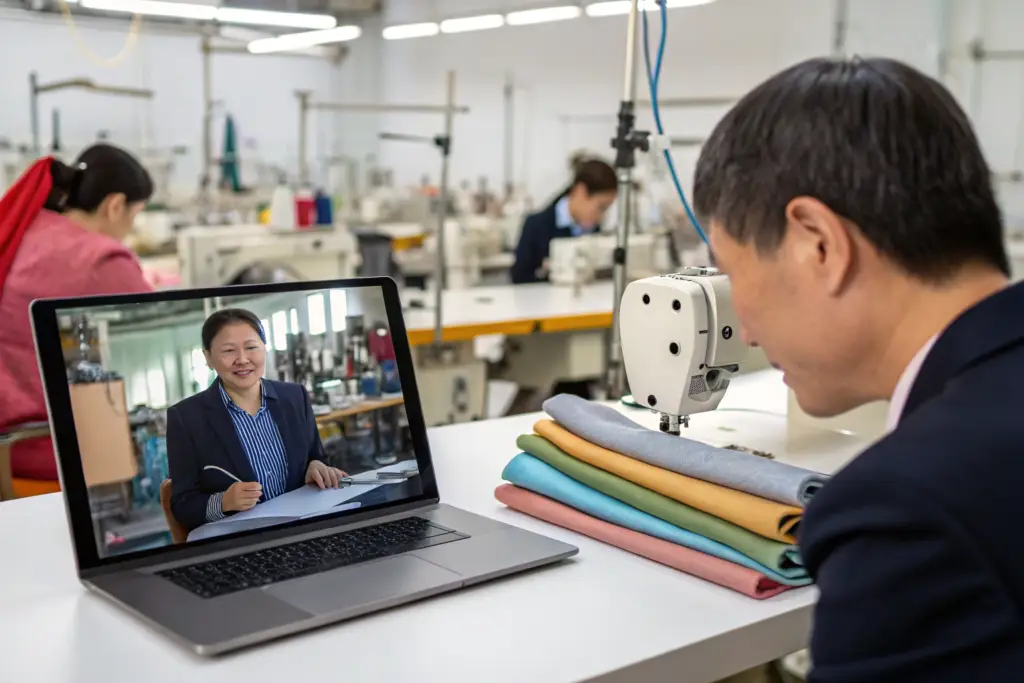
Establishing trust with a new Chinese garment factory over the internet requires moving beyond polished Alibaba profiles and staged photos. You must build a system of small, verifiable actions that prove the factory is a real, operational, and accountable entity. This means requesting live, unscripted video walkthroughs of the production floor, verifying business licenses through independent third-party databases, starting with a low-risk sample order paid through a traceable method, and testing the factory's communication responsiveness and problem-solving honesty during the sampling phase. Trust is not a feeling you get from a friendly email. It is a conclusion you reach after a factory demonstrates transparency and consistency over a series of small tests.
I run Shanghai Fumao, and I have been on the other side of this screen for over a decade. I know what a legitimate factory looks like from the inside. I want to give you the exact playbook I would use if I were in your shoes, sitting in America, trying to figure out which of the hundred supplier profiles on my screen is the real deal.
What Red Flags Indicate a Trading Company Masquerading as a Factory?
This is the first filter. In the apparel sourcing world, there are real factories with cutting tables and sewing lines. And there are trading companies with a nice website, a WeChat account, and a rolodex of small workshops they have never visited. Trading companies are not inherently evil. They can provide value in sourcing hard-to-find items. But if you think you are talking to a clothing manufacturer and you are actually talking to a middleman, you are paying an extra margin and you have no direct line to the people making your garment.
You need to spot the difference within the first three interactions. The signs are usually obvious once you know what to look for. Trading companies are skilled at deflecting questions about production details. They use vague language. They promise capabilities that no single factory could possibly have under one roof.
How Can You Verify a Factory's Physical Address and Production Capacity?
A website can list an address that is actually a virtual office in a high-rise building. You need to verify that the address corresponds to an industrial zone with actual manufacturing activity.
The Verification Process:
- Google Maps / Baidu Maps Satellite View: Take the address the supplier gives you. Paste it into Google Maps and switch to Satellite View. Do you see a large, flat-roofed industrial building with loading docks and trucks? Or do you see a residential apartment block or a downtown office tower? A real garment factory looks like a warehouse from above.
- Ask for the "Business License" Photo: Every legitimate factory in China has a Business License issued by the State Administration for Market Regulation. It is a public document. Ask for a clear photo of it. The license will state the company's "Business Scope." Look for the Chinese characters 生产 (shēngchǎn) which means "Production" or "Manufacturing." If the business scope only says 贸易 (màoyì) which means "Trading," you are dealing with a trader.
- The Production Line Count Question: Ask: "How many sewing lines do you have running right now?" A factory owner like me can answer instantly. "We have five lines active this week." A trader will hesitate. They might say, "We have many partner factories," or give a vague number. Follow up with: "What is the daily output capacity per line for basic T-shirt manufacturing?" A factory knows the rough pieces-per-day number. A trader does not.
I had a potential client who asked me these exact questions. I sent him a screenshot of our Baidu Maps satellite view showing our building's footprint, a redacted photo of our business license with the 生产 scope highlighted, and a photo of our production whiteboard showing the five lines and their daily targets. He wired his sample deposit the next day. Transparency is the fastest way to build trust.
Why Do Vague Answers About MOQs Signal a Lack of Control?
MOQ stands for Minimum Order Quantity. A trading company's MOQ is determined by the smallest workshop they can find to take the order. A factory's MOQ is determined by the efficiency of their own cutting and sewing lines.
If you ask about MOQ for custom logo embroidery on a hoodie, a trader might say, "We can do 50 pieces." A real factory like mine will likely say, "Minimum 300 pieces per color for cut-and-sew." Why the difference? Because I have to stop a production line, change the thread, change the machine settings, and that costs time and labor. Running 50 pieces is not profitable for my fixed overhead.
If a supplier agrees to any MOQ without hesitation, especially very low ones for complex apparel, be suspicious. They are likely planning to outsource your order to a small, unvetted workshop. They have no quality control over that workshop. You lose the consistency you need for your brand.
How Should You Structure the First Sample Order to Minimize Financial Risk?
You found a supplier that passes the initial sniff test. Now comes the moment of financial commitment. Do not wire $10,000 for a bulk order of 5,000 clothing units based on a few photos. That is gambling. You need a structured, low-risk path to test the relationship.
The first transaction should be a paid sample order. This is not a free sample they send to everyone. A paid sample is a custom sample made to your specifications with your fabric and logo. It costs money—usually between $100 and $300 depending on complexity, plus courier shipping. Paying for the sample achieves two things: It shows you are a serious buyer, and it gives you a small, tangible test case to evaluate their work before you commit to bulk apparel orders.
Why Should You Use Trade Assurance or PayPal for Initial Transactions?
Never, ever send the first payment via Western Union or direct bank wire to a personal account. This is the number one rule I tell every new brand buyers client.
Secure Payment Methods for First Orders:
- Alibaba Trade Assurance: If you found the supplier on Alibaba, use Trade Assurance. It holds the payment in escrow. The supplier only gets the money when you confirm receipt of the goods and that they match the agreed specifications. It is not perfect, but it provides a layer of leverage.
- PayPal (Goods and Services): Many factories, including Shanghai Fumao, accept PayPal for sample fees and small orders. PayPal offers Buyer Protection. If the sample never arrives, you can file a dispute. Factories pay a high fee for PayPal, so they will not use it for large bulk payments, but it is perfect for the $200 sample stage.
- Credit Card: If they accept credit cards, even better. You have chargeback rights.
If a factory insists on a wire transfer to a Hong Kong bank account with a different company name for a $150 sample, walk away. That is a red flag. A legitimate factory interested in a long-term wholesale relationship will accommodate a secure, traceable payment method for the first small transaction. They want to build trust as much as you do. For more guidance on secure international trade payments, consult the U.S. International Trade Administration guide on payment methods.
What Specific Instructions Should Accompany a Test Sample Request?
The sample order is also a test of their communication and attention to detail. You need to give them a small but specific set of instructions that are easy to verify.
The Sample Instruction Test:
Send an email with this exact structure:
- Style Reference: "Please make one sample of Style #TS-001, Men's Heavyweight T-Shirt."
- Fabric Spec: "Fabric must be 100% Combed Cotton, 280 GSM, Color: Pantone 19-4050 Classic Blue. Please send a photo of the fabric roll label before cutting."
- Logo Spec: "Left chest embroidery. Attached is the DST file. Thread color: White. Size: 2 inches wide."
- Measurement Spec: "Attached is the size chart for Size Medium. Tolerance +/- 0.5 inches."
- The "Hidden" Instruction: "Please include a 2x2 inch swatch of the exact bulk fabric used for this sample, attached to the hang tag."
Here is what you are testing:
- Response Time: Do they acknowledge the email within 24 hours?
- Clarification Questions: Do they ask good questions? "Is the 280 GSM before or after wash?" "Do you want the embroidery backing removed?" A good clothing manufacturer asks these clarifying questions. A bad one just says "OK."
- The Swatch Test: When the sample arrives, is the fabric swatch attached? If they forgot this simple, specific instruction, they will forget other things in bulk production.
This small sample order is a microcosm of the entire production relationship. If they handle it professionally, communicate clearly, and deliver exactly what you asked for, you have a strong data point for trust.
What Communication Protocols Build Transparency Across Time Zones?
You are in New York. I am in Shanghai. When you are waking up, I am finishing my day. This time gap can be a curse or a blessing. It is a curse if you rely on real-time chat for urgent decisions. It is a blessing if you use structured, asynchronous communication because it creates a written record of every decision.
I have learned that the most successful relationships with overseas brand owners use a specific communication rhythm. They do not send a WhatsApp message saying "Any update?" at 3 PM their time. That message wakes me up at 3 AM, and I am groggy and annoyed. Instead, they use email for formal updates and a shared cloud folder for visual progress.

Email attachments are a nightmare for version control. You send "Tech_Pack_v3.pdf." I make a change and send back "Tech_Pack_v4_Revised.pdf." Then you send "Tech_Pack_v4_FINAL.pdf." Then you find a mistake and send "Tech_Pack_v5_USE_THIS_ONE.pdf." I guarantee you, at some point, the wrong file gets used.
The Solution: A Single Source of Truth
We ask our private label clothing clients to use a shared Google Drive folder or Dropbox link. The file is always named simply: "STYLE_NAME_Tech_Pack." We edit the same document. We use the "Comments" feature to ask specific questions right next to the measurement in question. There is only one version.
This simple change eliminates the "I thought you were working from the old spec" problem that causes so many garment quality failures. It also creates a transparent, time-stamped log of every change request. If you asked to change the pocket size on March 10th, the comment is there with a date. No one can claim they didn't see the email.
How Often Should a Factory Provide Unprompted Production Updates?
This is the single biggest indicator of a trustworthy factory. A factory that communicates only when there is a problem is a factory that hides problems until they are too big to fix. A factory that communicates weekly, regardless of problems, is a partner.
The Ideal Update Cadence:
- Sampling Phase: Update with a photo of the cut fabric before sewing. Then a photo of the finished sample before shipping.
- Bulk Production Phase: A weekly email every Friday (Shanghai time). The email should contain 3-5 photos of your specific order on the cutting table or sewing line. It doesn't need to be a professional photoshoot. An iPhone photo of the bundle ticket with your style number visible is enough.
- Shipping Phase: A photo of the packed cartons with the shipping marks visible, and the bill of lading number within 24 hours of vessel departure.
At Shanghai Fumao, we assign a dedicated project manager to each brand. That person's job is to send that Friday update. It takes 10 minutes. It saves hours of anxious emails from the client. It proves that the apparel order is moving. This proactive communication is the bedrock of internet-based trust.
How Can Third-Party Verification Replace an In-Person Factory Visit?
You cannot fly to China for every order. Even if you could, walking through a factory for 20 minutes doesn't tell you if they pay their workers fairly or if their fire exits are blocked. You need objective, third-party data.
This is where independent verification becomes your eyes and ears. It costs money, but it is significantly cheaper than a bad bulk order or a PR disaster from partnering with an unethical clothing factory. You should budget for third-party verification as part of your cost of goods, just like you budget for fabric and trims.
What Independent Audit Reports Should You Request Before Placing a Bulk Order?
Do not accept a PDF certificate from the factory's own email. Certificates can be photoshopped. You need to verify the audit report on the official database of the auditing body.
The Two Essential Audits:
- BSCI (Business Social Compliance Initiative): This audit covers labor hours, wages, health and safety, and prohibition of child labor. It is the standard for European and many North American importers. Ask for the BSCI Audit Report and the BSCI ID Number. You can verify the validity of the certificate on the BSCI Platform website using that ID number. If the factory is not BSCI certified, you are taking a significant reputational risk.
- WRAP (Worldwide Responsible Accredited Production): This is the gold standard for social compliance in the apparel industry, widely recognized in the U.S. A WRAP Gold certificate means the facility has been audited and found fully compliant with 12 principles of ethical manufacturing.
I provide our BSCI and WRAP certificates proactively to serious inquiries. I include the link to the verification portal. I want you to check. A factory that is proud of its compliance will make it easy for you to verify. A factory that is hiding something will be evasive or provide expired documents. For a deeper understanding of what these audits entail, read the resources on the WRAP Compliance website.
When Should You Hire a Third-Party Inspection Service Like SGS or Intertek?
You have placed the bulk order. The goods are 80% finished. Now is the time to hire an independent inspection company. This is not an insult to the factory. I encourage my clients to do this. It protects me as much as it protects them.
The Two Critical Inspection Points:
- Inline Inspection (DUPRO - During Production): The inspector visits when about 20-30% of the order is packed. They can catch systemic issues—like a crooked custom logo print—early enough to fix the remaining 70% without delaying shipment. This costs roughly $300-$400.
- Final Random Inspection (FRI): The inspector visits when 100% of the order is finished and packed. They pull a random sample based on AQL standards and check for defects. They issue a report that says "Pass," "Fail," or "Pending." This report is your objective evidence if a dispute arises.
A brand buyers client of ours in Texas uses SGS for every single order over $20,000. He has never visited our factory. He told me, "I don't need to see the floor. I need to see the SGS report that says the stitching is straight and the count is correct." That is the modern, data-driven approach to international sourcing trust.
Conclusion
Trust over the internet is not built in a day, and it is not built on a handshake. It is built through a series of small, verifiable tests that prove the factory on the other side of the screen is exactly who they say they are. It starts with verifying the physical reality of the factory using satellite maps and business licenses. It continues with a low-risk, paid sample order that tests their attention to detail and their willingness to use secure payment methods.
We explored the importance of structured, proactive communication that bridges the time zone gap and creates an auditable record of every decision. And we looked at how independent third-party audits and inspections can provide the objective, professional oversight that replaces the need for you to be on the factory floor yourself.
The goal is not to find a supplier who tells you what you want to hear. The goal is to find a manufacturing partner who shows you the reality of the production floor, even when it's not perfect. A factory that admits a small delay early is infinitely more trustworthy than a factory that promises perfection and delivers excuses.
At Shanghai Fumao, we operate with the understanding that trust must be earned through transparency. We provide our licenses, our audit reports, and our weekly production photos because we want our clients to sleep as well as we do. If you are looking to establish a new sourcing relationship and want to start with a transparent, low-risk sample process, you can reach out to our Business Director Elaine at elaine@fumaoclothing.com. She can walk you through our verification documents and help you structure a test order that makes you feel secure.