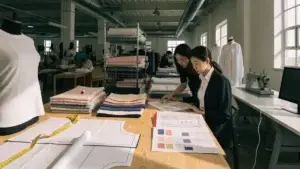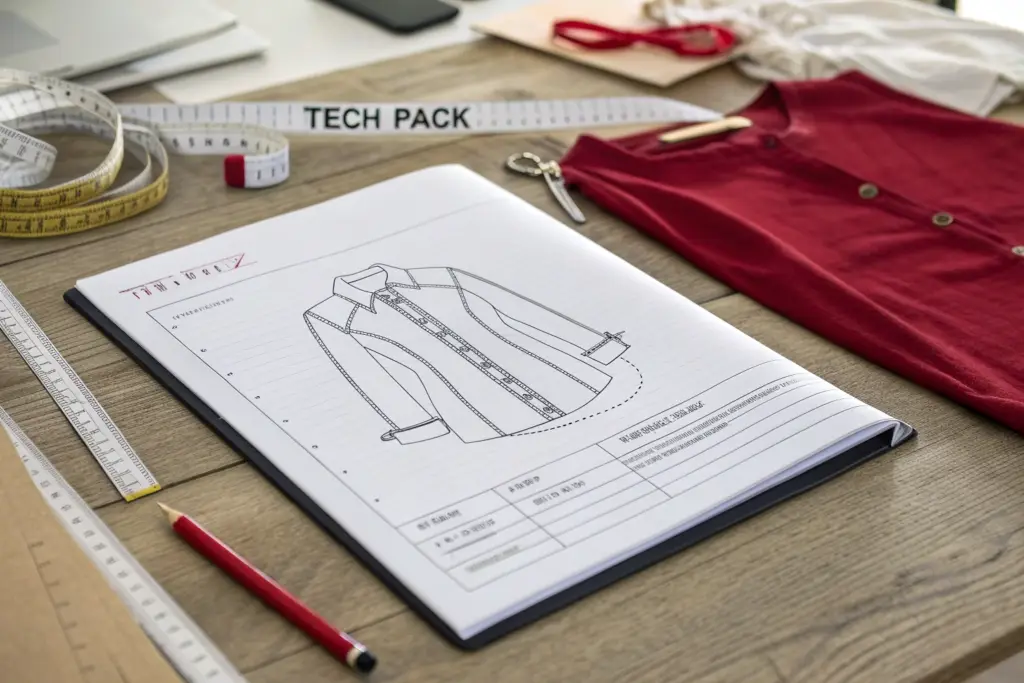
Three years ago, a talented designer from Austin sent me a "tech pack" for a women's woven dress. It was a single PDF page. It had a beautiful watercolor sketch of the dress floating on a model. It had one measurement: "Size Small." And it had a note that said, "Make it flowy." I stared at the screen. I wanted to help her. But that document was not a tech pack. It was a wish. The factory made a guess. The sample arrived looking like a potato sack with sleeves. She was devastated. She had spent months on the design but ten minutes on the instructions. The factory failed, but only because she failed to give them a map.
A perfect tech pack for customized women's wear is a comprehensive blueprint that eliminates all guesswork by including detailed flat sketches, a graded measurement chart with tolerances, a bill of materials specifying every trim, and clear construction callouts for stitching and finishing. It is the single most important document for ensuring your vision translates accurately into a physical garment.
Women's wear is particularly unforgiving. Men's sizing is relatively standardized. Women's sizing is a wild landscape of vanity sizing, different body proportions, and complex fit issues like bust darts and hip curves. A vague tech pack guarantees a bad sample. A precise tech pack saves thousands of dollars in sampling costs and weeks of back-and-forth emails. At Shanghai Fumao, the difference between a smooth production run and a disaster almost always comes down to the quality of the tech pack. Here is exactly how to build one that works.
What Essential Components Must Every Women's Wear Tech Pack Include
Before you open Adobe Illustrator, you need to understand the anatomy of a document that a factory can actually use. A factory is not a design studio. The pattern maker does not care about your mood board. The cutter does not need to see the lifestyle photo of a girl laughing on a beach. They need cold, hard, specific data. Giving them anything else is just noise that increases the chance of error.
A functional women's wear tech pack must include a cover page with version control, a detailed flat sketch with stitch annotations, a graded size specification sheet, a complete bill of materials, and a colorway breakdown.
If any of these five elements are missing, the factory will make an assumption. And I promise you, the assumption they make will be the cheapest, fastest option, not the one you had in your head. At Shanghai Fumao, we see hundreds of tech packs. The ones that result in perfect samples on the first try are the ones that leave no room for interpretation.

Why Are Flat Sketches More Important Than Fashion Illustrations?
A fashion illustration is art. It shows drape, movement, and emotion. It has flowing hair and dramatic shadows. It is useless for manufacturing.
A Flat Sketch is a technical drawing. It shows the garment as if it were laid perfectly flat on a table, usually in black and white, with clean, solid lines. It shows the front view and the back view. It shows every seam, every dart, every pocket, and every button placement.
The difference is clarity. Look at a flat sketch of a women's blouse. You can see exactly where the shoulder seam sits. You can see if the sleeve is set-in or raglan. You can see the shape of the collar point. You can see the number of buttons and the spacing between them.
I tell all my clients at Shanghai Fumao: "If you only have budget for one thing in your tech pack, make it a perfect flat sketch." A pattern maker can reverse-engineer measurements from a good flat sketch. They can figure out construction from the seam lines. They cannot do anything with a watercolor painting except guess. And guessing is expensive.
What Information Belongs in a Bill of Materials?
The Bill of Materials is the grocery list for your garment. It tells the factory exactly what to buy. If the BOM is vague, the factory will substitute cheaper alternatives. That beautiful, heavy YKK zipper you imagined becomes a generic, lightweight zipper that jams. That soft, branded satin label becomes a scratchy piece of polyester taffeta.
A proper BOM for women's wear must be obsessive about details. Women's garments often use more complex trims than men's—delicate lace, narrow elastic, decorative buttons, hook-and-eye closures.
Here is the level of detail required:
| BOM Item | Vague Description (Bad) | Precise Specification (Required) |
|---|---|---|
| Main Fabric | "White Cotton" | "100% Cotton Poplin, 120 GSM, Optical White (PMS 11-0601)" |
| Lining Fabric | "Polyester Lining" | "100% Polyester Taffeta, 210T, Color: Match Shell" |
| Zipper | "Invisible Zipper, 22 inch" | "YKK #3 Invisible Coil Zipper, Nylon Tape, Color: Match Shell, Length: 56cm" |
| Label | "Woven Neck Label" | "Damask Woven Label, 2cm x 6cm, Folded Center, Soft Hand, Color: Black/White" |
| Thread | "White Thread" | "100% Spun Polyester, Tex 27, Color: Match Shell" |
Providing this level of detail forces the factory to use the exact components you designed with. It also protects you legally. If the factory uses a different zipper and it fails, you have a written record of what was specified.
How Do You Specify Women's Sizing and Fit Accurately
Men's fit is largely about chest and length. Women's fit is a three-dimensional puzzle involving bust, waist, hip, and the complex curves that connect them. A half-inch error in the placement of a bust dart can make a $200 dress look like a $20 dress. It can gap open. It can pull tight across the chest. It can ruin the silhouette.
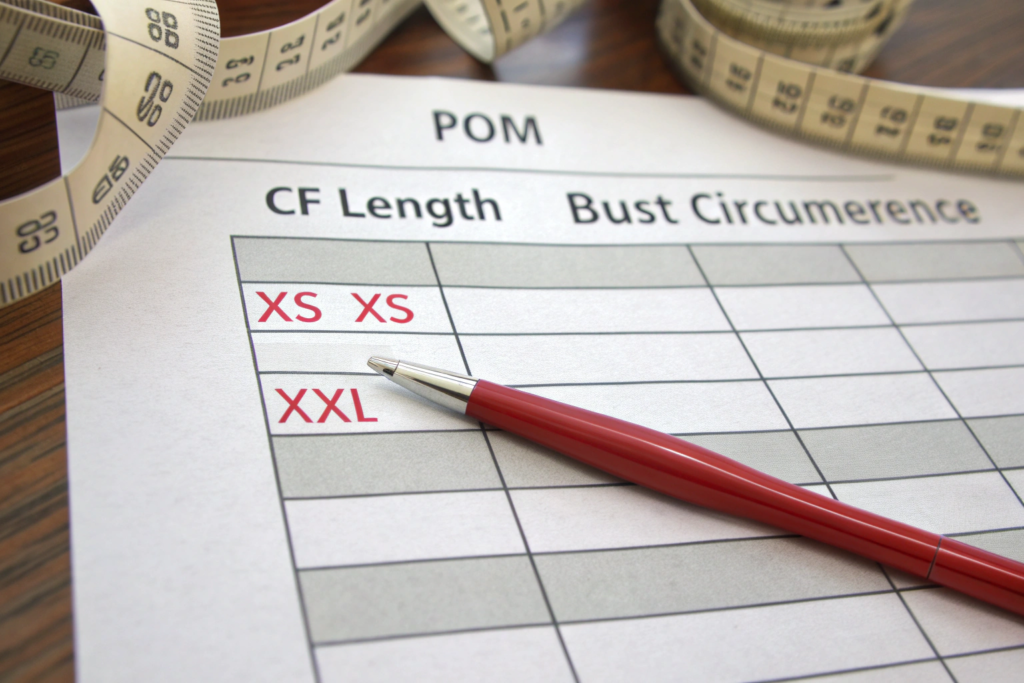
Accurate women's sizing requires providing a full graded measurement chart with clear Points of Measure definitions, realistic tolerance ranges for each measurement point, and specific instructions regarding ease and intended fit.
You cannot just send a list of numbers. You must define how those numbers are measured. Is the "Bust" measurement taken 1 inch below the armhole? Or is it taken at the fullest point of the bust curve? These two points can be an inch apart. That inch is the difference between a perfect fit and a return.
What Are the Critical Points of Measure for Women's Tops?
Different garment types have different critical points. For a women's woven top or blouse, these are the non-negotiable measurements that must be on your spec sheet:
| POM Code | Description | How to Measure | Why It's Critical for Women's Fit |
|---|---|---|---|
| CFL | Center Front Length | From High Point Shoulder straight down to hem. | Determines overall body proportion and crop level. |
| CB | Chest/Bust | 1" below armhole, straight across. | Primary fit point. Must accommodate bust without pulling. |
| SW | Shoulder Width | From shoulder point to shoulder point across back. | Affects sleeve drape and neckline width. |
| SL | Sleeve Length | From shoulder point to cuff edge. | Critical for long sleeve styles. Too short looks cheap. |
| BIC | Bicep Circumference | 1" below armhole on sleeve, measured around. | Women's sleeves often fail here. Too tight is uncomfortable. |
| SWP | Sweep/Hem Opening | Straight across bottom hem. | Determines if the top is fitted, straight, or flared. |
You must also include Dart Placement specifications. Where does the bust dart point end? It should point toward the apex of the bust but stop about 1 inch short. If it points too high, it creates a "bullet bra" effect. If it points too low, it creates a droopy look. Specifying this is what separates a professional tech pack from an amateur one.
How Do You Communicate "Ease" to a Factory Pattern Maker?
"Ease" is the difference between the body measurement and the garment measurement. It's the extra room that allows you to breathe, move, and sit down. It's also the secret to a garment's style. A "fitted" dress has very little ease. An "oversized" shirt has a lot.
The problem is that "fitted" and "oversized" are subjective words. To a pattern maker in another country, "fitted" might mean 1 inch of ease. To you, it might mean 4 inches of negative ease (the garment is smaller than the body and stretches).
You must quantify ease. Here is the language we use at Shanghai Fumao to bridge this gap:
| Fit Description | Subjective Term | Objective Spec (Bust Ease for Wovens) |
|---|---|---|
| Bodycon/Compression | "Very Tight" | 0" to -2" ease (Requires stretch fabric) |
| Fitted | "Slim" | 2" to 3" ease |
| Semi-Fitted | "Classic" | 4" to 5" ease |
| Relaxed | "Comfortable" | 6" to 8" ease |
| Oversized | "Boyfriend Fit" | 10"+ ease |
Instead of saying "Make it flowy," your tech pack should say: "Intended Fit: Relaxed. Bust Ease: 8 inches. Hip Ease: 6 inches." This gives the pattern maker a clear, mathematical target to hit. They can calculate the exact garment measurements needed to achieve that look on a standard size 8 fit model.
Which Construction Details Prevent Women's Wear Quality Issues
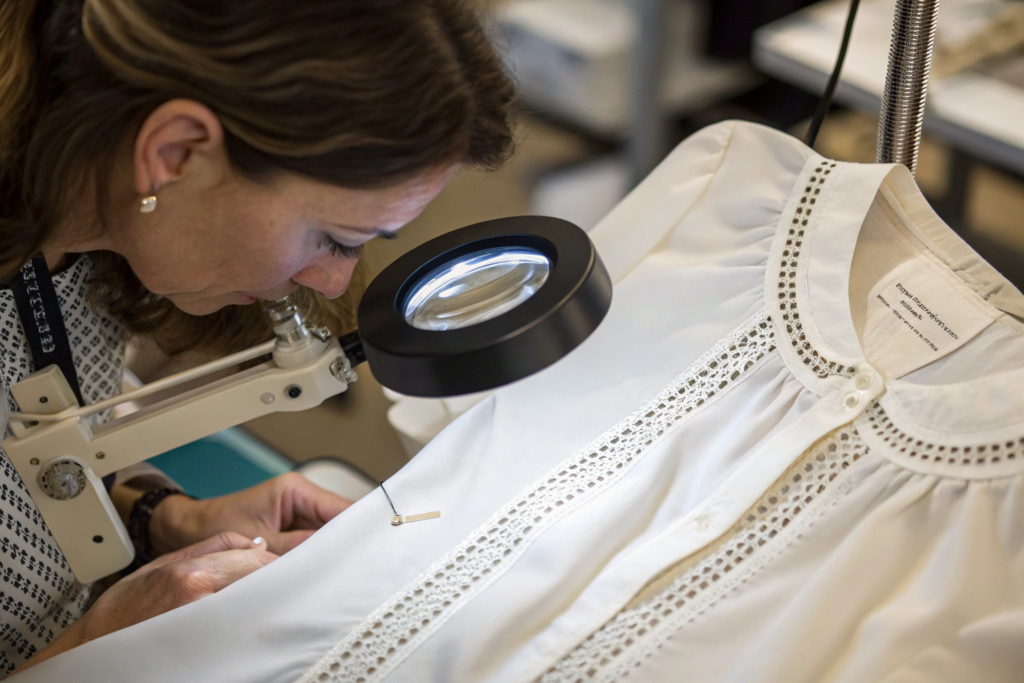
Women's wear often uses lighter, more delicate fabrics than men's wear. Silk charmeuse. Rayon challis. Fine gauge knits. These fabrics are beautiful. They are also unforgiving. A wavy hem on a men's oxford shirt might be acceptable. A wavy hem on a women's silk camisole is a disaster. It looks cheap. It hangs wrong. It screams "poor quality."
Specifying construction methods in the tech pack prevents the factory from defaulting to the fastest, cheapest sewing method. Women's wear demands specific seam finishes, hem treatments, and stabilization techniques.
If you don't specify these details, the factory will likely use a basic Overlock (Serged) Seam with a single needle topstitch. That's fine for a basic cotton t-shirt. It's completely wrong for a sheer chiffon blouse. The seams will be bulky and visible through the fabric. The garment will look homemade.
Why Must You Specify Seam Finishes for Delicate Fabrics?
Different fabrics require different seam finishes. A good tech pack calls out the specific finish required for each major seam.
Here is a quick reference for women's wear fabrics:
| Fabric Type | Recommended Seam Finish | Why? |
|---|---|---|
| Sheer Chiffon/Georgette | French Seam | Encases raw edge completely. No visible serging. Looks clean and expensive. |
| Silk Charmeuse | Narrow Rolled Hem | Delicate finish for lightweight fabrics. Prevents bulk. |
| Rayon Challis | Flat-Felled Seam | Durable and clean finish. Often used on side seams of casual woven tops. |
| Mid-Weight Linen | Bound Seam (Hong Kong Finish) | Uses bias tape to cover raw edge. Adds structure and a pop of color inside. |
| Stretch Jersey Knit | Coverstitch Hem | Professional finish that stretches with the fabric. Prevents popped stitches. |
I worked with a designer who was making a line of sheer blouses. She didn't specify the seam finish. The factory used a standard overlock stitch. The dark thread of the serging was visible through the white fabric from ten feet away. The entire production run of 800 units was rejected by the boutique buyer. She had to pay to have the entire order remade. That's a $15,000 mistake that could have been avoided with one line in the tech pack: "All seams: French Seam."
How Do You Prevent Stretching on Necklines and Armholes?
This is a common failure point in women's woven tops. The neckline is cut on the bias or on a curve. Without stabilization, it will stretch out during sewing and handling. The result is a "gaping" neckline that doesn't lie flat against the chest.
The solution is to specify Stay Tape or Clear Elastic in the tech pack.
In your construction callouts, you must write exactly this: "Apply 1/4" clear elastic or fusible stay tape to neckline seam allowance before attaching facing/binding. Stretch elastic slightly while sewing to prevent gaping."
This one sentence tells the factory exactly what to do. It tells them this is a critical quality point. It prevents the most common fit complaint in women's tops. At Shanghai Fumao, we automatically add this step for any woven neckline. But if you're working with a new factory, you cannot assume they will do it. It must be in the tech pack.
What Information Prevents Costly Sampling Delays and Errors
Time is the hidden cost of bad communication. Every round of sampling takes 2-4 weeks and costs $100-$300 per sample, plus international shipping. If it takes four rounds to get approval because the tech pack was incomplete, you've just lost two months and $1,200. In the fashion calendar, two months is the difference between delivering on time for the Spring collection and missing it entirely.
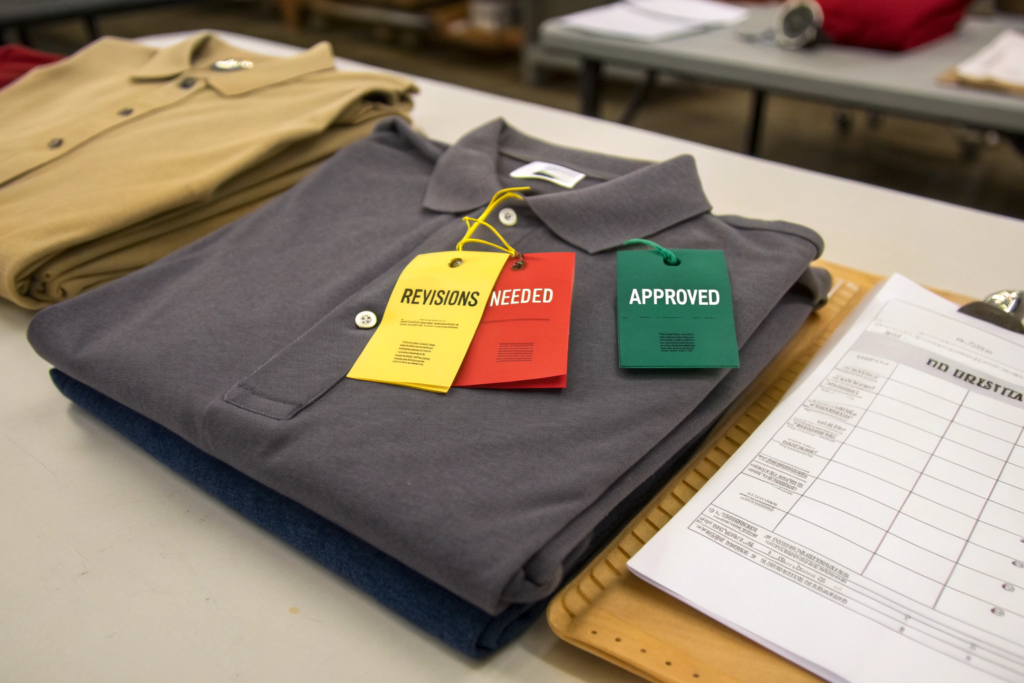
Providing comprehensive visual references, specifying label and hangtag placement, and defining packaging requirements within the tech pack streamlines the sampling process and gets you to bulk production faster.
The factory is not a mind reader. If you want the care label sewn into the left side seam and the brand label centered on the back neck, you have to say that. If you don't, the factory will put them wherever is most convenient for the sewer. You might end up with a scratchy care label poking out of the neckline. That's a customer return waiting to happen.
Why Are Visual References for Tricky Details Essential?
Words can fail. "Gathered sleeve cap" can mean a subtle puff or a dramatic leg-of-mutton sleeve. "Ruffle detail" can mean a delicate 1/2 inch frill or a massive 4-inch flounce.
For any detail that is visual or textural, you must include a reference image. This does not mean a mood board photo of a vintage dress. It means a Technical Reference Image—a close-up photo of the specific detail on another garment, annotated with arrows and notes.
For example, if you want a specific type of shirring (elastic smocking), don't just write "Shirring." Include a photo of the shirring density you want, with a note like: "Shirring to match reference image: 8 rows of elastic thread, 3/8 inch apart."
I tell my clients at Shanghai Fumao to create a "Details" page in their tech pack. On this page, they paste photos of:
- The exact collar shape they want.
- The exact cuff placket construction.
- The exact hem finish.
This page is worth a thousand emails. It aligns the factory's visual understanding with yours instantly.
How Do You Specify Label and Hangtag Placement Exactly?
Labels seem like a small detail until they are wrong. A crooked label makes the entire garment look counterfeit.
Your tech pack must include a diagram showing label placement. It should look like a mini blueprint.
Neck Label Placement Spec:
- Position: Center Back Neck.
- Distance from neck seam: 1/2 inch down.
- Sewing Method: Single needle topstitch on all four sides.
Care Label Placement Spec:
- Position: Inside Left Side Seam.
- Distance from bottom hem: 3 inches up.
- Orientation: Folded with logo facing out.
Hangtag Placement Spec:
- Attachment Point: Through neck label or left sleeve cuff.
- Attachment Method: 4-inch natural cotton twine looped through safety pin.
This level of specification ensures that every garment in your order of 2,000 units looks identical. Consistency is the hallmark of a premium brand. Inconsistency in labeling is the hallmark of a disorganized supply chain.
Conclusion
Creating the perfect tech pack for customized women's wear manufacturing is not an artistic exercise. It is an exercise in precise, technical communication. We've dissected the essential components—the flat sketches that replace vague illustrations, the bill of materials that locks in quality trims, and the measurement charts that define the fit. We've explored the construction details that separate a luxury garment from a fast fashion piece, focusing on seam finishes and stabilization techniques that prevent the most common women's wear failures. Finally, we've addressed the visual references and placement specifications that eliminate the costly back-and-forth of multiple sampling rounds.
The time you invest in building a comprehensive tech pack is the single highest-leverage activity in your production calendar. It is the difference between a factory guessing and a factory executing. It protects your vision from being lost in translation across languages and time zones. It signals to your manufacturing partner that you are a serious, professional brand worth prioritizing.
You don't have to build this document from scratch in the dark. The right factory partner can provide templates, guidance, and feedback on your tech pack before you even place an order. We help our clients refine their specifications to ensure a smooth path from digital file to finished garment.
If you need assistance creating or refining a tech pack for your women's wear collection, we are here to provide expert support. Let's ensure your next sample is your last sample before bulk production.
For guidance on creating a factory-ready tech pack, please contact our Business Director, Elaine.
Contact Elaine at: elaine@fumaoclothing.com