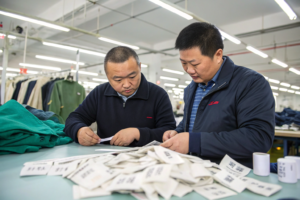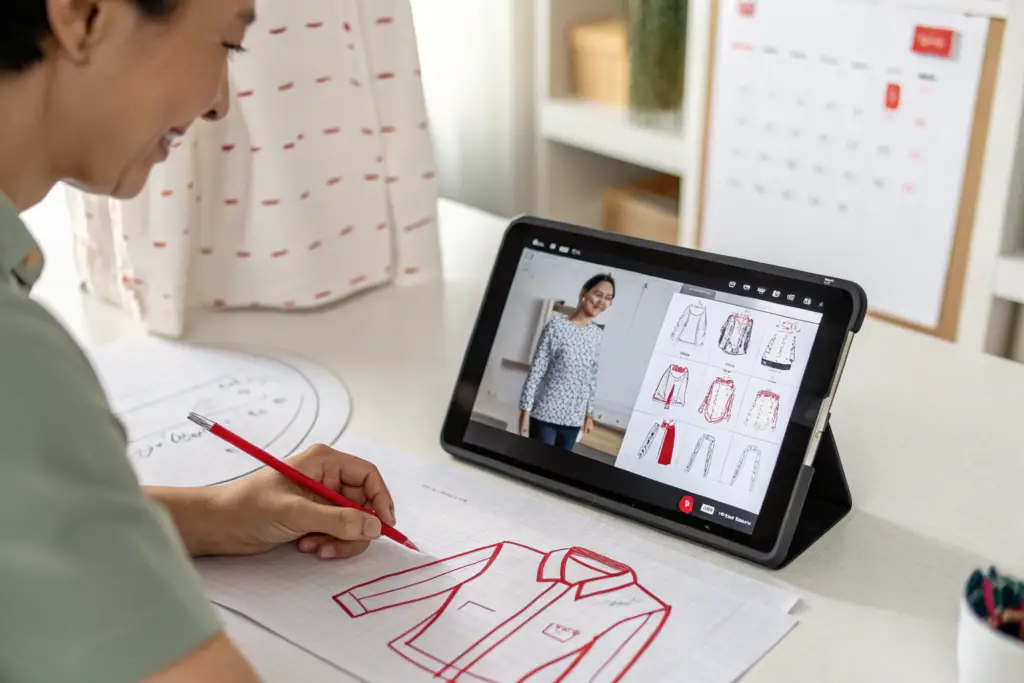
A brand owner from Los Angeles once called me on a Tuesday afternoon with panic in his voice. He had just returned from a buyer meeting with a major department store. The buyer loved his collection, but wanted one change: the collar on the signature jacket needed to be 1.5cm wider. The original collar looked too narrow on the store's mannequin. The buyer placed a $45,000 order, contingent on that one revision. The problem? His production was scheduled to begin cutting the following Monday. He told me, "I need to change the collar on 600 jackets, and I need to know if this is a small pivot or a collection-killing disaster. Can you help me, or do I have to call the buyer back and potentially lose the order?"
His situation was not unusual. Design changes happen. A buyer requests a modification. A trend shifts mid-season. A fabric delivery forces a creative pivot. A fit sample reveals an unexpected issue. The difference between a successful brand and a frustrated one is often not the absence of change, but the quality of the response to change. A rigid factory responds to a last-minute design change with a hard "no" or a punitive surcharge and a massive delay. An agile, partnership-oriented factory responds with a clear-headed feasibility assessment, transparent cost and timeline implications, and a collaborative effort to execute the change with minimal disruption.
Shanghai Fumao handles last-minute design changes through a structured, transparent Change Order Protocol. When you request a change, our Business Director immediately assembles the relevant technical team, pattern maker, cutting supervisor, or sourcing specialist, to assess the impact. Within hours, you receive a clear, written assessment covering three specific areas: the technical feasibility of the change, the exact cost implication, and the realistic impact on the delivery timeline. We then present you with options, not ultimatums, and work collaboratively to find the best path forward. We treat design changes not as an annoyance, but as a normal part of the creative and commercial process of building a successful brand.
A late-stage design change is a stress test of the manufacturing partnership. It reveals whether the factory's systems are rigid or flexible, whether their communication is transparent or evasive, and whether they view their client's commercial success as their own. I want to walk you through exactly how our Change Order Protocol works, the honest boundaries of what is possible, and how we mitigate the cost and timeline impacts of necessary changes.
What Is Our Change Order Protocol for Production Changes?
The Los Angeles brand owner's previous experience with design changes at another factory had been a nightmare. He had requested a simple pocket shape change mid-production. The factory said "okay" immediately, without any discussion of cost or timeline. Three weeks later, the order was delivered late, and the invoice had a vague $800 "change fee" added. When he questioned it, the factory said the delay and the fee were because of his change. He had no written agreement on the impact. He learned that an easy "yes" upfront can hide a messy, unaccountable reality downstream.
A structured, transparent Change Order Protocol protects both the client and the factory. It ensures that everyone understands the full implications of the change before it is executed. There are no surprises, no hidden fees, and no uncommunicated delays.
How Quickly Can You Get a Feasibility Assessment for a Change Request?
When you communicate a design change request to your Business Director, our goal is to provide a complete, written feasibility assessment within hours for simple changes, and within one business day for complex ones.
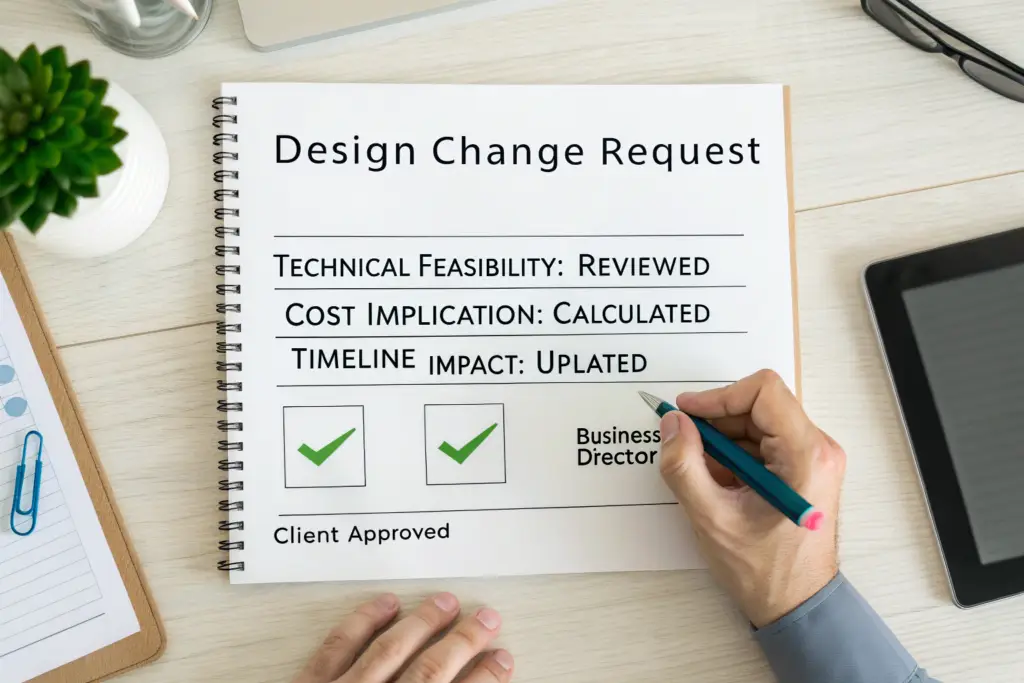
The process is immediate. Elaine receives your request, detailing the specific change and ideally a sketch or photo. She instantly pulls in the relevant internal specialists. If the change involves a pattern adjustment, our pattern maker reviews the digital pattern and assesses the impact. If it involves a new trim, our sourcing specialist checks availability and lead time. If production has already begun, the production manager assesses the impact on the cut fabric, the work-in-progress, and the production schedule. This cross-functional team assembles, assesses, and Elaine synthesizes their input into a clear, written response to you. You are not waiting days for a vague answer. You receive a specific, data-backed assessment, quickly, so you can make an informed decision and communicate with your buyer or retail partner. The rapid design change feasibility assessment is a core competency of our agile production model.
What Information Does the Change Impact Report Contain?
The change impact report you receive from Elaine is structured around three specific, non-negotiable questions. First, is the change technically feasible at this stage of production without compromising the quality or structural integrity of the garment? This is a yes/no technical assessment. Second, what is the exact cost implication? This is a transparent breakdown of any additional charges, such as pattern revision time, new trim sourcing, fabric wastage from re-cutting, or labor surcharges for reworking in-progress units. There are no vague "change fees." Every cost is itemized and justified. Third, what is the revised delivery timeline? This is an honest assessment of the impact on the originally agreed ship date. The report presents the best-case, worst-case, and most-likely revised delivery dates.
For the Los Angeles brand owner's collar change, the assessment was that the change was technically feasible. The pattern could be adjusted digitally. However, 200 jackets had already been cut with the original, narrower collar pieces. The cost implication included the fabric wastage from re-cutting those 200 collars, plus the pattern revision time. The timeline impact was a two-day delay to the original ship date. Elaine presented this in a clear email. The client approved the change and the two-day delay within an hour. The buyer was informed. The production resumed with the revised collar. There was no conflict, no surprise invoice, and no blown deadline. The transparent change order impact report is the document that aligns expectations and prevents downstream disputes.
What Design Changes Are Realistic After Production Has Started?
A startup brand owner once asked me, just as his order was about to ship, if we could change the buttons on 300 shirts to a different style. The shirts were fully finished, pressed, and packed into cartons. The buttons were securely machine-sewn. Changing them would require unpacking every shirt, carefully seam-ripping 2,400 buttons without damaging the delicate cotton fabric, and re-sewing 2,400 new buttons. The labor cost would exceed the cost of making new shirts. The risk of fabric damage was high. I told him honestly, "We can do this, but I strongly advise against it. The cost and the risk of fabric damage are too high. It would be more economical and safer to place a new, small-batch order with the new buttons and sell the existing stock as a variant." He appreciated the honesty and made the smarter commercial decision.
Part of being a reliable partner is the honesty to define the boundaries of what is realistic. A factory that says "yes" to every change request, regardless of the stage of production, is not being helpful. They are avoiding a difficult conversation and potentially setting the client up for a costly mistake.
What Changes Are Easily Made Before Cutting vs. After Assembly?
The stage of production at which the change is requested is the primary determinant of feasibility and impact.
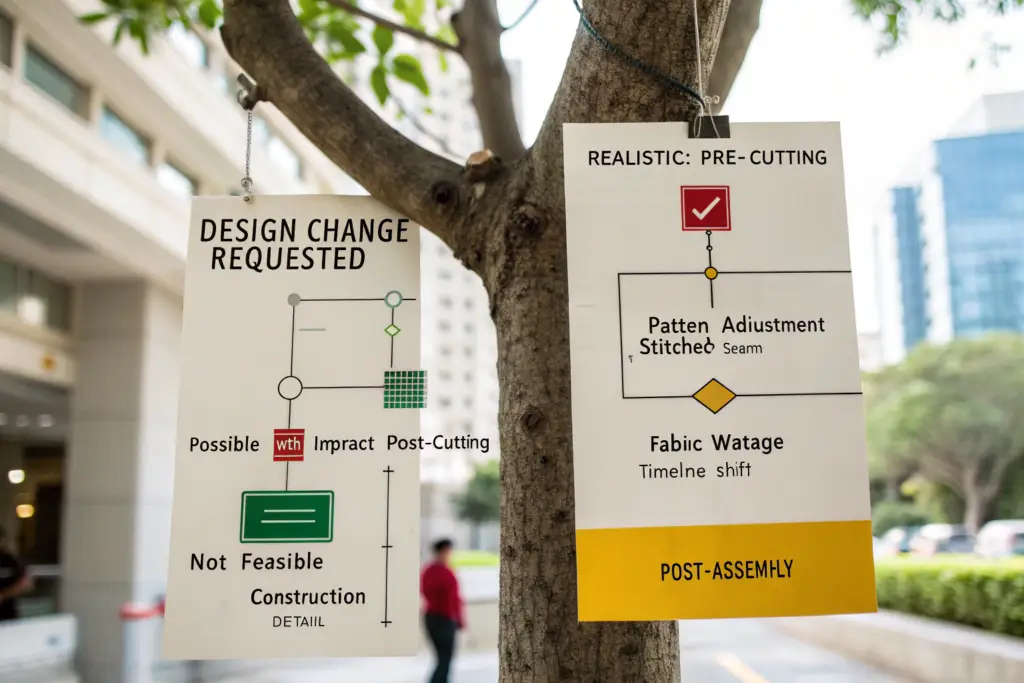
Changes requested before fabric cutting are the easiest and least costly. The pattern can be adjusted digitally. The fabric is untouched. The cost is limited to the pattern revision time. The timeline impact is minimal, often zero if the revision is quick. Changes requested after cutting but before sewing are possible but more costly. Cut panels may need to be discarded and re-cut, resulting in fabric wastage. The timeline is impacted by the re-cutting and any new material sourcing. Changes requested after assembly and finishing are the most difficult, costly, and risky. Completed seams may need to be unpicked. New components may need to be attached. The labor cost is high. The risk of damaging the garment is significant. The timeline impact is substantial. We advise clients to avoid post-assembly changes whenever possible, and we explore alternative solutions, such as a small-batch reorder or selling the existing stock and incorporating the change into the next production run. The impact of change timing in garment production is a critical concept for every brand owner to understand.
Can We Substitute Trims or Fabrics If There Is a Supply Issue?
Yes, trim or fabric substitution due to unforeseen supply chain issues is a specific, common type of change that we manage proactively. If a specific zipper, button, or fabric finish becomes unavailable or suffers a quality failure, we do not simply halt production and send you a panic email.
We immediately source functionally and aesthetically equivalent alternatives from our approved supplier network. We present you with the specific alternative, complete with a physical or photo sample, the technical specifications, and the cost comparison. We explain why the substitution is necessary and why this alternative is the recommended solution. We obtain your written approval before proceeding with the substitution. This proactive, solution-oriented approach to supply chain disruptions minimizes delays and keeps the production moving. The trim and fabric substitution due to supply chain issues is managed as a collaborative problem-solving exercise, not a crisis communication.
How Do We Minimize the Cost and Time Impact of Late Changes?
The Los Angeles brand owner's collar change caused a two-day delay. For a normal sea freight shipment, a two-day delay could mean missing the vessel, waiting a week for the next one, and arriving ten days late. A two-day production delay can cascade into a two-week delivery delay if not actively managed.
Minimizing the impact of a late change requires having pre-planned mitigation strategies that can be activated immediately. We do not just report the delay. We present a menu of options to recover the timeline or minimize the financial damage.

Can We Use Air Freight or Partial Shipments to Recover a Delayed Timeline?
Yes. These are standard, pre-discussed acceleration options that we can activate when a late-stage design change impacts the delivery date.
If a design change causes a delay that threatens the original sea freight vessel, we can upgrade all or part of the shipment to air freight. We present the exact additional cost and the revised, earlier delivery date. For a change that affects only a portion of the order, we can split the shipment: the unaffected portion ships via sea freight as originally planned, and the affected, delayed portion ships via air freight to catch up. This minimizes the air freight cost by only applying it to the delayed units. For the Los Angeles collar change, the two-day delay meant missing the original vessel. We presented the option of air freighting the entire order, which was cost-prohibitive, or air freighting the first 200 units for the department store's initial floor set and sea-freighting the remaining 400 units. The client chose the partial air freight option. The department store received their initial stock on time. The air freight and partial shipment solutions for timeline recovery are pre-planned and rapidly executable.
How Does Our Modular Production System Help Absorb Small Changes?
Our modular production system, with its self-contained production cells, is inherently more flexible and adaptable to late changes than a traditional long assembly line.
If a change only affects a specific component, like a collar or a pocket, we can isolate the change to a specific module or workstation without disrupting the entire line. The modular team can be quickly retooled with a new jig or a new attachment. The rework of in-process units can be handled by the module as a parallel task. The flexibility and adaptability of a modular system mean that small, localized design changes can often be absorbed with minimal impact on the overall production flow and timeline. The modular manufacturing flexibility for design changes is a structural advantage of our production architecture.
Conclusion
A last-minute design change is not a failure of planning. It is often a response to real-time market feedback, a buyer request that opens a significant sales opportunity, or a creative refinement that elevates the collection from good to great. The right manufacturing partner does not resist change. They manage it with a structured, transparent protocol that assesses feasibility honestly, communicates cost and timeline implications clearly, and actively works to minimize disruption through pre-planned mitigation strategies. At Shanghai Fumao, we have built our Change Order Protocol, our cross-functional rapid assessment process, and our flexible modular production system, specifically to support the creative and commercial agility that successful brands require.
If you are working on a collection and anticipate potential design iterations, or if you are currently facing a late-stage change with a rigid supplier, I invite you to test our collaborative approach. Contact our Business Director, Elaine, at elaine@fumaoclothing.com. Describe the change you are considering. Ask her for a rapid feasibility assessment. Evaluate the speed, the transparency, and the solution-oriented nature of her response. Let that interaction demonstrate how a true manufacturing partner handles the inevitable pivots of the fashion business.