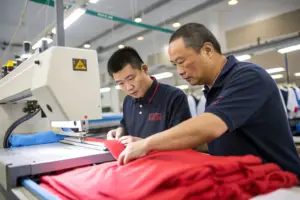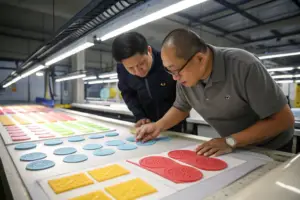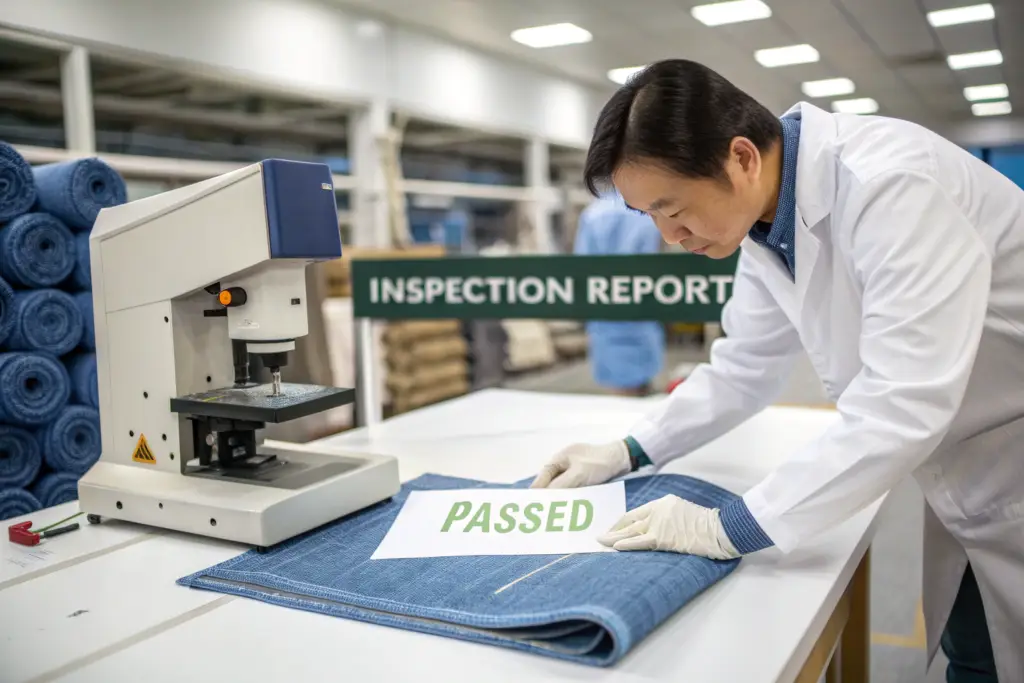
I will let you in on a frustrating secret I see almost weekly. A distributor in America receives a PDF from their supplier titled "4-Point Inspection Report." The file shows a score of 18 points. The distributor sees "18" and "Pass" and thinks, "Great, the fabric is perfect." They wire the balance payment. Six weeks later, they open the carton and find shirts with horizontal bars running across the chest. The factory says, "It was within tolerance." The distributor is left with 2,000 unsellable units. The report was technically correct, but it was a lie by omission.
A standard fabric inspection report is not a binary "good" or "bad" document. It is a coded message that requires you to understand the specific test methods, the acceptable quality limits for your market segment, and the difference between a cosmetic flaw and a structural failure. Learning to read the data behind the 4-point system protects your profit margin from surprise chargebacks and retail rejections.
I learned this lesson the hard way years ago before I understood the science behind the numbers. I shipped a container of striped woven shirts to a client in Chicago. The stripes matched perfectly on the cutting table. They didn't match after the first home laundry cycle. That's when I realized the inspection report was only half the story. Let me show you how to get the full picture.
Why Is the 4-Point System Not Enough to Guarantee Quality Fabric?
Many buyers treat the 4-Point System like a gospel. It is the industry standard for visual defects, but it has a massive blind spot. The system assigns penalty points based on the size of a hole or a stain. A hole bigger than 1 inch gets 4 points. A stain between 3 and 6 inches gets 3 points. You tally the points per 100 square yards. If the total is under 40 points, the fabric "passes" inspection.
However, the 4-Point System only measures what the inspector can see on the surface of the roll at that exact moment. It does not predict what will happen to that fabric after it is cut, sewn, washed, and worn. A fabric can score a perfect "Zero Points" on visual inspection and still be a catastrophic failure due to hidden chemical or physical instability.
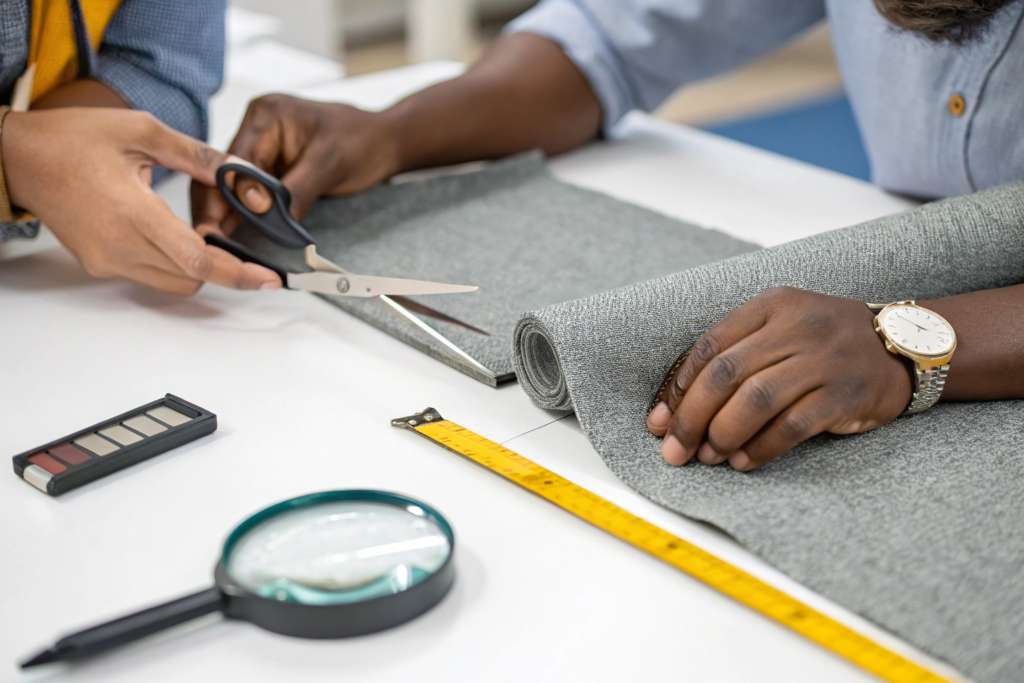
What Is the Difference Between a 'Major' Defect and a 'Critical' Defect?
This is where the language of the report matters more than the score. I worked with a brand owner in Texas last summer who was launching a premium line of men's dress shirts. The inspection report from the fabric mill showed a score of 12 points—well within the passing limit. But when I reviewed the raw data photos they shared with me, I noticed the description for two of the defects: "Slub - 2 inches."
In the report's legend, a "Slub" was classified as a Minor Defect. But for a premium dress shirt selling for $89, a thick, lumpy yarn in the chest area is not minor. It is a Critical Defect because it ruins the aesthetic. The factory's 4-Point standard uses a generic tolerance for mass-market t-shirts. You need to adjust the tolerance based on your final product price point.
Here is how we at Shanghai Fumao re-classify defects for our clients compared to the generic industry standard:
| Defect Type | Industry Standard Classification | Shanghai Fumao Classification (For Premium Brands) | Reason for Stricter Standard |
|---|---|---|---|
| Slub / Thick Yarn | Minor (If 1.5 lbs for lightweight wovens | Durability: Ensures the seat seam doesn't rip when a customer bends over. |
I recall a specific issue we caught in November 2025. We were running 1,500 yards of a beautiful dark green twill for a brand in Seattle. The visual inspection was flawless. The 4-Point score was 8. But the lab crocking test came back with a Wet Crocking score of 2.5. That meant the green dye was not properly fixed. If we had shipped that fabric, the customer's sweat would have turned their undershirt green. We caught it at the greige stage, re-processed the dye fixation, and saved the client a $20,000 product recall. That data point never shows up on a simple 4-Point tally.
How Do You Verify Fabric Weight and Shrinkage Claims from Overseas?
This is the most common area where I see miscommunication between Chinese suppliers and American distributors. A distributor specs a "200 GSM Heavyweight T-Shirt." They receive a shipment that feels thin and flimsy. The factory sends a test report showing "Weight: 200 GSM." Both sides are angry. Who is right? Usually, the factory is measuring the weight of greige fabric before dyeing, while the distributor is feeling the finished weight after shrinkage and softening wash.
Verifying fabric weight claims requires you to mandate the testing standard in the purchase order. You must specify whether the weight should be measured "As Received" from the mill or "After Wash." Furthermore, understanding the relationship between a fabric's cuttable width and its shrinkage percentage is essential for accurate costing and pattern making.
What Is the Correct Way to Measure Fabric Weight (GSM)?
GSM stands for Grams per Square Meter. It is the only universal language for weight. Avoid "ounces per square yard" in your tech pack if you can, because the conversion (divide oz/yd² by 33.906) often leads to rounding errors that factories exploit.
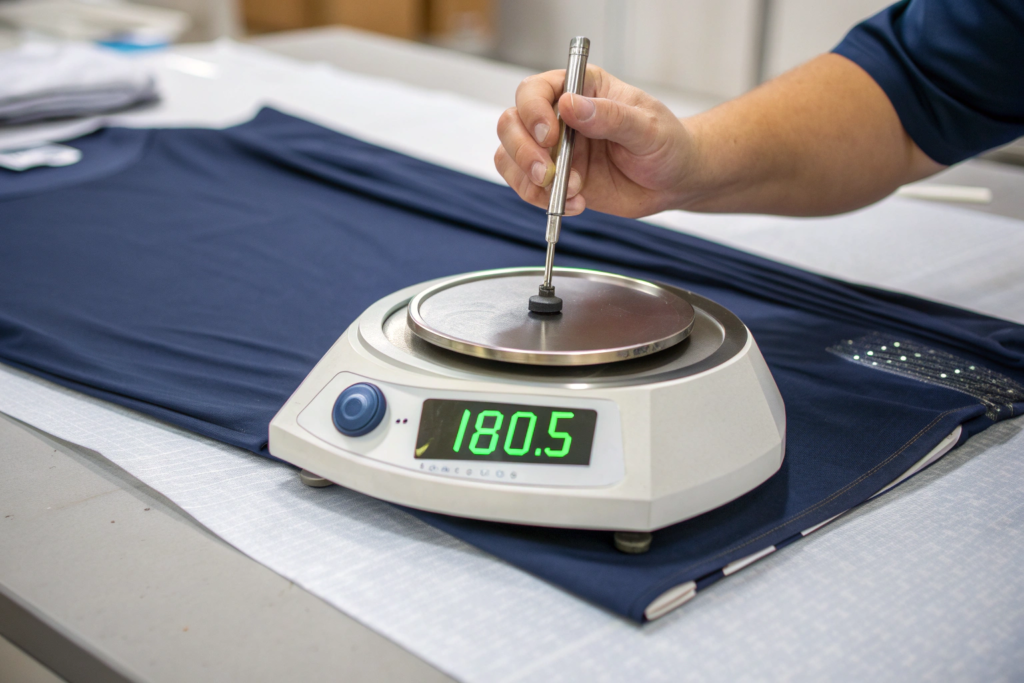
Here is the process we follow at Shanghai Fumao to ensure a client's "180 GSM" polo shirt actually feels like a 180 GSM polo shirt:
- Sampling Method: We use a precise GSM Round Cutter. This tool cuts a perfect circle of fabric with an area of exactly 100 square centimeters.
- Weighing: We place that circle on a calibrated digital scale. Multiply the reading by 100 to get GSM.
- The Wash Variable: This is the critical part. We weigh the fabric "As Is" and then "After 1 Home Laundry Cycle" (AATCC 135).
I had a client from Denver who was furious that his 200 GSM hoodies felt like 180 GSM. I asked him to send me a physical sample he had received from a different factory for comparison. I cut the swatch myself. The fabric was 200 GSM... when it was bone dry and stretched flat on the inspection table. After one wash, the yarns relaxed and the fabric shrank in dimension. The post-wash thickness measured 210 GSM. It felt heavier because it was denser and shorter.
The lesson? You must look for Dimensional Stability data on the report. This is commonly tested under AATCC 135. If the report says "Length Shrinkage: -5%," your 200 GSM fabric will effectively become 210 GSM in the garment. That might be good for thickness, but it ruins the fit of the body length.
How Much Shrinkage Is Actually Acceptable for Woven and Knit Fabrics?
This depends entirely on the fiber content, but too many buyers accept "5% shrinkage" as a standard answer. 5% on a 30-inch inseam is 1.5 inches. That is the difference between a regular fit and a high-water flood pant.
Here is a practical guide based on our quality control data from the last 12 months of production for the US market:
| Fabric Type | Typical Expected Shrinkage (Max) | How to Compensate in Pattern Making |
|---|---|---|
| 100% Cotton Jersey (T-Shirt) | Length: 5-7% / Width: 3-5% | Add 2 inches to body length pattern. |
| Cotton/Poly Blend (Activewear) | Length: 2-3% / Width: 1-2% | Minimal compensation needed. |
| 100% Cotton Twill (Chino Pants) | Length: 3-4% / Width: 1-2% | Pre-shrink fabric before cutting. |
| Rayon/Viscose Challis (Blouse) | Length: 8-10% / Width: 5% | Danger Zone. Requires a full wash of fabric rolls before cutting. |
I remember a specific issue with a women's fashion line in New York last spring. They ordered a beautiful printed rayon fabric for a midi dress. The factory's inspection report noted "Shrinkage: 8%." The buyer saw that number and approved it without reading the fine print. The fine print said "Test Method: AATCC 135 (I)." The "(I)" stands for One Wash Cycle. The problem? Rayon keeps shrinking over multiple washes. By the third wash, that dress was 4 inches shorter than the spec.
At Shanghai Fumao, when we work with rayon or viscose, we always run the AATCC 135 (III) test—that is Three Wash Cycles. We then adjust the pattern based on the fully relaxed dimensions. This prevents the "I loved this dress until I washed it" return reason. You should always check the specific test method suffix on the report. It changes everything.
What Specific Data Points Predict Fabric Performance After Washing?
Fabric performance is not about how it looks on the cutting table. It is about how it behaves after it meets water, heat, and agitation. A garment that loses its shape or pills up after three wears generates returns. Returns kill cash flow. The data to predict this is often buried in the back pages of a mill test report under terms like "Spirality" or "Pilling Resistance."
Advanced testing metrics like Spirality (torque) and Pilling Resistance are direct predictors of customer satisfaction and brand reputation. A distributor who ignores these sections of the report is effectively gambling that their end customer won't notice twisted side seams or fuzzy sweaters. In the competitive US market, they absolutely will notice.
Why Does 'Spirality' Matter for Your T-Shirt Side Seams?
This is my favorite "gotcha" in the knitwear world. Spirality is the tendency of a knitted tube of fabric to twist. You see it when you lay a t-shirt flat and the side seam curves from the armpit toward the belly button instead of hanging straight down.
Spirality is caused by the twist of the yarn itself. Single jersey fabric wants to untwist. If the factory does not properly "set" the fabric during finishing (using a compactor or cross-lay spreader), the twist will show up after the first wash.
I recall a batch of premium heavyweight t-shirts we produced for a streetwear brand in Los Angeles in early 2025. The factory we partnered with for knitting provided a report showing "Spirality: <3%." That is the industry standard for "acceptable." But for a $60 t-shirt, 3% twist on a 20-inch body width is 0.6 inches. That is a visible curve.
We rejected that lot of fabric. We sent it back to be re-processed on a Tubular Compactor. This machine uses steam and pressure to overfeed the fabric and neutralize the yarn torque. The second inspection report showed "Spirality: <1%."
How do you read this on a report? Look for AATCC 179. The lower the percentage, the straighter the seam. If you are buying ring-spun cotton or slub yarn, you must see this data. If the report does not list spirality testing, assume the fabric will twist.
How Can You Verify Pilling Resistance Before Production?
Pilling is those annoying little fuzz balls that form on sweaters and fleece. It is caused by loose fibers tangling together during wear and washing. A fabric can be soft as a cloud but pill like crazy.
There is a specific machine for this test called a Martindale Abrasion Tester. It rubs the fabric against itself or a standard wool abrader in a figure-eight motion. After a set number of rubs (usually 500, 1,000, or 2,000 cycles), the lab technician compares the fabric to a visual rating scale.
The scale is 1 to 5. 5 is no change. 1 is severe pilling.
| Rating | Visual Appearance (After 1,000 Rubs) | Action for Distributor |
|---|---|---|
| Grade 4-5 | Slight fuzziness, no pills. | Excellent. Suitable for premium activewear. |
| Grade 3-4 | Moderate fuzz, few small pills. | Acceptable for budget fleece or fashion sweaters. |
| Grade 2-3 | Distinct pills covering surface. | Reject. Will look worn out after 3 washes. |
Last winter, we were sourcing a brushed fleece for a client in Michigan. The initial test came back as Grade 2.5 for pilling. The fabric was incredibly soft, which the buyer loved. But we advised against using it for the high-friction areas (underarm and sides). We found an alternative fleece with a tighter twist yarn that tested at Grade 4.0. It was slightly less soft to the initial hand feel but retained its appearance for the life of the garment.
The key is that this test is governed by ASTM D4970 (for Martindale). If you are buying any brushed, fuzzy, or wool-blend fabric, you need to see a pilling grade on the inspection report. It is the single best predictor of whether the garment will look new for 6 months or 6 weeks.
How Can You Use Tech Packs to Eliminate Fabric Inspection Disputes?
The most expensive disputes are the ones where both sides are technically "right." The distributor says, "This fabric is too light." The factory says, "We delivered what you ordered." The distributor points to a sample they bought at a store. The factory points to a purchase order that only says "Black Jersey."
A detailed Tech Pack serves as the legally binding supplement to the fabric inspection report. It translates subjective descriptions like "soft" or "heavy" into objective, measurable standards. By locking in the exact test methods and tolerance ranges before the lab cuts the first swatch, distributors can pre-empt 90% of quality control arguments.

Why Are Tolerance Ranges More Important Than Target Specs?
Every fabric mill has a +/- allowance. This is reality. You cannot order "100% exact 200 GSM." Nature (cotton) and machinery have variance. The question is: how much variance will you accept?
If you leave the tolerance blank, the factory will apply their own standard—which is often +/- 7% to 10% for weight. That means a "200 GSM" order could legitimately arrive at 180 GSM or 220 GSM. Both pass inspection according to the factory's internal rules.
We always advise clients to specify +/- 5% for weight and +/- 3% for width. But here is the advanced tactic: Specify the tolerance direction.
For example:
- Weight: Minimum 190 GSM. Not "+/- 10 GSM."
- Width: Minimum 58 inches cuttable. Not "60 inches open width."
Why minimum? Because you pattern for the minimum width. If the fabric comes in narrower than 58 inches, you cannot cut your marker. You lose yield. You lose money.
At Shanghai Fumao, we use a shared digital spec sheet. When a client uploads their tech pack, we run a pre-production meeting where we physically sign off on the tolerance for each row. This is how we avoided a huge issue with a plus-size women's wear brand from Atlanta. Their pant pattern required 60 inches of cuttable width. The mill offered a roll that was "60 inches total width." But the selvage (the woven edge) took up 1 inch on each side. The cuttable width was only 58 inches. Because we had "Minimum 59" Cuttable" in the tech pack, we rejected the roll before it hit the cutting table. That is the power of precise language.
How Do You Standardize Color Approval Across Continents?
This is the single biggest headache in remote sourcing. "Navy" is a feeling. It is not a color. I have seen ten different versions of "Navy" in one week.
You cannot rely on a photo taken with an iPhone in a fluorescent-lit factory. The inspection report must reference a color standard that is universal.
We require clients to provide Pantone Fashion, Home + Interiors (FHI) codes. We do not accept "TCX" (Textile Cotton) codes for synthetics because the dye absorption is different. We then use a Spectrophotometer to measure the Delta E (color difference) between the bulk fabric and the Pantone chip.
Here is what the numbers mean in the real world:
| Delta E (dE) Value | Visual Perception | Industry Standard for Apparel |
|---|---|---|
| dE 2.5 | Obvious difference. Looks like a different shade. | Reject. Will cause returns if customer buys two pieces of same "color." |
We share the spectrophotometer reading in the inspection report. It looks like a series of graphs called a Spectral Curve. You don't need to understand the physics. You just need to look for the "dE" number. If it is above 2.0, and your brand is strict about color consistency (think bridesmaids dresses or uniform programs), you must reject the dye lot.
We worked with a corporate uniform company in Chicago where color consistency was critical. The Pantone matching was non-negotiable. By using a lightbox (D65 daylight simulation) and a spectrophotometer for every single roll, we maintained a dE of under 1.0 for an entire 5,000-unit order. The client's procurement manager said it was the first time in three years they didn't have to sort incoming cartons by "shade banding." That saves them thousands in warehouse labor.
Conclusion
Reading a fabric inspection report is like reading a medical lab result. You cannot just look at the word "Normal" at the top and assume you are healthy. You must look at the specific metrics: the GSM, the dE value, the Spirality percentage, and the Pilling Grade. A perfect 4-Point score means nothing if the color bleeds onto your customer's white couch or the side seam twists into their armpit after one wash.
The difference between a profitable season and a season lost to chargebacks is hidden in these numbers. It requires you to ask for the AATCC test methods, not just the pass/fail stamp. It requires you to set minimum cuttable widths in your tech pack, not just target weights. And it requires a factory that understands that "Major" and "Minor" defects are defined by your brand's retail price, not by a generic factory chart.
At Shanghai Fumao, we believe that education is the best way to prevent disputes. We would rather spend an extra hour explaining a shrinkage report before cutting than spend a week negotiating a discount after delivery. We are a factory with five production lines, but more importantly, we are a team of engineers and craftspeople who speak the language of ASTM and AATCC.
If you are tired of gambling on fabric quality and want a partner who provides lab-verified data with every shipment, I encourage you to reach out.
To discuss your specific fabric requirements or to get a second opinion on an inspection report you recently received from another supplier, please contact our Business Director, Elaine. She can connect you with our quality assurance team for a detailed technical review. You can email her directly at elaine@fumaoclothing.com. Let's make sure your next shipment meets the numbers that matter.