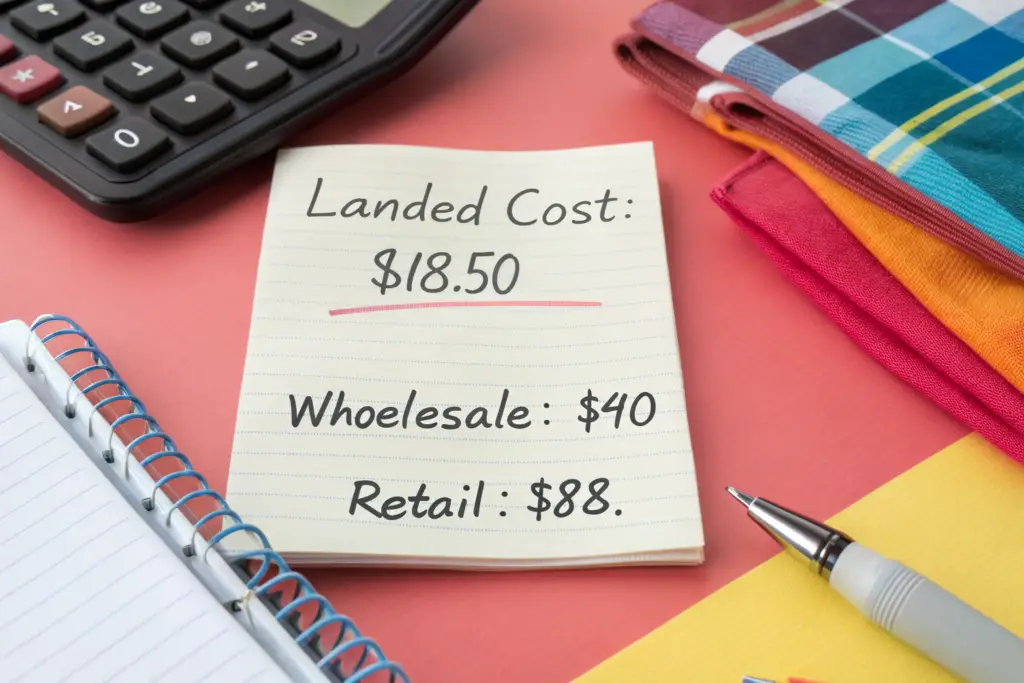
You found the perfect supplier. The samples are beautiful. The landed cost is $22 per dress. You feel great. You decide to price them at $55 retail. That is a 2.5x markup. You think you are making money. Then you run a Facebook ad. It costs $12 to acquire a customer. You offer free shipping. That is $8. You have a 15% off welcome discount. That is another $8.25. Suddenly, your $55 dress is netting you $26.75 after ad spend and discounts. You paid $22 for it. Your gross profit is $4.75. You forgot about credit card fees, returns, and your own salary. You are losing money on every sale and you do not even know it yet. This is the most common math error in the apparel industry. Let me show you how to fix it.
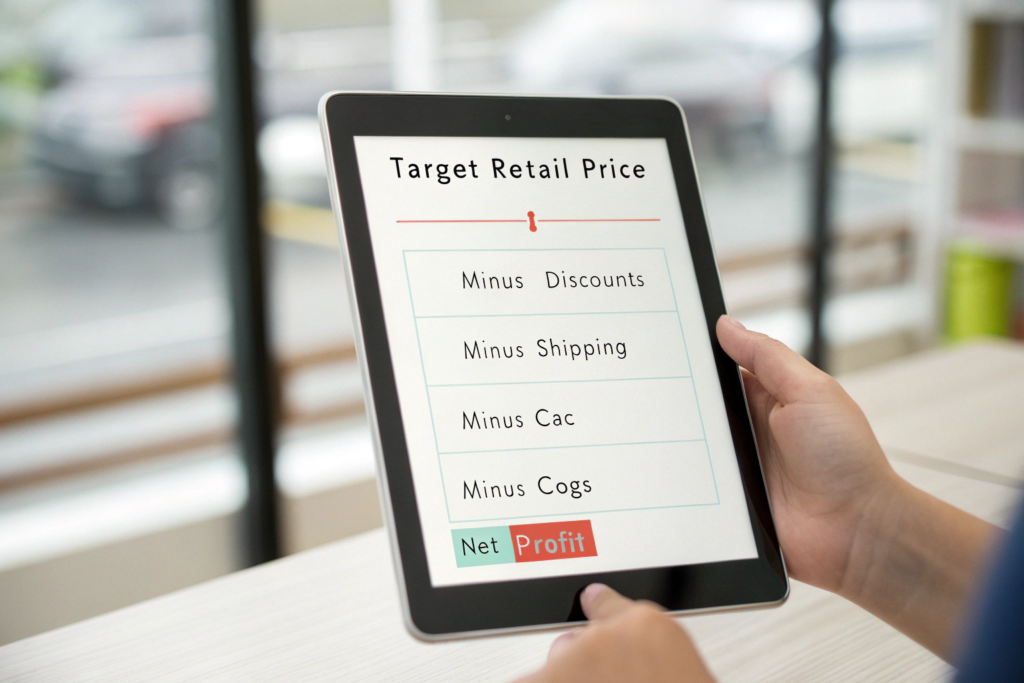
Calculating the perfect retail markup for wholesale clothing imports requires building a “Backward Margin Model” that starts with your desired Net Profit and works backward through all variable costs to arrive at the Minimum Retail Price. The traditional formula of “Cost x 2.5 = Retail” is dangerously simplistic for an import business. The correct formula is: (Total Landed Cost Per Unit + Fulfillment Cost + Marketing Cost Per Order) / (1 – Target Net Margin Percentage – Return Reserve Percentage – Discount Allowance Percentage). For a healthy direct-to-consumer apparel brand, the retail price should typically be 3.5x to 4.5x the landed cost. A 2.5x markup might work for wholesale-to-retailer models, but it is a path to bankruptcy for DTC. The difference lies in the cost of customer acquisition, which is absorbed by the retailer in a wholesale model but paid directly by the brand in DTC.
At Shanghai Fumao, I advise all my startup clients to build their pricing model before they even approve the first sample. The fabric choice and construction details must fit within the math. Let me walk you through the exact model we use to keep brands profitable.
Why Does the “2.5x Keystone Markup” Fail Importing Brands?
The “keystone” markup is retail folklore. It comes from a time when a boutique owner bought a dress for $20 from a domestic wholesaler, put it on a rack, and sold it for $50. The $30 gross profit covered the rent, the electricity, and the owner’s time. It worked because there was no Facebook ad manager to feed. There was no “free shipping” expectation. There was no influencer gifting budget. You are operating in a completely different economic environment. When you import, you have a cost advantage, but you also have new costs. You have freight. You have duties. You have warehousing. If you apply a 2.5x markup on your landed cost, you are pricing like a brick-and-mortar store but spending like a digital brand. The math does not work.
The 2.5x keystone markup fails importing brands because it ignores the four “Margin Eroders” unique to the modern DTC and e-commerce landscape. First, Customer Acquisition Cost (CAC) now consumes 15-30% of the retail price for a new brand running paid ads. Second, “Free Shipping” is no longer a perk; it is a conversion requirement that costs 8-12% of the order value. Third, Return Rates for online apparel average 20-30%, and each return costs the brand $7-$12 in reverse logistics and restocking labor. Fourth, Discounting Culture means the average unit sells for 10-15% below the ticketed price due to welcome codes, SMS signup offers, and seasonal sales. When you sum these four factors, they can easily consume 50-60% of the retail price. A 2.5x markup leaves only 40% of the price to cover these costs AND the cost of goods AND profit. The math is simply impossible.
At Shanghai Fumao, we often help clients reverse-engineer their target retail price to determine what their maximum landed cost can be.

How Much of Your Retail Price Actually Goes to Meta and Google?
This is the number that shocks most new founders. They think, “I’ll just post on Instagram and go viral.” That is not a strategy. That is hope. Paid acquisition is the engine of most scaling DTC brands.
The blended Cost Per Acquisition (CPA) for a new apparel brand in 2026 is rarely below $15 on Meta. For a $65 dress, that is 23% of the revenue gone immediately. If you are selling a $40 t-shirt, a $15 CPA is 37.5% of revenue. You have not paid for the shirt, the shipping, or the rent yet.
I worked with a client in Austin last year. She was selling linen shorts with a landed cost of $19. She priced them at $48 (2.5x). Her Facebook ads were performing at a $14 CPA. After ad spend, she had $15 left to cover the $19 cost of goods. She was $4 in the hole on every single transaction. She was literally paying Meta for the privilege of sending out free shorts.
We helped her restructure. We found ways to reduce the landed cost slightly by adjusting the pocket construction. More importantly, we raised the retail price to $68. Her conversion rate did not drop. Her perception of value actually increased. At $68, she could afford the $14 ad spend and still have a healthy margin. The price point filtered out bargain hunters and attracted customers who valued the unique linen fabric. She became profitable within two weeks.
Why Is “Free Shipping” a Hidden Tax on Your Markup?
You cannot charge for shipping in 2026 and expect to convert cold traffic. Amazon Prime has conditioned everyone. Free shipping is table stakes.
If you are using a 3PL, shipping a 1lb poly mailer across the country costs roughly $6-$8 on average. On that $55 dress, that is 12-14% of the retail price. If you are using a 2.5x markup, you have now lost another 12% of your revenue.
You must bake the average shipping cost directly into the retail price. Do not treat it as a separate line item in your mental accounting. The formula should be: Retail Price = (Landed Cost + CAC + Fulfillment) / (1 – Target Margin %).
For example, if you want a 20% net margin:
- Landed Cost: $22
- CAC: $14
- Fulfillment: $7
- Total Costs = $43
- Target Margin = 20% (which means costs are 80% of price)
- Minimum Retail Price = $43 / 0.80 = $53.75
Notice that $53.75 is almost 2.5x the $22 landed cost. But at $53.75, you are making 20% profit. At $55 (a simple 2.5x), you are making closer to 15% profit. Small changes in the multiplier have massive impacts on the bottom line.
How Do You Build a Bulletproof “Backward Margin” Pricing Model?
You need to stop guessing. You need a spreadsheet. You need to input your real costs and let the math tell you the minimum price. This is called a Backward Margin Model. You start with the profit you need to make to sustain the business, and you work backward to find the required retail price. If that retail price is unrealistic for the market, you know you have a sourcing problem (landed cost too high) or an efficiency problem (CAC too high). This model removes emotion from pricing. It replaces hope with arithmetic.
Building a backward margin pricing model involves creating a “Waterfall Analysis” of the unit economics. The specific steps are: (1) Define Target Net Margin (Usually 15-25% for healthy DTC brands), (2) Estimate Return Reserve (Budget 3-5% of retail price to cover return shipping labels and lost inventory value), (3) Estimate Discount Allowance (Budget 10% of retail price for site-wide sales and promo codes), (4) Add Fixed Transaction Costs (Credit card fees of 2.9% + $0.30), (5) Add Variable Fulfillment (Average pick/pack/ship cost from your 3PL or self-fulfillment), (6) Add Blended CAC (Your average cost to acquire a customer across all channels), (7) Add Landed Cost Per Unit. The sum of steps 2 through 7 is your “Break-Even Price.” You then divide that sum by (1 – Target Margin) to get the Minimum Retail Price. This is the non-negotiable floor for your business.
At Shanghai Fumao, we often use a simplified version of this model to help our clients understand if a particular fabric or construction detail is “affordable” for their target market.
What Is a Realistic Net Margin Target for an Imported Apparel Brand?
You read about software companies with 80% gross margins and feel inadequate. Apparel is a physical goods business. Margins are thinner.
A healthy, sustainable DTC apparel brand should target a Net Profit Margin of 15-20% after all expenses, including the owner’s market-rate salary. Many brands operate at 5-10% net for the first few years while they scale. Some never get above 5%.
You must be honest about the owner’s salary in this model. If you are taking a $60,000 salary, that is $5,000 per month. If you sell 500 units a month, that salary costs $10 per unit. You must account for that in the “Fixed Costs” portion of the model, or you must accept that the business will not pay you for the first two years. Both are valid paths, but you must choose one consciously.
| Here is a realistic pro-forma for a $65 dress: | Line Item | Amount | % of Retail |
|---|---|---|---|
| Retail Price | $65.00 | 100% | |
| Discounts & Returns Reserve | -$6.50 | 10% | |
| Credit Card Fees | -$2.20 | 3.4% | |
| Fulfillment (3PL) | -$7.00 | 10.7% | |
| Customer Acquisition (CAC) | -$14.00 | 21.5% | |
| Net Revenue | $35.30 | 54.3% | |
| Landed Cost of Goods | -$22.00 | 33.8% | |
| Gross Profit | $13.30 | 20.5% | |
| Fixed Costs (Rent/Software/Salary) | -$6.50 | 10% | |
| Net Profit | $6.80 | 10.5% |
This is a very realistic model for a brand doing mid-six figures in revenue. The 3.0x markup ($22 cost x 2.95 = $65 retail) yields a 10.5% net margin. To get to a 20% net margin, this brand would need to price closer to $78 (3.5x markup) or reduce CAC.
How Do You Account for the Cost of Returns in Your Markup?
Returns are the silent killer of DTC apparel margins. You sell a dress for $65. The customer returns it. You refund the $65. You also paid $7 to ship it to them. That money is gone. You also pay $5 for the return shipping label. That is $12 of cash outlay. The dress comes back. It is wrinkled. It might have deodorant marks. You have to pay someone $2 to steam and repack it. Your total loss on that transaction is $14 plus the lost opportunity to sell it to someone else while it was in transit.
You must build a Return Reserve into your pricing. A conservative estimate is to take your expected return rate (e.g., 20%) and multiply it by the cost of outbound and return shipping plus handling. If the average round-trip return cost is $12, and you have a 20% return rate, the cost per unit sold is $12 * 0.20 = $2.40.
That $2.40 must be included in your break-even calculation. You are paying $2.40 on every single unit sold to subsidize the ones that come back. This is a real cost of doing business online. Do not ignore it. If you do, you will wonder why you have no cash in the bank even though your “Gross Margin” looks great on paper.
How Can You Strategically Adjust Markup Based on Product Category and Perceived Value?
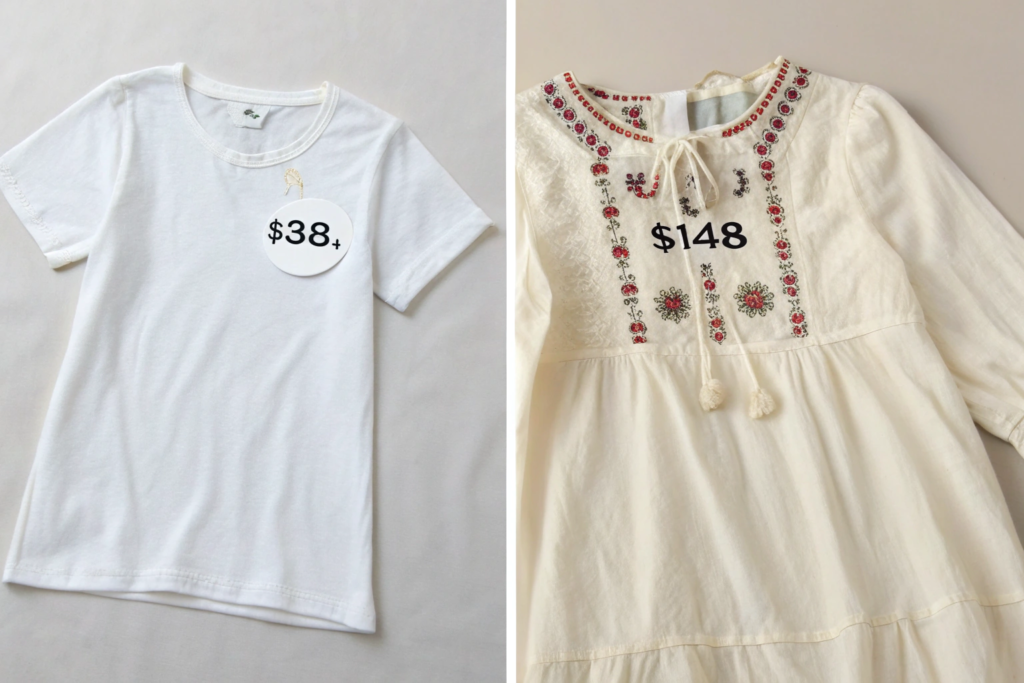
Not all garments are created equal in the eyes of the customer. A basic white t-shirt has a market ceiling. The customer knows they can get one from Uniqlo for $15 or Buck Mason for $45. Your ability to charge a 4x markup on a basic tee is limited unless you have a truly unique fabric story. However, a statement piece—a printed maxi dress, an embroidered jacket, a tailored pant in a rare color—has a much higher perceived value ceiling. The customer cannot easily find a comparable item. This allows for a higher markup. Smart importers use a “Good, Better, Best” markup strategy. They use basics to acquire customers (lower markup) and use fashion items to generate profit (higher markup).
Strategic markup adjustment based on product category involves recognizing the “Price Elasticity of Demand” for different garment types. Commodity items like solid t-shirts, hoodies, and sweatpants are subject to intense price comparison shopping. These items should target a 3.0x to 3.5x landed cost multiplier to remain competitive. “Better” items, like woven tops with unique prints or subtle design details, can support a 3.5x to 4.0x markup. “Best” items, which are high-involvement purchases like outerwear, dresses with complex construction, or pieces made from premium deadstock fabric, can sustain a 4.0x to 5.0x markup. The key is to balance the average markup across the entire collection. A brand might sell a $40 tee at a 3.0x markup to attract a new customer, and then sell that same customer a $150 dress at a 4.5x markup. The blended margin across the customer lifetime value is what matters, not the margin on the first purchase.
At Shanghai Fumao, we advise our clients to design their collection with this “margin ladder” in mind from the very first sketch.
How Do You Price a “Basic” Commodity Item for Profit?
You cannot charge $65 for a plain white crewneck t-shirt unless you have an incredible brand story (think James Perse or Asket). The market just will not bear it for a new brand.
So how do you make money on a basic tee with a landed cost of $9? You optimize for Average Order Value (AOV) . You accept a lower margin on the tee itself. You price it at $34 (3.7x markup). Your margin after CAC is thin, maybe $3-$5. But you do not sell the tee alone. You bundle it. You offer free shipping over $100. You use it to lower the barrier to entry.
I have a client who sells supima cotton tees. His landed cost is $11. He prices them at $36. He makes very little on a single tee order. But his AOV is $110 because people buy two tees and a pair of shorts. The shorts have a landed cost of $21 and sell for $78 (3.7x markup). The blended margin of the basket is healthy. He uses the tee as a “gateway drug.” This is a sophisticated strategy. You cannot look at unit margin in isolation. You must look at Contribution Margin per Order.
When Can You Justify a 5x or 6x Markup on an Imported Garment?
A 5x markup means a $20 landed cost dress sells for $100. Is that possible? Yes, but only under specific conditions.
You can justify a premium markup when the garment possesses “Scarcity Value” or “Technical Value.” Scarcity value comes from deadstock fabric (only 20 units made), complex hand-work (embroidery, smocking), or a highly specific fit that solves a real body problem. Technical value comes from performance fabrics (certified UV protection, antimicrobial properties) that are expensive to develop and source.
I recall a client who designed a linen wrap dress with hand-stitched embroidery on the sleeve. The landed cost was high—$34—because of the labor involved. A traditional 3x markup would have put it at $102. She was nervous to price it higher. We looked at the market. Similar dresses from Dôen or Christy Dawn were $200-$300. Her dress was unique. The customer could not reverse-image search it and find a cheaper version. She priced it at $178 (5.2x markup). It became her best-selling SKU. The high price signaled “luxury” and “craftsmanship.” She had to turn off ads because she could not keep it in stock.
The lesson here is that if your product is undifferentiated and available on Amazon, you are stuck with 3x. If your product is a unique expression of your brand’s point of view, you have pricing power. But you must build that uniqueness into the design and sourcing from day one.
How Should You Adjust Your Markup for Wholesale vs. DTC Channels?
You cannot sell a dress for $65 on your website and then try to sell it to a boutique for $35 wholesale. The math does not work. You would be losing money on the DTC side, or you would be pricing yourself out of the wholesale market. You must decide your primary channel before you set your pricing architecture. If you are a wholesale-first brand, you build your model backward from the retailer’s required margin. If you are DTC-first, you build from your own acquisition costs. Trying to do both with the same retail price is a recipe for channel conflict and margin erosion.
Adjusting markup for wholesale versus DTC channels requires building a “Two-Tiered” cost structure. For a wholesale-focused brand, the formula is: Wholesale Price = Landed Cost x 2.5 (minimum). The retailer then applies their own 2.2x to 2.5x markup to arrive at the MSRP. This means a $20 landed cost item wholesales for $50 and retails for $110-$125. The brand makes $30 gross profit per unit. For a DTC-focused brand, the formula is: Retail Price = Landed Cost x 4.0 (minimum). This allows the brand to absorb the $15 CAC and $8 fulfillment cost directly. A brand that attempts to operate both channels simultaneously must either (a) accept a lower margin on DTC sales to keep the retail price consistent, or (b) create “Wholesale Exclusive” styles that are not sold DTC at a discount.
At Shanghai Fumao, we ask our clients upfront: “Are you selling to stores or selling to consumers?” This answer dictates how we help them engineer the product cost.
What Is the Minimum Margin a Boutique Retailer Requires?
You cannot walk into a boutique and offer them a 2.0x markup opportunity (keystone). They will laugh you out of the store. Boutiques have rent, payroll, and slow months. They need margin to survive.
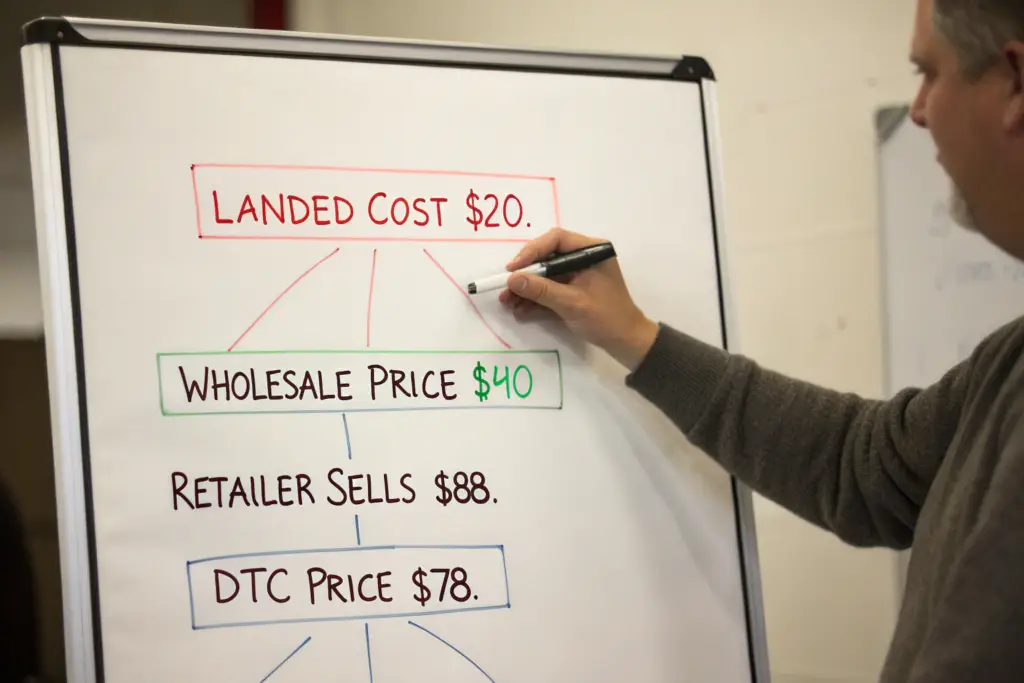
The standard boutique expectation is a 2.5x to 2.7x markup on wholesale cost. This means if you want the dress to retail for $100, your wholesale price to the store must be around $36-$40. This leaves the store with $60-$64 of gross profit to run their business.
If your landed cost is $20, and you sell wholesale for $38, your gross margin is $18 (47%). This is a tight but viable model for a wholesale brand. The key is that you have zero marketing cost in this model. The boutique does the marketing. Your $18 gross profit is pure contribution to overhead.
I have a client who runs a successful wholesale-only label. Her landed cost on a rayon crepe blouse is $14. She wholesales it for $34. It retails for $88. She makes $20 per blouse. She sells 3,000 units a year. That is $60,000 in gross profit before her overhead. She runs the business solo. It works because she does not spend a dime on Facebook ads. Her entire marketing budget is a trip to New York for Coterie trade show once a year.
How Do You Avoid Channel Conflict Between Your DTC Site and Your Wholesale Accounts?
This is the biggest tension in modern apparel. You want to sell DTC because the margins are higher. But if you undercut your retailers, they will drop you.
The golden rule is Price Parity. If the dress retails for $128 in a boutique, it must retail for $128 on your website. You cannot sell it for $128 in the store and $89 on your site. That is a betrayal of your wholesale partners.
So how do you make DTC profitable if you are tied to a 2.5x wholesale markup model? You have three levers:
- Offer Free Gifts, Not Discounts: Instead of a 30% off sale, offer a free tote bag with purchase. This preserves the perceived value of the garment.
- Sell “Web Exclusives”: These are styles or colorways that are only available on your site. You can price these with a higher DTC-specific markup because there is no retail comparison.
- Use Bundles: On your site, offer a “Complete the Look” bundle (Shirt + Pant) at a 10% discount. The bundle discount is less offensive to retailers than a straight item discount.
Managing this conflict is hard. Many brands eventually choose to go 100% DTC or 100% Wholesale to avoid the headache. But the brands that succeed at both treat their website as a marketing tool first and a discount channel last.
| Channel Strategy | Landed Cost | Wholesale Price | DTC Retail Price | Key Profit Driver |
|---|---|---|---|---|
| Wholesale Only | $18 | $45 | $110 (MSRP) | Volume and zero ad spend. |
| DTC Only | $18 | N/A | $78 | High margin absorbs CAC. |
| Hybrid (Balanced) | $18 | $45 | $98 | Avoid price undercutting; use exclusives. |
Conclusion
Calculating the perfect retail markup for your imported clothing is not about picking a random multiplier. It is about building a financial model that reflects the reality of your business costs. The days of blindly applying a 2.5x keystone markup are over for DTC brands. The cost of acquiring a customer online and shipping them a product has fundamentally reshaped the economics of apparel.
We have dissected why the old rules fail. We built a backward margin model that forces you to account for the silent killers: returns, discounts, and credit card fees. We explored how to strategically vary your markup based on whether you are selling a commodity basic or a unique statement piece. And we navigated the tricky waters of balancing wholesale and DTC pricing without destroying your relationships with retailers.
At Shanghai Fumao, our job is not just to sew clothes. Our job is to help our clients build viable businesses. We understand that the decision to add a $0.30 pocket detail changes the landed cost and ripples all the way through to the final retail price. We work with you to find the balance between construction quality and cost of goods that allows your pricing model to work.
If you are in the process of developing a new collection and you want to ensure your sourcing costs align with your retail pricing goals, let us help. We can review your tech packs and provide guidance on how different fabrics and construction methods will impact your landed cost. This allows you to make informed decisions before you commit to production.
You can reach out to our Business Director, Elaine. She can provide you with a transparent cost breakdown for your designs and help you understand the manufacturing variables that affect your ultimate retail markup.
Email: elaine@fumaoclothing.com