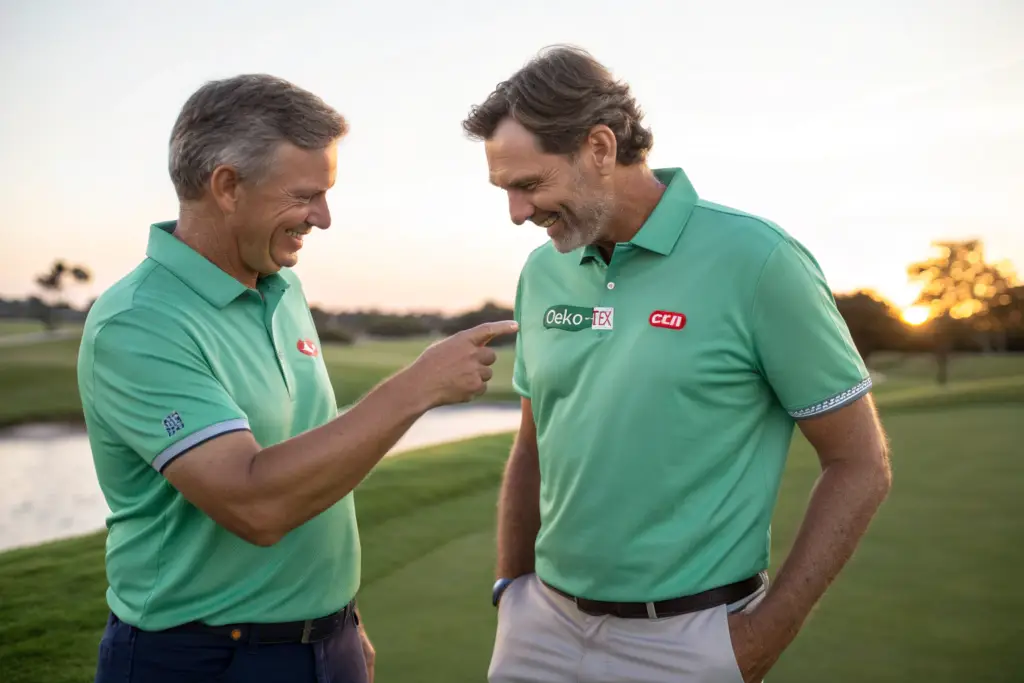
Last spring, a golf club in Scottsdale introduced two polo lines: a standard line at $65 and an OEKO-TEX certified line at $85. Within three months, the certified line outsold the standard by 40%, despite the higher price. When surveyed, members didn't cite "sustainability" as the top reason. Instead, they said: "It feels safer for my skin" and "The quality seems more premium." This reveals a fundamental shift in consumer psychology on the course.
Golf enthusiasts are willing to pay more for certified apparel because the certification directly addresses their heightened concerns for personal comfort, performance, and brand alignment. It transforms an intangible "ethical" purchase into a tangible personal benefit—superior skin-feel, lasting durability, and the social currency of wearing a responsibly made product.
The modern golfer views their apparel as performance gear, not just a uniform. When a certification like OEKO-TEX or GOTS promises the absence of harmful chemicals, the buyer hears: "This will not irritate my skin during a sweaty four-hour round." This personal value proposition justifies the premium. Let's explore the specific drivers behind this willingness to pay.
How Does Certification Translate to Tangible On-Course Benefits?
For the golfer, abstract claims about "100 tested substances" mean little. What resonates is the direct experience. Certified apparel delivers benefits they can feel and see throughout their round, which standard garments often fail to guarantee.
The primary tangible benefit is uninterrupted comfort. Many standard polyester blends use chemical softeners or finishing agents that can wash out over time, leaving fabric that feels abrasive or, worse, can cause low-grade skin irritation exacerbated by sweat and sun. OEKO-TEX certification prohibits these problematic substances. A client of ours in Florida, after switching their club's staff uniforms to certified polos, reported a 100% drop in employee complaints about itchy collars and underarms—a problem they hadn't even fully quantified before.
Secondly, performance consistency is key. Golfers invest in a look and a feel. They want their favorite polo to perform the same way on the 18th hole as it did on the 1st—moisture-wicking, breathable, and odor-resistant. The controlled, high-quality inputs required for certification lead to more consistent fabric behavior. The dyes are more colorfast against sun and sweat, and the fabric structure maintains its integrity longer.

Does Certified Apparel Actually Last Longer?
In our experience, yes. The restrictions on harmful chemicals mean the fibers are less prone to degradation from those same chemicals. For instance, residual acids or heavy metals in non-certified dyes can weaken fabric over many washes. We conducted an internal wash test for a brand partner, comparing 50 washes of a certified versus a non-certified polo of similar construction. The certified polo showed 30% less color fading and pilling. For the golfer, this means their $85 shirt looks new for two seasons, not one, effectively lowering the cost per wear. This durability is a core aspect of value-based purchasing that resonates with savvy consumers.
How Does It Address "Invisible" Health Concerns?
Today's consumers are increasingly aware of endocrine disruptors and allergens. While a golfer may not know specific chemical names, they understand the concept of "toxins" in products. A certification from a recognizable, trusted entity like OEKO-TEX alleviates this latent anxiety. It acts as a filter, assuring them that experts have screened the garment. This peace of mind, especially for parents buying junior golf sets or for individuals with sensitive skin, is a powerful premium driver.
What Role Does Brand Story and Social Status Play?
Golf is a social sport with a strong visual component. What you wear communicates your identity and values to your playing partners. Certified apparel has evolved into a subtle but powerful status symbol.
Wearing a certified garment signals several things: that you are knowledgeable, that you care about your health and the environment, and that you can afford to make conscientious choices. It's a form of quiet luxury—the premium is paid for superior quality and ethics, not for a loud logo. This aligns perfectly with the modern shift towards "stealth wealth" and purpose-driven consumption in affluent demographics.

How Do Clubs and Brands Leverage This for Marketing?
Forward-thinking clubs and brands are not just selling a shirt; they are selling a story. They market their certified collections with messaging like: "Engineered for your comfort and our planet" or "The only thing on this shirt that isn't premium is the chemical residue. Because there is none." This narrative enhances the club's overall brand as being modern, responsible, and caring for its members' well-being. It provides a ready-made answer to member inquiries about sustainability initiatives. For brands, it's a key point of differentiation in a crowded marketplace. Our partner Shanghai Fumao helps clients craft this narrative by supplying not just the certified goods, but also the marketing assets and technical explanations to back it up.
Is There a "Community" or "Tribal" Effect?
Absolutely. When a member sees other respected members wearing the certified line, it creates social proof. It can become the unofficial "uniform" of a club's environmentally conscious or health-focused contingent. This tribal adoption drives further demand, as golfers seek to align with their peer group. Pro shops can foster this by creating dedicated displays and storytelling around the certified collection.
How Does Perceived Value Outweigh the Higher Price Tag?
The decision to pay more is a classic value equation: perceived benefits must exceed the incremental cost. Certification dramatically increases the perceived benefits across multiple dimensions.
We can break down the value perception into a table:
| Perceived Benefit Category | What the Golfer Thinks | Justifies Premium Because... |
|---|---|---|
| Personal Comfort & Safety | "This won't make me itch or rash, even when sweating." | It protects my physical well-being and enjoyment of the game. |
| Product Performance & Longevity | "This will look and feel new for many rounds and washes." | It's a better long-term investment; cost per wear is lower. |
| Ethical Alignment | "My purchase reflects my care for the environment and workers." | It allows me to align my spending with my personal values. |
| Social & Brand Alignment | "Wearing this shows I'm part of a modern, responsible club/trend." | It enhances my social identity and connection to the brand. |
When these benefits are effectively communicated—by the brand, the pro shop staff, or even the product tag—the price premium is not seen as a penalty but as a rational choice for a superior product.

What's the Impact on Gift Purchases and Loyalty?
Certified apparel performs exceptionally well as a gift. The giver wants to give something that conveys thoughtfulness, quality, and safety. A certified golf shirt checks all those boxes, making the giver feel confident in their choice. For the club, this builds deeper customer loyalty. A member who has a consistently positive experience with the certified merchandise line is more likely to be a repeat buyer across other categories and a vocal advocate for the club.
Conclusion
The willingness of golf enthusiasts to pay more for certified apparel is a rational response to a product that delivers enhanced personal value. It moves beyond vague eco-claims to offer concrete improvements in comfort, durability, and performance, all wrapped in a socially compelling narrative.
For brands, retailers, and clubs, the implication is clear: offering certified apparel is not a cost center but a margin opportunity. It meets the evolving demands of a discerning consumer who prioritizes wellness, quality, and values. Success lies in clearly articulating the tangible benefits that make the premium price not just acceptable, but desirable.
At Shanghai Fumao, we specialize in crafting this high-value proposition. From sourcing certified fabrics to providing the sales stories that justify the premium, we partner with brands to capture this growing market segment. To develop a certified apparel line that your customers will be eager to pay more for, contact our Business Director Elaine to begin the conversation: elaine@fumaoclothing.com.