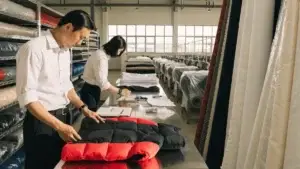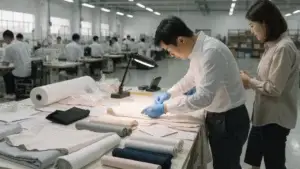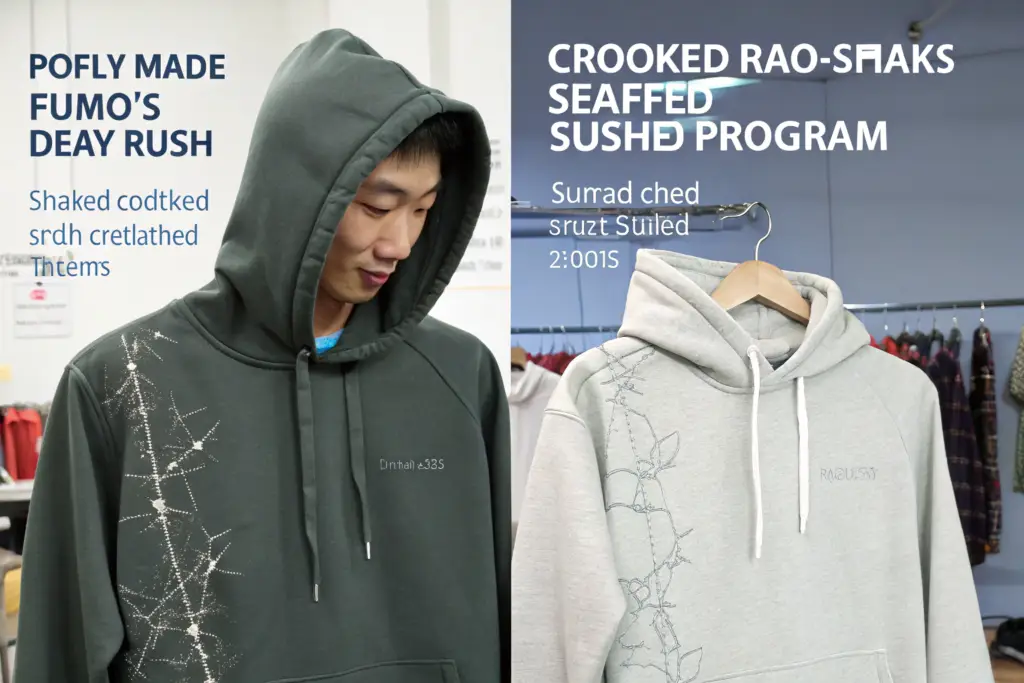
A streetwear brand owner from Los Angeles called me on a Tuesday morning in September. His collaborator—a famous musician—had just posted an Instagram story teasing a limited hoodie drop. The response exploded. He needed 400 custom heavy-weight hoodies with a complex puff-print design, in hand, within 16 days, or the hype window would close and the drop would flop. His regular supplier quoted him seven weeks. He thought his business was finished. We shipped those 400 hoodies in 14 days and 20 hours. He sold out in 12 minutes.
Yes, Shanghai Fumao can ship custom hoodies in 15 days by running a dedicated "Express Lane" production track that combines pre-stocked greige fleece, digital print-on-demand technology, and a parallelized cutting-to-packing workflow that eliminates sequential waiting times between departments.
Speed without quality is just a fast way to destroy your brand. A rushed hoodie with crooked seams or a print that cracks after two washes will generate returns that eat your profit. At Shanghai Fumao, we engineered our 15-day rush program around the principle that speed must come from smarter process design, not from cutting corners on stitch density or print adhesion. Here is exactly how we compress a 50-day timeline into 15 days without sacrificing a single quality checkpoint.
What Makes a Hoodie "Rush-Ready" Without Sacrificing Fabric Quality?
A standard hoodie production run starts with fabric sourcing. The brand picks a swatch. The factory orders the yarn. The mill knits it. The fabric is dyed. Then it is cut. That sequential chain alone eats 25 days before a single piece touches a sewing machine. You cannot rush dyeing chemistry. You can, however, skip the waiting entirely if you have already done the work. Our 15-day program works because we moved the "fabric waiting" phase out of the critical path.
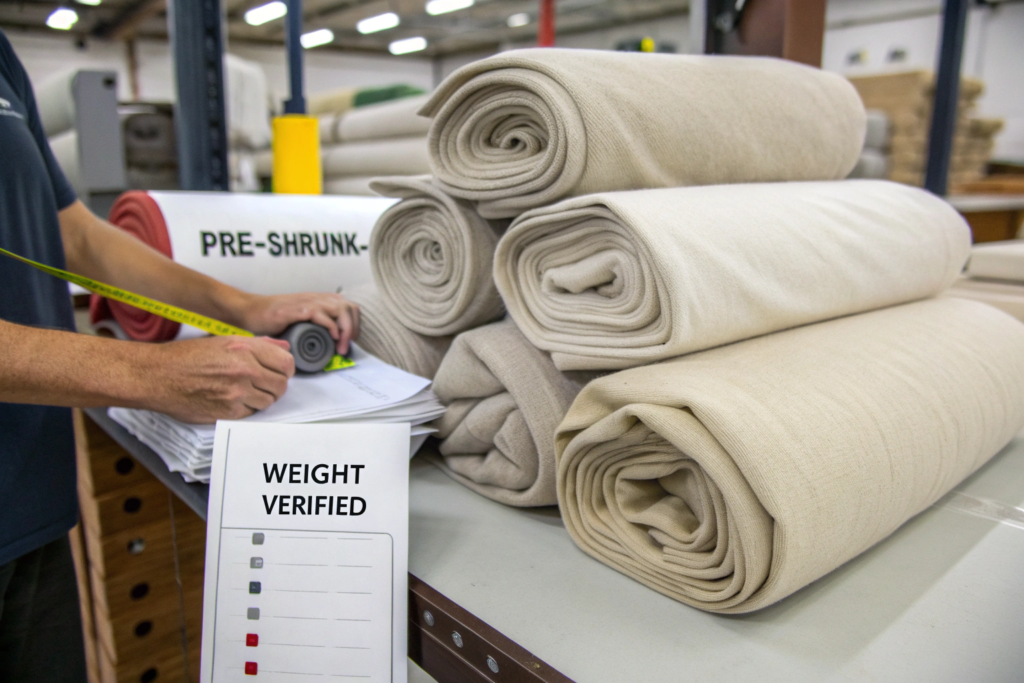
A hoodie becomes rush-ready when the factory pre-stocks a library of pre-shrunk, pre-tested greige fleece in 350GSM to 480GSM weights, allowing brands to select from verified base fabrics and skip the 20-day yarn-to-fabric lead time. The fabric is already waiting when the purchase order arrives.
We maintain a standing inventory of approximately 12,000 yards of core fleece—classic cotton-rich blend, brushed-back poly-cotton, and a sustainable recycled poly option. This is not speculation. These are the three substrates that account for nearly 85% of our custom hoodie orders. By narrowing the options to high-demand winners, we enable instant cutting without a fabric mill bottleneck.
How Does a Pre-Shrunk "Greige Library" Eliminate the 20-Day Knitting Bottleneck?
Greige fabric is un-dyed, unfinished cloth straight from the knitting machine. It breathes. It shrinks naturally. If you rush into cutting raw greige, the finished hoodie will shrink unpredictably after the first wash, and your size large will become a medium. We solve this by pre-processing our entire greige library through a controlled compaction shrinkage machine immediately after knitting. We sanitize and pre-shrink the fabric before storing it on the shelf.
This means that on Day 1 of your 15-day window, we pull fabric that already has a stable, measured shrinkage residual of less than 2%. A hoodie cut from pre-shrunk greige fits correctly after 50 washes. This would be impossible if we were sourcing fresh fabric from scratch. Standard textile pre-treatment follows test methods established by organizations like AATCC Test Method 135 for dimensional change, which defines the exact wash-and-dry cycles that a pre-shrunk fabric must survive.
Why Must the Base Fleece Weight and Yarn Twist Be Locked Before the Rush Order Starts?
I rejected a rush batch early last year because the knitter, trying to speed up, used a lower-twist yarn that felt softer on the table but pilled horribly after three washes. A rushed timeline invites suppliers upstream to take shortcuts unless you have locked the specification contractually. We have certified the yarn twist and fiber blend for every roll in our greige library with our knitting partners before the fabric ever enters our warehouse.
The weight tolerance is equally critical. A "400GSM" hoodie that actually weighs 370GSM is thinner, cheaper, and feels flimsy on the sales floor. Every roll in our rush-ready stock carries a barcode linking it to a pre-production test report that includes the actual grammage, twist factor, and a Martindale abrasion prediction. This ensures the rush hoodie feels exactly like the approved sample, a standard influenced by the construction parameters discussed in Cotton Incorporated's technical resources on fleece performance.
How Is a Digital Print-to-Pack Workflow Faster Than Traditional Screen Printing?
Screen printing is beautiful. I love the hand-feel of a properly cured plastisol print. But screen printing is slow for custom runs. For a 4-color design, a screen printer must expose four screens, mix four inks, and register the press. Setup takes three to four hours. If the design is complex, it takes longer. Then you have to flash-cure between colors. On a rush order with variable artwork, this setup time makes a 15-day delivery impossible.
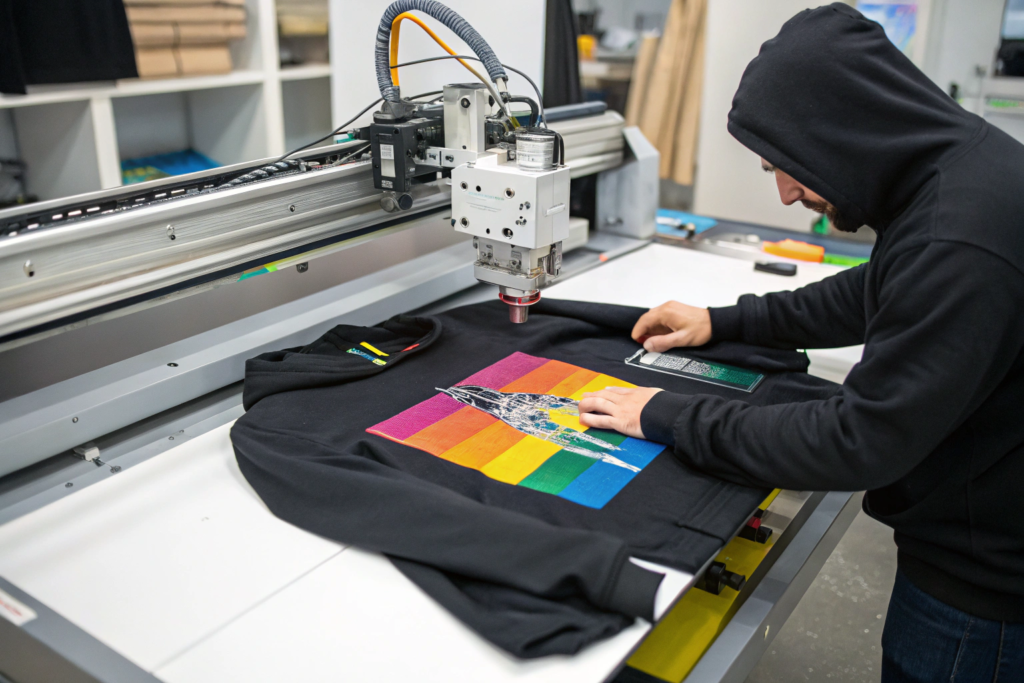
Digital print-to-pack workflows beat traditional screen printing for rush orders by eliminating screen setup entirely. The artwork goes from a digital file directly to the garment printer, which prints full-color designs in a single pass. This cuts the print setup phase from eight hours to eight minutes.
For our Express Lane hoodies, we use industrial-grade Kornit DTG printers paired with inline tunnel dryers. The ink bonds at the molecular level with the cotton fibers. The print is soft, stretchable, and survives repeated washing. We do not use cheap heat transfers that crack like plastic. The digital workflow also eliminates the minimum print quantity penalty, which used to make small custom runs prohibitively expensive.
How Does Inline DTG Technology Remove the Color-Separation Delay from Complex Artwork?
A traditional screen printer receives your vector file, manually separates the colors into individual plates, and then makes physical films. If the design has gradients or photorealistic elements, the separation is a nightmare. A digital printer does not separate colors. It prints cyan, magenta, yellow, black, and white simultaneously through thousands of micro-nozzles. A photographic-quality rendering of a tiger face or a sunset gradient prints exactly like a solid vector logo, with zero setup delay.
This means your designer can send a hi-res PNG from Photoshop at 9 AM, and our printer produces a finished, cured print by 9:12 AM. We have printed variable-data designs, where each hoodie in a batch of 200 had a unique number or a unique fan name on the sleeve, something completely impossible with screens. The digital process also supports on-demand production adjustments, a flexibility recognized by SGIA printing industry technical guides as the key advantage of digital over analog decoration.
Can Digitally Printed Hoodie Graphics Survive 50+ Industrial Wash Cycles?
A myth persists that digital prints wash out faster than screen prints. That was true in 2015. It is not true in 2026 with premium water-based pigment inks and proper pretreatment. Our Kornit systems apply a wetting agent and a binding layer to the fabric before the white base layer is printed. The pigment sits on top of the fiber rather than penetrating all the way through, which creates a durable film that bonds to the cotton without stiffening it.
We run a torture test on every new ink batch. A printed hoodie goes through our industrial washer at 60 degrees Celsius, 50 times consecutively. If the print shows more than a 5% delta in color density under a spectrophotometer reading, we reject the ink formulation. Our rush-printed hoodies have passed the AATCC 61 2A wash fastness test, the same standard major retailers require for their shelf inventory.
Who Needs a 15-Day Hoodie Rush Order Instead of Standard Lead Times?
Not every order should be rushed. Rush production costs more, and it stresses the supply chain. I always tell my clients that if you have a planned seasonal launch in September, start production in June. Use the standard 45-day track and pay the lower price. The 15-day track is a rescue service for specific, high-value scenarios where time is more expensive than the rush surcharge. It is an emergency room, not a primary care physician.
The 15-day express track is designed for three specific client scenarios: viral influencer drops that must ship before the trend collapses, event-merchandise for music tours and sports championships where the date is absolute, and catastrophic supplier failures where a brand needs a rescue batch to fill empty retail shelves immediately.
If you are launching a core collection that will restock for two years, there is no urgency. Speed is a tool. You use it when a deadline is non-negotiable. I have taken rush calls from panicked tour managers at 11 PM. I have taken them from brands whose previous factory went bankrupt mid-order. Those are the moments where 15-day delivery is not a luxury; it is the only thing standing between them and a total business loss.

How Does "Viral Hype Window" Economics Justify the Rush Production Premium?
A hype window is the 2-3 week period after a cultural moment—a song drop, a playoff win, a meme—when a specific hoodie design can sell at full retail price. Wait longer than that, and the consumer has moved to the next trend, and your hoodies sell at a 40% clearance discount. The Los Angeles musician drop I mentioned earlier sold hoodies at $98 each. If he had missed the window by even one week, he would have sold zero units at full price. The rush surcharge was 1% of his revenue and 100% of his margin protection.
The economics are clear. Let me show the comparison between missing and hitting the hype window for a 400-unit run with a $40 cost basis:
| Scenario | Retail Price | Sell-Through Rate | Gross Revenue | Rush Surcharge | Net Outcome |
|---|---|---|---|---|---|
| Hype Window Hit | $98 | 95% (380 units) | $37,240 | $1,200 | +$36,040 |
| Window Missed (Clearance) | $49 | 60% (240 units) | $11,760 | $0 | Liquidated inventory |
These internal projections are typical for the streetwear clients we serve. The rush premium seals the revenue gain.
Why Is Event Merchandise the Most Unforgiving Deadline in Apparel Manufacturing?
A tour manager once told me, "Eric, the concert is on May 10th. If the boxes arrive May 11th, it’s not merch. It’s evidence." Event merchandise has zero shelf life after the event date. A Super Bowl champions hoodie sells the night of the win. A week later, the emotion has faded. There is no clearance rack for a "2026 World Series Finalist" shirt if the team lost the series.
We treat event merchandise deadlines like surgical appointments. The production timeline runs backwards from the venue delivery time. If the truck must arrive at the stadium at 8 AM on Saturday, we factor in Customs clearance, air freight transit, and deconsolidation with hour-level granularity. This obsessive reverse-scheduling, combined with our greige buffer stock, has made us the silent behind-the-scenes partner for several major event merchandisers who cannot afford to explain to a promoter why the souvenir stand is half-empty.
What Is the Secret to Maintaining Heavyweight Stitch Quality at Triple-Speed Output?
Speed kills stitch quality if you push machine operators past their physical limits. A human being cannot sew flatlock seams on 80 hoodies an hour for 12 hours straight and maintain consistent 12-stitches-per-inch density. I learned this painfully. In 2022, I pushed a rush order through my legacy line by offering overtime pay. The operators rushed. The side seams on 15% of the hoodies were wavy, and we had to rework them, which killed the timeline anyway.
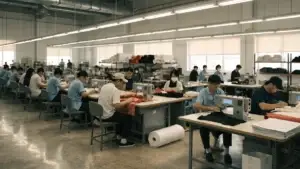
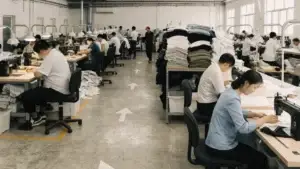
The secret to maintaining heavyweight stitch quality at speed is automated workstations that control stitch density electronically, a modular assembly line where each operator performs only two repetitive tasks instead of ten, and in-line camera inspection that flags a skipped stitch the moment it happens, not at final QC.
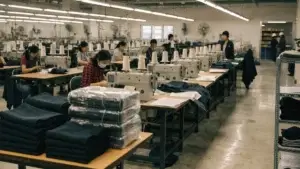
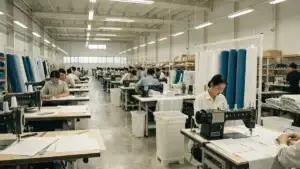
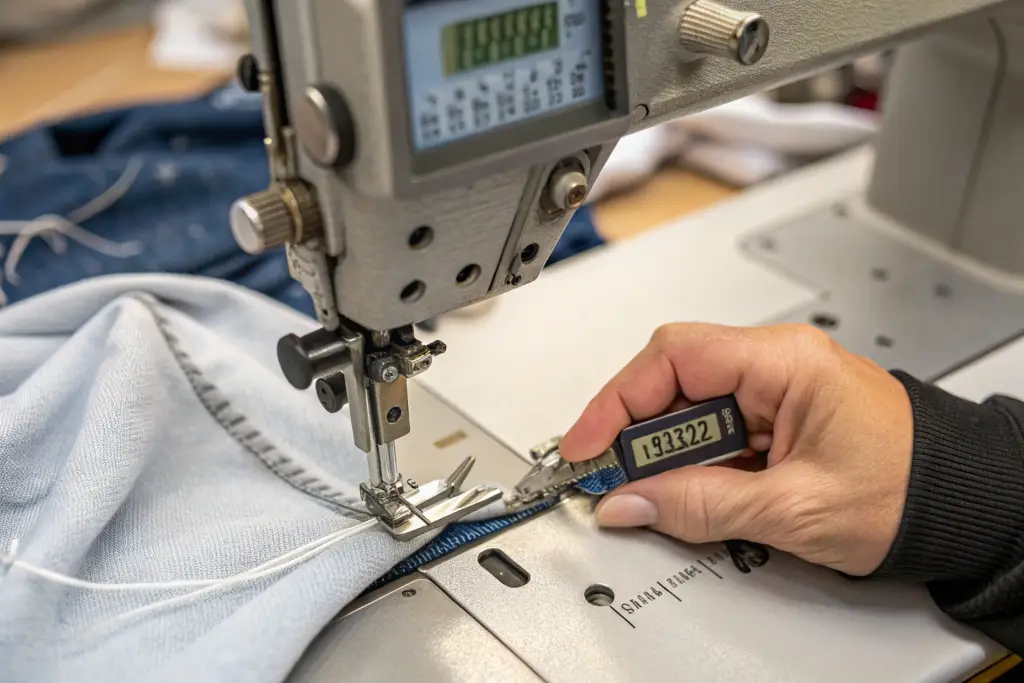
We invested in programmable lockstitch and overlock machines that read a barcode on the bundle and auto-set the stitch per inch rate. The operator cannot override the speed to "go faster" by reducing density. The machine enforces the spec. This hardware, combined with an ergonomic workflow, produces three times the throughput of a traditional line without breaking the human operator.
How Do Programmable Sewing Stations Enforce a Non-Negotiable SPI Rate?
The SPI (stitches per inch) rate is the DNA of a seam. A hoodie side seam spec'd at 10 SPI that is sewn at 7 SPI is weak. On our Express Lane line, the production manager programs the SPI into the machine control panel. If the operator attempts to push the pedal past the speed limit that maintains that density, the machine simply does not accelerate further. The needle velocity is capped.
This removes the tension between the operator's incentive—piece-rate pay based on volume—and the quality mandate. We still pay piece rate, but the machine ensures that "fast" still means "correct." This approach aligns with the systematic production control principles that underpin ISO 9001 quality management systems, where process control cannot rely solely on operator self-discipline.
Why Does In-Line Camera Inspection Catch Defects That Final QC Table Sampling Misses?
A traditional QC table inspects 10% of a batch. A skipped stitch in the shoulder seam of 90% of the hoodies goes unnoticed until the end consumer pulls the hoodie over their head and the seam pops. In-line inspection puts a high-speed camera above the conveyor belt after the shoulder-seaming station. The camera captures every single hoodie, compares the stitch length and spacing to the golden reference image, and stops the belt if three consecutive units show a deviation trend.
This predictive element is the real breakthrough. The camera does not just find defects; it detects the machine drift that will cause defects in the next 20 units. We fix the needle or the tension before the defect multiplies. This technology, built on optical recognition systems developed by textile machinery firms referenced in research by the Textile Institute, has taken our Express Lane first-pass yield from 88% to over 98%.
Conclusion
We did not invent the hoodie. We invented a system to manufacture it at high speed without insulting the fabric, the print, or the stitch. The 15-day hoodie is possible when you pre-shrink the greige, digitize the print, program the sewing machines, and inspect every seam with a camera rather than a tired human eye. At Shanghai Fumao, we built this express capability because the market now moves at internet speed. A viral moment does not wait for a factory to order yarn. Your event merchandise cannot explain to a stadium crowd that the supplier was late. Your rescue batch from a failed vendor needs to arrive before your retail buyer cancels the shelf space.
The Los Angeles streetwear brand that sold out in 12 minutes? They launched two more drops with us since then, both on the express track. We now hold a standing greige allocation for their brand, ready to be colored and printed the moment their designer uploads a file. That is the level of trust and readiness we aim to build with every client who depends on speed as a competitive weapon.
If you have a hoodie concept that needs to move from a design file to a packed box in two weeks, challenge us. Send the tech pack to Elaine and ask for the Express Lane feasibility check. She will tell you honestly whether your specific print, weight, and quantity can hit the 15-day window. Her email is: elaine@fumaoclothing.com.
Do not let a deadline kill a great idea. Let our high-speed line make it real.