Running a clothing brand is a war fought on two fronts. First, you have the creative battle. You need to design something people actually want to wear. You need to build a website, run ads, and build a community. That is your zone of genius. That is why you started the business. Then there is the second front: logistics. It is the battle of freight rates, customs bonds, HS codes, port congestion, and last-mile delivery. This is the battle that drains your bank account and your sanity. I see it happen all the time. A brand owner from Miami told me he spent fourteen hours on the phone in one week trying to locate a container that was stuck at the port of Savannah. Fourteen hours he was not designing, not marketing, and not selling. That is a failing business model.
DDP (Delivered Duty Paid) is the preferred logistics mode for busy apparel company owners because it transforms a complex, multi-vendor international transaction into a single, predictable line item. Instead of managing a freight forwarder, a customs broker, a trucking company, and the U.S. Customs and Border Protection separately, the owner simply pays one price to the factory and waits for the goods to arrive at their warehouse door. This eliminates hidden fees, reduces administrative labor, and shifts the risk of delays from the buyer to the manufacturer.
I want to explain this from the perspective of a factory owner who offers this service. At Shanghai Fumao, we did not start offering DDP because it was easier for us. It is actually harder for us. It requires more paperwork, more cash flow management, and more risk. But we started offering it because it solves the number one pain point for our U.S. clients: the fear of the unknown. The fear that the $8 shirt you bought will end up costing $14 after all the "port fees." Let's break down exactly why DDP gives you your time back and your budget predictability.
How Does DDP Shipping Simplify Importing Apparel from China to the USA?
There is a massive gap in knowledge when it comes to importing. Most first-time buyers think the price the factory quotes them is the price they pay to get the goods. That is only true if the quote specifically says "DDP." If it says "FOB" or "EXW," you are only paying for the goods to reach the port of Shanghai. What happens after that is a mystery to most brand owners until the invoices start rolling in from strangers.
DDP simplifies importing apparel by consolidating all logistics costs and legal responsibilities under the supplier's umbrella. When you agree to a DDP term with a manufacturer like Shanghai Fumao, you are effectively hiring our logistics department as an extension of your own company. We are responsible for booking ocean freight, paying the U.S. import duties on your behalf, clearing customs using our broker's license, and paying for the truck that delivers the pallets to your door. For the buyer, this means you receive a single invoice with a final, all-in cost.
Why Do FOB Shipments Often Lead to Unexpected "Surprise" Invoices?
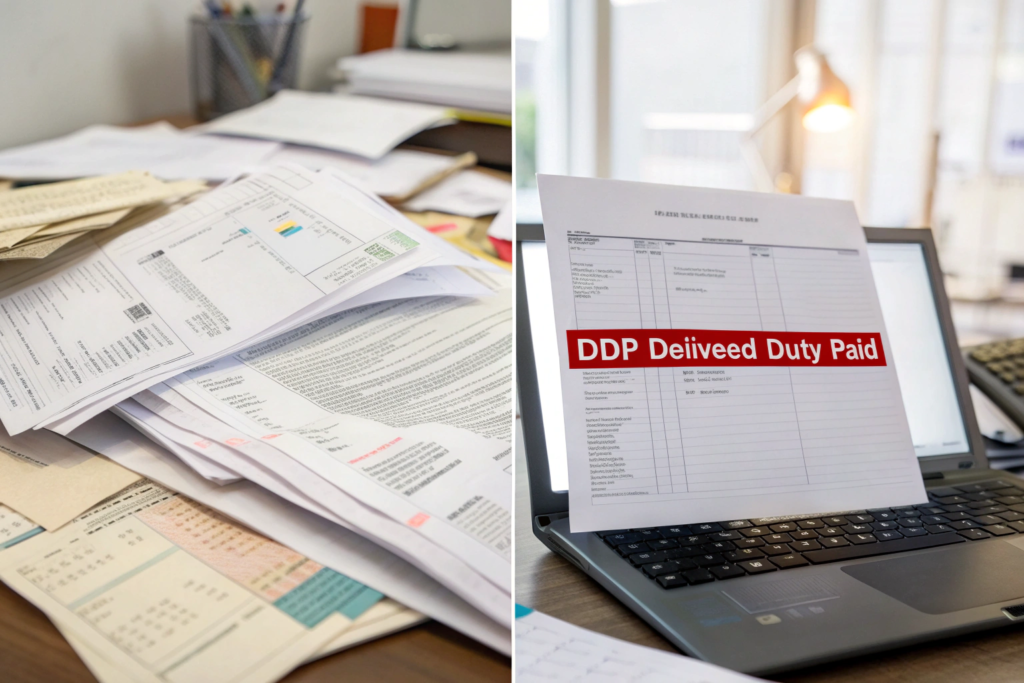
FOB stands for "Free on Board." It sounds like freedom, but for a busy clothing brand owner, it is often a trap. Under FOB, the risk and cost transfer to you the moment the container is lifted onto the ship in Shanghai. Let me share a real cost breakdown from a client who switched from FOB to DDP with us. He imports about 300 cartons of men's knitwear per season to Los Angeles.
| Cost Category | FOB Scenario (Managed by Brand Owner) | DDP Scenario (Managed by Shanghai Fumao) |
|---|---|---|
| Ex-Factory Cost | $15,000 (Paid to Factory) | Included in DDP Quote |
| Ocean Freight | $2,200 (Market Rate Fluctuation) | Included |
| Terminal Handling Charges (Origin) | $175 | Included |
| U.S. Customs Duty (16% on Sweaters) | $2,400 | Included |
| Merchandise Processing Fee (MPF) | $29.50 | Included |
| Customs Bond (Single Entry) | $85 | Included |
| ISF Filing Fee | $45 | Included |
| Port Drayage & Chassis Fee | $450 | Included |
| Pier Pass / Congestion Fee | $120 (Variable) | Included (Our Risk) |
| Trucking to LA Warehouse | $650 | Included |
| Total Landed Cost | $21,154.50 | $20,500 (Example Flat Quote) |
Look at the FOB column. That is nine different vendors you have to coordinate with and pay. Nine opportunities for someone to make a billing error. Nine opportunities for a hidden fee. The "Pier Pass" fee alone is a notorious surprise. It is a fee for moving containers during peak hours at the ports of Los Angeles and Long Beach. It changes based on the time of day the trucker arrives. Under FOB, that surprise is your problem. Under DDP, it is my problem. If the trucker has to wait four hours at the port and charges a detention fee, that is Shanghai Fumao's bill, not yours. We have the local relationships and the scale to manage those variables. You do not.
What Exactly Is the ISF Filing and Why Shouldn't I Handle It Myself?
Importer Security Filing (ISF), also known as "10+2," is a U.S. Customs and Border Protection (CBP) regulation. It requires importers to transmit specific data about the cargo to CBP at least 24 hours before the vessel departs from the foreign port. This is not optional. It is a security measure.
If you file the ISF late, or if you make a mistake on the data (like the wrong container number), CBP issues a fine of $5,000 per violation. Yes, you read that right. Five thousand dollars for a typo on a form.
This is the exact type of administrative detail that busy apparel owners should never touch. You should be picking out buttons and trims, not trying to figure out the HTS code for a cotton-blend cardigan. When you ship DDP with Shanghai Fumao, we handle the ISF filing as part of our service package. We use our own in-house logistics partner who files dozens of these every day. They know the exact format CBP expects. They know the difference between the "Manufacturer ID" and the "Supplier ID." If there is an error, it is on our insurance, not yours.
The alternative is you, the brand owner, receiving a frantic call from your freight forwarder at 11:00 PM on a Friday because they need the "Container Stuffing Location" address immediately to avoid the $5,000 fine. That scenario plays out every single week in this industry. DDP ensures you never get that call. You sleep, we file the forms, the goods move.
Why Is DDP Considered Less Stressful for Managing Cash Flow and Inventory?
Cash flow is the lifeblood of an independent fashion brand. You are constantly investing in next season's samples while waiting for this season's sales to clear. Any surprise expense can wipe out your marketing budget for the month. The traditional FOB shipping model is a nightmare for cash flow planning because the final bill is never the final bill. DDP is the opposite. It is the only way to know your exact landed cost per unit before you even cut the fabric.
DDP is less stressful for cash flow because it provides a fixed, all-in cost at the time of the purchase order. This allows a brand owner to accurately calculate their profit margin and retail pricing strategy weeks or months in advance. Furthermore, because the supplier controls the shipping timeline, DDP allows for a more predictable inventory arrival window, helping to align stock receipt with marketing campaigns and planned selling seasons, eliminating the costly risk of paying for goods that are sitting at a port while ads are running.
How Can a Fixed DDP Price Protect My Profit Margins?
Let's talk about margin erosion. You design a beautiful dress. You calculate the cost of fabric, labor, and trims. You factor in your brand markup. You decide to retail it for $98. You need to make a 65% margin to cover your overhead and ads.
Here is a real scenario from last summer. A women's wear client had a quote from another factory for FOB $9.50 per unit for a rayon dress. She budgeted an extra $1.50 per unit for shipping and duty. That is $11.00 landed cost per dress. She priced her inventory accordingly.
Then the reality of the global shipping market hit. In the three months between her order placement and the ship date, the Global Container Index spiked. Spot ocean freight rates from Shanghai to New York jumped from $3,000 per container to $8,500 per container.
Under FOB, that increase was passed directly to her. Her freight cost per dress went from an estimated $1.50 to $4.25. Her landed cost jumped to $13.75. That $2.75 difference ate almost 20% of her expected profit margin on that entire collection. She had to choose between raising her retail price mid-season (angering customers) or taking the loss.
At Shanghai Fumao, our DDP quotes are valid for the production window. We build a buffer into our logistics cost modeling, but we do not pass along market volatility to the client after the PO is signed. We absorb the risk of the rate fluctuation. This is possible because we are a factory, not a trading company. We make our primary profit on the efficient production of the garment. The logistics service is a value-add we offer to secure the manufacturing business. This alignment of interests protects your retail math.
Can DDP Help Me Avoid Demurrage and Detention Charges?
These two words strike fear into the heart of every importer: Demurrage and Detention. They are penalty fees charged by the steamship line when you hold onto their container too long.
- Demurrage: You keep the container inside the port terminal too long after it is unloaded from the ship. (Usually 3-5 "free days").
- Detention: You keep the container outside the port (at your warehouse) too long before returning it empty.
These fees are brutal. They can be $150 to $300 per day. If your customs broker is slow to clear the entry, or if your trucker cannot get an appointment to pick up the container due to port congestion, the clock keeps ticking.
I cannot tell you how many times a new client has come to me after a "good deal" FOB shipment turned sour. They saved $0.15 per unit on FOB price but ended up with a $1,800 demurrage bill because they did not know they had to hire a trucker and clear customs before the free time expired.
With our DDP service at Shanghai Fumao, the management of free time is entirely our responsibility. We use customs brokers who file entries electronically the second the vessel departs China. We use trucking partners who have "peel-off" agreements at the terminal to move containers quickly. Because our volume is larger than a single brand owner's, the steamship lines and terminals give us priority and slightly longer free time allowances.
This is a hidden benefit that is rarely discussed. The administrative cost of managing these dates and appointments is zero for the DDP buyer. The financial risk of the penalty is zero. For a busy apparel company owner, that peace of mind is worth more than a few cents on the unit price.
What Are the Hidden Risks of Using FOB Terms for My Clothing Brand?
I do not want to make FOB sound like a scam. It is not. It is a valid and widely used trade term. For a giant corporation like Nike or Gap that has an entire in-house logistics department with fifty employees and a multi-million dollar customs bond, FOB makes sense. They want control over every leg of the journey to optimize for pennies on the dollar. But for an independent brand owner who is also the head designer, the marketing manager, and the customer service rep, FOB is a time bomb.
The hidden risks of FOB terms for a small clothing brand include exposure to volatile freight spot market pricing, lack of control over unexpected port storage fees, and the administrative burden of coordinating with multiple third parties across different time zones. The most significant risk is the "Beneficial Cargo Owner" liability, where you are legally responsible for a container sitting on the dock even if you have no visibility of its status.
Who Is Liable If the Container Falls Overboard During a Storm?
This is a legal question that most brand owners never ask until it is too late. The answer under FOB terms is terrifying for a small business: You are.
Under FOB, the "Incoterms" rules state that risk transfers to the buyer once the goods pass the ship's rail at the port of loading. If the vessel encounters a storm in the Pacific Ocean and loses 20 containers overboard (an event known as "General Average"), the owner of the cargo shares in the loss.
If your container is one of the 20 lost, the shipping line does not just say "Sorry, we will reimburse you." They declare General Average. They hire an adjuster. They calculate the total value of the ship and the lost cargo. Then they send a bill to every cargo owner on that ship for a percentage of the loss. You have to pay a deposit to get your surviving cargo released. This deposit can be tens of thousands of dollars, even if your goods are safe on the ship.
This is an extreme example, but it happens. More commonly, there is "Sweat Damage" or "Condensation." A container is loaded in humid Shanghai and travels to cold New York. Water forms inside the container roof and drips on your cartons. The clothes arrive with mold spots.
Under FOB, you fight with the marine insurance company yourself. Under DDP with Shanghai Fumao, the cargo is our responsibility until it is in your warehouse. If it arrives damaged, we replace it or refund it. We have the volume to fight with the insurance company. You have a business to run. That difference in liability is why DDP is the preferred mode for busy owners.
What Happens When My FOB Shipment Is Selected for a Customs Exam?
U.S. Customs has the right to inspect any container entering the country. It is a random process, but certain factors (like a new importer or certain types of goods) trigger more exams.
There are two types of exams:
- VACIS Exam (X-Ray): Non-intrusive. The container is scanned. This might delay the container by 1-2 days.
- Intensive Exam (Tail Gate): CBP physically opens the container, cuts open cartons, and examines the goods. This requires moving the container to a Centralized Examination Station (CES) .
Here is the financial nightmare of an Intensive Exam under FOB:
- Exam Fee: $500 - $1,000+ (Paid by you).
- Drayage to CES: $350 - $600 (Trucking the container to the exam site).
- Devanned Labor: $400 - $800 (Labor to unload and reload the container).
- Storage: $150/day while waiting for exam results.
- Delay: 7 to 14 days.
If you are shipping FOB, you get an email from your customs broker saying, "Your container has been flagged for exam. You need to pay these fees to get it released." You have no choice. You must pay. You have no idea if the factory packed the goods correctly to pass inspection.
When a Shanghai Fumao DDP shipment is flagged for exam, we pay those fees directly. Because we pack our containers with a detailed Packing List that matches the Commercial Invoice exactly, our exams are usually quick and uneventful. But more importantly, the cost of that exam is our risk, not yours. This is the ultimate benefit of DDP. It insulates the busy brand owner from the random, expensive chaos of international trade enforcement.
How Can I Find a Trustworthy Apparel Supplier That Offers True DDP Service?
Finding a supplier who says "Yes, we do DDP" is easy. Finding one who actually does it correctly, transparently, and without hidden markup is harder. There is a world of difference between a supplier who offers DDP as a convenience and one who operates it as a core competency. Many trading companies in China will offer a DDP price that is simply the FOB price plus a random 20% markup. They are not managing the logistics themselves. They are just forwarding your money to a freight forwarder and pocketing the difference.
To find a trustworthy apparel supplier that offers true DDP service, you must ask for a detailed cost breakdown of the DDP line item, verify they have an in-house logistics team or a long-standing exclusive partnership with a U.S.-licensed customs broker, and request references from other U.S. clients who have used their DDP service for at least three shipments. A trustworthy supplier will be transparent about how they calculate duty rates and will advise you on the correct Harmonized System (HTS) code rather than just picking the cheapest one to lower the quote.

What Questions Should I Ask Before Agreeing to a DDP Quote?
You need to interrogate the DDP quote as much as you interrogate the sample quality. Here are the five questions I recommend every client ask Shanghai Fumao (and any other factory) before agreeing to a DDP shipment.
1. "Is the Duty Rate Included in This Quote Accurate for My Product?"
Some suppliers will under-quote the duty rate to make the total DDP price look cheaper. For example, they might quote a duty rate of 8% for a men's woven shirt when the actual rate is 19.7%. When the goods arrive in the U.S., they will come back to you asking for the difference. A trustworthy supplier will provide the exact HTS code and the corresponding duty rate.
2. "Who Is the Importer of Record?"
This is the most critical legal question. Under DDP, the Supplier (or their nominated agent) is the Importer of Record (IOR). If the answer is "You are the IOR," it is NOT DDP. That is FOB with freight prepaid. As IOR, you are on the hook for anything that goes wrong with customs.
3. "Do You Use Your Own Customs Bond?"
We use a Continuous Customs Bond through our logistics partner. If the supplier asks you for a copy of your bond, they are not doing DDP.
4. "What Happens If the Freight Rate Goes Up Before My Order Ships?"
As I mentioned earlier, the answer should be: "The price is fixed for the validity of this quote (usually 30 days) or we will absorb minor fluctuations." If they reserve the right to adjust the price up to market rate, you are back to FOB risk.
5. "Can You Show Me a Sample DDP Invoice and Arrival Notice?"
A professional factory should be able to show you a redacted example. Look for a single line item that covers the goods and the logistics.
Why Does a Factory Offering DDP Usually Indicate Better Management?
I might be biased because I run Shanghai Fumao, but I firmly believe this. A factory that has the internal systems to handle DDP is a factory that has its act together in production as well.
Think about what is required to execute DDP perfectly:
- Accurate Forecasting: We need to know the exact weight and volume of your order to book space on a vessel weeks in advance.
- Document Accuracy: The commercial invoice, packing list, and ISF must match perfectly. If the factory's shipping department is sloppy, customs stops the container. We have a dedicated documentation specialist just for export docs.
- Financial Strength: Factories usually pay the ocean freight and duty before the buyer pays the final balance. This requires working capital and a healthy cash flow. A factory living hand-to-mouth cannot offer real DDP.
If a factory can manage the complexity of U.S. Customs and the volatile shipping market, they can almost certainly manage the complexity of a tricky sewing pattern or a difficult fabric wash. The discipline required for logistics flows back into the discipline required for quality control.
At Shanghai Fumao, our DDP service is not an afterthought. It is part of our commitment to being a reliable manufacturing extension for your brand. We want you focused on selling the clothes, not on moving the boxes.
Conclusion
The preference for DDP among busy apparel company owners is not about laziness. It is about strategic focus and financial prudence. It is the recognition that time spent tracking a container on a ship-tracking website is time stolen from designing the next collection or engaging with customers on social media. It is the understanding that a fixed, predictable cost is more valuable for a growing business than a variable, risky cost that might be slightly cheaper on paper.
We have examined the mechanics of DDP versus FOB. We saw how DDP consolidates nine different vendors and nine different invoices into one line item with one point of contact. We discussed how it protects your cash flow from the unpredictable swings of the global freight market and shields you from the nightmare of demurrage fees and customs exam costs. We also looked at the hidden legal liabilities of FOB, from General Average claims to the responsibility of being the Importer of Record. And finally, we discussed how to identify a supplier who truly understands DDP, using their logistical competence as a proxy for their overall factory management skills.
As the owner of Shanghai Fumao, I have spent fifteen years watching brands succeed and fail. The ones who scale and thrive are the ones who master delegation. They delegate their logistics to partners they trust so they can focus on their creative and commercial strengths. DDP is the tool that makes that delegation possible in the complex world of China-to-USA apparel manufacturing.
If you are tired of juggling freight forwarders and customs brokers, or if you have been burned by hidden port fees in the past, I encourage you to experience the simplicity of a true DDP partnership. Let us handle the shipping, the duties, and the stress.
To get a clear, transparent DDP quote on your next production run, or simply to ask a few questions about how the process works, please reach out to our Business Director, Elaine. She can walk you through our fixed-cost model and explain exactly how we make importing easy. Contact her at: elaine@fumaoclothing.com. Let us free up your time so you can focus on building your brand.