You are ready to produce your collection. You are talking to factories, and you keep hearing two terms: CMT and Full Production. The quotes look different. The processes sound different. You are trying to figure out which model is right for your brand. Do you want to be deeply involved in sourcing materials, or do you want a turnkey solution where you hand over a design and receive finished garments? A brand owner told me, "I felt like I was choosing between two completely different businesses. One where I was a supply chain manager, and one where I was just a designer. I didn't know which path to take."
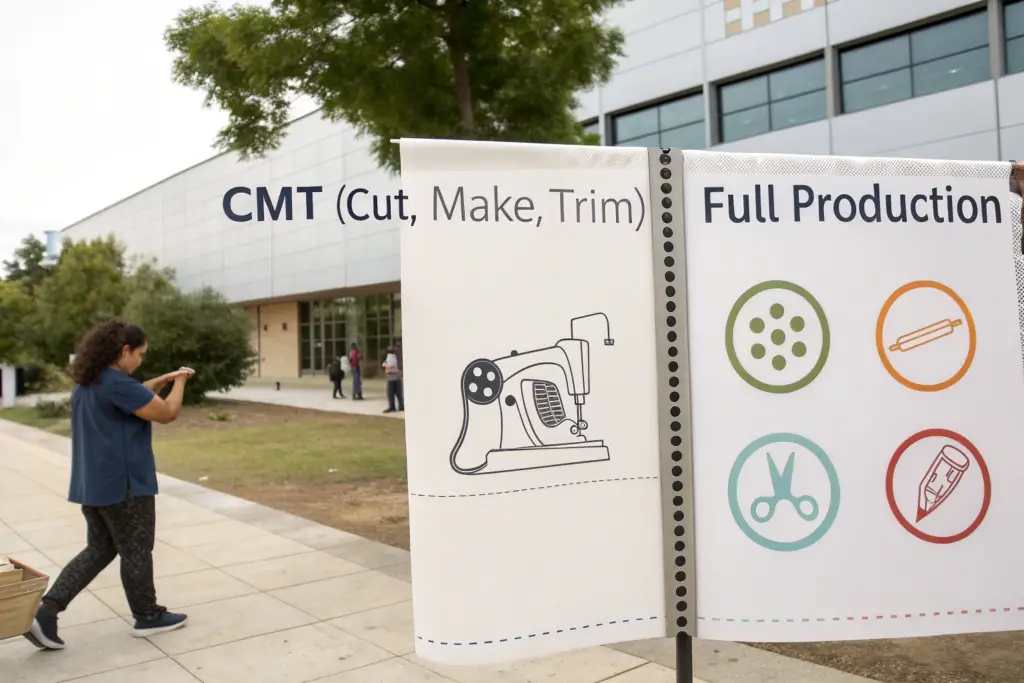
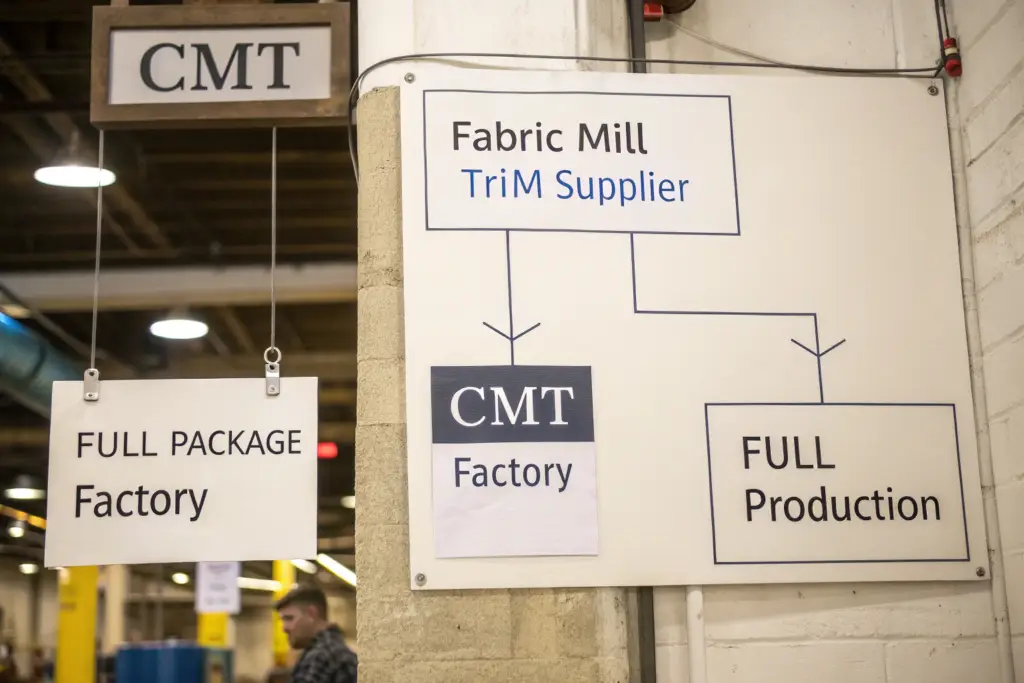
The fundamental difference between CMT (Cut, Make, Trim) and Full Production (often called FFP or Full-Package) is the division of responsibility. In CMT, the brand is responsible for sourcing and supplying all fabric and trims; the factory provides only the manufacturing labor. In Full Production, the factory takes on the responsibility of sourcing all materials, in addition to manufacturing, providing a single, bundled price for the complete, finished garment. CMT offers greater control; Full Production offers greater convenience.
At Shanghai Fumao, we are experts in both models. We do not push our B2B partners toward one or the other. Instead, we help them understand the profound trade-offs in control, cost, and operational complexity. Let me walk you through a detailed, side-by-side comparison of CMT and Full Production, so you can make the strategic choice that best fits your brand's capabilities and goals.
What Are the Core Differences in Responsibility and Scope of Work?
The most significant difference between the two models is the simple question of "Who does what?" In one model, you are the conductor of a multi-part orchestra. In the other, you are the patron who commissions a piece from a full-service ensemble. This division of responsibility impacts every aspect of the project, from your daily workload to your financial risk.
In CMT, the brand's scope of work is extensive: it includes designing the garment, creating the Tech Pack, sourcing and purchasing all fabric and trims, managing the logistics of getting those materials to the factory, and often managing the final shipment. The factory's scope is narrow and specialized: Cut the provided fabric, Make the garment, and apply the provided Trims. In Full Production, the brand's scope is primarily creative: design the garment and provide a Tech Pack. The factory's scope is comprehensive: source all materials, manage all logistics, and manufacture the finished garment.
I recall a men's wear brand founder who was a brilliant designer but had no interest in logistics. He tried the CMT model once, sourcing his own GOTS organic cotton and custom buttons. He spent weeks tracking shipments and coordinating with the mill. He hated it. He told me, "I'm a designer, not a freight forwarder. I want to create, not chase fabric rolls." He switched to our Full Production model and was relieved. He sent us his designs, and we handled everything else. He got his time and sanity back. For him, the convenience of Full Production was worth far more than the potential cost savings of CMT. This is the fundamental trade-off. This is why we help our clients assess their operational capacity before choosing a model.
Who Is Responsible for Material Defects and Shortages?
This is a critical risk distinction.
- In CMT: The brand owns the fabric and trims. If a fabric roll has a hidden flaw, or if a trim shipment is short, it is the brand's financial responsibility to resolve the issue with their supplier. The factory's role is to inspect and report, but the risk lies with the brand.
- In Full Production: The factory sourced the materials. If there is a material defect or shortage, it is the factory's responsibility to fix the problem at their own cost. The brand is protected.
This risk transfer is a primary reason many brands choose Full Production. This is a key part of our risk management discussion with new partners.
How Does the Management of Logistics Differ?
- In CMT: The brand is the logistics coordinator. They must ensure fabric from Mill A and trims from Supplier B both arrive at the CMT factory on time. They often manage the final shipment of finished goods as well.
- In Full Production: The factory manages all inbound material logistics and, often, the final shipment (especially with DDP terms). The brand provides the destination, and the factory makes it happen.
The logistical burden is significantly higher for the brand in a CMT model. This is the "hidden time tax" of CMT. This is why our Full Production service is so popular with growing brands.
How Do Cost Structures and Financial Implications Compare?
The choice between CMT and Full Production has profound implications for your cost structure, cash flow, and financial planning. One model offers potential unit cost savings but requires more upfront capital and financial management. The other offers a simpler, more predictable cost, albeit often at a slightly higher per-unit price. The "cheaper" model is not always obvious.
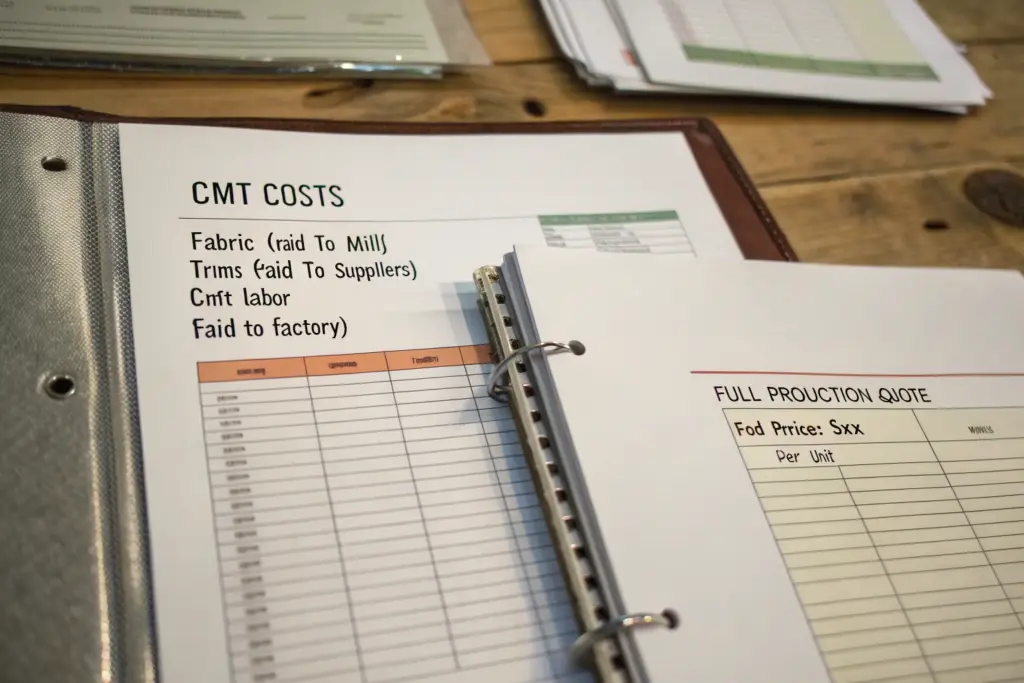
In CMT, your costs are unbundled and transparent. You see the exact cost of fabric, trims, and labor. This allows you to potentially achieve a lower total unit cost by sourcing materials directly and eliminating the factory's markup. However, it requires you to pay for all raw materials upfront, which ties up significant working capital. In Full Production, you pay a single, bundled FOB price. This price is convenient but opaque; it includes the factory's material costs, their markup, and their labor. You pay a deposit and a balance, which is often better for cash flow management.
A women's wear client switched a core style from Full Production to CMT to try and save money. On paper, she saved about $2.50 per unit. However, she had to pay her fabric mill $6,000 upfront, weeks before she would have paid the Full Production deposit. She also spent about 15 hours managing the logistics. She realized that the "savings" came at the cost of her time and a significant strain on her cash flow. For her next run, she switched back to Full Production, valuing the predictable cash flow and the return of her time. The cheapest unit cost is not always the most profitable business decision. This is the nuanced financial analysis we provide our B2B partners .
Which Model Is Better for Managing Cash Flow?
This depends on your specific situation.
- Full Production is often better for a brand with tighter cash flow. The 30/70 payment structure means a smaller initial outlay, and the factory finances the materials.
- CMT can be better for a brand with strong cash reserves. You can pay suppliers on your own terms and potentially capture early payment discounts, but the upfront capital requirement is much higher.
We work with our clients to model both scenarios. This is part of our financial planning support .
Where Can a Brand Find the Most Significant Cost Savings?
- In CMT: The primary savings come from eliminating the factory's markup on materials, which can be 10-25%. You can also save by negotiating directly with mills and optimizing logistics.
- In Full Production: Savings come from the factory's economies of scale. Because they buy large volumes of fabric for multiple clients, they may get better pricing than a small brand could get on their own.
There is no universally cheaper model. The answer depends on your specific materials and volumes. We provide transparent cost comparisons to help our partners decide. This is the value of our transparent costing .
What Level of Control and Flexibility Does Each Model Offer?
Beyond cost and responsibility, the choice between CMT and Full Production is a choice about the nature of the control you want over your supply chain. Do you want granular control over every component, even if it means more work? Or do you want to control the final outcome and outsource the complexity of the inputs? This is a philosophical question as much as a logistical one.
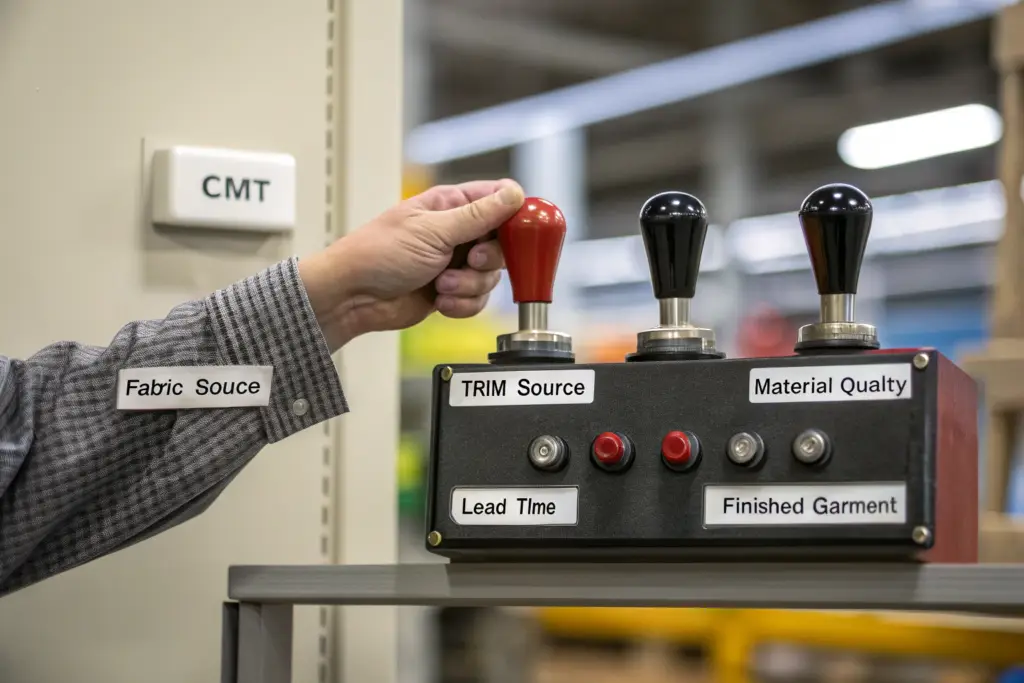
CMT offers a high degree of granular control over your supply chain. You choose every mill and every trim supplier. You can build direct relationships, ensuring your unique, proprietary, or sustainable materials are used. This model is ideal for brands whose identity is deeply tied to their material sources. Full Production offers a different kind of control: control over the final outcome with less operational complexity. You approve a final sample, and the factory is responsible for replicating it in bulk. This is ideal for brands that want to focus their energy on design and marketing.
A brand that makes premium activewear from a specific, patented recycled nylon uses our CMT services. They must control the fabric source to protect their unique performance story and their IP. They would never trust a Full Production factory to source a generic alternative. On the other hand, a brand that makes classic women's wear blouses loves our Full Production model. They trust our sourcing team to find beautiful, high-quality Tencel and silk options. They are happy to relinquish that control in exchange for the time and mental freedom it provides. The "right" level of control is different for every brand. This is why we offer both flexible manufacturing models .
Which Model Is Better for Protecting Proprietary or Unique Materials?
CMT is the superior model for protecting proprietary materials. If you have developed a unique fabric or trim, you maintain the direct relationship with the supplier. You control the supply. In a Full Production model, you would have to share your supplier's information with the factory, which introduces a risk of that source being used for other clients. For brands with valuable material IP, CMT is often the preferred path. This is a key part of our brand protection strategy.
How Does Flexibility in Scaling Production Differ?
- CMT can be more agile for reorders. Because you own the raw materials, you can hold buffer stock and trigger smaller, faster CMT runs.
- Full Production is often better for large, seasonal bulk orders. The factory manages the entire supply chain, which is efficient for large volumes.
The scalability of each model depends on your specific growth trajectory. We help our partners develop a scalable production strategy that may involve a hybrid approach.
The decision between CMT and Full Production can feel overwhelming. There are compelling arguments on both sides. The right choice depends on a nuanced understanding of your own business's operational strengths, financial situation, and long-term vision. We do not believe in a one-size-fits-all answer. Our role is to be your trusted guide, providing the clarity and expertise you need to make the best decision for your unique brand.
Fumao helps you navigate the CMT vs. Full Production decision by first understanding your brand's specific needs and capabilities. We discuss your team's operational bandwidth, your cash flow situation, your desire for material control, and your risk tolerance. We provide transparent cost comparisons and realistic assessments of the "hidden" time and effort required for CMT. Based on this collaborative analysis, we recommend the model—or a hybrid approach—that best sets your brand up for success.
A new brand founder was convinced that CMT was the "smart" choice because it seemed cheaper. We walked her through a detailed, week-by-week breakdown of the tasks she would need to manage under CMT. She realized she simply did not have the 10-15 hours a week to dedicate to it while also running her marketing and sales. She chose our Full Production service. It was the right decision for her sanity and her business. A year later, with a larger team, she successfully transitioned a portion of her production to CMT. We supported her through that evolution. This is the benefit of a partner who offers both models and provides honest, unbiased guidance. This is the value of a true strategic manufacturing partner .

Can a Brand Use a Hybrid of CMT and Full Production?
Absolutely, and this is often the most sophisticated strategy. A brand might use Full Production for their complex, high-development rare styles, leveraging the factory's expertise in sourcing all the unique components. At the same time, they might use CMT for their high-volume, core basic program, where they can achieve maximum cost efficiency by sourcing the fabric in bulk themselves. Our flexible infrastructure is designed to support this kind of hybrid, multi-model partnership seamlessly. This is the ultimate level of a customized supply chain solution .
What Is the First Step in Deciding Which Model Is Right for You?
The first step is an honest self-assessment. Ask yourself:
- Team Bandwidth: Do I have the time and skills to manage material sourcing and logistics?
- Cash Position: Am I comfortable paying for all raw materials upfront?
- Brand Priority: Is my brand identity tied to a specific, proprietary material?
Once you have clarity on these questions, the path forward often becomes much clearer. And we are here to help you find that clarity. This is the starting point of our client onboarding process .
Conclusion
The difference between CMT and Full Production manufacturing is the difference between being a supply chain conductor and being a creative director with a trusted production partner. CMT offers the allure of control, transparency, and potential cost savings on materials. Full Production offers the invaluable benefits of convenience, simplicity, and risk transfer. Neither model is inherently superior; they are simply designed for different types of brands at different stages of their journey.
At Shanghai Fumao, we are masters of both. We do not just offer these as options; we provide the expert guidance to help you choose the right path. We are your partner in navigating this critical strategic decision, ensuring that the manufacturing model you select empowers your brand's growth, rather than hindering it.
If you are weighing the pros and cons of CMT vs. Full Production and want an expert, unbiased perspective, let's talk. Our Business Director, Elaine, can walk you through a detailed comparison tailored to your specific business. Please email Elaine at: elaine@fumaoclothing.com.