You have sourced the most beautiful fabric. You have designed the perfect custom trim. You have entrusted these precious materials to a CMT (Cut, Make, Trim) factory. Now, the anxiety sets in. How do I know they will treat my materials with care? How can I be sure the finished garments will meet my standards? How do I prevent a quality disaster from 7,000 miles away? A brand owner told me, "Handing over my own sourced materials for CMT felt like the ultimate leap of faith. Quality control was my biggest fear. I needed to know there was a system in place to protect my investment."
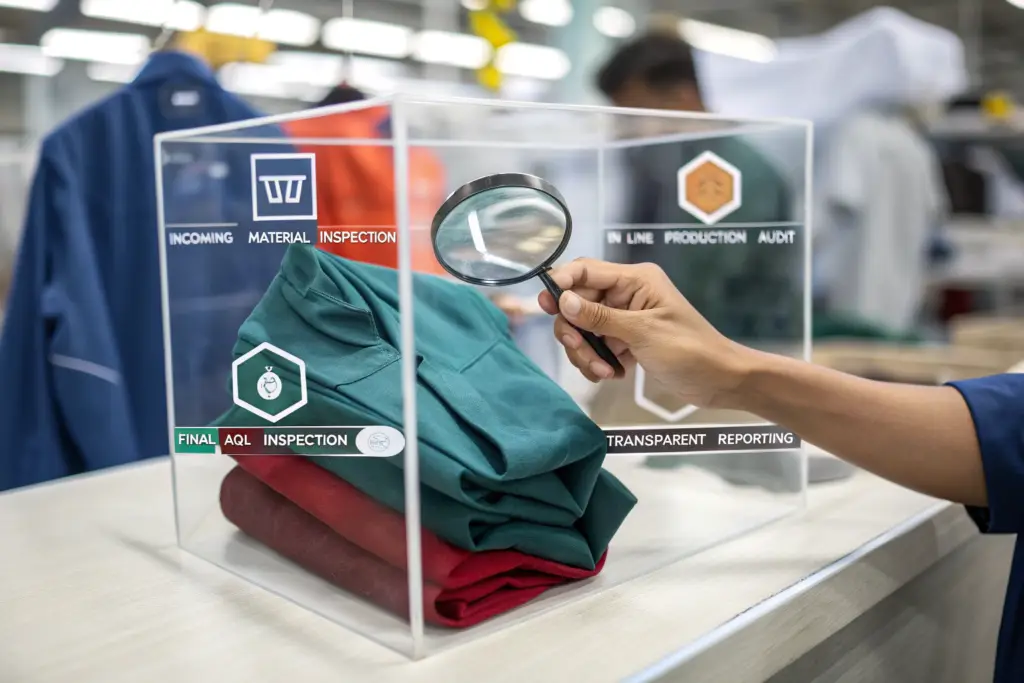
Ensuring quality control in CMT production requires a comprehensive, multi-stage system that is even more rigorous than in a standard full-package model. Because the materials belong to the client, the factory must act as a fiduciary, providing total transparency and accountability. The key pillars are: 1) Meticulous Incoming Inspection of all client-supplied materials, 2) Proactive In-Line Audits during the sewing process, 3) A rigorous Final AQL Statistical Inspection, and 4) Transparent Reporting that provides a complete audit trail.
At Shanghai Fumao, our CMT services are built on a foundation of obsessive quality control. We know that our clients' brand reputation rests on our ability to handle their unique materials with expert care and precision. Let me walk you through the specific, actionable steps in our CMT quality control system, so you can have complete confidence in where and how your garments are being made.
How Does Rigorous Incoming Inspection Protect Your CMT Investment?
In CMT, the quality battle is won or lost before the first stitch is sewn. It begins the moment your materials arrive at our loading dock. This initial, rigorous inspection is the single most important step in protecting your investment. It is our fiduciary duty to ensure that the materials you have paid for and shipped to us are exactly what you ordered, in perfect condition, and suitable for producing first-quality garments. This step prevents costly downstream disasters.
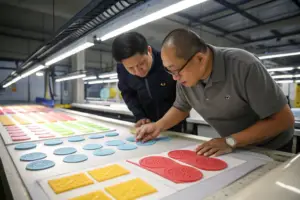
Rigorous Incoming Inspection is the cornerstone of CMT quality control. We perform a 100% inspection of all client-supplied fabric and trims. For fabric, this involves checking every roll on a backlit table for weaving/knitting defects, stains, and, most critically, shade continuity. For trims, we verify quantity, color, and functionality against the client's Bill of Materials (BOM). Any discrepancies or defects are immediately documented with photos and reported to the client before any material is cut.
I recall a women's wear client who shipped us a stunning, expensive wool coating for a CMT blazer order. During our incoming inspection, our team discovered that three of the ten rolls had a subtle, but unacceptable, "barre" mark—a faint horizontal stripe caused by inconsistent yarn tension during weaving. It was only visible under our bright, backlit inspection. We immediately halted the process, photographed the flaw, and sent a detailed report to the client. She was able to return the defective rolls to the mill for a full credit. If we had skipped this step, we would have cut into the flawed fabric, producing dozens of blazers with a hidden defect that would have surfaced later, resulting in customer returns and irreparable damage to her brand's reputation. This is the invaluable protection of a thorough incoming inspection. This is a standard part of our CMT quality assurance .
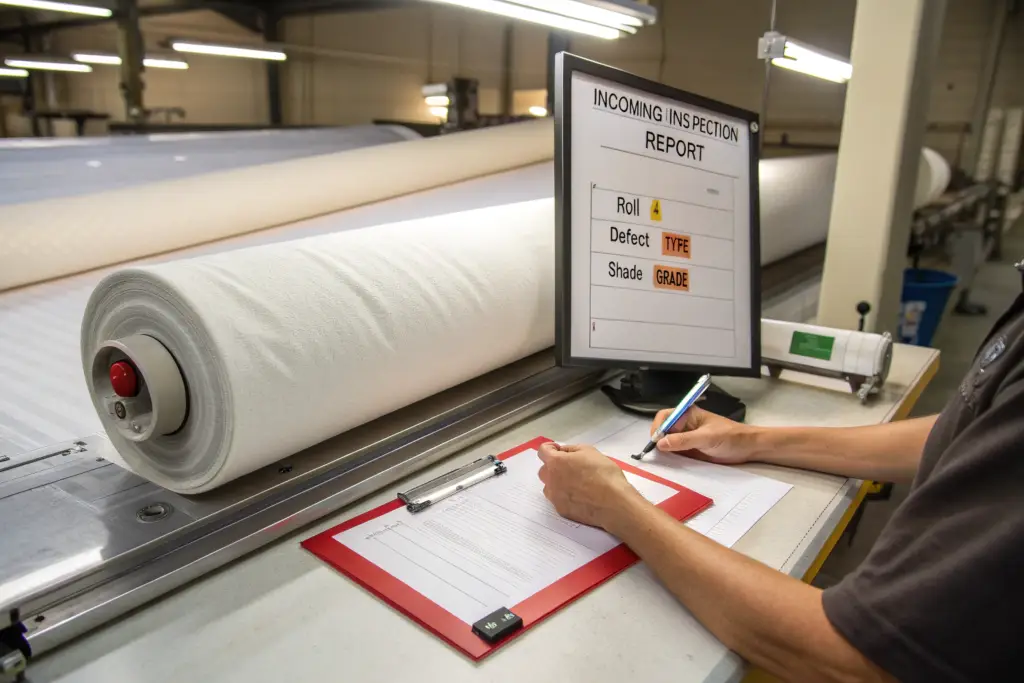
What Is "Shade Banding" and Why Is It Crucial for CMT?
Even within a single dye lot from a top-tier mill, there can be micro-variations in color from one fabric roll to the next. This is a normal part of textile production. The problem arises when a garment is cut from two rolls with slightly different shades—the left sleeve is a hair darker than the right body. To prevent this, our inspectors perform Shade Banding. They evaluate every roll under a calibrated D65 lightbox and group them into "light," "medium," and "dark" bands. The cutting plan then ensures that all panels for a single garment are cut from rolls within the same shade band. This meticulous process guarantees color consistency within each finished piece. This is a detail that defines a premium garment .
How Are Client-Supplied Trims Verified and Secured?
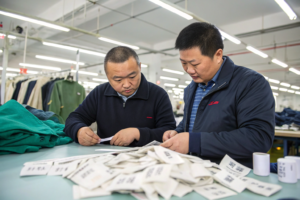
Our team opens and counts every box of buttons, zippers, and labels. We pull a sample and compare it against the client's approved standard. Is the custom-engraved button the correct size and finish? Does the zipper tape perfectly match the Pantone color specified? Once verified, all trims are logged into our Trim Tracker system and stored in a secure, locked area of our warehouse, separate from other clients' materials. This ensures nothing is lost, damaged, or mixed up. This is a key part of our inventory management for CMT .
What Role Do In-Line Audits Play During the "Make" Phase?
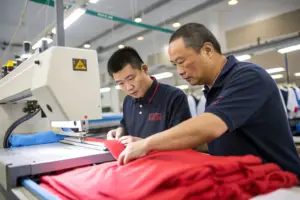
In a lesser factory, quality control is a final, reactive gate. Inspectors look at the finished goods and either pass or fail the entire lot. This is inefficient and costly. In a top-tier CMT operation, quality control is a continuous, proactive process that happens during the sewing phase. This is where small errors are caught and corrected in real-time, preventing them from becoming large-scale batch defects. This is the most effective way to ensure consistency across your entire order.
In-Line Audits are proactive quality checks performed continuously during the sewing process. A roving QC inspector pulls random samples from the bundles on the line and inspects them against the client's approved "Sealed Sample" and Tech Pack specifications. They check for correct stitch types, seam alignment, and proper trim application. If they find a recurring defect, they have the authority to stop the line immediately, identify the root cause with the supervisor, and implement a corrective action before hundreds of defective units are produced.
A men's wear client of ours had a CMT order for 2,000 shirts with a specific, detailed pocket construction. During an in-line audit, our inspector noticed that the pocket placement on the first 30 units was consistently 1/4 inch too low. It was a subtle drift. She stopped the line. The issue was traced to a worn guide on the pocket-setting machine. The guide was replaced in 15 minutes. The next 1,970 shirts had perfectly placed pockets. Without that in-line audit, the error would have continued, and the entire order would have been rejected by the client. This proactive intervention saved the order and protected the client's valuable fabric. This is the power of a robust in-line QC system .
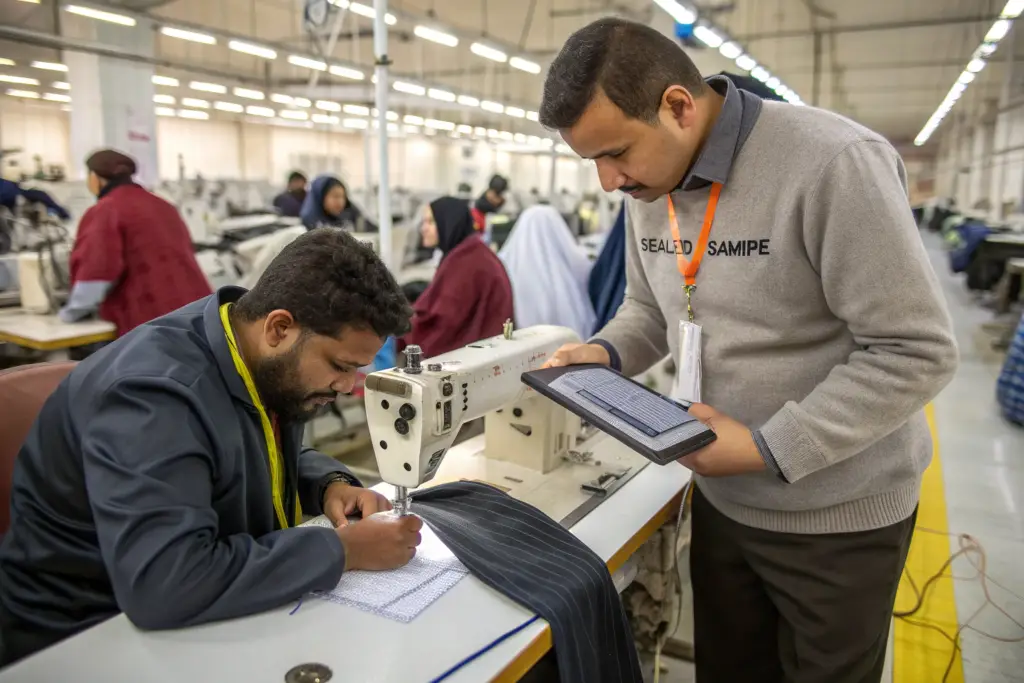
What Specific Defects Are In-Line Inspectors Trained to Catch?
Our inspectors are trained to spot a range of specific, recurring issues:
- Skipped Stitches & Broken Threads: Weak points in the seam.
- Puckering: Fabric gathers along the stitch line due to incorrect tension.
- Incorrect Seam Allowance: Seams that are too narrow or too wide, affecting fit.
- Misaligned Seams: Stripes or plaids that do not match up.
- Incorrect Trim Application: Wrong button, misplaced label.
Catching these issues early saves time, money, and the client's materials. This is a core part of our quality control culture .
How Is the "Sealed Sample" Used During In-Line Audits?
The Sealed Sample is the ultimate, physical reference standard. Our in-line inspectors do not rely on memory. They carry a high-resolution photo of the approved sample on a tablet, or they physically walk the line with the sample itself. They perform a side-by-side comparison, checking the collar roll, the pocket shape, and the seam finish. This constant, physical anchor ensures that the production standard never drifts from the approved design. This is how we guarantee sample-to-bulk consistency .
How Does the Final AQL Inspection Work in a CMT Context?
After production is 100% complete and the goods are packed, they face the final, formal gate: the Pre-Shipment Inspection (PSI) . In a professional CMT environment, this is not a casual glance. It is a rigorous, statistical audit using the globally recognized AQL (Acceptable Quality Limit) standard. This is the objective, data-driven process that determines if the shipment is released to the client.
The Final AQL Inspection in CMT is a statistical sampling of the finished, packed goods. Using the agreed-upon AQL standard (e.g., AQL 2.5, Level II), our QC team randomly selects a specific number of cartons and inspects a specific number of units. Each unit is examined for defects, which are classified as Major (rendering the garment unsellable) or Minor. The lot passes or fails based on the number of defects found compared to the AQL tables. This provides an objective, auditable measure of the entire production run's quality.
For a recent CMT order of 3,000 units, we performed an AQL 2.5, Level II inspection. This required us to inspect a random sample of 125 units. The AQL tables allowed for a maximum of 7 major defects and 10 minor defects. Our inspection found 2 major defects (a small hole and a broken zipper) and 5 minor defects (loose threads). The lot passed. We provided the client with the full AQL report, showing exactly what was found. The two defective units were replaced from the client's buffer materials. The client received a shipment with a statistically verified, known level of quality. This is the transparency and rigor of a professional final QC process .
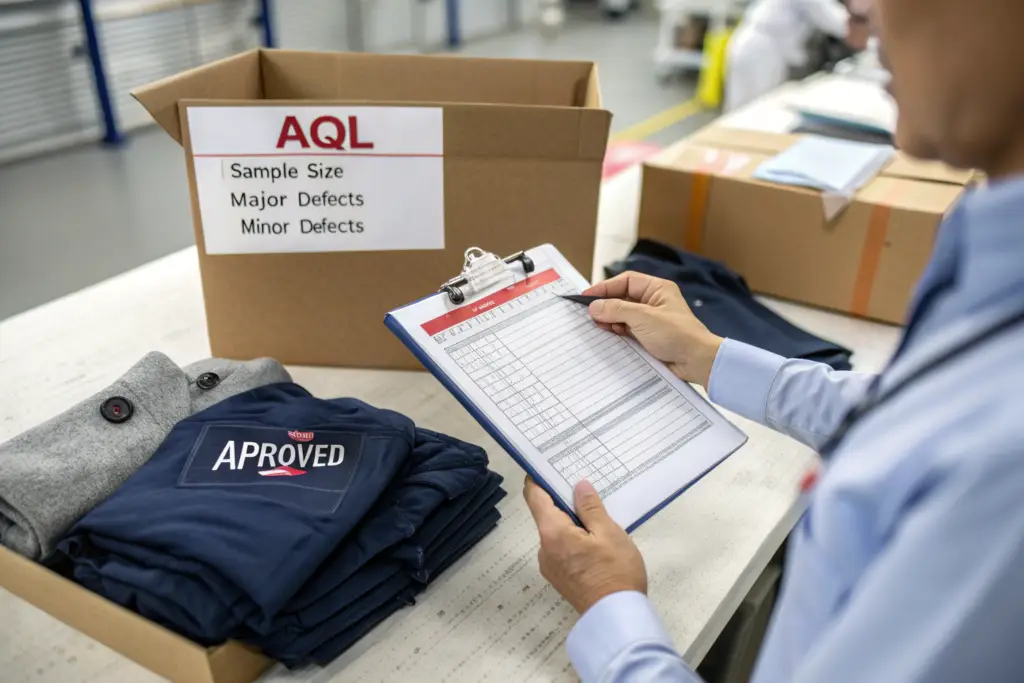
What Is the Difference Between a Major and Minor Defect in an AQL Audit?
This classification is critical and standardized:
- Major Defect: A flaw that would likely cause a customer to return the garment or render it unsellable at full price. Examples: a hole, a broken zipper, a significant stain, a seam coming apart, a missing button, a wrong size label.
- Minor Defect: A noticeable imperfection that does not prevent the garment from being sold or worn. Examples: a loose thread, a slight wrinkle, a hangtag attached slightly off-center.
Our inspectors are rigorously trained on this classification. We are strict on Major Defects, as these are the ones that damage a brand's reputation.
What Happens If a CMT Order Fails the AQL Inspection?
If the number of defects in the sample exceeds the AQL limit, the lot fails. We do not ship. We immediately inform the client of the findings. We then conduct a 100% inspection of the entire order. Every single unit is inspected, and all defects are sorted out. The defective units are either repaired (if possible) or replaced using the client's buffer materials. The order is then re-inspected. While this causes a delay, it is the only responsible course of action. It protects the client from receiving substandard goods. This is our commitment to accountability in CMT .
What Transparent Reporting Should You Expect from a CMT Partner?
In a CMT partnership, the factory's responsibility extends beyond just sewing the clothes. You have entrusted them with your valuable assets. Therefore, a critical component of quality control is transparent reporting. You should receive a clear, documented audit trail that accounts for every yard of fabric and every individual trim. This is not just good service; it is a fundamental requirement of the CMT model.
A transparent CMT partner provides a comprehensive "Closeout Package" after every production run. This package should include: 1) An Incoming Inspection Report documenting the initial state of your materials, 2) A Cutting Yield Analysis showing fabric utilization, and most importantly, 3) a detailed Material Reconciliation Report that clearly accounts for all fabric and trims received, consumed in production, and any remaining remnants. This level of transparency builds trust and allows the brand to close its books on the project with complete accuracy.
A brand owner I work with told me that the Material Reconciliation Report from our CMT service is his favorite document. He said, "It gives me a perfect, auditable record of my inventory. I know exactly what happened to every yard of my expensive fabric. It makes my accountant happy, and it gives me total peace of mind." He uses these reports to precisely manage his raw material inventory and plan his finances. This is the level of transparency and accountability that defines a true CMT partner .
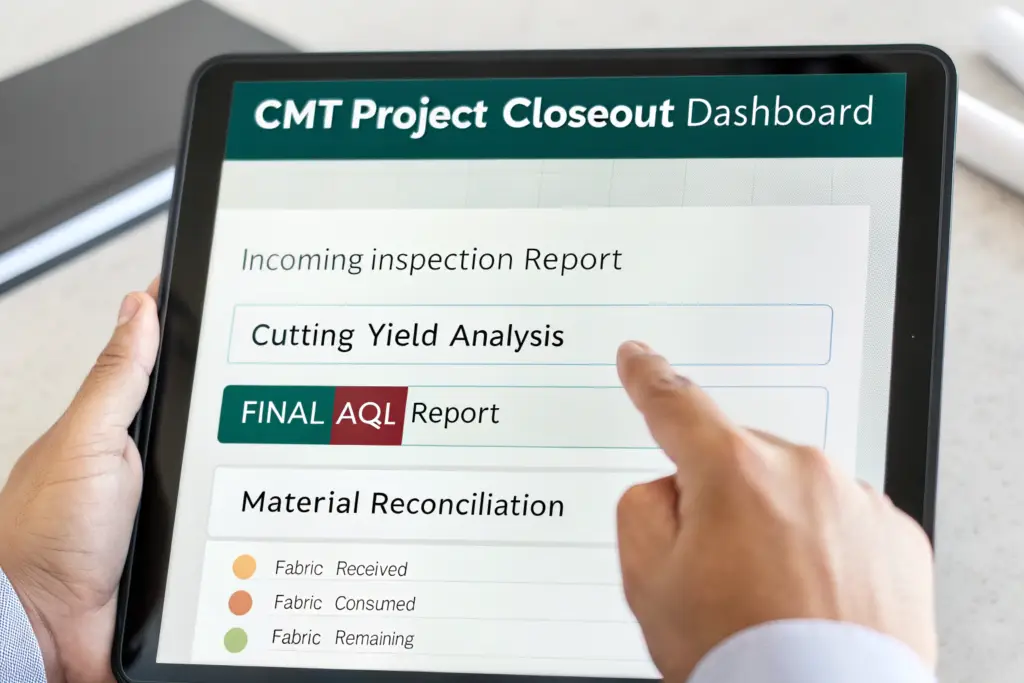
What Should a Material Reconciliation Report Include?
A professional report should clearly show:
- Fabric: Total yardage received by roll number, yardage consumed in production (based on marker efficiency), yardage of any defects found, and final yardage remaining.
- Trims: Quantity of each trim received, quantity consumed, and quantity remaining.
- Finished Goods: The exact quantity of first-quality units produced.
This report provides a complete financial and operational audit trail. It allows you to verify that your materials were used efficiently and that any leftovers are accounted for. This is the standard of our transparent CMT reporting .
How Does This Reporting Help with Future CMT Planning?
The data from the Cutting Yield Analysis is invaluable. It tells you the exact fabric consumption for that specific style and size breakdown in bulk production. This allows you to order your raw materials with greater precision for the next run, reducing waste and saving money. The Defect Log from the AQL report can highlight recurring issues that you can work with us to prevent in the future. This data-driven approach enables continuous improvement and long-term cost optimization.
Conclusion
Ensuring quality control in CMT production is a comprehensive discipline that requires a proactive, multi-layered system and a culture of transparency. It begins with the meticulous inspection of client-supplied materials, continues with vigilant in-line audits during sewing, and culminates in a rigorous, data-driven final inspection. It is all documented in transparent reports that provide a complete audit trail and protect the client's material investment.
At Shanghai Fumao, this rigorous system is the bedrock of our CMT services. We understand that when you entrust us with your unique fabrics and trims, you are placing your brand's reputation in our hands. We honor that trust with an unwavering commitment to quality at every step. We are not just a factory; we are the guardian of your vision and your valuable assets.
If you are looking for a CMT partner whose quality control system you can trust completely, let's talk. Our Business Director, Elaine, can walk you through our QC protocols and share sample reports. Please email Elaine at: elaine@fumaoclothing.com.