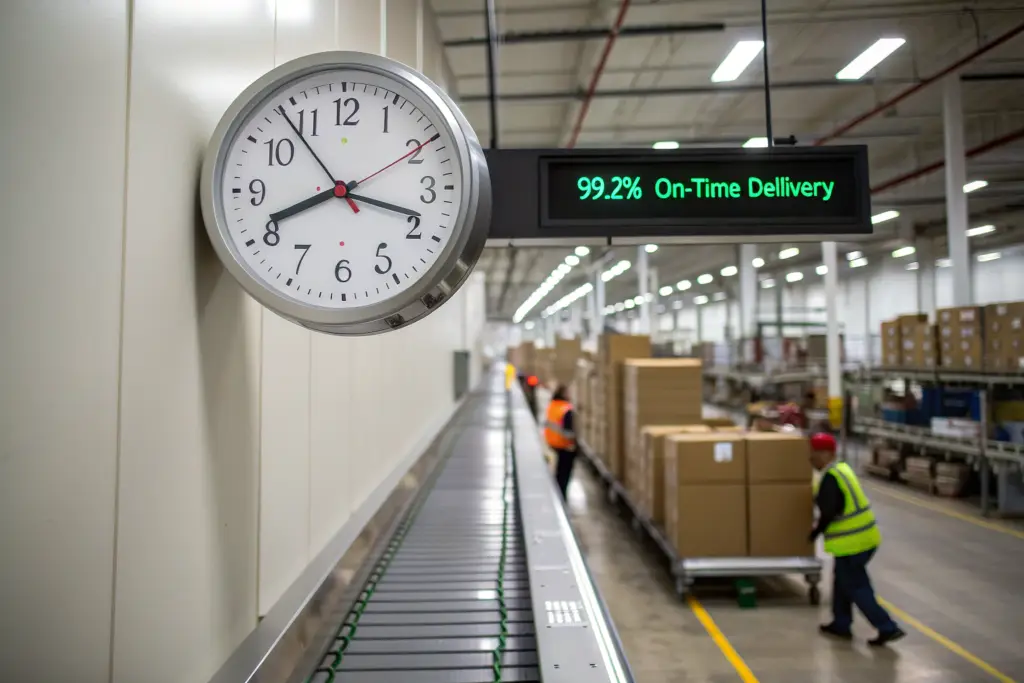
I received a text message at 10:42 PM on a Thursday last November. It was from a brand owner in Philadelphia. His previous supplier had just informed him that his 2,000-unit holiday sweater order, promised for November 15th, was delayed until December 20th. December 20th. For holiday sweaters. His entire seasonal revenue was evaporating on a single email. He asked if we could do anything. We pulled fabric from our greige bank, cut on Saturday, sewed on Sunday, and shipped by air on Wednesday. The sweaters arrived at his warehouse on December 2nd. He sold out by December 15th. He told me later that one text message saved his company. That is not a brag. That is the standard we set for ourselves.
The secret to Shanghai Fumao's 99% on-time delivery rate is a brutal commitment to buffer inventory, production schedule transparency enforced by digital tracking at every workstation, and a logistics strategy that pre-books carrier space 60 days in advance. We do not promise a date and hope to hit it. We build the schedule backwards from the delivery date and refuse to accept a single day of drift.
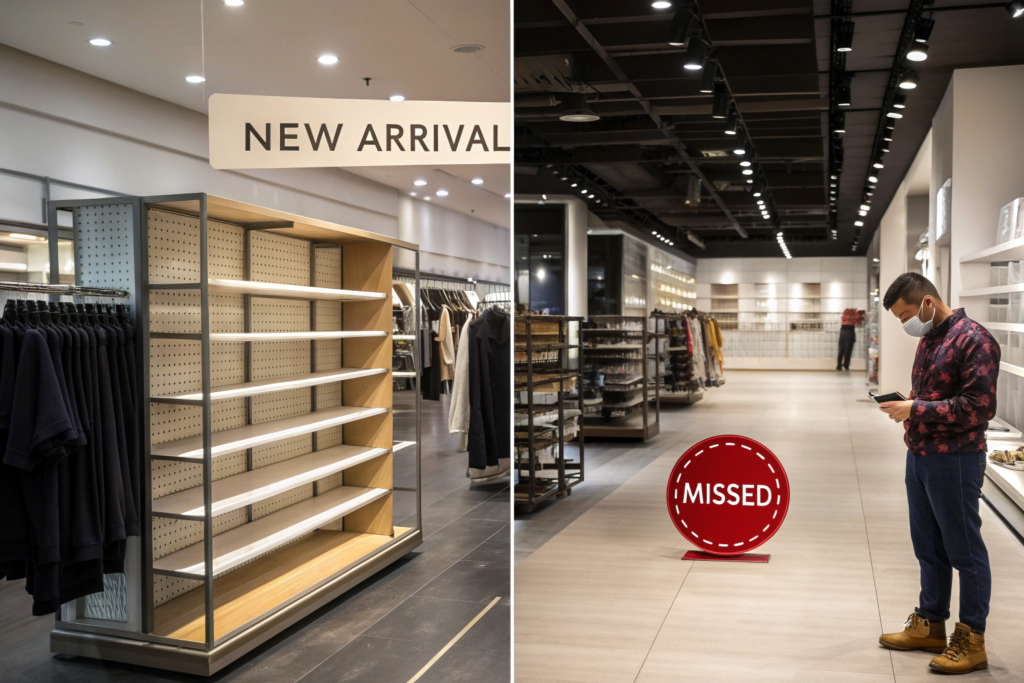
On-time delivery is the single most important metric in B2B apparel manufacturing. A beautiful garment that arrives late is a liability, not an asset. Missed floor sets, empty retail racks, chargeback penalties, and broken consumer trust cascade from one late container. At Shanghai Fumao, we treat delivery reliability not as a goal but as the foundation of our operating system. Here is how we built the machine that delivers 99 times out of 100.
Why Is "On-Time Delivery" the Most Important KPI for Apparel Vendors in 2026?
Price, quality, sustainability—all of these matter. But none of them matter if the goods are sitting on a dock in Shanghai while the selling season burns away. I learned this lesson painfully in 2021 when a freight delay pushed a shipment of summer linen dresses into August. The retailer canceled the order. We ate $28,000 in production costs and lost the client. After that disaster, I redesigned our entire production control system around the delivery calendar.
On-time delivery is the most important KPI because a late shipment triggers a domino effect of financial damage: retail chargebacks averaging 3-5% of invoice value, air freight surcharges to expedite recovery, missed seasonal markdown protection windows, and permanent brand-reputation damage with wholesale buyers who will simply de-list a chronic late supplier.
Brands budget their inventory flow six to nine months in advance. A late shipment does not just delay revenue. It triggers contractual penalties. Major retailers operate automated vendor compliance portals. One late PO and the system automatically docks a fine, downgrades your vendor score, and reduces your future allocation. Three strikes, and you are removed from the approved vendor list permanently.
How Much Does a Single Week of Delay Actually Cost a Mid-Sized Brand?
I sat with a brand owner in Dallas last year and calculated the true cost of a 10-day delay on one 5,000-unit shipment of woven shirts. Here is what we found:
| Cost Category | Amount | Notes |
|---|---|---|
| Retail Chargeback (3%) | $4,500 | On $150,000 wholesale invoice value |
| Air Freight Premium (partial) | $3,200 | To expedite 1,000 units for initial fill |
| Missed Full-Price Sell-Through | $8,700 | Estimated 15% of units forced to markdown |
| Internal Ops Disruption | $2,100 | Labor to re-route, customer service complaints |
| Total Delay Cost | $18,500 | 12.3% of the order's total gross margin |
These are real figures he shared from his P&L. The supplier who caused the delay offered a 3% discount on the next order as compensation. It did not come close to covering the damage. The lesson is stark: the cheapest FOB is expensive if it arrives late. This financial reality is why retail compliance enforcement has become increasingly automated, with platforms standardizing the vendor chargeback compliance rules that govern exactly when and how retailers penalize suppliers for late, incomplete, or incorrectly labeled shipments.
Why Has Delivery Reliability Surpassed Price as the Top Sourcing Criterion?
During the 2026 supply chain crisis, a sourcing director at a major midwestern retail chain told me his CEO had issued a new directive: "I will pay 8% more per unit for a factory that ships on time, every time." The reason was simple arithmetic. The hidden cost of a late shipment—chargebacks, air freight, lost full-price sales—exceeded an 8% unit cost premium. The CFO ran the numbers and concluded cheap was expensive.
This shift is permanent. The post-crisis market now asks for delivery date before price in RFPs. We have won multiple bids where our FOB was not the lowest, but our on-time scorecard was the highest. A 99% delivery track record is not a feel-good metric. It is a pricing power asset that pays for itself in every negotiation.
How Does Our "Backward-Scheduling" System Eliminate Deadline Drift?
Most factories schedule forward. They start with "fabric arrives Monday" and then estimate, loosely, when cutting, sewing, and packing will finish. The delivery date is a hopeful calculation, not a fixed commitment. When fabric arrives two days late, every downstream step shifts, and no one recalibrates the final date until it is too late. This forward-scheduling mindset is the root cause of almost every late shipment I have witnessed.
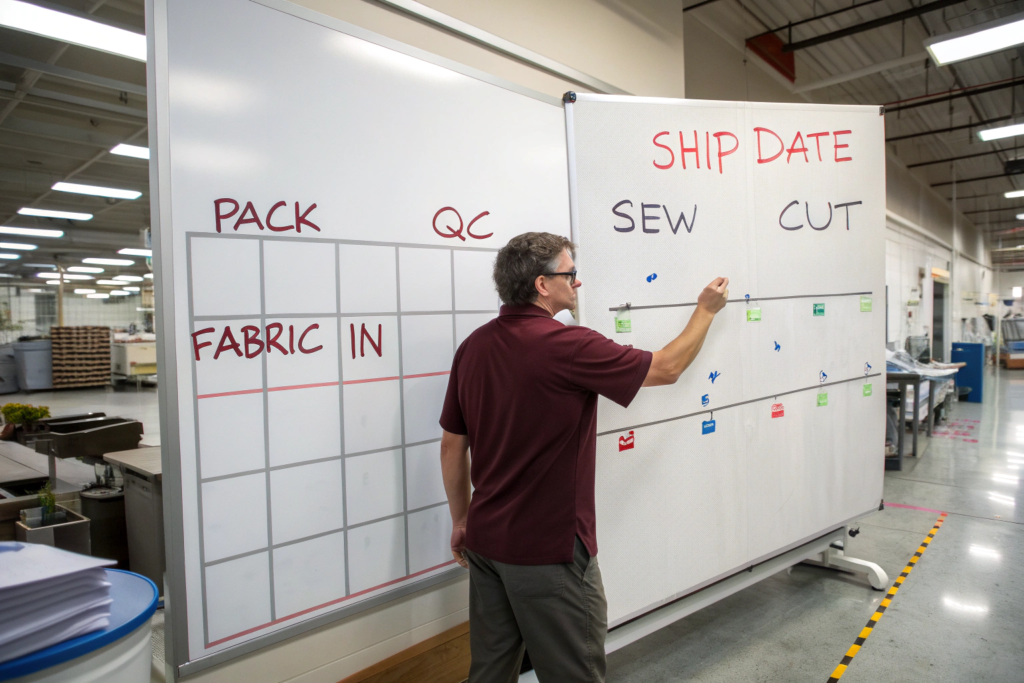
Our backward-scheduling system starts with the absolute, non-negotiable delivery date—the day the container must be loaded at the port—and works backwards, assigning a hard calendar date to every milestone: packing, final QC, sewing completion, cutting, and fabric in-house. If a milestone slips by even one day, the system immediately recalculates the downstream compression required to recover.
We implemented this system in 2023 after reading about critical chain project management used in aerospace manufacturing. A rocket launch date is fixed; the work plan flexes to meet it. A retail floor-set date is no different. The calendar is the master, and the production line is the servant.
What Happens When the Cutting Room Finishes a Day Late Under This System?
The system does not shrug. The production planning software immediately recalculates the sewing schedule and flags the delay to the Production Director's phone. The sewing line supervisor receives an alert: "Cutting delay: 1 day. Sewing deadline compressed by 8 hours. Overtime authorization granted." The decision to authorize overtime is made on Wednesday, not on the Sunday before the Monday deadline.
The recovery plan is executed immediately, while there is still time to absorb the delay. In a traditional factory, the cutting room delay is noticed on Friday, discussed on Monday, and the recovery plan starts Tuesday. That is four days of drift. Our system eliminates the gap between detection and response. This integration of real-time production data into scheduling decisions is a core principle of advanced manufacturing execution systems, and we apply it rigorously to our workflow.
How Do We Set Realistic Lead Times Without Overpromising to Win the Order?
A factory that promises a 30-day lead time just to win the contract and then consistently delivers in 45 days is not a partner; it is a liar. We calculate our lead times based on actual historical throughput data, not sales optimism. Our ERP system tracks the average cycle time for every garment category across the last 100 orders. A heavyweight fleece hoodie has a different lead time reality than a lightweight cotton tee, and we quote accordingly.
When a prospect asks for a 20-day delivery on a product that our data says requires 30, we say no, or we explain the rush surcharge required to compress the schedule safely. Underpromising and overdelivering is a cliché, but in apparel manufacturing, it builds a 99% track record. Our clients know that the date on our order confirmation is the date the container leaves. They build their inventory plans around it with confidence.
What Role Does Digital Production Tracking Play in Identifying Bottlenecks Early?
You cannot fix a problem you do not see. For years, factory management relied on the morning production meeting, where line supervisors verbally reported yesterday's output. By the time the bottleneck was discussed, 24 hours had already been lost. Digital tracking shrinks that latency to seconds. I know the exact output of every sewing line, every cutting table, and every packing station at this very moment, not yesterday afternoon.
Digital production tracking places a barcode scanner or RFID sensor at every critical workstation. As each bundle of garments moves from cutting to sewing to finishing, its progress is logged in real-time on a central dashboard. The system automatically compares actual throughput against the required pace to meet the ship date and flags any station operating below the target velocity.
We deployed a production tracking system across all five lines. Every bundle carries a barcode. Every operator scans the bundle when they start a task and when they finish. The data flows into our dashboard, which color-codes every workstation: green for on-pace, yellow for slightly behind, red for critically behind.

How Does Real-Time WIP Data Prevent a Small Delay from Snowballing?
Work-in-process inventory is the silent killer. A sewing line that runs slightly faster than the finishing line produces a mountain of unfinished garments waiting for buttons or pressing. The bottleneck is hidden by the buffer. Our tracking system monitors the physical location of every single bundle. If the buffer between sewing and finishing exceeds two hours of work, the system alerts us to reallocate a finisher from a slower line.
This micro-adjustment capability prevents the 4 PM panic where a supervisor discovers 400 un-pressed garments sitting in bins and realizes the pack-out deadline is impossible. We spot the 400-unit buildup when it is only 80 units, at 11 AM, and we fix it by lunch. This lean manufacturing principle of continuous flow management, informed by decades of research into production bottleneck theory and throughput optimization, is embedded directly into our digital tracking logic.
Can Clients Access a Live View of Their Specific Order's Production Status?
Yes, and this is a service that separates us from most competitors. Through our client portal, a brand owner can log in and see exactly where their PO sits in the production pipeline. They see "Cutting: Complete. Sewing: 72% complete. Finishing: Not started. Estimated pack date: On schedule." They do not need to email their sales rep and wait 12 hours for a reply. They look at the screen and see reality.
This radical transparency builds trust that no marketing copy can replicate. Last quarter, a client noticed his sewing progress was at 85% when it should have been at 92% according to the plan. He emailed us before we emailed him. He asked if everything was okay. We replied within ten minutes explaining that a machine had been down for maintenance for two hours and was now back online, with overtime already scheduled to recover the gap by end of shift. He replied, "No worries. Just checking." That is the relationship real-time data creates.
How Are Shipping Partnerships Structured to Guarantee Container Space During Peak Season?
The smoothest production schedule in the world is meaningless if the container never gets on the vessel. Peak season—August through October for holiday goods—is a brutal competition for container slots. Carriers overbook vessels, and the lowest-paying or latest-booking cargo gets rolled to the next sailing, then the next. A factory without a carrier partnership does not control its own shipping timeline.
We structure our shipping partnerships through annual Minimum Quantity Commitment contracts with two first-tier global carriers. We guarantee each carrier a defined monthly container volume. In exchange, they guarantee us vessel space, even during peak season, and a fixed contract rate that does not fluctuate with spot-market volatility.
These contracts are not gestures. They are legally enforceable agreements with performance guarantees on both sides. If we fail to tender the committed volume, we pay a shortfall fee. If the carrier fails to load our confirmed booking, they pay a "roll penalty" per container. This mutual accountability keeps both sides honest.

What Is a "Roll Over" Guarantee and Why Does It Matter for Christmas Orders?
A roll-over happens when a container booked on Vessel A is bumped to Vessel B, which sails a week later. For a Christmas order, a one-week roll at origin can compound into a two-week delay at the destination once port congestion is factored in. That delay misses the Black Friday distribution window entirely.
Our carrier contracts include a "no-roll" clause for premium peak-season bookings. We pay a small premium per container for this guarantee—roughly $150—but in exchange, the carrier commits that our containers will not be rolled except in force majeure circumstances. In Q3 2026, when the spot market exploded and carriers were rolling 20% of general cargo, none of our contracted containers were rolled. The premium paid for itself a hundred times over in avoided chargebacks. Tracking the performance of carriers on these commitments is possible through real-time vessel schedule data provided by global container tracking visibility platforms.
How Do We Pre-Clear Customs Documentation While Goods Are Still in Production?
The traditional sequence is: finish goods, prepare documents, send to broker, wait for clearance. That sequence adds two to three days of idle time after packing. We run documentation in parallel with production. As soon as the final carton count is confirmed at the packing station, our customs team finalizes the commercial invoice and submits it to the U.S. broker electronically.
By the time the container arrives at the port of departure, the Importer Security Filing (ISF) is already filed, the duties are pre-calculated, and any classification questions have been resolved. The container does not wait for paperwork. The paperwork is ready before the container. This parallel processing is made possible through digital integration with customs brokerage platforms and adherence to U.S. Customs and Border Protection electronic filing requirements. Every hour of delay we eliminate in the documentation phase is an hour of buffer we preserve for unexpected physical logistics disruptions.
Conclusion
Our 99% on-time delivery rate is not the result of a single clever hack. It is the cumulative effect of a system designed to honor a calendar date as though it were a legal contract. The backward-scheduling process treats the delivery date as fixed and forces every upstream step to justify its place in the timeline. The digital tracking system makes drift visible the moment it occurs, not the morning after. The carrier partnerships ensure that a perfectly produced garment does not die on a dock waiting for a vessel slot. And the buffer inventory strategy—the greige bank, the in-process stock, the pre-booked freight—absorbs the shocks that an unpredictable world throws at us.
The Philadelphia brand owner who texted me in desperation now runs all his seasonal programs through Shanghai Fumao. His operations manager recently told me that our delivery consistency has allowed them to reduce their safety inventory buffer from six weeks to two, freeing up working capital that they reinvested in marketing. That is the second-order benefit of a factory that ships on time, every time. It changes how you can run your business.
If late shipments have damaged your retail relationships or forced you into expensive air-freight fire drills, let us show you what a 99% on-time delivery system looks like. Contact Elaine to discuss your production calendar and receive a lead-time proposal based on actual throughput data, not a sales promise. Her email is: elaine@fumaoclothing.com.
Stop hoping your supplier ships on time. Partner with a factory that guarantees it.