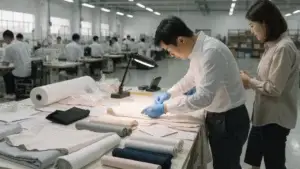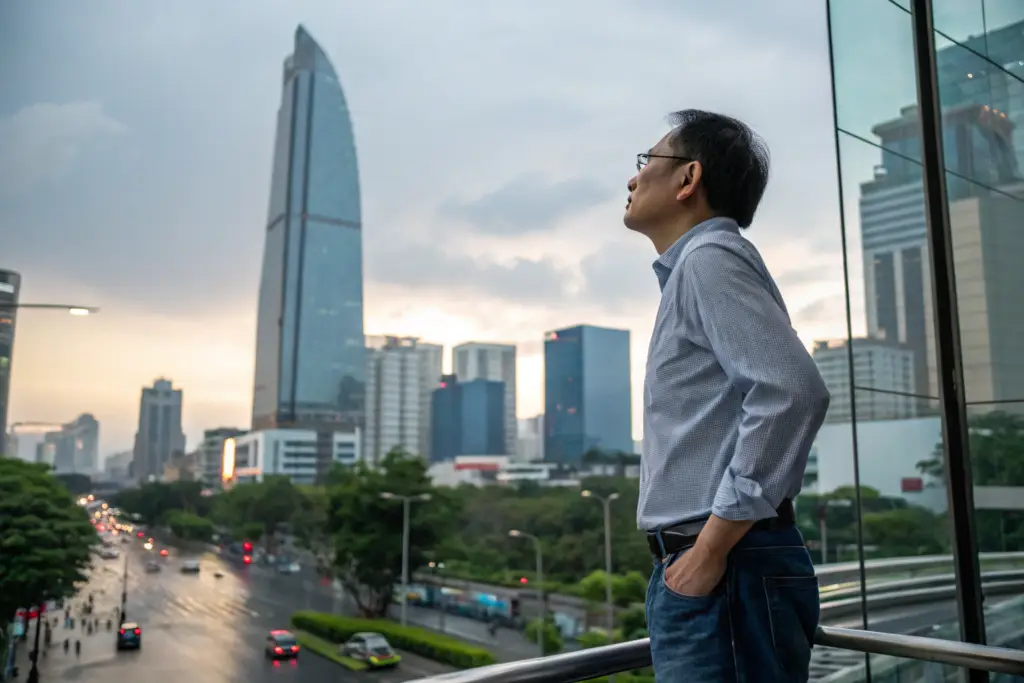
Last March, a surf-and-skate brand owner from San Clemente, California, flew 20 hours to Ho Chi Minh City. He had sourced his basic cotton tees from a Vietnamese factory for three years. He walked into their office expecting a routine production meeting. He walked out after being told his MOQ was doubling, his lead time was extending by 30 days, and his price was increasing 8% because the factory was prioritizing larger European accounts. He called me from the taxi to the airport. "I thought Vietnam was the answer," he said. "I need a factory that actually wants my business." Three months later, his entire knitwear program was running through our lines.
Whether you should switch from Vietnam factories to Shanghai Fumao depends on three data points: your product complexity, your volume flexibility needs, and your tolerance for hidden logistics friction. If you make complex garments—multi-piece outerwear, tailored wovens, or anything requiring advanced embellishment—and you need MOQs under 500 units per style, China, and specifically our factory, still holds a structural advantage that Vietnam's textile ecosystem cannot yet match.
The narrative that "everything is moving to Vietnam" is an oversimplification. Vietnam is excellent at what it does well: basic knits, simple synthetics, and high-volume, low-complexity programs for mega-brands. But the hollowing out of China's mid-market manufacturing is a myth. What actually happened is a bifurcation. The low-end commodity work migrated. The high-skill, fast-turnaround, small-batch, complex work stayed, and the best factories like Shanghai Fumao invested heavily in automation and AI to make that remaining work better and faster than anywhere else on earth. Here is the evidence that should inform your decision.
What Product Categories Does Vietnam Excel at Compared to China?
Vietnam's textile industry is exceptional at high-volume, low-variety production. Vietnamese factories have invested heavily in modern single-purpose machinery optimized for long runs of the same garment. If you need 50,000 basic polo shirts in three solid colors, Vietnam will likely beat China on price. The comparative advantage is real, and I acknowledge it. But that advantage narrows and eventually reverses as product complexity increases.
Vietnam excels at basic knit tops, simple activewear, commodity-level woven bottoms, and single-layer synthetic jackets. The Vietnamese textile ecosystem is optimized for long runs with minimal style variation. China, particularly Shanghai Fumao, excels at multi-piece woven garments, complex outerwear, advanced print and embroidery techniques, and small-batch flexible production that a basic-focused Vietnamese line cannot accommodate.
The structural reason is raw material access. Vietnam imports roughly 60% of its fabric, mostly from China. When you order a complex cotton-nylon blend with a specific mechanical stretch in Vietnam, the mill in China supplies the fabric. You have added a cross-border step, additional lead time, and another markup in the chain. In China, the mill is often a truck drive away, not a customs clearance away.
Why Does Vietnam's Raw Material Import Dependency Add Hidden Lead Time?
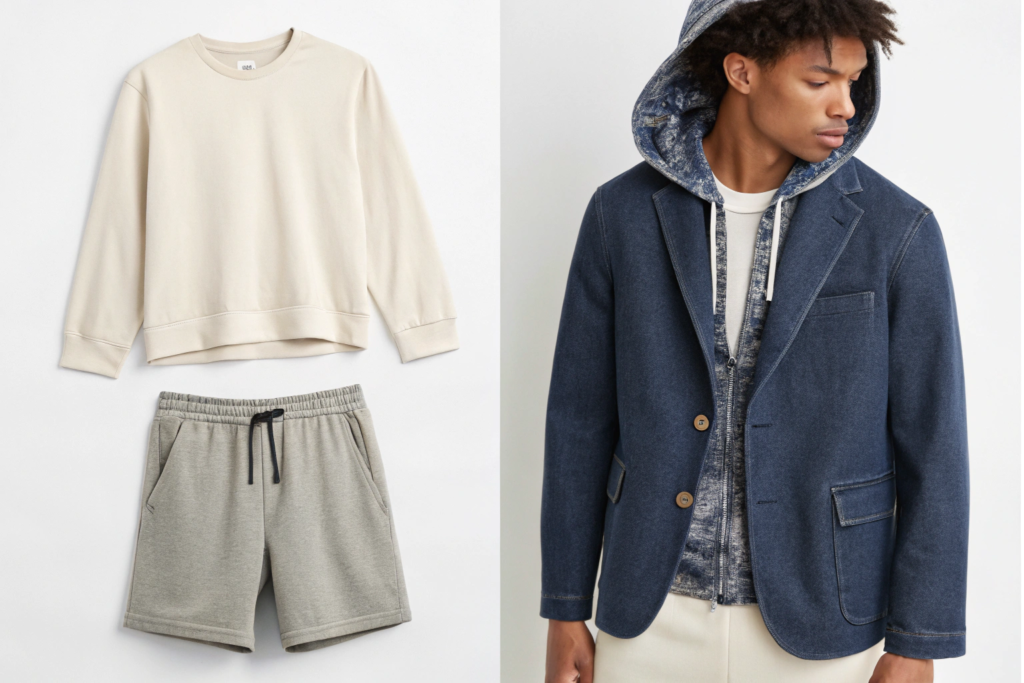
I ran a comparison for a client considering shifting a brushed-flannel shirttail blouse program to Vietnam. The Vietnamese factory quoted a 60-day lead time. On paper, competitive. Then we examined the breakdown. The factory needed 18 days just to import the certified organic flannel fabric from a mill in Jiangsu, China. Add 7 days for customs clearance at the Vietnamese port. That is 25 days of the 60-day lead time consumed by fabric logistics before a single cut was made.
Our lead time for the same blouse? 28 days. Because the identical Jiangsu fabric mill is a four-hour truck drive from our cutting tables. The geographic compression of the Chinese supply chain—where fiber, yarn, fabric, dye, trim, and sewing all exist within a single industrial cluster—remains a unique structural advantage for complex garments.
Is Vietnam's Lower Labor Cost Offset by Productivity and Automation Differentials?
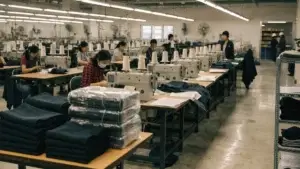
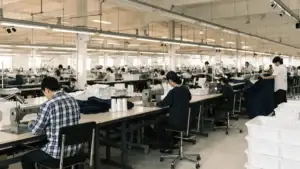
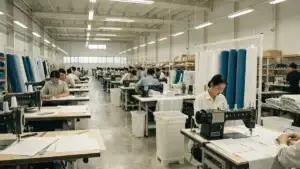
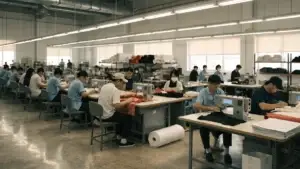
Vietnamese garment worker wages are approximately 30-40% lower than Shanghai-area wages. That is a factual cost advantage. But the wage gap is only part of the equation. Our factory operates automated spreading machines, laser-guided cutting, and AI-optimized marker making that consistently achieve 87% fabric utilization versus a regional average of 80%. We employ fewer workers per unit, and each worker produces more output per hour because of the technology stack.
The productivity gap offsets roughly half the wage gap. When you add the fabric waste differential, the supply chain compression advantage, and the elimination of cross-border fabric logistics costs, the total landed cost comparison shifts dramatically for complex garments. This aligns with productivity data tracked by organizations like the International Labour Organization on sectoral productivity, which consistently finds that technology investment per worker is a stronger predictor of total unit economics than wage rates alone.
How Does China's Fabric Ecosystem Still Outpace Vietnam for Complex Designs?
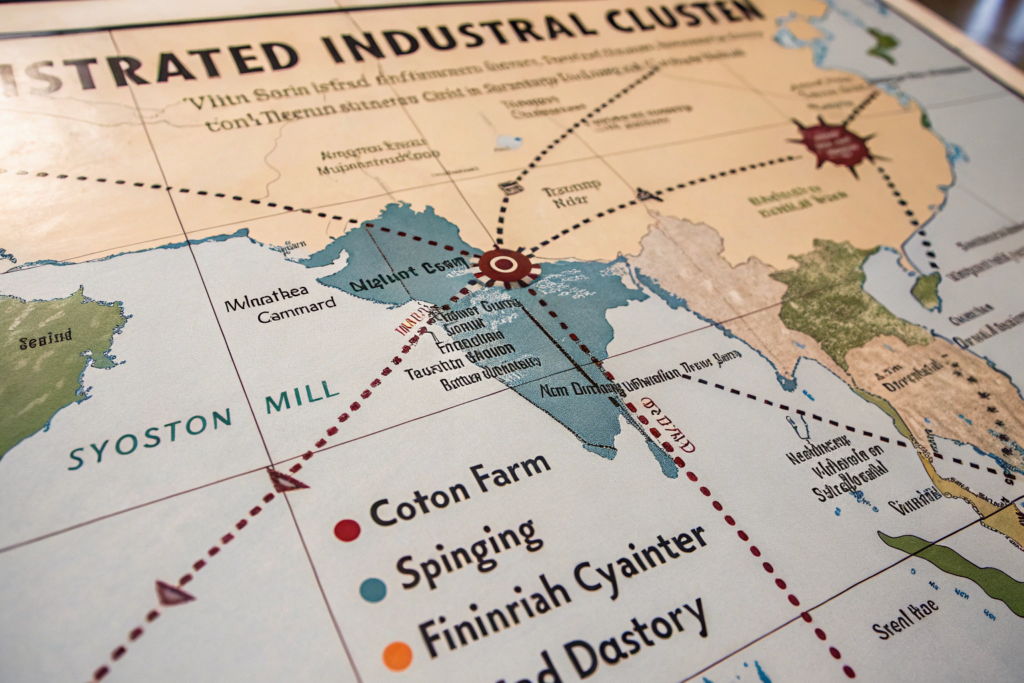
The most underappreciated advantage of manufacturing in China is the textile cluster. In a 200-kilometer radius of Shanghai, I can access every major category of fabric mill, every dye technique from reactive to pigment to indigo rope-dyeing, every wash from enzyme to ozone, and every trim from custom-engraved buttons to RFID-embedded care labels. This density does not exist anywhere else on earth, not in Vietnam, not in Bangladesh, not in Turkey.
China's fabric ecosystem outpaces Vietnam for complex designs because the entire textile value chain—petrochemical fiber extrusion, yarn spinning, fabric knitting or weaving, dyeing, finishing, and printing—exists within a single integrated industrial geography. Complex multi-component designs that require iterative fabric development, custom dye matching, and specialized finishing can be prototyped and sampled in days, not weeks.
Vietnam's fabric industry is growing rapidly, particularly in synthetic knits for athletic wear. But for complex wovens, premium natural fibers, and specialty finishes, the capability depth is still shallow. A brand that needs a custom jacquard woven with recycled polyester and organic cotton, then garment-dyed to a specific Pantone shade, will find five mills within an hour of our factory that can execute that. In Vietnam, they may find one, and that one may be fully booked by a mega-brand.
What Happens to Sampling Timelines When Fabric Must Cross an International Border?
A New York-based contemporary womenswear brand tested this recently. They sent the identical tech pack for a lined linen blazer to a Vietnamese factory and to us. The Vietnamese factory had to request the specialty linen from a Chinese mill. The fabric sample took nine days to arrive in Ho Chi Minh City. Our sample department received the same fabric in three hours by courier from a mill in Changzhou. The physical sample from Vietnam arrived 22 days after the tech pack was sent. Our sample arrived in 7 days.
That 15-day gap on one style multiplies across a 12-piece collection. A brand developing a full seasonal line can compress their total development calendar by five to seven weeks by manufacturing in China, simply because the fabric and trim logistics are local. In fashion, time is not just money. Time is shelf life, trend relevance, and wholesale booking window capture.
Are the Specialty Finishing Techniques Required by Premium Brands Available in Vietnam?
Garment washing technique—the specific shade of a vintage wash denim, the soft handfeel of a silicone-washed modal, the exact worn-in abrasion on a jacket elbow—is both science and art. China, and particularly the Guangdong-Zhejiang axis, houses the world's most advanced garment wash facilities. They have invested in laser finishing, ozone bleaching, and nanobubble washing that delivers authentic vintage aesthetics without water waste.
When a premium streetwear brand needs a specific "eight-year-worn" denim jacket finish with targeted abrasions and a resin-cured crease pattern, the wash houses in China can execute that repeatably at scale. The Vietnamese wash industry is maturing but has not yet developed the deep bench of master wash technicians who have been doing this work for two decades. This capability gap, documented by industry analyses from the denim finishing technology sector, means the highest-value, most brand-differentiating garments still flow through Chinese factories.
What Are the Hidden Risks of a Single-Country Vietnam Sourcing Strategy?
Diversification is risk management 101. Yet I see brands that proudly announce they have "moved 100% of production out of China," as if concentration risk disappears when the country changes. It does not. It just moves. If your entire supply chain depends on one country—any country—you are one port strike, one policy change, one currency swing away from a crisis. The smartest sourcing strategy is not "China or Vietnam." It is "China and Vietnam."
The hidden risks of a single-country Vietnam strategy include exposure to U.S. trade policy shifts that could suddenly target Vietnamese transshipment or currency practices, bottleneck risk at a single port infrastructure like Ho Chi Minh City, and the limited domestic fabric supply chain that makes Vietnam dependent on Chinese inputs anyway.
Vietnam is a great sourcing destination. We respect Vietnamese manufacturers. But placing all your bets on one geography repeats the exact vulnerability that brands thought they were escaping when they left China in 2020. The difference now is that China has deepened its infrastructure advantage, and we, the manufacturers who survived the consolidation, are stronger operationally than before.
Could a U.S. Trade Policy Shift on Vietnam Suddenly Erase the Tariff Advantage?
The same political logic that applied tariffs to Chinese goods can apply to Vietnamese goods. Vietnam currently enjoys a large trade surplus with the United States. If that surplus continues to widen, particularly in textiles, trade enforcement action is a realistic scenario. A brand that shifted 100% of production to Vietnam to avoid China tariffs could face the nightmare of new Vietnam tariffs, with no alternative production base ready.
We advise our U.S. clients to maintain at least two active sourcing countries at all times. We have even helped clients identify reputable Vietnamese partners for the commodity-knit portion of their program while we handle the complex woven and outerwear portion. A diversified sourcing strategy is the only durable defense against trade policy volatility. Monitoring the risk profiles of major sourcing countries requires attention to indicators like those tracked by the United States Fashion Industry Association trade policy resources, which benchmarks political risk across major apparel-exporting nations.
What Happened When a Major Vietnamese Port Faced an Unexpected Shutdown in 2025?
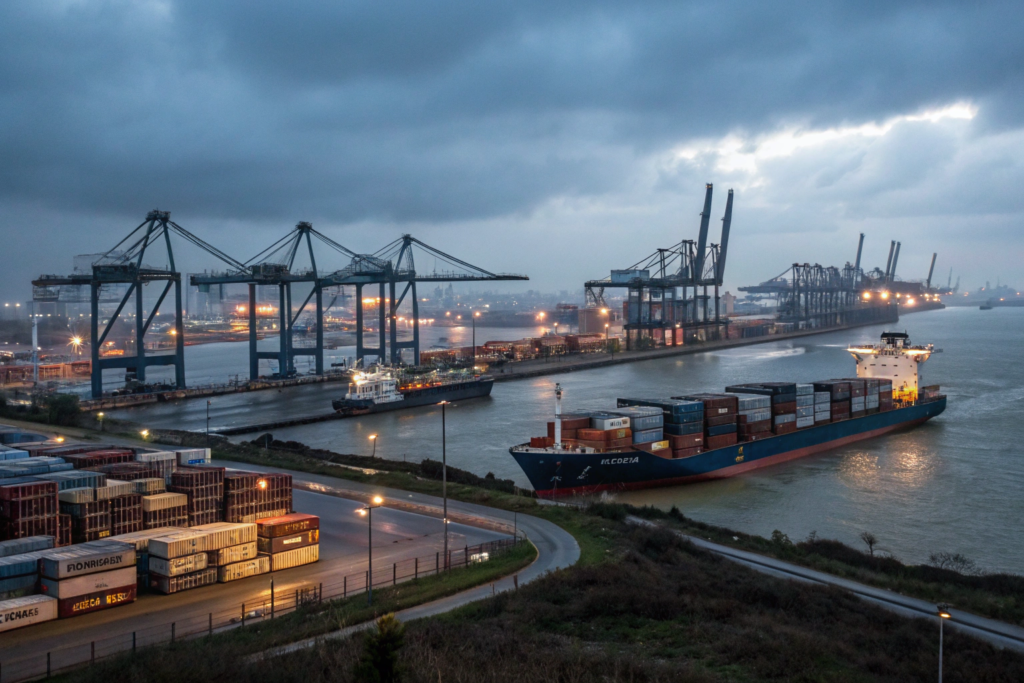
Port congestion is not hypothetical. In mid-2025, the Cai Mep deep-water port complex near Ho Chi Minh City experienced a severe congestion event due to a combination of a typhoon and a labor shortage. Vessel waiting times extended to 10 days. Factories that shipped exclusively through that port had no alternative. Containers sat idle. Brands missed delivery windows.
Chinese manufacturers have multiple deep-water port options: Shanghai, Ningbo, Shenzhen, Qingdao, Xiamen. If one port is congested, we truck containers to another. This port redundancy is a structural resilience advantage of manufacturing in a geographically large country with multiple world-class maritime gateways. A single-country strategy in a nation with essentially one major export port concentrates logistics risk unnecessarily.
Who Should Make the Switch and What Does the Migration Process Look Like?
Switching suppliers is not a light decision. It involves emotional energy, financial risk, and the fear of the unknown. I do not recommend switching for a 2% cost improvement. I recommend switching when the current supplier's structural limitations are actively constraining your brand's growth—when you cannot add the new product categories you need, when MOQs are preventing you from testing new designs, or when delivery unreliability is damaging your wholesale relationships.
The ideal candidate for migration is a brand currently doing $500,000 to $5 million in annual sourcing, whose product mix includes at least 40% complex garments, and who needs flexible MOQs below 500 units per style. The migration process follows a structured, de-risked path: a test project with one product category, a parallel production run alongside the existing supplier, and a graduated volume shift over two to three seasons.
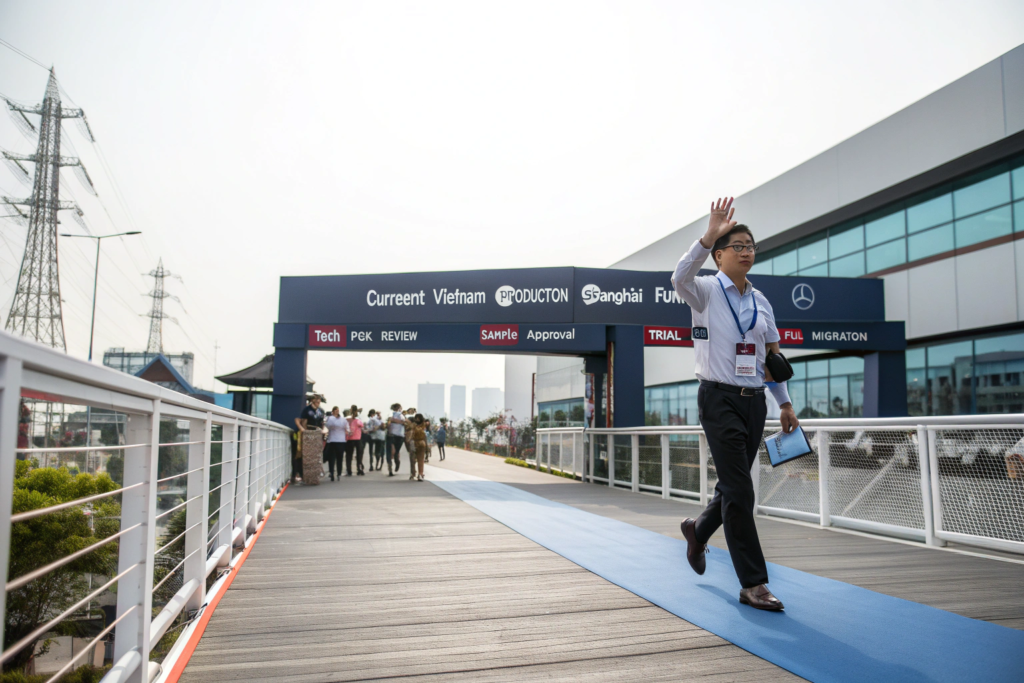
We have migrated over a dozen brands from Vietnamese suppliers in the past two years. Not one migration happened overnight. Each followed a deliberate sequence designed to verify quality, test communication cadence, and build trust before committing serious volume. Here is the path we recommend.
What Does a "No-Risk Test Order" Look Like for a Brand Considering the Switch?
A test order is a small-batch, single-style production run that serves as a proof-of-concept. We recommend selecting a mid-complexity style—not your easiest commodity tee, but not your hardest tailored jacket. Something like a printed French terry hoodie or a five-pocket woven chino that tests pattern making, print execution, and wash quality simultaneously.
The test order is typically 100-300 units, run on our standard production line, with full quality documentation and daily digital updates through the client portal. The brand evaluates the sample accuracy, the communication responsiveness, the on-time delivery, and the garment quality against their existing supplier's baseline. The test order is low-risk, low-volume, and fully transparent. If the test succeeds, we move to the parallel production phase.
How Long Does a Full Supplier Migration Typically Take from First Sample to Full Volume?
The typical migration timeline, based on our last 12 client transitions:
| Migration Phase | Duration | Key Milestone |
|---|---|---|
| Tech Pack & Fabric Review | 1-2 weeks | Fabric sourcing and digital pattern generation |
| First Sample & Fit Approval | 2-3 weeks | AI-assisted pattern, physical sample shipped |
| Test Order (100-300 units) | 4-5 weeks | Full production run, shipped DDP |
| Parallel Production (2-3 styles) | 8-10 weeks | Running alongside existing Vietnamese supplier |
| Volume Shift (50%+ of program) | Season 2 | Graduated transfer, Vietnam held as backup |
| Total to Full Migration | 5-7 months | Existing supplier relationship maintained |
This timeline is deliberate. It prevents the brand from being exposed during a supplier transition. The Vietnamese supplier remains active while we prove our performance. By Season 2, the brand has objective data comparing our defect rates, delivery reliability, and communication speed against the incumbent. The decision to shift volume is data-driven, not based on a sales pitch.
Conclusion
Vietnam is an important and capable apparel manufacturing country. For high-volume basic knits and simple synthetic activewear, it often represents the most cost-effective option. But for brands whose product mix includes complex wovens, tailored outerwear, advanced embellishment, or who need flexible MOQs and rapid sampling, China—and specifically Shanghai Fumao—retains a structural advantage that no other country currently matches. The fabric mills next door, the wash houses with decades of expertise, the automated cutting tables, and the AI that optimizes every pattern are not easily replicable.
The San Clemente surf brand owner who called me from the taxi now runs his 3,000-unit monthly knit program through us. He also added a woven shirt category that his Vietnamese factory could not execute at the quality level his boutique accounts demanded. His business grew 22% last year, not because he found a cheaper factory, but because he found a more capable one that removed the product ceiling his previous supplier imposed.
If you are evaluating whether to maintain, supplement, or replace your current Vietnamese production, let us run a low-risk test order. Send a tech pack to Elaine. She will return a sample, a transparent production timeline, and a cost breakdown that allows you to compare our performance objectively against your current supplier. Her email is: elaine@fumaoclothing.com.