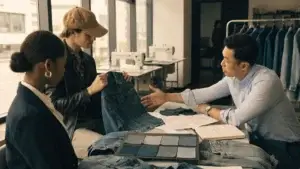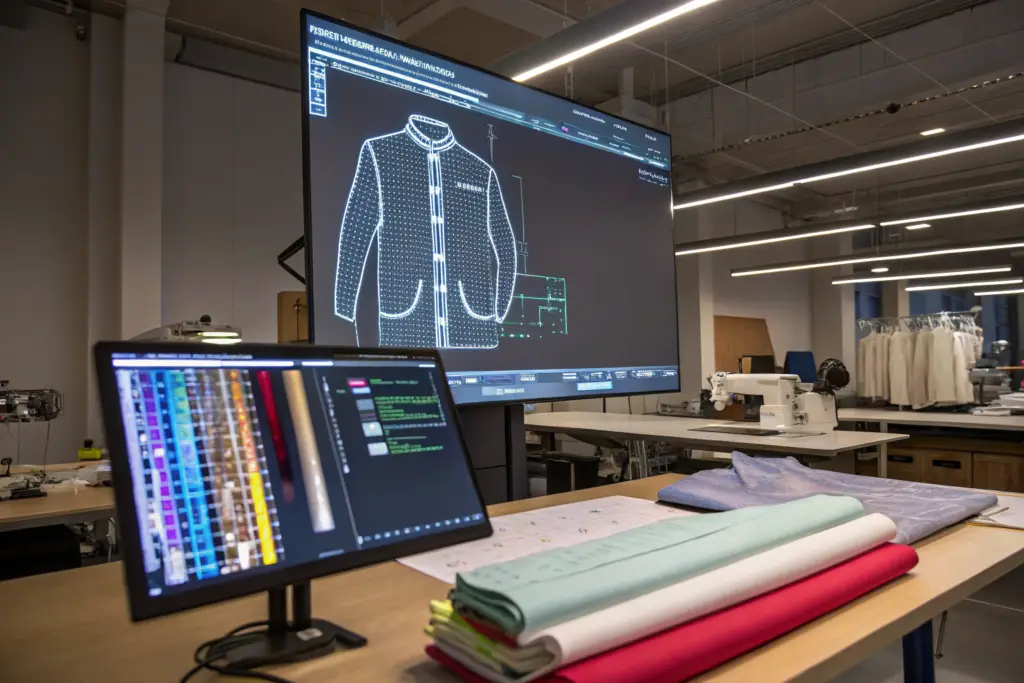
Three years ago, a pattern maker who had worked for me for over a decade handed in his resignation. He was moving to a competitor. He took 25 years of experience with him, locked inside his head. I panicked, briefly. Then I realized his expertise was already being digitized. Every curve he had ever adjusted, every armhole he had corrected, every neckline he had smoothed, was captured in our pattern database. The AI did not replace him. It had learned from him. Today, a junior technician can produce a first-sample pattern that rivals what my veteran created, in one-tenth of the time.
Yes, AI pattern making at Shanghai Fumao represents the future of apparel manufacturing because it collapses the design-to-sample timeline from weeks to hours, reduces fabric waste at the cutting table by optimizing marker efficiency beyond human capability, and democratizes access to expert-level garment engineering for brands that lack in-house technical designers.
The apparel industry has been cutting fabric from paper patterns for centuries. The core skill—translating a 2D design sketch into a 3D body shape using flat pieces of cloth—remained an artisanal, human craft. Until now. At Shanghai Fumao, we have integrated AI into our pattern-making workflow not as a gimmick, but as a genuine structural change in how we build garments. Here is why this matters for every brand we serve.
What Is AI Pattern Making and How Does It Actually Work in a Real Factory?
When I first heard the term "AI pattern making," I pictured a robot sewing a shirt. That is not what it is. AI pattern making is the use of machine learning algorithms trained on thousands of historical patterns to generate a new pattern instantly from a set of inputs: a body measurement spec, a fabric type, a desired fit style, and a design sketch. The AI does not guess. It references a database of every pattern that previously fit well, and every pattern that was rejected, and it finds the optimal geometric solution.
AI pattern making in a real factory works by ingesting a digital tech pack, analyzing the fabric's drape and stretch coefficients, and then generating a 2D pattern that is immediately cut by an automated laser or blade cutter. The AI continuously learns from the fit approval and rejection data fed back by the quality team, improving its accuracy with every production run.
Our system, which we call internally "PatternEngine," was trained on a proprietary dataset of 12,000 graded patterns we have developed over the past eight years. It covers wovens, knits, outerwear, and childrenswear. The system does not just place seams randomly; it understands the structural logic of a raglan sleeve versus a set-in sleeve. Here is the technical breakdown.
How Does the AI Translate a 3D Body Scan Into a 2D Pattern Block?
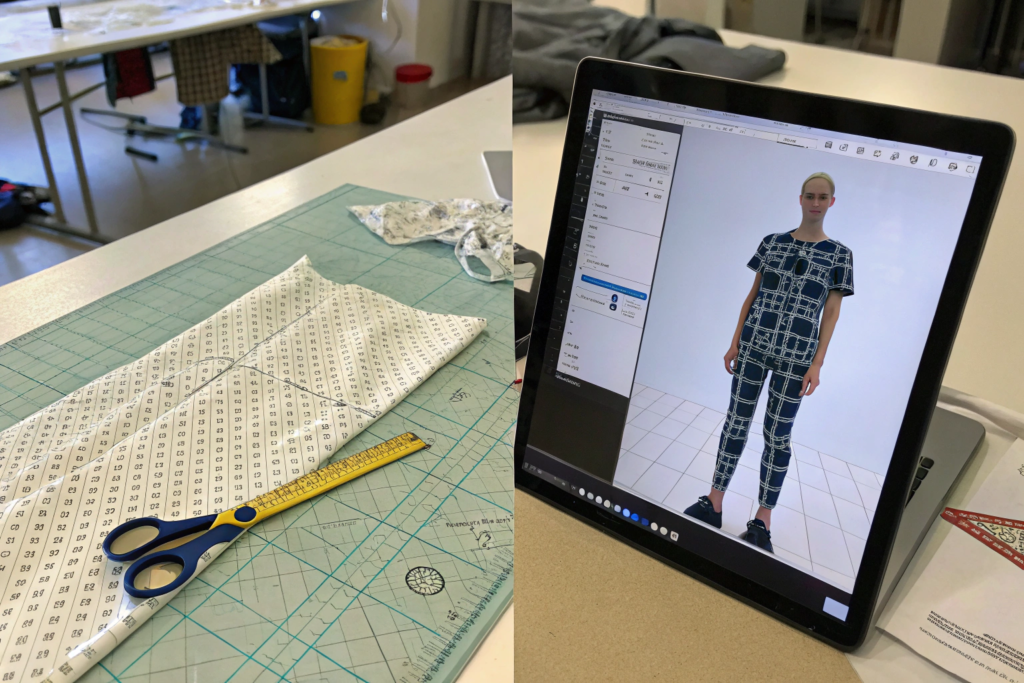
The fundamental challenge of pattern making is flattening a three-dimensional human body into two-dimensional fabric pieces that, when sewn together, recreate the exact 3D shape. Traditional grading is an approximation. The pattern maker manually adjusts key points based on a grade rule table. The AI approaches it differently. It builds a 3D digital avatar of the target body measurements, "wraps" it in a virtual fabric simulation, and then mathematically flattens the fabric into 2D pieces.
The AI simulates the fabric's mechanical properties—how much the cotton jersey stretches, how the denim drapes under gravity. This simulation means the flat pattern already accounts for the fact that a knit sleeve will stretch lengthwise when worn, but a woven sleeve will not. This capability transforms pattern generation from an interpretive art into a physics-based simulation, a technology heavily researched and validated by the 3D body scanning and virtual try-on industry, which provides the underlying anthropometric data frameworks.
Does the System Learn From a Brand's Unique "Fit DNA" Over Time?
Every successful brand has a fit DNA. Brand A's medium shirt fits slightly looser in the chest. Brand B's size 28 jeans have a higher back rise. A new pattern maker learning a brand's fit typically destroys a lot of sample fabric figuring this out. Our AI ingests the brand's approved golden samples, digitizes the actual measurements of those garments, and builds a "Fit DNA Profile."
When a new style for Brand A is developed, the AI loads Brand A's profile and biases the pattern generation toward their historical fit preferences automatically. The first sample comes out 90% closer to the desired fit than a generic base-size pattern would. A streetwear brand from Chicago recently onboarded with us, and their design director was stunned that the first hoodie sample fit their model exactly as they wanted, without a single pattern revision. The AI had simply applied their Fit DNA from day one.
How Does Automated Grading Cut Production Costs for Small and Medium Brands?
Grading is the process of scaling a base-size pattern into a full size run—Small through 3XL. It is tedious, mathematical, and prone to human error. A manual grader must adjust dozens of points on each size, ensuring the shoulder slope, armhole curve, and body length increase proportionally. A mistake of two millimeters at the shoulder point creates a size Large that fits differently than the size Medium, and a customer return is triggered. Small brands often cannot afford a professional grader, so they accept poor fit as the cost of doing business.
Automated grading cuts production costs because the AI grades an entire size run from XXS to 5XL in under three minutes, compared to four to six hours of manual labor. This eliminates a significant line item from the development cost for each style, making small-batch production with full size diversity economically viable for indie brands.
The cost structure of sampling and grading is a barrier to entry for new labels. When a factory charges $300 per pattern plus $150 for grading, launching a 10-piece collection costs thousands of dollars before a single garment is sold. Our AI-driven process has cut our internal grading cost by roughly 70%, and that saving passes directly to our clients.
What Is the Cost Difference Between Manual and AI Grading for a 5-Size Run?
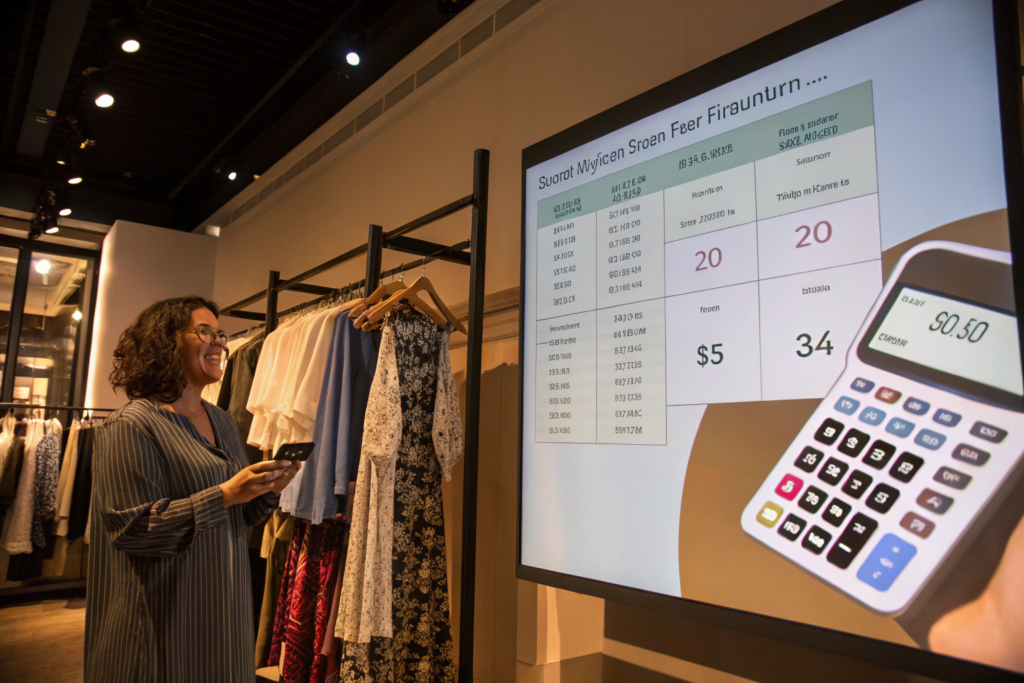
Let me give you actual numbers from our costing analysis. These are the development costs for a standard five-pocket jean, graded from XS to XL, comparing our old manual process to our current AI process:
| Development Task | Manual Process Cost | AI-Assisted Process Cost | Time Saved |
|---|---|---|---|
| Base Pattern Creation | $280 (8 hours) | $90 (30 min AI + 1 hour human review) | 6.5 hours |
| 5-Size Grade | $180 (5 hours) | $0 (included in AI processing) | 5 hours |
| Nesting & Marker | $70 (2 hours) | $15 (5 minutes automated) | 1.9 hours |
| Total Development Cost | $530 | $105 | 13.4 hours |
These are real figures from our Q1 2026 internal cost accounting. The savings multiply when a brand develops 10 or 20 styles per season. The AI investment pays for itself not just in reduced labor, but in the sampling fabric we no longer waste on correction rounds. This cost reduction for grading aligns with the efficiency principles advocated by automation leaders in the digital pattern making software sector, who have demonstrated that computational grading eliminates the geometric drift that manual grading introduces.
Why Does Faster Turnaround on Samples Win More Retail Buyer Appointments?
A retail buyer at a trade show sees hundreds of brands. A brand that can say, "You like this fit. I can have a full graded size set in your hands in 72 hours," wins the account over a brand that says, "We can grade that in three weeks." Speed of sample iteration is a sales weapon. The buyer's enthusiasm is hottest the day after the meeting. Every day that passes, the impression cools.
Our AI grading pipeline allows our brand clients to close wholesale accounts faster. When a boutique owner from Austin received a provisional order from a department store last month contingent on a graded sample set, we turned the full XS-3XL set in two days. The store confirmed the order within the week. The competitor who needed three weeks for grading lost the slot.
Can AI Predict Fabric Behavior to Reduce Sampling Waste?
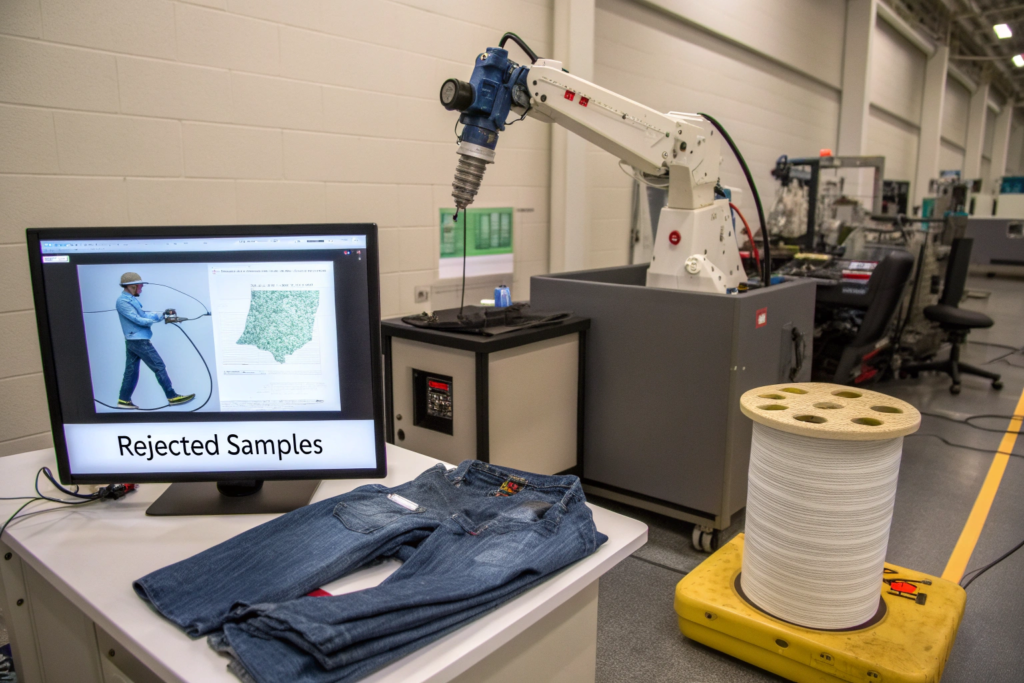
The dirtiest secret of the apparel industry is the mountain of fabric buried in the sampling process. Before AI, we would cut five to seven physical samples of a new style, each one slightly adjusted, until we got the fit right. By the time the style was approved, the rejected prototypes filled a storage box. Multiply that by 200 styles a year, and we were burying thousands of yards of perfectly good cotton in the sample archive.
AI predicts fabric behavior by simulating the mechanical properties—stretch recovery, drape coefficient, shrinkage rate—of the selected fabric within a virtual environment. The digital twin behaves identically to the physical textile, so the first physical sample cut is often the only one needed, reducing sampling waste by up to 80%.
We digitized our entire fabric library. Every new fabric we source—whether a lightweight linen for summer shirts or a heavyweight fleece for winter hoodies—undergoes a battery of physical tests. The results are fed into the AI's physics engine. The engine knows that linen has zero stretch but frays easily, so it automatically adds a wider seam allowance to the pattern.
How Does the Digital Twin of a Fabric Eliminate the Need for Multiple Fitting Prototypes?
When a brand submits a tech pack for a woven blazer, the AI selects the digital twin of the specified wool blend. The digital twin contains data on the fabric's weight, bending stiffness, and warp-weft shear behavior. The AI drapes the virtual blazer on a 3D avatar and shows where the fabric will pull, where it will sag, and where the shoulder pad will create a stress point.
Our pattern engineer reviews the simulation and adjusts the pattern digitally before a single thread is cut. What used to require three physical samples and three fit sessions now requires one. The AI-optimized pattern produces a first sample that fits correctly 85% of the time, compared to roughly 50% with traditional methods. This virtual sampling methodology is aligned with the simulation capabilities of 3D fashion design technologies that enable zero-waste virtual prototyping.
Does AI Pattern Engineering Actually Contribute to Our Zero-Waste Production Goals?
Absolutely. The connection between AI pattern making and waste reduction is direct. A human pattern maker cuts pattern pieces with generous safety margins because they are unsure of fabric shrinkage. The AI knows the exact shrinkage rate of the specific fabric lot, so it applies the precise allowance with zero guesswork. This cuts fabric consumption by 3-5% per garment.
The AI also calculates the most efficient marker layout—how the pattern pieces are arranged on the fabric like puzzle pieces. While a human nesting technician achieves 80-82% fabric utilization on complex woven markers, our AI achieves 87-90% on the same garments. That 8% gap, across thousands of yards, is tons of fabric that never enters a landfill. The AI pattern system is the upstream brain that feeds our zero-waste cutting tables the optimized instructions they execute.
Who Benefits Most from AI-Driven Customization in B2B Apparel Manufacturing?
The loudest complaint I used to hear from small brands was that they could not get the same pattern quality as Nike or Zara. The best pattern makers worked for the biggest factories, who served the biggest accounts. The small label with a 200-unit order got the junior pattern maker, and the fit suffered. AI does not have favorites. It applies the same expert-level logic to a 50-unit boutique order as it does to a 5,000-unit wholesale order.
The biggest beneficiaries of AI-driven customization are emerging streetwear labels and direct-to-consumer brands who need small-batch production with premium fit, plus mid-sized workwear and uniform companies who require precise, consistent grading across a wide size spectrum. AI grants them access to pattern engineering expertise that was previously gated by high minimums and scarce senior talent.
Democratization is an overused word in technology, but in pattern making, it is accurate. The AI encodes the knowledge of a master pattern maker and makes it available instantly, at a marginal cost near zero, to any brand regardless of order volume. This is shifting competitive dynamics in apparel.

How Does AI Empower Smaller Streetwear Brands to Compete with Established Giants on Fit?
A small streetwear brand from Atlanta approached us with a complex oversize-drop-shoulder hoodie design. The silhouette was fashionable but structurally tricky. The drop shoulder, if patterned incorrectly, creates an armpit wing that ruins the look. A junior pattern maker would likely botch it. Our AI analyzed the oversize fit intent from the design reference images, cross-referenced thousands of successful oversize patterns in its database, and generated a pattern where the shoulder seam dropped smoothly without pulling.
The brand owner, a 23-year-old with a strong Instagram following but no technical training, received a sample that looked exactly like his sketch. He sold out a 300-unit pre-order in six hours. Before AI-driven pattern technology, his lack of technical design knowledge would have been a fatal barrier. Now, the AI fills his technical gap, and he focuses on design and marketing. This democratization of technical capability is being enabled by platforms and tools recognized by the apparel industry's digital transformation movement, which provides training and advocacy for tech-enabled fashion careers.
Why Do Uniform Companies With Extreme Size Diversity Need AI Grading Most?
A uniform supplier for a national hospitality chain must deliver the same polo shirt in sizes ranging from Women's XXS to Men's 6XL. Extreme grading is mathematically dangerous. A simple linear grade—adding the same inch to every circumference for every size—produces a 6XL that fits no human being correctly. Bodies do not scale like balloons.
Our AI grading engine uses a non-linear anthropometric model. It understands that as the chest circumference increases from XL to 6XL, the armhole depth and shoulder slope must change at a different rate than the body length. The grade is customized to the body shape distribution of the actual employee population. A uniform client tested our AI-graded polos against their previous supplier's linear-graded polos and the AI-graded size 4XL had a fit approval rate 40% higher among their wear-testers. That feedback was definitive.
Conclusion
AI pattern making is not a distant experiment at Shanghai Fumao. It is an installed capability that is cutting our clients' development costs, reducing their sampling timelines, and improving their fit consistency across every size we produce. The technology learned from our most experienced craftspeople, amplified their expertise, and now delivers it on demand to brands of every size. The Chicago streetwear founder who received his perfect-fit hoodie sample in one round, the Atlanta creative who sold out his pre-order without a single fit complaint, and the uniform company that finally got a size 4XL that fits real bodies—these are the faces of the AI-driven future.
The future of apparel is not a factory without humans. It is a factory where humans are armed with tools that eliminate guesswork, reduce waste, and close the technical skill gap that has historically separated big brands from independent labels. The pattern cutter's art is not being erased. It is being digitized, preserved, and scaled.
If you want to experience the speed, cost savings, and fit accuracy of AI pattern making for your next collection, send a tech pack to Elaine. She will return an AI-generated pattern, a virtual fit simulation, and a development cost estimate that reflects the new economics of automated expertise. Her email is: elaine@fumaoclothing.com.