I received a panicked call from a brand owner in Miami about six months ago. He had found a supplier for denim jackets on Alibaba. The price was great. The communication was decent. The supplier asked for a 50% deposit via Western Union to a personal name in Hong Kong. It felt a little odd, but the supplier said it was "easier for accounting." My friend sent the $12,000. Two weeks later, the supplier's WhatsApp went silent. The Alibaba store disappeared. The money was gone. Untraceable. Unrecoverable. That $12,000 was his entire production budget for the season. He had to cancel his launch. That is the moment a brand owner realizes that how you pay is just as important as who you pay.
The best secure payment methods for international B2B clothing orders are Letters of Credit (L/C) for large first-time orders, Trade Assurance via verified B2B platforms like Alibaba for medium-sized orders, and Telegraphic Transfer (T/T) with a structured 30/70 split for established relationships. Using PayPal for samples is acceptable, but for bulk production, it carries high fees and limited seller protection. The security of the method depends less on the tool itself and more on the payment structure, which should always tie the release of the final balance to a satisfactory third-party inspection report.
I want to share the payment protocols we use at Shanghai Fumao to protect both our cash flow and our clients' trust. I have been on both sides of the table. I have had clients worry about sending money to China, and I have had to chase clients for final payments. A clear, secure payment structure eliminates anxiety on both ends and allows everyone to focus on making great clothes. Let's break down exactly how to protect your money while keeping the production wheels turning.
How Does a Letter of Credit Protect My Clothing Order Investment?
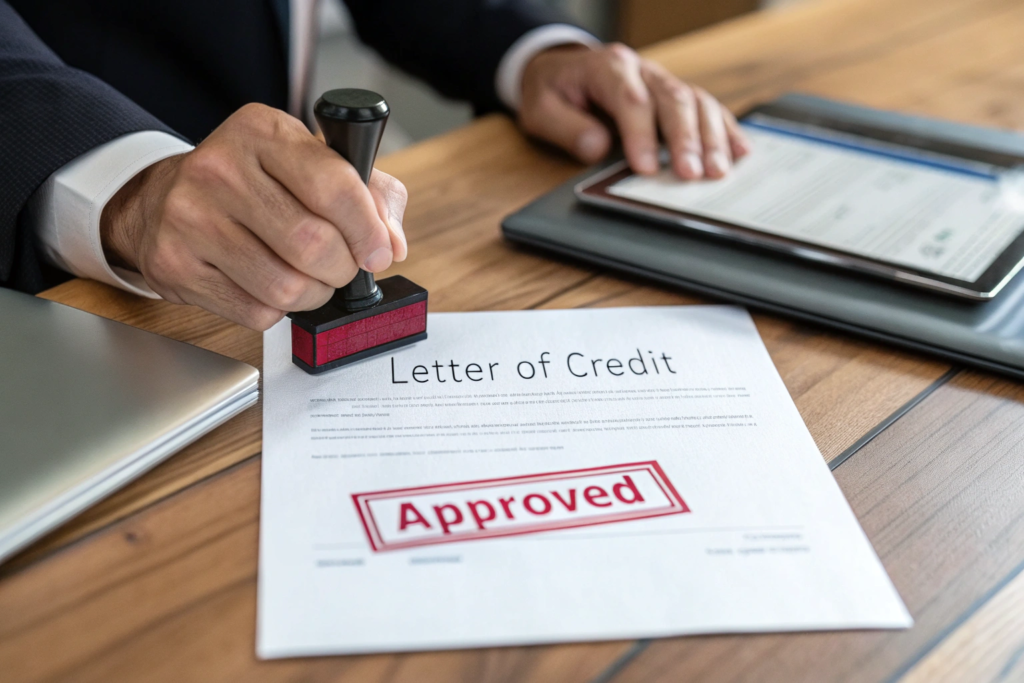
A Letter of Credit, often called an L/C, is the gold standard for security in international trade. It is the tool used by giant retailers like Macy's and Nike. It is also available to independent brands, though it requires a bit more paperwork. Think of an L/C as a referee holding the money in a glass box. The factory does not get paid until they prove they shipped exactly what you ordered.
A Letter of Credit protects a clothing order investment by replacing the buyer's credit risk with the bank's credit risk. The buyer's bank issues a guarantee to the supplier's bank. The supplier will only receive payment if they present a specific set of documents—including a Bill of Lading, Commercial Invoice, and Inspection Certificate—that strictly comply with the terms of the L/C. If the documents do not match exactly, the bank rejects the payment. This ensures the supplier ships the correct goods on time, or they do not get paid.
What Are the Exact Documents Required to "Draw" on an L/C?
This is the part that intimidates new buyers. An L/C is a documentary transaction. It is not about the physical goods. It is about the paper. The factory gets paid when they hand the correct papers to their bank.
For a clothing order with Shanghai Fumao, the L/C we would request from a client would typically require the following documents. The bank checks every single word and number. A typo in the container number is a reason to refuse payment.
| Document Name | What It Proves | Who Provides It |
|---|---|---|
| Bill of Lading (B/L) | The goods were loaded onto the correct vessel by the deadline. | Shipping Line / Freight Forwarder |
| Commercial Invoice | The value and description of the goods match the L/C exactly. | Shanghai Fumao |
| Packing List | The quantity and carton details match the L/C. | Shanghai Fumao |
| Certificate of Origin | Where the goods were manufactured (for duty purposes). | Shanghai Fumao / Chamber of Commerce |
| Third-Party Inspection Report | The goods meet AQL standards before shipment. | SGS / Bureau Veritas / Intertek |
| Beneficiary's Statement | A signed letter stating that one set of documents was couriered to the buyer. | Shanghai Fumao |
The critical document here for a clothing brand is the Inspection Report. This is how you prevent the "falsified certificates" pain point. You can specify in the L/C that the Inspection Report must show an "AQL Level 2.5 Pass." If the factory produces defective goods and the inspection fails, the report will not be issued. Without that report, the bank will not release the money. The factory has a massive financial incentive to fix the quality issues before shipping. This is the ultimate protection for your investment.
Why Do Small Brands Rarely Use Letters of Credit?
If L/Cs are so secure, why doesn't every brand use them? There are two main barriers for independent apparel companies:
- Cost: Banks charge an issuance fee (usually 0.5% to 1% of the L/C value). There are also amendment fees if you need to change the ship date. For a $10,000 order, the fees might be $150-$300. For a $100,000 order, this is negligible insurance. For a small test order, it eats into tight margins.
- Complexity: The application process requires specific details about the shipment. You must list the exact port of loading and discharge. You must describe the goods precisely. If you are new to importing, this paperwork can feel overwhelming.
However, for a first order with a new factory exceeding $25,000, I actively encourage my clients at Shanghai Fumao to consider an L/C. It signals to me that they are a serious professional buyer. It also gives them complete peace of mind to sleep at night. We have processed dozens of L/Cs. Our documentation department knows exactly how to format the invoice so the bank accepts it without "discrepancies." A factory that refuses an L/C for a large order is a red flag. It usually means they cannot produce the necessary compliance documents, or they have cash flow issues and cannot wait for the bank processing time. We are happy to accept L/Cs because we know our paperwork is clean and our quality is solid.
Is PayPal a Safe Option for Paying Overseas Clothing Manufacturers?
Many new brands want to use PayPal. It is familiar. It is fast. It feels like buying something on eBay. And for Samples and Small Deposits, PayPal is perfectly fine. At Shanghai Fumao, we accept PayPal for sample development and courier fees. It is convenient for both parties. But for paying the 70% balance on a 2,000-unit bulk production order, PayPal is not the ideal tool for either the buyer or the seller.
PayPal is safe for paying overseas clothing manufacturers only when used for sample orders or initial small deposits under $2,000. For bulk production balances, PayPal offers limited protection for custom-manufactured goods, charges high cross-border fees (up to 4.4% plus fixed fees), and holds funds for new seller accounts, which disrupts the factory's cash flow for purchasing raw materials. The Buyer Protection policy also explicitly excludes "items that are significantly not as described" if the item is custom-made, which applies to almost all private label apparel.
What Are the Hidden Limitations of PayPal Buyer Protection for Apparel?
This is the crucial fine print that gets brands into trouble. You pay $15,000 via PayPal for a custom cut-and-sew order of your own designs. The goods arrive, and the color is three shades off. Or the sizing is completely wrong. You file a dispute with PayPal for "Item Not as Described."
PayPal's official User Agreement states that their Purchase Protection does not cover:
- "Custom-made items that are significantly not as described."
- "Items that you claim are counterfeit." (This requires extensive third-party documentation).
Because you are a clothing brand, your order is almost always custom-made. The factory sewed your label into it. It is your design. PayPal will likely view this as a B2B transaction for custom goods, not a retail purchase of a standard item. They will ask for a third-party inspection report from an accredited lab to prove the "significant" difference. Most small brands do not have this.
I have seen cases where the buyer loses the dispute because they cannot meet PayPal's burden of proof for a custom item. Meanwhile, the factory has their account frozen for weeks while PayPal investigates. It is a lose-lose situation.
Instead of relying on PayPal's dispute system, rely on the Payment Structure. Use PayPal for the 30% deposit to get the order started. But use a Bank Transfer (T/T) against Copy of Documents for the 70% balance. This means you do not release the final payment until you see the Bill of Lading and the Inspection Report. This is a stronger, industry-standard protection than PayPal's consumer-focused policy.
Why Do Factories Dislike Receiving Large Balances via PayPal?
Let me give you the factory's perspective. It is not that we do not trust you. It is about Cost and Cash Flow.
- Fees: PayPal's cross-border fee for receiving a business payment from the U.S. to China is approximately 4.4% + $0.30. On a $20,000 balance payment, that is $880 in fees. That is $880 that is not buying fabric or paying wages. Bank wires (T/T) usually cost a flat $15-$30 fee at our end.
- Holds: If a factory is new to receiving large payments, PayPal may hold the funds for up to 21 days. We need that money immediately to pay our fabric supplier and our workers. We cannot wait three weeks for PayPal to release the funds.
- Currency Conversion: PayPal's exchange rate from USD to RMB is usually 2-3% worse than the bank rate. This is another hidden cost that eats into the thin margins of a factory.
When a client insists on paying a large balance via PayPal, I usually have to add the PayPal fee to the invoice. Most clients switch to T/T when they see the cost difference. For the security of a large transaction, a bank wire to a verified corporate account combined with Trade Assurance or a clear contract is far superior to PayPal for both parties.
What Is a Secure T/T Payment Structure for First-Time Factory Orders?
Telegraphic Transfer, or T/T, is simply a bank wire transfer. It is the most common way B2B payments move around the world. But the security does not come from the wire itself. A wire transfer is like sending cash in an envelope. Once it is gone, it is very difficult to get back. The security comes from When you send the money.
A secure T/T payment structure for first-time factory orders is a 30% deposit to initiate production and a 70% balance paid only after a third-party inspection report is issued and a copy of the Bill of Lading is received. This structure aligns the interests of both parties. The factory has enough capital (30%) to purchase raw materials. The buyer retains leverage (70%) until the goods are verified as correct and shipped. Avoid 100% upfront T/T payments unless you have a long-standing, trusted relationship with the factory.
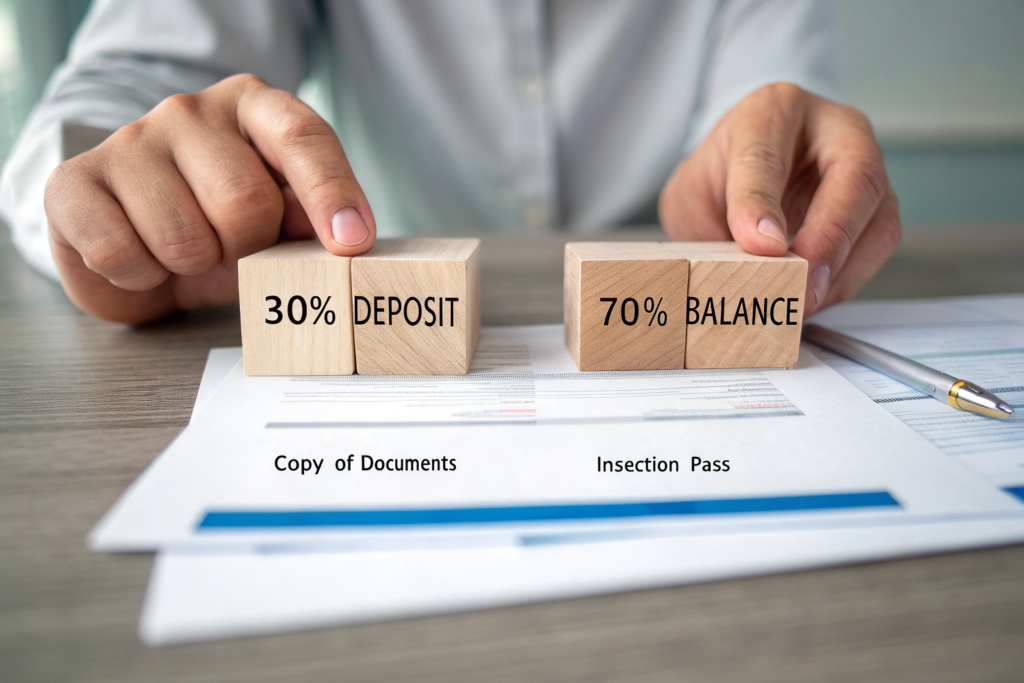
How Does "30/70 Against Copy of Documents" Work in Practice?
This is the standard we use at Shanghai Fumao for all new client relationships. It is the industry norm for professional apparel manufacturing. Let's walk through the exact timeline of a typical order.
Stage 1: Purchase Order & Proforma Invoice (Day 0)
We agree on the style, quantity, price, and DDP shipping terms. We issue a Proforma Invoice (PI) that clearly states the payment terms: "30% Deposit by T/T, 70% Balance against Copy of Documents."
Stage 2: Deposit Payment (Day 1-3)
You wire the 30% deposit to our corporate bank account. We confirm receipt. This deposit is non-refundable because we immediately use it to reserve production space and order custom trims and fabric.
Stage 3: Production & Inspection (Day 30-45)
We manufacture the goods. When the order is 100% complete and packed, we arrange for a third-party inspection (if requested) or we provide our internal QC video and report.
Stage 4: Shipping & Document Release (Day 46-48)
The container is loaded onto the vessel. We receive the Bill of Lading from the shipping line. This is the legal document of title. The person holding the original Bill of Lading controls the goods.
Stage 5: The "Copy" Documents (Day 48)
Here is the critical step. We email you scanned copies of:
- Commercial Invoice
- Packing List
- Bill of Lading (Non-Negotiable Copy)
- Inspection Report (Pass)
Seeing the Bill of Lading proves the goods are on the water and heading to you. Seeing the Inspection Report proves they passed quality control.
Stage 6: Balance Payment (Day 48-50)
You wire the 70% balance.
Stage 7: Release of Original Documents (Day 50)
We courier the Original Bill of Lading and other documents to you via DHL. You need these originals to clear customs and take delivery of the container in the U.S.
This structure is secure because the goods are already on the ship. The factory has fulfilled their primary obligation. If you fail to pay the 70%, we simply do not send the Original Bill of Lading. You cannot pick up the container. The goods sit at the port accruing storage fees that you would be liable for. This mutual financial exposure ensures both parties act in good faith.
What Is the Risk of Sending a 100% T/T Upfront Payment?
I want to be very direct about this. Do not do it. Not for a first order. Not even for a second order with a factory you barely know.
I understand the temptation. Some factories offer a 5% discount for 100% upfront payment. They say it streamlines the process. In reality, it removes all your leverage. Once the factory has 100% of the money, what is their incentive to ship on time? What is their incentive to fix a quality issue if it costs them extra labor?
I had a client who came to us after a bad experience. He had paid 100% upfront to a new supplier for a run of 800 hoodies. The factory used the money to finish a different client's order first. His order was delayed by six weeks. He missed his pop-up shop event. He had zero recourse because the factory already had all his cash. He could not threaten to withhold the balance because there was no balance left.
At Shanghai Fumao, we never ask for 100% upfront payment from a new client. We want you to have the confidence of the 70% balance lever. It keeps us sharp. It keeps us focused on your deadlines. If a supplier demands 100% upfront and you have never worked with them before, it is a bright red flag. Walk away. The risk of losing your entire production budget is too high.
How Does Trade Assurance on Alibaba Protect Against Supplier Fraud?
Alibaba is the world's largest B2B platform, and it is the starting point for many U.S. brands looking for Chinese suppliers. The platform has a major problem with supplier verification, which is why they created Trade Assurance. It is a free service provided by Alibaba that acts as a digital escrow.
Trade Assurance protects against supplier fraud by holding your payment in an Alibaba escrow account and releasing it to the supplier only after you confirm receipt of the goods. It covers specific scenarios: if you do not receive the goods by the agreed ship date, or if the goods received are significantly different from the contract in terms of quality or quantity. The coverage amount is limited to the order value processed through the Alibaba platform.
What Exactly Does Trade Assurance Cover (and Not Cover)?
This is where many buyers get confused. Trade Assurance is not a blanket insurance policy. It is a dispute resolution mechanism with a specific scope.
Covered Scenarios:
- Non-Shipment: The supplier fails to ship the goods by the date on the contract. You get a refund.
- Quality Discrepancy: The material or craftsmanship is significantly below the agreed standard (e.g., you ordered 100% cotton and got polyester). You need to provide third-party inspection evidence to win this claim.
- Quantity Shortage: The carton count is less than the packing list states.
Not Covered Scenarios:
- Minor Defects: Loose threads or slight color variation that is within industry tolerance (AQL 4.0).
- Design Disputes: "I don't like how the collar turned out." If it matches the approved sample, it is not covered.
- Shipping Delays Due to Force Majeure: If a typhoon closes the port for a week, that is not fraud. It is an act of nature.
- Off-Platform Payments: This is the biggest one. If the supplier asks you to pay the deposit via T/T off Alibaba, and you pay, Trade Assurance does not cover that portion.
I always advise buyers to keep 100% of the transaction value on the Alibaba order if they want full Trade Assurance coverage. At Shanghai Fumao, we are a verified supplier on Alibaba, and we accept Trade Assurance orders. However, for established relationships, we often move to direct T/T to avoid the platform commission fees. This is a trust transition that happens naturally after a few successful orders. For the very first order, Trade Assurance provides a valuable safety net, especially if you are not using a third-party inspection service.
How Do I Win a Trade Assurance Dispute About Fabric Quality?
Winning a dispute requires evidence. You cannot just say, "This feels cheap." Alibaba's mediation team is not a panel of textile experts. They are arbitrators looking at documents.
Here is the exact evidence package you need to assemble to win a fabric quality dispute:
- The Contract: The Alibaba order must specify the exact fabric composition (e.g., "95% Cotton, 5% Spandex, 280gsm").
- Approved Sample Photo: You must have a photo of the approved pre-production sample that you signed off on.
- Received Goods Photo: A clear side-by-side comparison showing the bulk fabric vs. the approved sample.
- Third-Party Lab Test: This is the gold standard. If you claim the fabric is 60% Polyester instead of 95% Cotton, you need an AATCC 20 lab report from an accredited lab. This costs $100-$150, but it is the document that wins the case.
Without a lab report, the dispute often ends in a compromise: Alibaba may offer a partial refund (e.g., 15% of order value) as a settlement. With a lab report proving fraud, you can get a full refund of the covered amount.
I recommend that all buyers who use Trade Assurance for orders over $5,000 also budget for a Pre-Shipment Inspection from a company like QIMA or SGS. The inspection report is uploaded directly to the Alibaba order. It creates an unbroken chain of evidence. If the inspector says "PASS," the supplier is largely protected from false claims. If the inspector says "FAIL," you have immediate grounds to demand rework before shipping or to cancel the order with a refund of your deposit. This combination of Trade Assurance and third-party inspection is the closest thing to a perfect security system for small to medium-sized apparel orders.
Conclusion
Securing your payment for an international clothing order is not about finding one magic button. It is about building a system of checks and balances that aligns the financial incentives of both the buyer and the supplier. The best method depends on the size of the order, the stage of the relationship, and your tolerance for administrative paperwork.
We have examined the institutional security of a Letter of Credit, which replaces trust with banking protocol for large investments. We looked at the convenience and limitations of PayPal, understanding that it is a tool for samples, not bulk production balances. We dissected the industry-standard 30/70 T/T structure, which uses the balance payment as the buyer's leverage to ensure timely shipping and quality control. And we explored how Trade Assurance on platforms like Alibaba provides a digital safety net for first-time transactions, especially when paired with third-party inspection.
At Shanghai Fumao, our goal is to make this part of the process boring and predictable. We offer transparent payment terms that protect you while allowing us to operate efficiently. We accept T/T, L/C, and Trade Assurance. We do not ask for 100% upfront payment. We do not ask for payments to personal accounts. We provide the documentation you need to release funds with confidence.
The Miami brand owner who lost his $12,000 learned a $12,000 lesson. He now works with us. He pays a 30% deposit, reviews his inspection report, sees the Bill of Lading, and then sends his balance. He sleeps better now. That is the outcome a secure payment process should deliver.
If you have questions about structuring a secure payment for your next production run, or if you want to understand how we handle financial transactions at Shanghai Fumao, please reach out to our Business Director, Elaine. She can explain our standard terms and help you choose the method that gives you the most peace of mind.
Contact Elaine at: elaine@fumaoclothing.com. Let's build a financial partnership as strong as the garments we produce.