You’ve agreed on a price and a timeline. Now comes the moment that tests trust and defines cash flow: the payment terms. For a brand, favorable terms can preserve working capital. For a factory, they mitigate the risk of producing thousands of dollars worth of goods for a new, unproven partner. Striking a fair balance isn’t just about negotiation; it’s about understanding the standard financial structures of the industry and the rationale behind them. Getting these terms wrong can strain the partnership before production even begins.
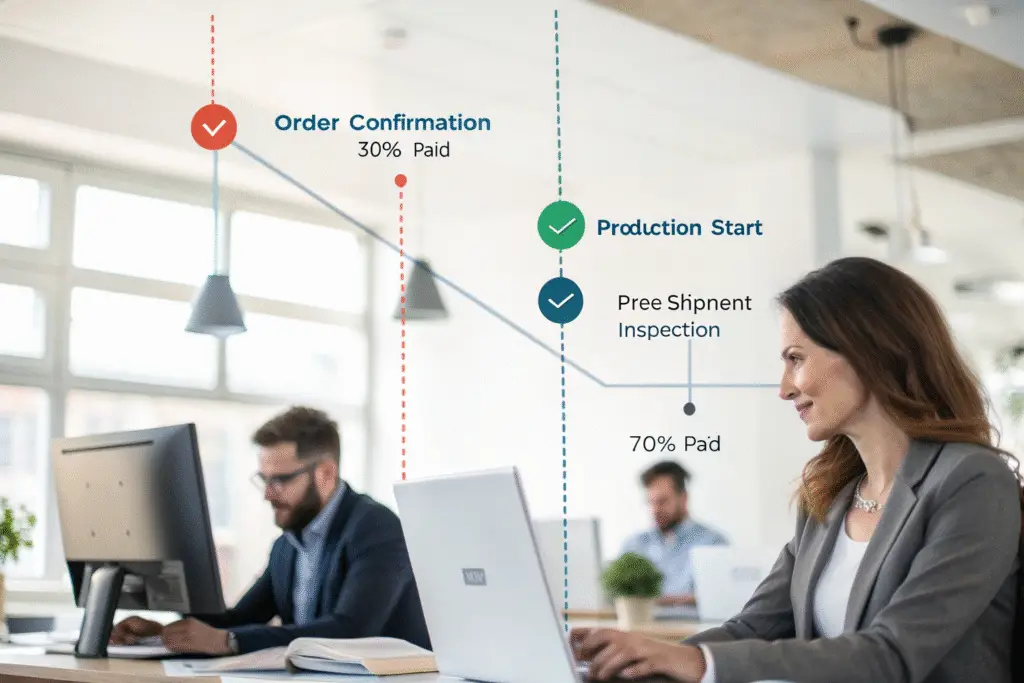
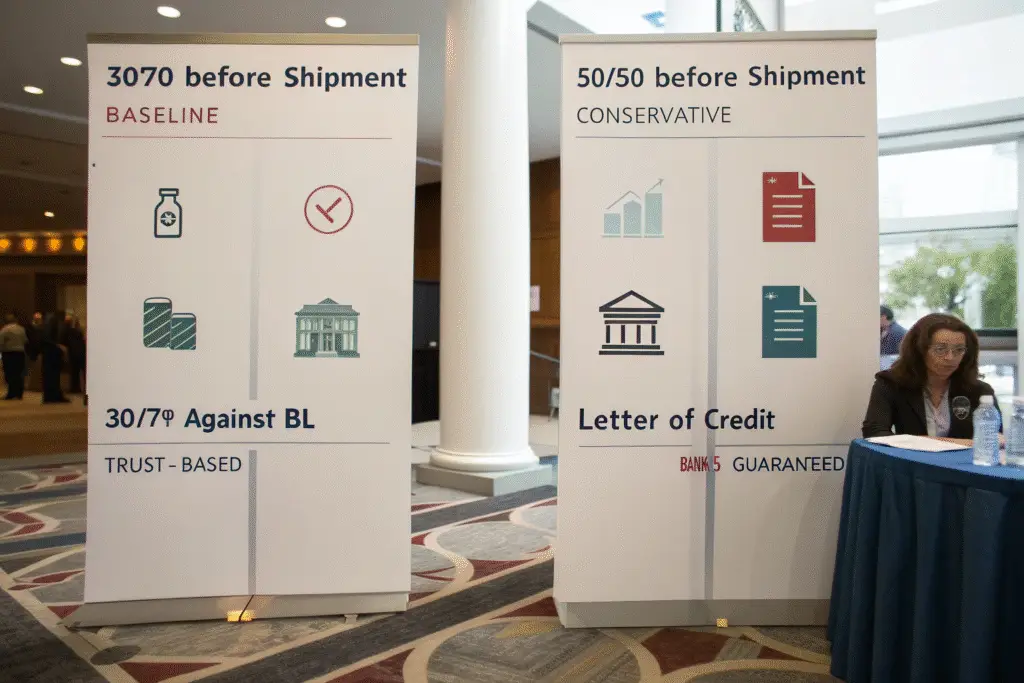
Standard payment terms for clothing manufacturers typically follow a structured, milestone-based model that balances the factory’s need for security and cash flow with the brand’s need for assurance. The most common structure is a 30% deposit with order confirmation, 70% balance before shipment. However, terms can vary based on order size, relationship history, and the manufacturer’s business model, ranging from more conservative 50/50 splits to more flexible terms like payment against documents. Understanding these norms is key to establishing a financially healthy and trustworthy partnership.
At Shanghai Fumao, a new client once demanded 100% payment after delivery and inspection. This is an extreme, non-standard request that no reputable factory can accept, as it transfers 100% of the financial and quality risk to us. We explained the standard terms and the mutual protection they offer. We eventually agreed on 30/70, and after three successful orders, we extended terms to 30% deposit, 70% against copy of Bill of Lading (BL), which gave them more time to pay. This evolution—from standard to preferential—is how trust is built. Let’s dissect the common structures and the logic behind them.
What Are The Most Common Payment Structures and Their Rationale?
The apparel industry has converged on a few standard payment term structures because they efficiently manage risk for both parties. Each term allocates risk, responsibility, and cash flow timing differently.
Choosing the right structure depends on your relationship stage and order specifics.
1. 30% Deposit, 70% Balance Before Shipment (T/T)
This is the industry standard baseline, especially for new relationships or orders under $50,000.
- How it Works: You wire a 30% deposit when you sign the Purchase Order (PO) and confirm production. The factory uses these funds to purchase raw materials (fabric, trims) and begin production. The remaining 70% is paid once production is complete and before the goods are loaded onto the vessel/airplane.
- Rationale:
- For the Factory: The 30% covers most of their upfront material costs, reducing their financial risk if the buyer disappears.
- For the Brand: You retain leverage until the final payment. The factory has an incentive to complete the order to your satisfaction to receive the bulk of their payment.
- Risk Balance: Fair. The factory shoulders the production execution risk; the brand shoulders the pre-payment risk for the deposit.
2. 50% Deposit, 50% Balance Before Shipment
This is a more conservative term, often used for:
- Very small orders (where material cost is a high percentage of total).
- Orders with extremely expensive or custom materials (e.g., exclusive fabrics where the material cost alone is >50% of the FOB price).
- Factories dealing with brands from regions perceived as higher financial risk.
3. 30% Deposit, 70% Against Copy of Bill of Lading (BL)
This is a more favorable term for the brand, typically earned through trust after several successful orders.
- How it Works: 30% deposit upfront. The 70% is paid after production is complete and the factory provides a copy of the Bill of Lading (proof the goods have been shipped). The goods are already in transit, but you haven’t paid the balance yet.
- Rationale: Improves the brand’s cash flow. It shows the factory trusts you to pay upon seeing proof of shipment. The factory’s risk is slightly higher, as they have shipped goods without full payment, but they still control the original BL, which is needed to claim the goods at destination.
4. Letter of Credit (L/C)
A bank-guaranteed instrument, common for very large orders or trade with certain countries.
- How it Works: Your bank issues a promise to pay the factory upon presentation of specific documents (commercial invoice, packing list, BL, inspection certificate). It’s secure but involves bank fees and complex paperwork.
- Rationale: Eliminates credit risk for both parties but adds cost and administrative burden. It’s a tool for large, impersonal transactions.
How Do Payment Terms Interact With Production Stages and Cash Flow?
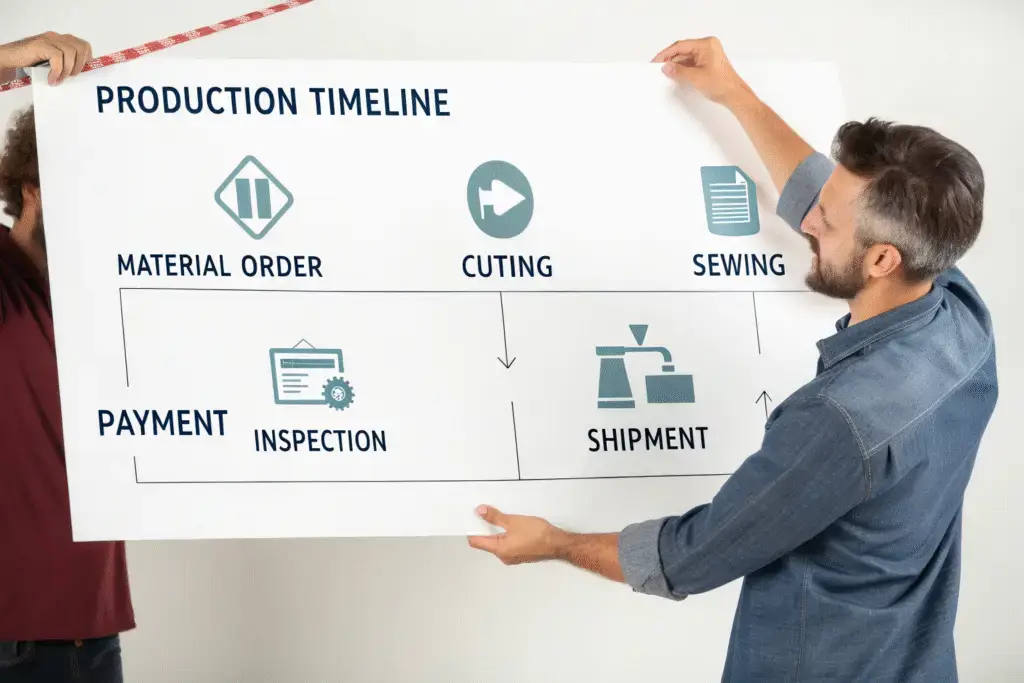
Payment terms are not arbitrary; they are timed to align with the factory’s cash outflows and the brand’s need for verification. Understanding this alignment helps you see why certain terms are non-negotiable at certain stages.
Think of it as financing the production cycle together.
Mapping Payments to the Factory’s Cost Cycle
A factory’s major costs occur in this sequence:
- Raw Material Procurement (Weeks 1-4): This is the largest cash outflow. The deposit (30-50%) is designed to cover this.
- Labor & Overhead During Production (Weeks 4-8): The factory pays workers weekly or monthly. They finance this from their own working capital, expecting recoupment via the balance payment.
- Logistics & Export Fees (Week 8-9): Trucking to port, documentation, etc. These are often covered by the balance payment.
If a brand delays the deposit, the factory cannot order materials. If the brand delays the balance, the factory cannot afford to ship and may hold the goods ("put on hold") until payment is received, causing demurrage and delay.
The Brand’s Cash Flow & Verification Points
From your perspective, payment milestones should allow for key verifications:
- Deposit Payment: Made after PO signing, but ideally after factory confirmation of all material samples (lab dips, trim submits).
- Balance Payment (Before Shipment): Made after you receive and approve the Pre-Shipment Inspection (PSI) report. This is crucial. Never pay the balance blindly. A professional factory will expect this.
- Balance Payment (Against BL): Allows you to verify the goods have actually shipped via the BL copy before paying.
This synchronization ensures the factory has funds to operate, and you have checkpoints to ensure quality and progress.
What Factors Influence Negotiated Payment Terms?
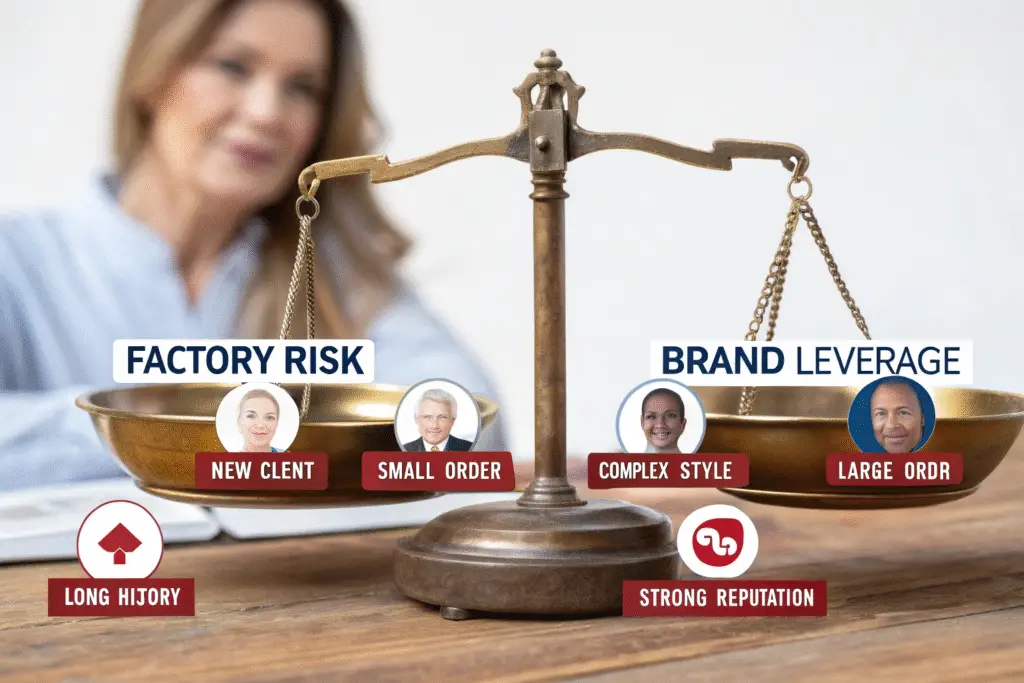
While 30/70 is the baseline, your actual negotiated terms can vary. A factory’s willingness to offer favorable terms is a direct reflection of their risk assessment of you and the order.
Understanding what levers you can pull helps in negotiation.
1. Order Volume & Value
- Larger Orders (>$100,000): You have more leverage. Factories may be willing to offer better terms (e.g., 25/75 or payment against BL) to win a sizable, profitable order.
- Small, Complex Orders: The factory has high fixed costs (sampling, setup). They will likely insist on standard or even stricter terms (50/50) to protect themselves.
2. Relationship History & Trust
This is the most important factor after the first order. Track record is currency.
- First Order: Expect standard 30/70. You are an unknown quantity.
- After 3-5 Successful Orders: You can reasonably request and receive improved terms, such as payment against BL. At Shanghai Fumao, we proactively offer better terms to our reliable, long-term partners as a sign of mutual trust.
3. Your Company’s Creditworthiness & Brand Reputation
A publicly traded company or a well-known, established brand presents lower financial risk. A factory might be more flexible with such entities from the start. A startup may need to build credit through initial on-time payments.
4. Country of Origin & Perceived Risk
Factories sometimes adjust terms based on the buyer’s country due to historical experience with payment delays or fraud in certain regions. This is not always fair, but it is a commercial reality.
5. Seasonality & Factory Capacity
During peak season when the factory is at full capacity, they have less incentive to offer favorable terms. During a slower period, they might be more flexible to secure business.
What Are Red Flags and Non-Standard Requests to Avoid?
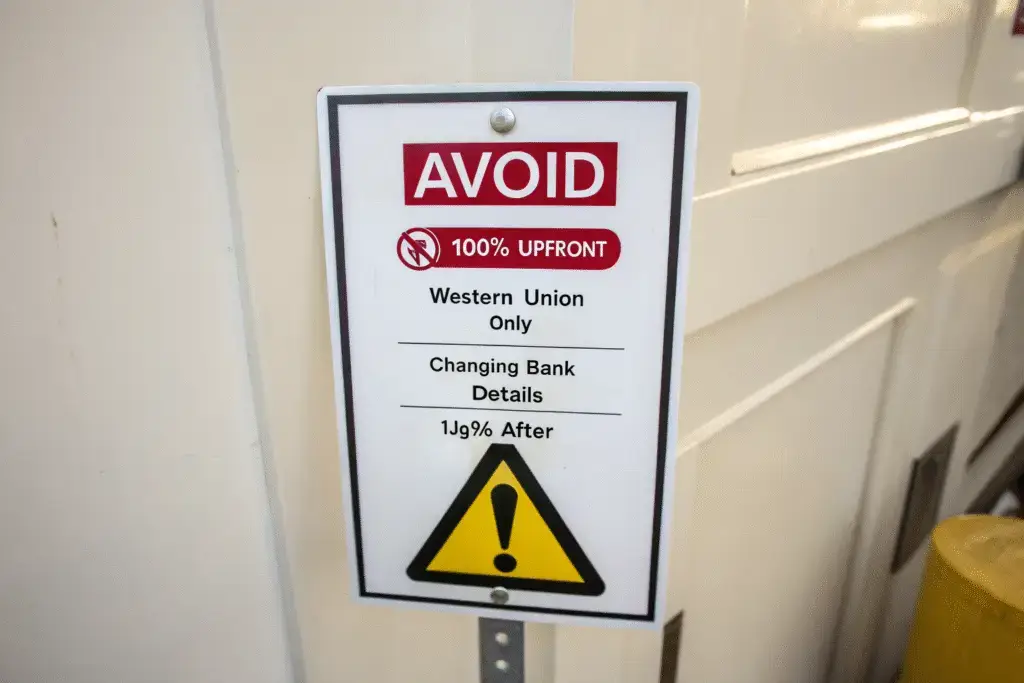
In the pursuit of favorable terms, be wary of requests that deviate wildly from industry standards. These can signal financial instability, poor practices, or even scams.
Protecting your capital is as important as preserving your cash flow.
Red Flags From Factories:
- Demanding 100% Payment Upfront: This is extremely rare and risky. It leaves you with zero leverage.
- Refusing to Provide a Proforma Invoice (PI): A proper PI details prices, quantities, and payment terms. Its absence is unprofessional.
- Pressure to Use Unsecured Payment Methods: Insisting on Western Union or MoneyGram for large transfers is a major red flag. These are irreversible and favored by scammers. Always use bank wire transfer (T/T).
- Changing Bank Account Details Last Minute: A classic scam tactic. Always verify any account change via a direct, confirmed phone call to a known manager.
Non-Standard (and Risky) Requests From Brands:
- Demanding 100% Payment After Delivery: As mentioned, no viable factory can accept this. It asks them to finance 100% of your order and assume all quality risk.
- Asking for Extended Credit (e.g., Net 60) as a New Client: This is a request for the factory to act as your bank. Without a strong relationship, it’s a non-starter.
- Withholding Payment Over Minor Disputes: Use the inspection report and contract to resolve disputes. Unilaterally withholding payment poisons the relationship and may lead to legal action.
The safest approach is to stick near industry standards, especially for a new partnership. Deviations should be mutually beneficial and earned through trust.
How Can You Build Trust to Secure Better Payment Terms?
Your goal shouldn’t just be to negotiate the best terms on the first order; it should be to build the credibility that earns you the best terms automatically on future orders. This is a strategic, long-term financial advantage.
Trust simplifies everything and reduces transaction costs.
The Trust-Building Checklist:
- Be Professionally Prepared: Have clear tech packs, realistic timelines, and organized communication. This signals you are a serious, low-maintenance client.
- Pay On Time, Every Time: This is the #1 trust-builder. If you promise to pay the deposit on Monday, pay it on Monday. Nothing earns credibility faster than financial reliability.
- Communicate Proactively: If you foresee a payment delay (it happens), inform your factory before the due date. Propose a new date and stick to it.
- Be Reasonable in Negotiations: Understand that the factory needs to make a fair profit. Squeezing them on price on every order makes them less likely to offer favorable terms.
- Visit or Audit the Factory: Showing investment in the relationship beyond emails builds strong personal connections.
The Evolution of Terms: A Case Study
A Shanghai Fumao client’s journey:
- Order 1 (2019): $25,000 order. Terms: 30% deposit, 70% before shipment.
- Orders 2-4 (2020-2021): Consistent on-time payments. Order values grew to ~$50,000.
- Order 5 (2022): $80,000 order. We offered: 30% deposit, 70% against copy of BL.
- Today (2024): Quarterly orders >$150,000. Terms: 30% deposit, 70% 10 days after BL date (Net 10).
This trajectory is typical. The factory’s reduced financial risk translates into improved cash flow for the brand.
Conclusion
Standard payment terms in clothing manufacturing exist to create a fair, predictable framework that protects both brand and factory during the capital-intensive production process. While 30% deposit, 70% before shipment is the common starting point, the ultimate terms are a reflection of mutual trust, order characteristics, and business maturity. Viewing these terms not as a battle to be won but as a risk-sharing mechanism to be optimized is the key to building a financially sustainable and resilient supply chain.
Your long-term goal should be to build such a strong partnership that payment terms become a simple, frictionless formality, allowing both parties to focus on creating great products and growing the business together.
If you are looking for a manufacturing partner who offers transparent, standard terms to begin with and the potential for improved terms as our partnership deepens, we operate on this principle of progressive trust. At Shanghai Fumao, we believe fair financial dealings are the foundation of a lasting alliance. Contact our Business Director Elaine to discuss your next project and our clear payment structure: elaine@fumaoclothing.com.