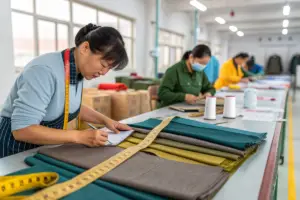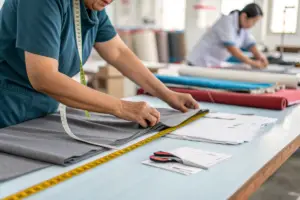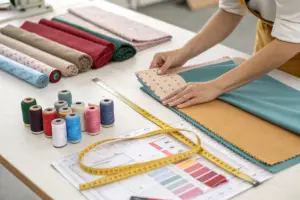
Last spring, a startup brand owner from Austin sent me a set of sketches. They were beautiful, expressive watercolors with flowing lines and exaggerated proportions. They looked like a Vogue editorial. He was immensely proud of them. The problem was, they were unmanufacturable. The armhole curve he had drawn, if interpreted literally by a pattern maker, would have created a sleeve that bound at the bicep and tore at the seam within five wears. He had spent $2,000 on a freelance fashion illustrator, and he had produced art, not a product. He was brilliant at branding but had no technical design language. He was stuck, and his launch date was slipping.
You should use your own sketches if they contain precise technical specifications, but partner with Shanghai Fumao's in-house designer if you want to translate a raw idea, a mood, or a market gap into a production-ready, cost-optimized garment that is engineered to be sewn efficiently on our lines. The choice is not between "good" and "bad." The choice is between two different inputs: a technical specification document versus a creative problem statement.
I have managed the transition of thousands of designs from concept to shipping container. The biggest, most expensive graveyard in the apparel industry is the space between a beautiful sketch and a scalable, profitable garment. This is not a conversation about creativity. This is a conversation about the specific format of information our production floor needs to avoid making a $10,000 sampling error. Let's break down exactly which input works best, at which stage, and for which type of brand.
What Information Does a Factory Need from a Sketch?
A sketch is a communication tool. Its sole purpose is to transfer a three-dimensional idea from your brain into our cutter's and sewer's hands with zero ambiguity. A beautiful sketch that is ambiguous is worse than no sketch at all. It creates dangerous assumptions on the factory floor.
I have seen a single missing measurement on a sketch cause a 500-unit production batch to be cut with the wrong neck drop, wasting $3,000 in fabric. The factory's job is not to interpret your art; it's to execute your specification. If your sketch forces us to guess, we will guess wrong, and you will pay for the guess.
Why Does a "Floating" Armhole Sketch Guarantee a Sampling Failure?
A "floating" armhole is one that is drawn as a smooth, elegant curve on a flat silhouette with no indication of the sleeve cap height or the bicep circumference. It looks graceful on paper. But an armhole is not a line. It is a three-dimensional geometric joint where a tubular sleeve meets a torso. The length of the curve, the depth of the scoop, and the height of the sleeve cap are mathematically interlocked.
If you don't specify the armhole drop and the cap height, our pattern maker must guess. The default guess on a basic block is a conservative, low-cap sleeve. If your design was for a high, tailored armhole, the sample will come back with a droopy, restrictive sleeve that pulls across the back. You will reject it. We will re-cut it. A single sampling iteration on a tailored jacket costs us about $85 in labor and material, and, more critically, it burns four precious days from your development calendar. We recently worked with a brand owner who provided a sketch with a clear note: "Armhole drop: 22cm from HPS. Sleeve cap height: 14.5cm. Bicep: 38cm." The first sample was perfect. The fit was approved in one round. The technical specification paid for itself in saved sampling costs and three weeks of saved lead time. A floating armhole is not a design detail; it is an unfunded sampling liability. It is the single most expensive missing number in a startup brand's tech pack, a truth well understood in technical pattern making education.
How Do Stitch and Seam Callouts Cut Weeks from Your Sampling Timeline?
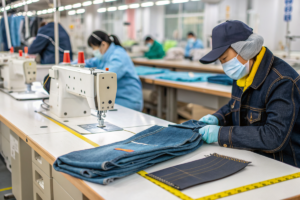
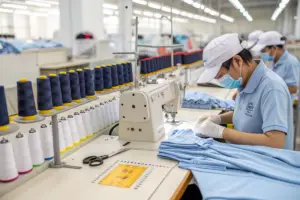
A stitch callout is a code, like "ISO 4016, 12 SPI, single needle lockstitch," or "4-thread overlock, 1/4 inch seam allowance." This is not technical jargon; it is a direct instruction to a machine operator. When your sketch includes these callouts, our production engineer can program the sewing line before the sample is even cut.
If the callout is missing, the sample room uses a default construction, which is often a basic 5-thread safety stitch. If your brand aesthetic requires a delicate, almost invisible 2-needle coverstitch on the hem, the default sample will look heavy and sporty. You will ask for a change. The sample will be re-sewn. We lose a week. When a brand provides a full seam and stitch specification, even a simple one-page table, the entire sample-making process becomes a programmed, predictable workflow, not an iterative guessing game. This is the difference between a four-week and an eight-week sampling phase. For a brand trying to hit a specific market window, those four weeks are the difference between a full-margin, in-season sale and a markdown rack. The callout is your accelerator pedal. The more precise your technical language, the faster our factory can move for you, a principle central to efficient apparel manufacturing.
When Is It Better to Use Your Own Detailed Tech Pack?
You are ready to use your own tech pack when your document leaves zero room for interpretation. A real tech pack is not a sketch; it's an engineering blueprint. It replaces artistic hope with manufacturing certainty. I can always tell a brand that is ready to scale by the weight and density of their tech pack.
This document is your legal and quality control. It is the standard against which every production sample and every bulk shipment will be measured. If it is incomplete, the factory's internal standards will fill the gaps, and those standards may not match your brand's promise. Providing a complete tech pack is the single most powerful step you can take to control your final product.
Can a Perfect CAD Flat Drawing Replace a Designer's Eye?
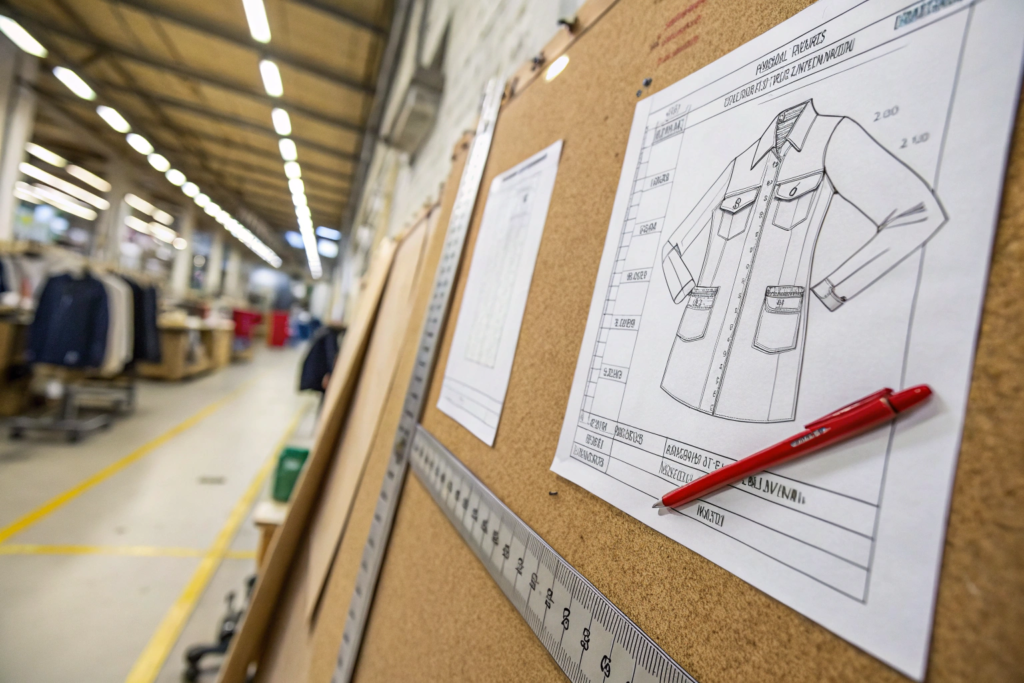
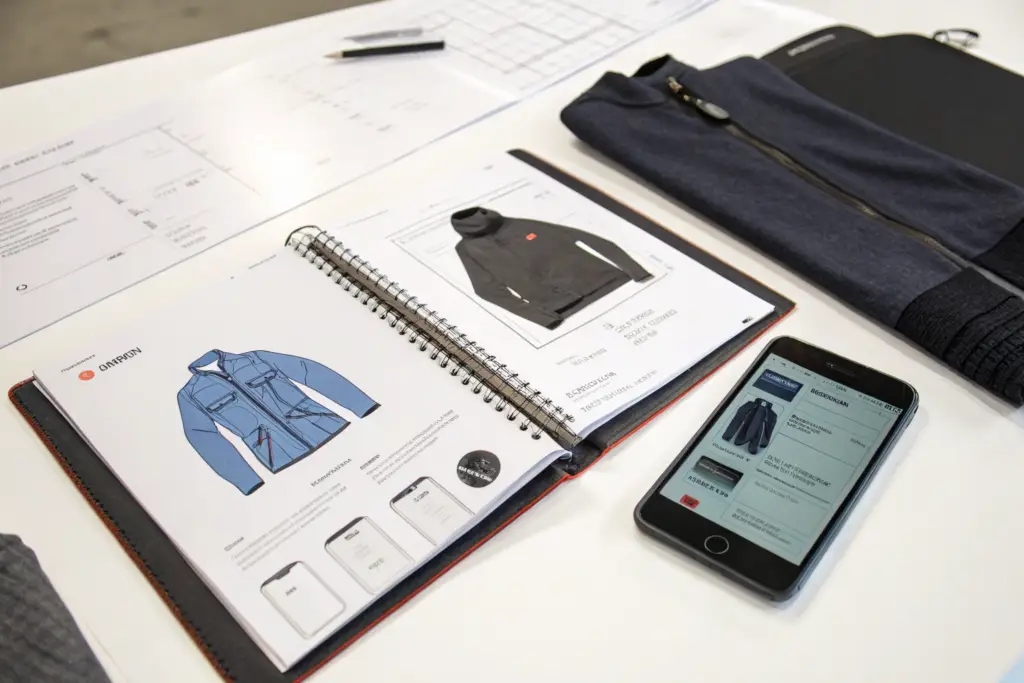
A perfect CAD flat drawing, with front, back, and side views, can absolutely replace our designer's creative interpretation for a core, structured garment. A CAD is a scaled, technical map of the garment's architecture. It shows the exact pocket placement, the curve of the yoke, the width of the placket, the number of buttons, and the topstitching millimeters.
If your brand is selling a refined, classic product—a perfect Oxford shirt, a tailored chino, a simple shift dress—your technical CAD is the superior input. It is faster, it is unambiguous, and it directly programs our cutting machine. Our favorite kind of tech pack is a clean, Illustrator-created CAD with a clear bill of materials and a reference physical sample. This combination allows us to digitize the pattern, cut a prototype, and ship it to you for fit approval in under ten working days. This is the workflow for a professional, scaling brand. You are not paying for our design interpretation because you don't need it. You have already solved the design problem. You are paying for our precision manufacturing execution, which is exactly what Shanghai Fumao is engineered to deliver at the highest level. This direct, specification-driven workflow is the most efficient and cost-effective path to market for a brand with a clear, established design language.
What Is a "Golden Sample" and Why Does It Override Everything?
A golden sample is a physical, fully approved, final prototype that you have signed, dated, and physically returned to us. This is not a picture. This is not an email approval. It is a tactile, stitched artifact. A golden sample overrides every other design document. If the CAD drawing says one thing, but the approved golden sample shows a slightly different collar angle, the golden sample wins. It becomes the law.
We have a sealed, climate-controlled sample library in our factory where we store the golden samples for all active brand partners. When your bulk production reaches the in-line QC stage, our inspectors do not check the garment against a PDF. They check it against your golden sample, which hangs on a hook at the inspection station. The color, the hand feel, the drape, the stitch density, and the label placement are all compared to the physical standard. This is the ultimate closure of the communication loop. You created a vision. We translated it into a sample. You touched it, wore it, washed it, and signed it. That signed artifact becomes the single source of truth for every pair of hands that will touch your product. This is the quality system that eliminates the "I thought you meant..." disasters. It is a rigorous, tangible, and defensible standard that has been the backbone of modern quality assurance for decades.
How Can Fumao's Designer Improve Your Raw Concept?
A raw concept is a powerful, valuable thing. It might be a single word—"weightlessness"—or a grainy photo from a 1970s film, or a piece of vintage fabric you found at a flea market. This is pure creative energy. It is also completely unusable by a production line. The line needs numbers. Our designer's job is to translate poetry into blueprints.
Our in-house design service is not about imposing our aesthetic on your brand. It is about solving the thousand tiny technical problems that exist between an inspiring idea and a wearable, durable, mass-producible garment. This is a structural, engineering-based design service, not a styling consultation.
How Does Our Designer Translate a "Mood" into a Measurable Pattern?
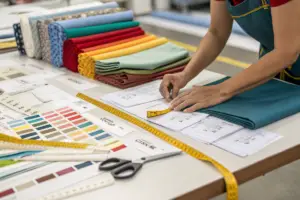
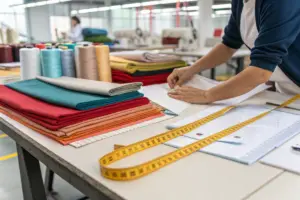
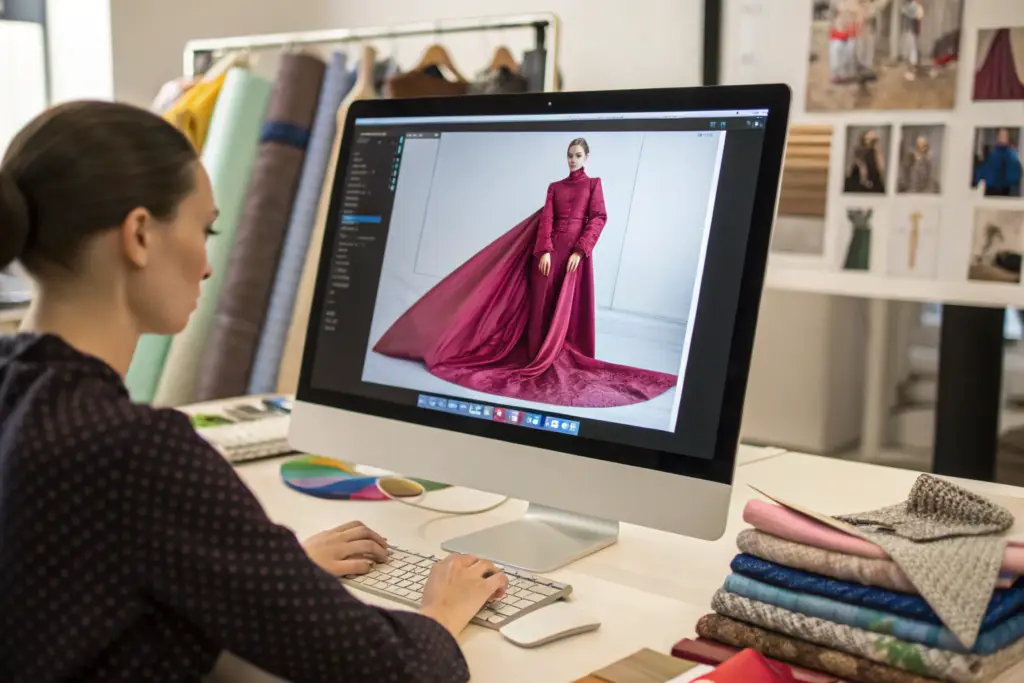
We use a process called "Material-Led Design." When a brand comes to us with a mood—"coastal, worn-in, effortless, like a linen shirt that's been in the sea"—we don't start by sketching. We start by pulling fabrics. Our designer selects ten physical swatches that match the tactile and visual mood. We drape them on a mannequin. We photograph them in natural light. We find the physical expression of the mood first.
Then we ask the structural questions the mood didn't define. How heavy is this effortless feeling? Is it a 90gsm featherweight, or a 150gsm slub that gives more structure? How does the collar stand? Is it a soft, one-piece collar, or a structured, two-piece? The mood is a feeling. The pattern needs a number. Our designer's value is in making these critical aesthetic-structural translations in collaboration with you, showing you three digital CLO simulations of the same "coastal" concept with different structural interpretations. You choose the feeling, and we capture it in a precise, measurable pattern. This is design as a service of clarification. It takes your intangible vision and turns it into a tangible, sample-ready digital asset. This is how we save a creative brand owner from the frustration of a sample that captures none of the soul of their original idea, a process similar to the material-driven methodology discussed in advanced textile design circles.
Can a "Cost-Engineered" Design Protect My Target Retail Price?
Yes, and this is the service that our most profitable brand partners use most aggressively. A beautiful garment that costs $48 FOB to make and is sold for $88 retail is a business failure if your customer will only pay $78. The design must fit the business model, not just the mood board. Our design team can "cost-engineer" a concept without destroying its aesthetic core.
For example, a brand recently asked us for a heavy, embroidered denim jacket with a very specific, vintage Western feel. The original design, with a large, intricate back embroidery, was quoted at a FOB that would force a retail price too high for their core customer. Our designer proposed a re-engineering. We kept the exact same silhouette and wash, but we replaced the massive back embroidery with a beautifully designed, smaller, high-density embroidered patch on the chest and a subtle, tone-on-tone embroidered stitch on the back yoke. The aesthetic spirit of the Western jacket was preserved entirely. The cost dropped by $4.20 per unit. The brand hit their target margin, and the jacket became a bestseller. This is not "cheapening" a design. It is surgically adjusting the material and labor inputs to fit a commercial constraint. It is the designer working as your business partner, protecting your profitability at the design stage, where 80% of a garment's final cost is locked in. This skill is what separates a factory that just sews from a factory that strategically partners with a brand to achieve its commercial goals. It is a core tenet of sound product development in the B2B apparel space.
What Are the Risks of Mixing Amateur Sketches With Professional CADs?
The single most dangerous design document in the world is a beautiful, artistic sketch with a few random measurements hastily scribbled on it. It is an information virus. It combines the ambiguity of art with the false authority of numbers. It is the leading cause of sampling disasters in our industry.
Mixing artistic and technical communication without a clear, primary reference standard creates a "jurisdictional dispute" on the factory floor. The cutter looks at the CAD. The sewer looks at the watercolor. They see two different garments. They make two different interpretations. The sample is a Frankenstein, and the brand owner doesn't know whom to blame.
Why Does a "Sketch Plus a Photo" Create a Dangerous Ambiguity?
Because the photo and the sketch are two different garments, and you haven't chosen which one is the primary source of truth. A photo of a vintage military jacket, combined with a loose sketch that tries to interpret it, is a trap. The sketch might simplify the collar, while the photo shows a complex, two-piece sleeve. Which is it?
The factory will try to reconcile both, producing a hybrid that satisfies neither. The photo has details the sketch missed. The sketch has proportions the photo contradicts. The sample room becomes a detective agency, and the sampling fee starts to climb as we bill for the time spent solving a puzzle you accidentally created. The solution is brutally simple: never send a sketch and a photo together without a clear written directive that states, "Sketch dictates silhouette and proportions. Photo dictates pocket flap construction details and button type only." Define the hierarchy. A single sentence of legal clarity in your email overrides hours of interpretive chaos on the cutting table. Ambiguity is a luxury you pay for with delays and defective samples. Clarity costs nothing and saves a fortune. This principle of a single source of truth is fundamental to avoiding costly mistakes in any design specification process, whether digital or physical.
How Can a Hybrid Submission Be Structured to Succeed?
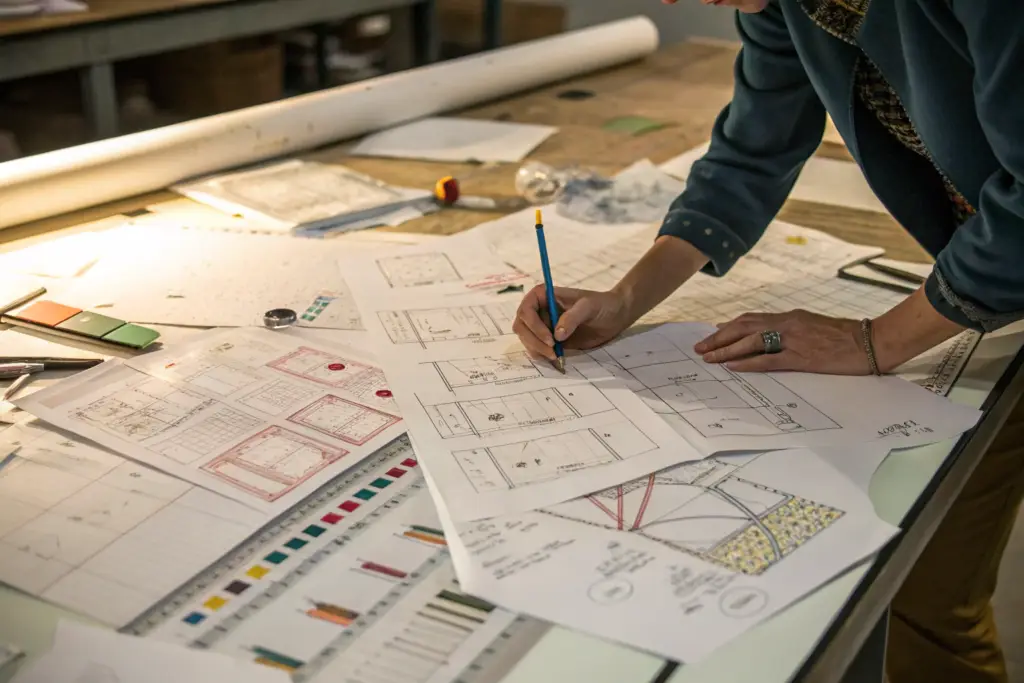
The hybrid submission—your own artistic vision combined with some technical data—can work perfectly, but only if it is structured as a clear, single-source packet. Do not mix media that conflict. Use a simple, three-component packet structure that we teach all our new brand partners.
First, provide a precise, clearly scanned CAD flat drawing as the primary legal design document. This is the contract. Second, attach a small, separate mood board image as a texture, drape, and vibe reference only, clearly labeled "For Hand Feel and Mood Reference Only." Third, include a physical, deconstructed reference sample, even if it's a thrift store find, tagged with a note: "I like this collar. I like this shoulder slope. I like this hem." This three-part packet is a complete brief. It gives us the legal precision of the CAD, the aesthetic inspiration of the mood, and the tactile, structural truth of a physical reference. It eliminates ambiguity entirely. It tells our pattern maker exactly what to draw, our fabric sourcer exactly what to find, and our sample sewer exactly what to stitch. We can take this packet and produce a first sample that is 90% approved in a single round. This is the language of a professional. It respects both your creative vision and our manufacturing reality. It is the fastest, cheapest, and most certain path from your idea to a finished garment, and it's the workflow we recommend to every brand that wants to move fast and avoid re-sampling costs with Shanghai Fumao.
Conclusion
A sketch is a question you ask your factory. A tech pack is the answer you give it. The decision to use our designer or your own sketch is fundamentally a decision about who will pay the cost of answering the question. If your sketch is a complete, technical answer—with measured CADs, stitch callouts, and a clear bill of materials—your document is production-ready, and you should use it. You have already done the design work, and our factory will execute it with precision. If your sketch is a question—a beautiful, ambiguous exploration of a mood, a market gap, or a piece of vintage inspiration—our in-house designer is your most valuable asset. We will translate that question into a cost-engineered, manufacturable answer that protects your margins and hits your launch date.
The graveyard of failed apparel brands is filled with companies that paid for a beautiful sketch but never paid for the technical translation. The successful brands understand that a factory is not just a sewing service; it is a design engineering partner that can save you thousands of dollars and weeks of time by bridging the gap between a watercolor and a wearable garment.
Are you holding a sketch and unsure if it's ready for the cutting table? Send it to us. We will review it, free of charge, and give you a frank assessment of whether it's a technical specification or a creative starting point. Contact our Business Director, Elaine, at elaine@fumaoclothing.com. Attach your sketch, your mood board, or just a description of the market gap you want to fill. Let's decide together whether your next step is a pattern, a prototype, or a design consultation. Let's build the garment that your customer will feel was made just for them.