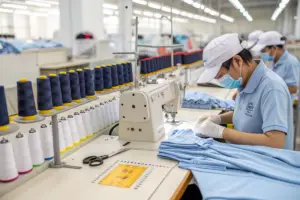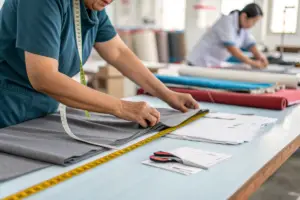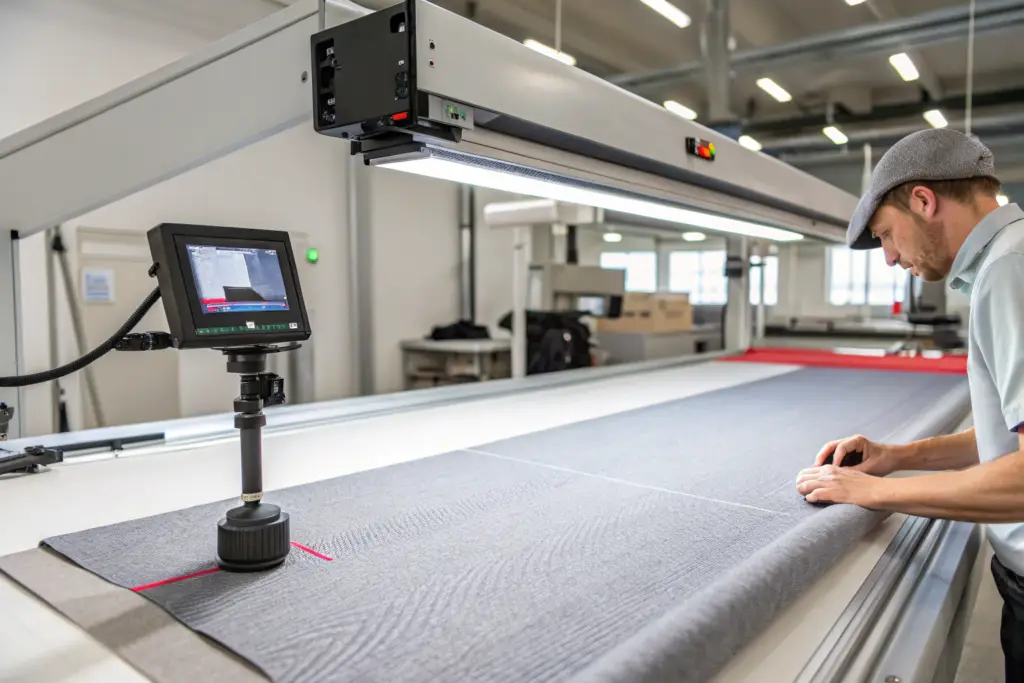
Three years ago, a promising menswear brand in Texas almost died. They had received a container of 8,000 chinos from a previous supplier. The fabric had passed a traditional, manual final inspection with a score of 28 points per 100 square meters, well within the industry's accepted standard. But the inspection had missed a systemic defect: a subtle, repeating barre mark that only appeared when the fabric was cut and sewn under specific directional light. The brand cut the entire batch. The chinos were unsellable. The $60,000 fabric write-off, plus the lost manufacturing cost, nearly bankrupted them. They came to me not for a better price, but for a better set of eyes.
Shanghai Fumao runs a digitally augmented 4-Point Fabric Inspection system that integrates AI-powered, high-resolution camera arrays with our certified human inspectors to catch both obvious and systemic defects in real-time, with every roll's data and imagery logged permanently to a blockchain ledger for our brand partners. We don't just find holes. We find the repeating patterns that a tired human eye, working a 10-hour shift, will inevitably miss.
The 4-Point System is the global standard for textile grading. But the way it's applied separates a factory that simply ships "acceptable quality level" garments from a factory that prevents a season-killing catastrophe. I want to pull back the curtain on exactly how we have digitized this 80-year-old inspection protocol, and why this invisible layer of technology in our Shaoxing facility is your strongest financial defense.
What Is the Traditional 4-Point Fabric Inspection System?
The 4-Point System is the grammar of our industry. It was developed to create a universal language for quantifying fabric defects, ensuring that a mill in China and a buyer in New York are looking at the same numbers. Without this standard, every shipment would be a subjective argument. The system is brutally simple in its logic.
A fabric defect is any imperfection that compromises the garment's appearance or durability. The "4-Point" name refers to the penalty points assigned to a defect based on its size. The point allocation creates a direct, mathematical relationship between the size of the failure and its severity. Understanding this baseline is essential before you can appreciate what our digital layer adds to it.
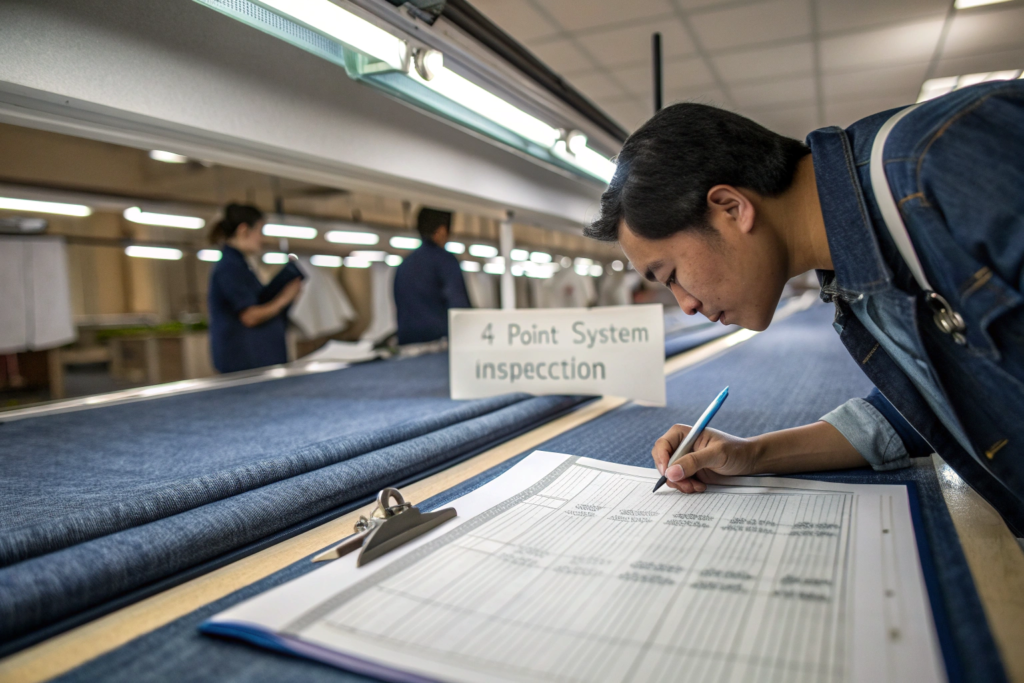
How Are Defect Points Calculated in a Standard Inspection?
The system assigns points based on the linear length of a defect, regardless of whether it is a hole or a stain. Here is the official breakdown we train every new QC inspector on, the exact table pinned to the wall of our inspection room:
| Defect Length | Points Assigned |
|---|---|
| 3 inches or less | 1 Point |
| Over 3 inches, up to 6 inches | 2 Points |
| Over 6 inches, up to 9 inches | 3 Points |
| Over 9 inches | 4 Points |
A hole, regardless of size, is always a minimum of 4 points because a hole means a cut-and-sew placement failure. The total points found in a sample of fabric are then calculated against the total yardage inspected to give a "points per 100 square meters" score. The industry standard for a first-quality garment fabric is a maximum of 40 points per 100 square meters. Anything above that is technically a substandard, or "seconds," roll. But here is the terrifying truth: a roll can pass with a score of 38 and still contain a single, 9-inch catastrophic stain that destroys two perfectly laid marker patterns. A roll can also pass with a score of 35 but be riddled with small, repeating 1-point defects that leave every single garment with a tiny, unsellable flaw. The standard ensures the shipment is not completely defective; it does not guarantee the shipment is commercially perfect. This is the critical gap in traditional, manual inspection that our quality assurance philosophy is built to close.
What Are the Key Defect Categories Inspectors Must Flag?
We categorize every defect into a primary color-coded system that our digital software uses. This classification is what allows us to run root-cause analysis, not just tally points.
The first category is Warp Defects, which are vertical faults running the length of the fabric. These include tight or slack warp threads, reed marks, and warp streaks. These are the most dangerous because they repeat over the entire roll. The second is Weft Defects, which are horizontal faults. These include broken picks, double picks, weft bars, and miss-picks. These are often caused by momentary loom malfunctions. A single slub yarn can create a repeating weft-line defect. The third category is Surface Defects, which are flaws that sit on the fabric's face. Oil stains, rust marks, dye blotches, and holes. These are often post-weaving defects caused by contamination in the finishing or transport process. A stained selvedge is one example, but a stained center-body is a 4-point, garment-killing failure.
By digitally tagging every defect not just by size but by its root category, we can tell a weaving mill, "You had a tension failure on warp beam #3 at 7 AM on Tuesday." This granularity transforms inspection from a pass/fail gate into a process improvement engine. For brand buyers interested in deeper textile technology, resources like Textile World offer comprehensive industry analysis on these systems.
How Has Fumao Digitized the Classic Inspection Process?
Digitalization is not about replacing humans with robots. It's about assigning the right task to the right intelligence. The human brain is exceptional at making judgment calls on ambiguous defects: a permissible slub versus a rejection-worthy knot. The computer is exceptional at never blinking. Our system marries the two.
We have digitized the three most vulnerable points in the traditional inspection workflow: defect detection, pattern recognition across multiple rolls, and data permanence. The goal was simple. We wanted to eliminate the "Monday morning" and "Friday afternoon" effect, where a fatigued inspector's performance dips, and we wanted to create a digital twin of every single roll of fabric we consume.
What Role Does an AI Camera Array Play in Catching Missed Defects?
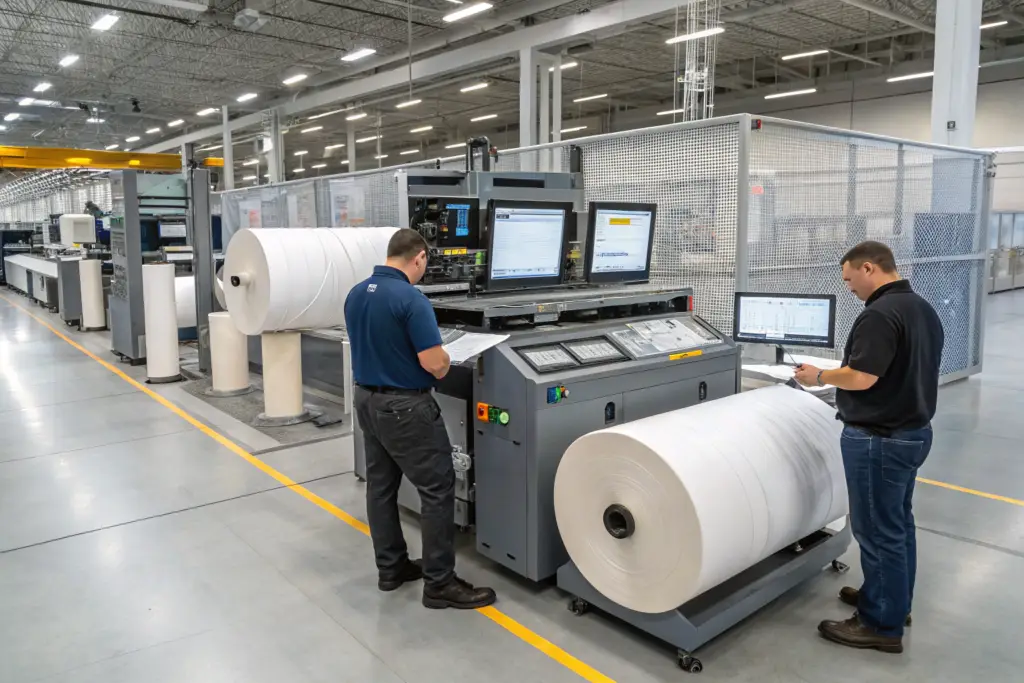
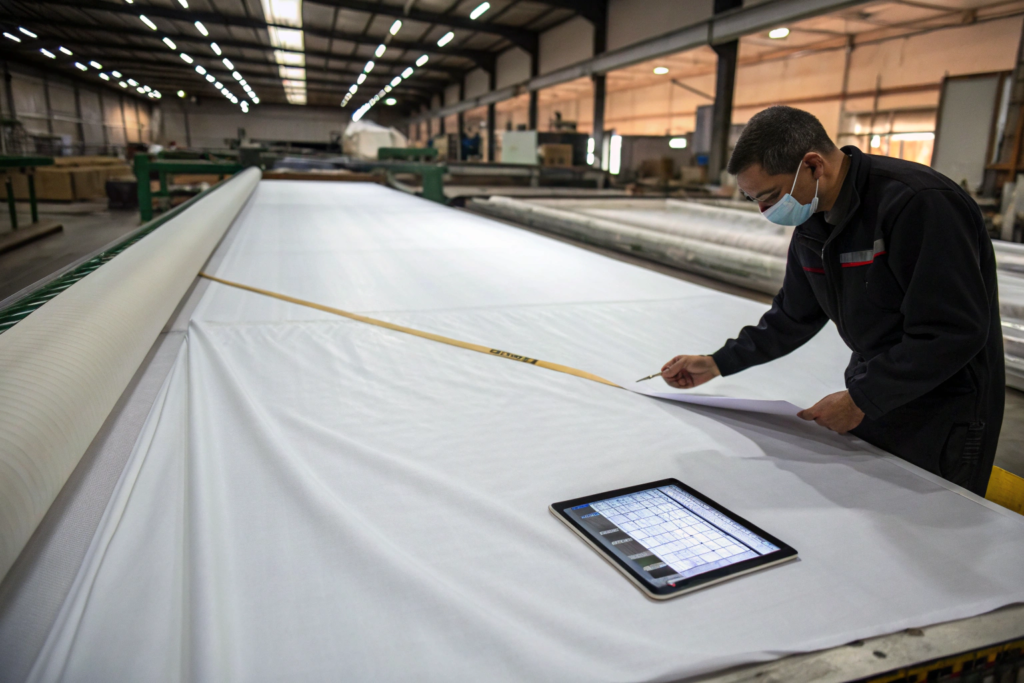
Our AI camera array is a high-resolution, line-scan camera system mounted directly over our backlit inspection tables. It operates like a digital retina. The camera, a Basler industrial vision system, scans the moving fabric at a speed of 60 meters per minute, capturing a continuous, perfect, 600-dpi image of the entire width and length of the roll. This is not a standard video camera; it's a machine vision system that sees the fabric in far greater detail and consistency than the human eye.
The AI software is trained on a proprietary library of over 100,000 defect images we have accumulated over five years of production. It can distinguish between a harmless, aesthetic yarn slub and a structural broken filament that will fail during washing. When it detects an anomaly, it doesn't stop the line. It draws a bounding box on the live feed, classifies the defect type, assigns a preliminary point value, and alerts the human inspector with a subtle visual flag on the monitor. The inspector reviews the flag, confirms or overrides the AI's judgment, and the final decision is logged. This closes the human fatigue gap. The camera doesn't get tired, it doesn't get distracted, and it doesn't forget a subtle barre mark that repeats every 1.3 meters. It catches the systemic, repeating defects that a human, scanning for large, singular flaws, will unconsciously skip. This fusion of machine detection and human judgment is the core of our modern, defensible supply chain transparency.
How Does a Blockchain Log Make Every Roll's History Immutable?
A PDF inspection report is a claim. A blockchain log is a verifiable fact. A standard paper or digital certificate can be lost, photoshopped, or accidentally backdated. For a brand owner facing a $50,000 chargeback from a retailer, the integrity of their documentation is everything. The quality of the record is as important as the quality of the fabric.
Our system automatically generates a cryptographic hash, a unique digital fingerprint, of every inspection report and its associated high-definition defect map. This hash is instantly time-stamped and uploaded to a private, permissioned blockchain ledger. The data itself—the report PDF and the images—is stored on our secure, redundant servers. The blockchain stores only the proof that this exact data existed at this exact moment and has not been altered by a single pixel or a single comma. For a brand partner, you are given a secure portal key. You can log in, select a specific fabric roll by its RFID tag number, and instantly see its entire digital pedigree: the raw material lot, the weaving shift, the AI inspection video, the inspector's verified point score, and the cryptographic proof that none of this data has been tampered with since the moment the roll left our inspection table. This is the new standard of due diligence. It transforms a trust-based relationship into a verify-based partnership, which is the only kind of supply chain partnership that will survive the coming wave of digital product passport legislation in the EU and the U.S. This is verifiable, auditable, third-party-grade evidence, not an internal promise, and it aligns with the core principles of modern textile quality systems as detailed by the AATCC.
Why Does Digital Fabric Inspection Prevent a "Roll of Shame"?
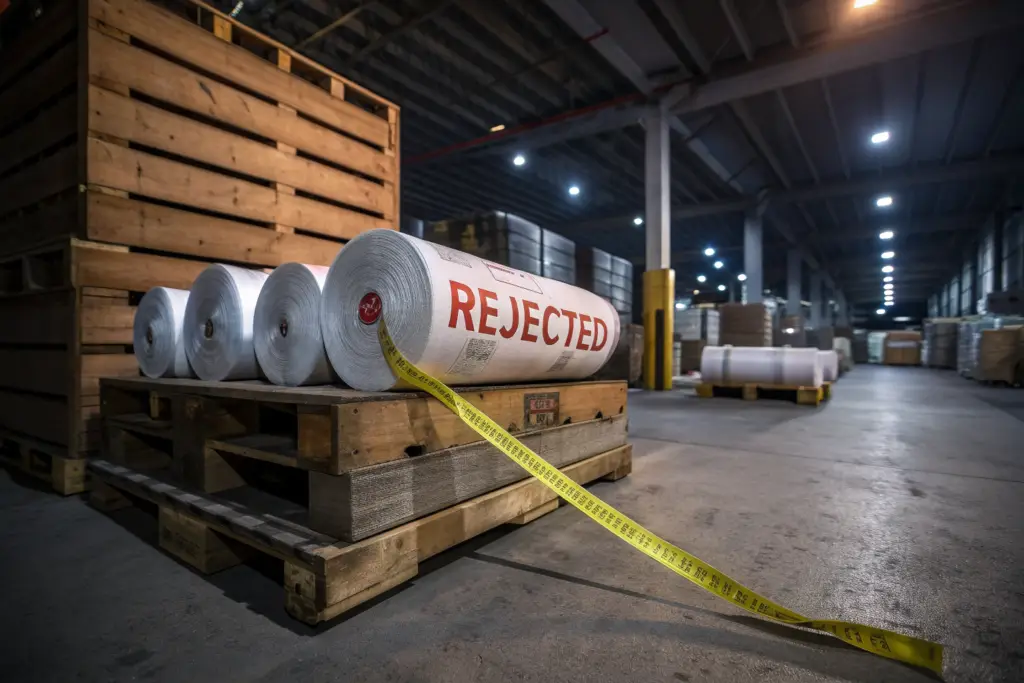
The "Roll of Shame" is an industry term. It's the one roll in a shipment that looks perfect but is a latent catastrophe. It passes standard AQL, gets unrolled on the cutting table, spreads across layers of fabric, and ruins every single garment panel it touches before the cutter finally notices. It is a $5,000 write-off dressed in a passing inspection score.
Digital inspection is designed to identify and isolate this roll before a single knife blade touches it. The economic logic is brutally simple: catching a systemic defect during inspection costs you some yardage. Catching it on the cutting table costs you the fabric, the trims, the labor, and the production slot. Catching it after the customer has worn it costs you your brand.
How Does AI Detect a Repeating Defect That Humans Miss?
The human brain is wired for survival, not for quality control. When an inspector scans fabric, their focus is drawn to large, singular, high-contrast anomalies: a dark oil stain, a bright white broken filament, a hole. The visual cortex prioritizes contrast and scale. A subtle, repeating defect—like a 2-millimeter warp streak that appears every 3.5 meters—is neurologically filtered out after the second or third occurrence. It becomes background noise. The inspector's brain literally stops seeing it.
The AI camera array has no such neurological filter. It compares every single square millimeter of fabric to the ideal template. When a subtle warp streak appears, the AI sees it as an anomaly against the baseline. When the same anomaly appears again 3.5 meters later, the software registers it not as a new defect, but as a Recurrence Event. A repeating pattern of small defects is statistically impossible in a random defect distribution. The software immediately flags the entire roll with a "Systemic Defect Alert." It maps the exact repeat interval. Our technician can then take the raw data back to the weaving mill and say, "You have a damaged heddle on loom seven. The warp streak repeats exactly with the circumference of the loom's take-up roller." This is impossible for a manual inspector to do, especially at the end of a long shift. The digital system catches not just the defect, but the machine malfunction that caused it, preventing a single bad loom from producing a hundred bad rolls. This is the transition from reactive sorting to proactive process control. It's a topic frequently analyzed in advanced manufacturing technology publications.
How Can a Brand Use Digital Defect Maps to File a Mill Claim?
A mill claim is a legal demand for compensation. Without evidence, it is an argument. With a digital defect map and a blockchain-timestamped report, it is a lawsuit winner. A traditional claim is usually settled with a grudging credit of 10% or 15% because the brand cannot prove the fabric was defective before it was cut. The mill simply argues that the brand's own cutting room mishandled the fabric.
Our digital system changes this negotiation completely. When a brand partner receives a roll with a systemic defect, they don't send us an angry email. They log into our portal, export the digitally signed, time-stamped inspection report, and the high-resolution scan video of the exact roll in question. They send this evidence package directly to the mill. The report proves the defect was present, located, and digitally mapped inside our inspection room, before the fabric was ever issued to the cutting table. The cryptographic hash proves the report has not been altered. The claim is no longer a request; it's an evidence-based invoice. We have helped our brand partners successfully recover 100% of the material cost, plus consequential cutting labor, on a systemic defect claim using this exact digital evidence package. The mill knows they will lose in an arbitration proceeding. This shifts the power dynamic. The digital inspection is not just a quality tool; it is a financial insurance policy on your raw material procurement, and it gives even a small brand the forensic leverage of a much larger corporation.
What Are the Financial Consequences of Skipping Digital Inspection?
Skipping digital inspection is a gamble where you are betting your entire production run on a single manual check. The odds are terrible. Every single physical inspection has a statistical miss rate. The question is not whether a defect will be missed; the question is what that missed defect will cost you in the subsequent stages of production.
The true cost of a fabric defect is not the fabric itself. It is the compounding, cascading financial damage that accrues as the defect moves, undetected, through your value chain. You can avoid all of this damage for a cost that is measured in cents per garment. The economics of not doing it are indefensible.
What Is the Real Cost of a Missed Defect on the Cutting Table?
Let's do the real math. A single missed major defect, a 4-point hole that the AI would have caught, has a hard cost cascade on your cutting table. The following table breaks down the real, itemized loss on a single garment style, based on a typical mid-tier U.S. brand.
| Loss Category | Cost per Unit Affected |
|---|---|
| Raw Fabric Cost | $4.50 |
| Consumed Trim Cost | $1.20 |
| Cut & Sew Labor | $3.80 |
| Production Slot Opportunity Cost | $2.00 |
| Total Hard Loss Per Garment | $11.50 |
If that single missed defect is a repeating warp streak from a damaged loom, and it ruins 150 units in a batch, the total hard financial loss is $1,725. This does not include the soft costs: the QC manager's time to investigate, the merchandiser's time to re-source, the production planner's time to reschedule. And this is the best-case scenario, where the defect is caught in the factory. The real nightmare, and the cost that digital inspection is primarily designed to prevent, is the failure that reaches the consumer.
How Much Can One Systemic Weaving Fault Cost in Returns?
A systemic defect that reaches the customer can destroy an entire SKU's profitability and your brand's digital reputation. Let's use a real, anonymized example from our archives. A brand not using digital inspection shipped a batch of 2,000 premium t-shirts. A subtle, systemic fabric defect—a weak spot in the yarn causing small, identical holes to appear after just two washes—was present in the entire batch.
The defect was invisible on the new garment. It was a latent, laundering-induced failure. The first customer reviews appeared three weeks after delivery, with photos. The return rate on this single SKU skyrocketed to 22%. The direct, fully loaded cost of a single return, including outbound shipping, return postage, repackaging, and transaction fees, was $8.50. For 440 returned units, the direct return cost was $3,740. The indirect cost was far worse. The product's star rating dropped to 2.8 stars. Organic sales collapsed. The brand had to liquidate the remaining 1,560 units of perfectly good stock at a 60% markdown, losing an additional $18,720 in margin. The total financial damage from this single, preventable systemic defect was over $22,000. The AI inspection would have caught the yarn weakness by detecting the microscopic irregularities in the fabric structure during the pre-production sample testing. The cost of the digital inspection for the entire batch would have been less than $300. This $300 versus $22,000 equation is the only financial logic that matters in modern garment manufacturing. It is the difference between a profitable season and a catastrophic loss, a reality frequently discussed in apparel industry financial analysis.
Conclusion
The 4-Point Fabric Inspection is not just a standard; it is a mathematical language of risk. But spoken through a manual, tired human eye alone, it is a language full of dangerous blind spots. At Shanghai Fumao, we have built a digital, AI-augmented inspection system that eliminates the neurological fatigue and pattern blindness that cause 95% of missed systemic defects. We pair a high-resolution camera array that sees everything, with a certified human inspector who judges the ambiguous, and we lock every single decision into a blockchain-timestamped, immutable record that becomes your legal and financial shield. A missed defect is not a statistic. It is a $22,000 hole in your season's profit and loss statement, waiting to happen on your cutting table or, far worse, in your customer's washing machine.
The cost of this digital inspection infrastructure is borne by our factory as a core part of our manufacturing service. The cost of not having it is borne entirely by your brand, in returns, markdowns, and destroyed reputation. The choice of a manufacturing partner is a choice of which set of risks you want to carry. We have chosen to carry the inspection risk ourselves, so you don't have to.
If you are ready to source fabric and garments that are protected by the most advanced, transparent, and defensible inspection system in our industry, let's talk. We can send you a sample technical pack that includes a live, anonymized digital inspection report and a blockchain verification key, so you can see exactly what your brand's quality dossier will look like. Contact our Business Director, Elaine, at elaine@fumaoclothing.com. Tell her you want to see the digital 4-point system in action. Let's build a product that ships with its own forensic proof of perfection.