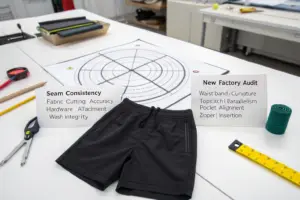
I once walked into our cutting room at the end of a production run and saw a bin full of fabric scraps. It was not a small bin. It was a one-cubic-meter trolley packed tight with cotton jersey offcuts. I asked my production manager to weigh it. The bin held 47 kilograms of waste from one day's cutting. That was 47 kilograms of fabric we had paid for, shipped, inspected, and then thrown away. I did the math that evening. At our average jersey cost of $6.20 per kilogram, that single bin represented $291.40 in pure material loss. Multiply that across 250 production days. The number made my stomach tighten. That day, I stopped thinking about fabric yield as a cutting room metric and started treating it as a direct profit margin lever.
You ensure maximum fabric yield and drastically reduce custom garment manufacturing waste by starting with a tightly engineered marker layout that achieves at least 85% efficiency on wide-width fabric. Then you implement a strict spreading tolerance of plus or minus 2 millimeters, use precision end-cutting, and systematically repurpose unavoidable offcuts into accessory components like pocket bags, inner yokes, and binding strips. The real secret is treating fabric utilization as a pre-production engineering problem, not a post-production accounting entry.
Most brands obsess over the fabric price per meter. They negotiate for weeks to save ten cents a yard. Then they accept a 12% cutting waste rate as normal. That math does not work. A 15% reduction in fabric waste adds more margin than a 5% reduction in fabric cost. I want to show you exactly how we attack this problem at Shanghai Fumao, from the marker planning software to the way we train our spreading operators. These are not theories. These are processes that converted that 47-kilogram bin into an 18-kilogram bin.
What Is an Efficient Fabric Marker Layout and How Does It Save Material?
Three years ago, a men's shirt brand sent us a marker layout from their previous factory. They wanted us to match it. When I opened the file, I found the markers used a standard rectangle nesting algorithm. The pattern pieces were placed like dominoes on a grid. The space between the shirt body and the sleeve piece was wide enough to fit a pocket. And the previous factory had not even tried to place one there. The marker efficiency was 78%. We rebuilt the same style using an interlocking algorithm. We rotated the sleeve pattern by 3 degrees and nested it into the curve of the side seam. The efficiency jumped to 87%. On a 5,000-unit order, that 9% gain saved 420 meters of cotton shirting. At $4.80 per meter, that was over $2,000 in recovered cost.
An efficient fabric marker layout saves material by interlocking pattern pieces at optimized angles, eliminating rectangular waste voids, and matching the layout to the exact fabric width being cut. A computer-aided design system can test hundreds of nesting combinations in minutes, finding a configuration that a manual marker maker would never discover. The efficiency target for woven fabrics should be above 85%. For knit fabrics, aim for 82% or higher.
Marker efficiency is a percentage. It is the area of the pattern pieces divided by the total area of the fabric they occupy. A 100% marker would mean no waste at all. That is impossible. But the gap between 78% and 88% is completely within a factory's control. It comes down to the software, the skill of the marker maker, and the time allocated to optimize the file before cutting begins.
How Does Computerized Marker Making Beat Manual Layouts on Complex Patterns?
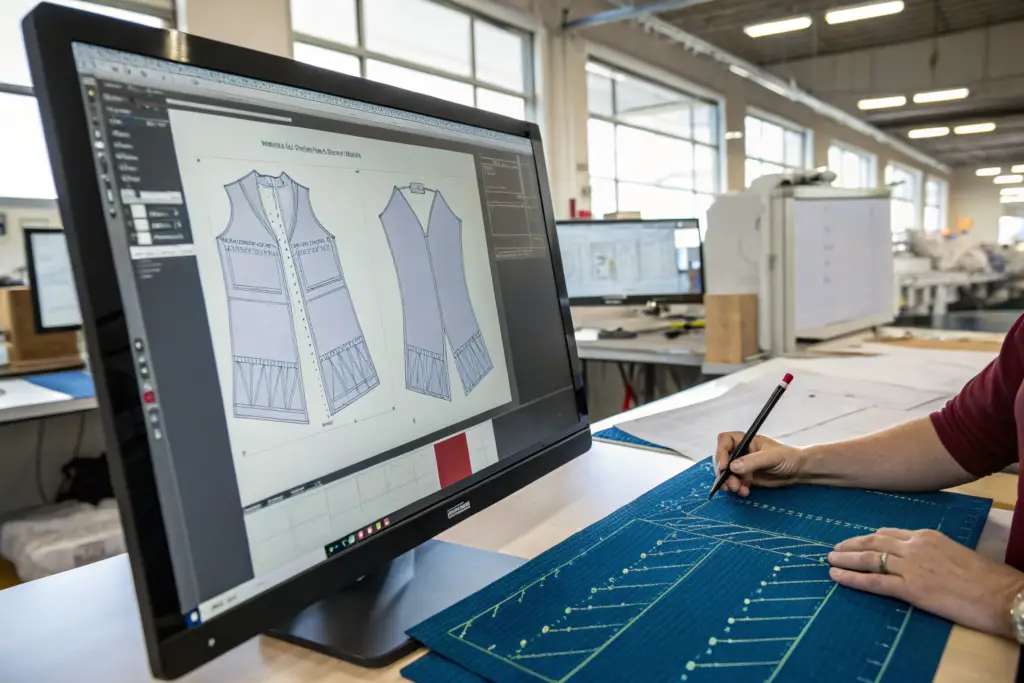
Manual marker making is an art form. An experienced technician with chalk and a ruler can create a decent layout on a paper sheet. But a human brain can only process about five to seven pattern pieces at once. When a garment has 12 pattern pieces, the manual marker maker starts making compromises. They place the large pieces first and then squeeze the small pieces into the remaining gaps. The result is suboptimal. A CAD marker making system can test 50,000 permutations of the same pattern set in under two minutes. It tries piece rotation at 0.1-degree increments. It considers fabric nap direction for each piece independently. It also calculates the cutting path length. A shorter cutting path means faster production and less blade wear. We switched to automated marker making for all our high-volume styles two years ago. Our average marker efficiency on woven shirts improved from 83% to 87.5%. That sounds small. On a single shirt, it saves about 0.12 meters. Across 10,000 shirts, that is 1,200 meters of fabric. The software also tracks historical efficiency data. We can look back at every marker we have ever built and identify which pattern pieces consistently create waste. That data feeds back into our pattern engineering team. Sometimes a slight adjustment to the shape of a facing piece, a curve that no customer will ever notice, can unlock an extra 1% on the marker.
What Fabric Width Selection Rules Maximize Yield on Your Specific Garment Type?
Fabric width is a parameter that most brands never discuss with their supplier. They accept whatever width the mill provides. That is a mistake. The relationship between fabric width and marker efficiency is not linear. A 58-inch width might produce 85% efficiency for a specific trouser marker. A 60-inch width, just two inches wider, might jump the efficiency to 88%. Those two inches create space for one more half-piece to fit into the layout. We publish a fabric width optimization table for our production team. For each garment category, we list the recommended fabric width range. Men's dress shirts work best on 58 to 60-inch goods. Women's bias-cut dresses need a minimum of 54 inches. Kids' wear, with its smaller pattern pieces, can achieve 90% efficiency on 48-inch fabric. When a brand comes to us with a new style, one of the first things we check is whether their chosen fabric is available in the optimal width for their marker. If it is not, we present the cost trade-off. A fabric that costs 50 cents less per meter but comes in a 52-inch width might actually increase the total fabric cost by 7% because the marker efficiency drops. We make this decision transparently with the brand before ordering a single yard of cloth.
How Can You Optimize the Fabric Spreading Process to Minimize End-Bit Loss?
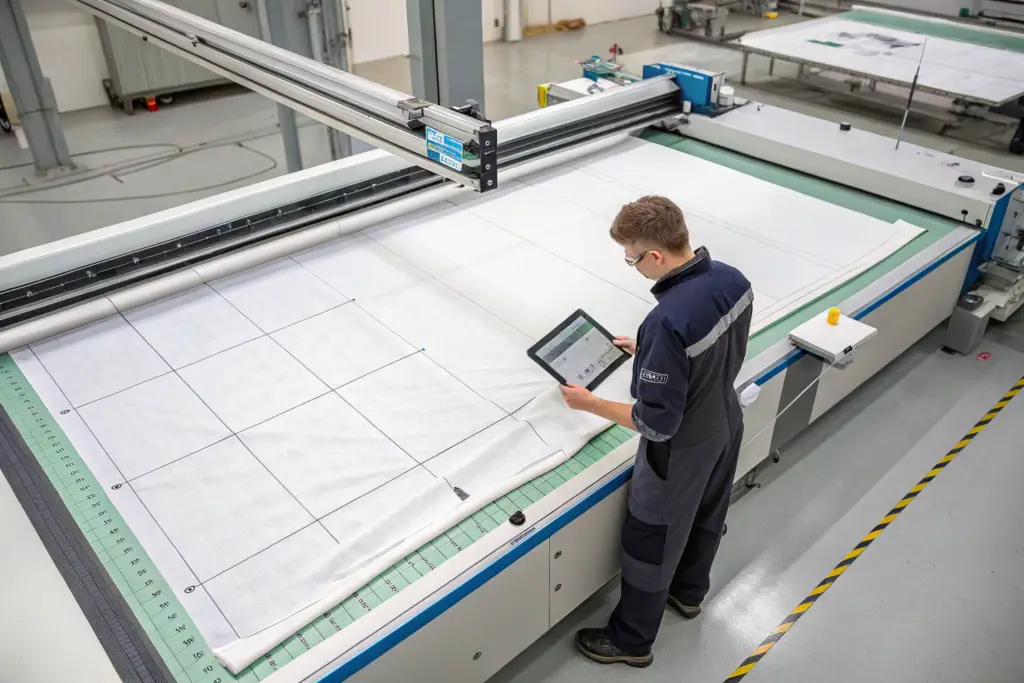
The most painful waste I see is not in the gaps between pattern pieces. It is at the ends of the spread. Every time a layer of fabric is laid on the cutting table, the spreader machine needs a few extra inches at the head and the tail to grip the fabric. Those extra inches become end bits after cutting. If a spreading operator is not paying attention, those end bits can be 8 inches long. Across a spread of 60 plies, that is 40 feet of wasted fabric per spread. On a fabric that costs $5 per yard, that one spread just burned through $67. And a busy cutting room might set up 10 spreads a day.
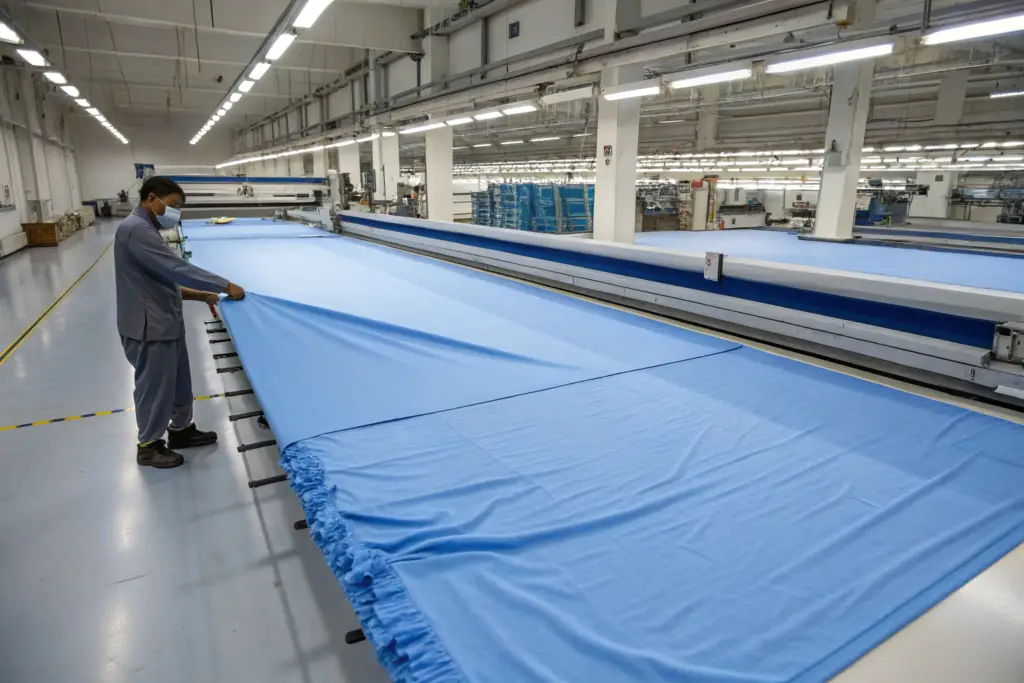
You optimize the fabric spreading process and minimize end-bit loss by setting a strict end-allowance standard of no more than 2 centimeters per ply, using automated spreading machines with precision tension control, and splicing the fabric roll changes mid-spread instead of starting a new spread for every roll. A laser alignment guide on the spreading machine also prevents the side-to-side drift that creates uneven salvage waste on every layer.
We treat the spreading table like a precision instrument. The table surface is leveled to within 1 millimeter across its entire length. If the table has a 5-millimeter dip in the middle, the fabric layers will shift during cutting. The blade will cut pieces that are distorted by half a centimeter. That sounds tiny, but across a 60-ply spread, that half-centimeter error multiplies into 3 centimeters of cumulative drift. The marker does not match the fabric anymore. Pieces get rejected at the sewing stage because the notches do not line up.
Why Does a 2mm Spreading Tolerance Matter More Than You Think?
Spreading tolerance is the acceptable variation in how straight the fabric edge is from one ply to the next. A common industry standard is plus or minus 5 millimeters. I believe that is too loose. At 5 millimeters of drift per ply, a 60-ply spread can have edge variation of up to 30 centimeters from the top layer to the bottom layer. The marker layout has a fixed width. If the fabric is narrower on the bottom layers due to drift, pattern pieces at the edge will fall off the fabric entirely. The cutter will flag those pieces as incomplete and scrap them. We enforce a 2-millimeter tolerance. To hit this, we use a spreading machine with a photoelectric edge-alignment sensor. The sensor tracks the fabric salvage in real time and adjusts the spreading carriage position automatically. We also train our operators to check the edge alignment every 10 plies with a physical gauge. If the drift exceeds 2 millimeters, they stop the machine and realign. This practice alone reduced our end-panel waste by 1.8% in the first year we implemented it. On a 50,000-unit annual production volume, that saved 900 meters of fabric that would have otherwise been trimmed off and thrown into that scrap bin.
How Does Roll-Splicing Technology Eliminate the Waste of a Roll-Change Break?
In a traditional cutting room, when one fabric roll runs out, the operator stops the spreading machine. They remove the empty roll, load a new one, and start a fresh spread. The leftover fabric from the previous roll, often 2 to 5 meters, goes into a remnant bin. Those remnants usually sit on a shelf for six months and then get sold to a rag dealer at a tenth of the purchase price. Roll-splicing technology eliminates this. The spreading machine has a splicing table at the infeed side. When the first roll is about to run out, the operator attaches the tail end of the old roll to the leading edge of the new roll with a heat-seal splice tape. The machine continues spreading without stopping. The splice point becomes part of the spread. The cutter operator marks the splice location in the cutting file. The blade skips the splice line by a 3-millimeter offset. The resulting cut pieces are clean. The splice scrap is a 3-millimeter sliver instead of a 3-meter remnant. We invested in fabric roll splicing equipment two years ago. The payback period was 14 months. Now, our remnant bin holds mostly true end-of-roll stubs that are genuinely too short to splice. The volume of fabric sold as scrap dropped by 60%.
What Cutting Techniques Maximize Utilization of Irregular or Small Pattern Blocks?
Small pieces are the silent killers of fabric yield. A shirt front and back take up most of the marker. They are easy to optimize. It is the collar stand, the cuff, the pocket flap, and the inner yoke that create the scattered voids in a layout. These pieces are too small to justify their own dedicated marker, but they add up to 15% of the total garment area. If they are not nested intelligently, they can drag a marker efficiency down by 5 percentage points all by themselves.
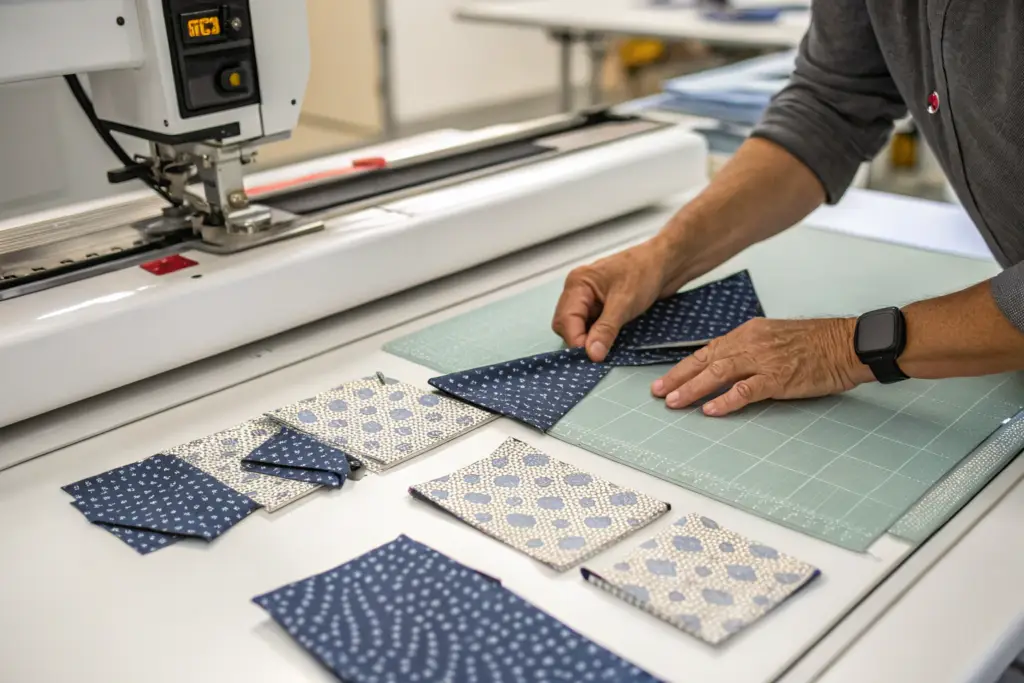
You maximize the utilization of irregular and small pattern blocks by grouping them into a dedicated mini-marker that runs alongside the main body marker, using a static cutting table with a vacuum hold-down to prevent piece shifting, and applying a knife-cut compensation offset that accounts for the blade kerf on intricate curves. These techniques turn what would be dead space between large pieces into productive fabric area.
We discovered the power of dedicated mini-markers by accident. Five years ago, we ran a production trial on a single style. We cut the main body pieces on one table and the small accessory pieces on a separate table using a mini-marker. The small pieces were cut from a different fabric roll of the same lot. The overall fabric consumption dropped by 3.5% compared to the previous production run where all pieces shared one marker. The reason was simple. On the combined marker, the small pieces were forced into whatever gaps the large pieces left behind. On the dedicated mini-marker, the small pieces were arranged in a tight, optimized grid with nothing else competing for space.
How Does a Vacuum Cutting Table Prevent Small Piece Movement During High-Speed Cutting?
Small pieces have low surface area. When a cutting blade moves through them at speed, the friction between the fabric and the table surface is often not enough to hold the piece in place. The piece shifts. The blade deviates from the cut line. The resulting piece is misshapen. The sewing operator receives a collar stand that is 2 millimeters too narrow on one end. They sew it anyway because they are on piece rate. The finished collar is slightly twisted. The garment passes inspection because the twist is subtle. But the customer eventually notices the collar does not sit flat. A vacuum cutting table solves this at the physics level. The table surface is perforated with thousands of tiny holes. A vacuum pump underneath pulls air down through the holes. The atmospheric pressure presses the fabric layers against the table surface. A single layer of cotton shirting experiences about 1,000 kilograms of holding force per square meter under vacuum. The blade can cut at maximum speed, and the piece will not move. We retrofitted our cutting tables with vacuum hold-downs three years ago. The defect rate on small-piece cutting dropped from 2.1% to 0.3%. The investment paid for itself in reduced remakes within eight months.
What Blade Compensation Settings Prevent Overcutting on Tight Curves?
A cutting blade has physical thickness. A standard round knife blade is 0.5 millimeters thick at its cutting edge. When the blade follows a curved path, the inner edge of the curve travels a shorter distance than the outer edge. This creates a kerf, a tiny wedge of fabric that the blade removes. On a long straight seam, the kerf is negligible. On a tight curve like a pocket flap corner, the kerf can remove up to 1.2 millimeters of fabric on the inside edge. That pocket flap comes out smaller than the pattern piece. Over multiple washes, the seam allowance on that curve is narrower than spec. The seam frays. The garment fails. We program our cutting machine software with a kerf compensation offset. For curves with a radius under 10 millimeters, the blade path is shifted outward by 0.3 millimeters. This means the cut piece matches the pattern dimension exactly, accounting for the material the blade removes. We calibrate this offset monthly because blade wear changes the effective cutting diameter. A blade that has cut 10,000 meters of fabric is slightly smaller than a new blade. Our cutting room supervisor measures the blade diameter at the start of every shift with a micrometer and updates the software compensation table. It is a 30-second task that eliminates a persistent source of dimensional drift.
Even with an 88% marker efficiency, 12% of the fabric still becomes offcuts. That is the mathematical floor. You cannot design a garment with zero waste unless you design the garment around the waste, which is a different design philosophy entirely. For most custom manufacturing, you will always have some fabric that does not make it into the main product. The question is whether that fabric goes into a landfill, into a rag bin sold for pennies, or into a secondary revenue stream.
You turn unavoidable fabric waste into a profitable by-product stream by sorting offcuts at the cutting table into grade-A and grade-B categories, partnering with accessory brands that use small-format textile pieces, and offering a closed-loop take-back program where a brand's own production waste is converted into matching accessories like scrunchies, dust bags, or pocket squares. The key is sorting the waste at the point of generation, before it becomes a mixed, contaminated pile.
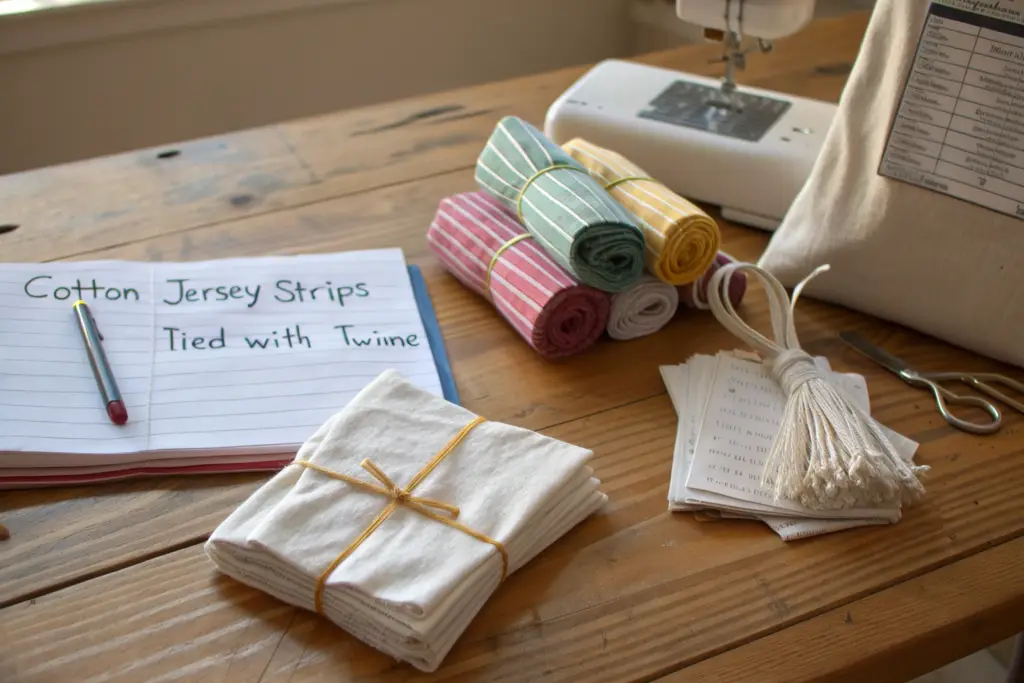
We started our waste repurposing program in 2023. In the first year, it did not generate profit. It generated confusion. The cutting room operators did not know which scraps to save and which to discard. The accessory production team did not have a clear specification for usable remnant sizes. We lost time and made a mess. By 2024, we had built a system. Now, every cutting table has two color-coded bins. The green bin is for grade-A offcuts: pieces larger than 15 centimeters by 15 centimeters with no defects. The red bin is for grade-B: everything else. The green bin contents are sorted by fabric type and color at the end of each shift and entered into a remnant inventory spreadsheet. This inventory is visible to our product development team. When a brand asks us to add a matching accessory to their collection, we check the remnant inventory first.
How to Categorize and Inventory Cutting Room Offcuts for Resale Value?
Not all offcuts have value. A triangular piece from the edge of a spread has no usable grainline and should go directly to recycling. A rectangular piece from between two main body pieces, with a clean grainline and a usable dimension, is a raw material waiting for a product. We categorize offcuts into three tiers. Tier 1 is pieces over 30 centimeters by 30 centimeters with a clean grain. These can become pocket bags, inner waistband facings, or accessory items like headbands. Tier 2 is pieces between 15 and 30 centimeters. These work for small trims, drawstrings, and fabric-covered buttons. Tier 3 is everything below 15 centimeters, which goes to a textile recycling partner for fiber reclamation. Our inventory system tracks the weight, fabric composition, and color of each tier. We price Tier 1 offcuts at 40% of the original fabric cost per kilogram. Tier 2 offcuts are priced at 20%. Last quarter, we sold 180 kilograms of Tier 1 cotton shirting offcuts to a small accessories brand that makes fabric-covered notebooks. The revenue was $1,440. That is not a huge number, but it is $1,440 that the previous year would have been a disposal cost. Multiply that across all our fabric types and the annual number is meaningful.
Can a Brand's Own Production Waste Become a Matching Product Line Extension?
The most elegant version of waste repurposing is a closed loop. A brand produces 2,000 linen dresses. The cutting waste from those dresses is 340 meters of linen remnants in various sizes. Instead of selling those remnants to an unknown third party, we offer to convert them into a matching accessory. A dust bag for the dress. A scrunchie in the same fabric. A pocket square that pairs with the men's shirt order. The accessory costs the brand only the sewing labor, because the fabric cost has already been absorbed by the main production order. The brand then sells the accessory as a value-add or includes it as packaging. One of our women's wear brand clients did this with their summer shirtdress line. We saved the cut-off fabric from the dress bodies and produced 500 matching scrunchies. The scrunchies cost them $0.60 each in labor and trims. They retailed them for $8 as a "complete the look" upsell at checkout. The scrunchies sold out in two weeks. The waste from their dress order generated $4,000 in accessory revenue. This model only works if the factory has in-house accessory production capability. We set up a dedicated small-batch sewing line for exactly this purpose. It runs on remnant fabric and produces accessories on demand. The line operates at a lower margin than our main production lines, but it turns a waste disposal problem into a brand loyalty tool.
Conclusion
Fabric waste is not a tax that the garment industry must pay. It is a symptom of inattention. Every meter of fabric that ends up in a scrap bin represents a failure in the marker layout, the spreading process, the cutting execution, or the waste sorting system. The factories that accept a 15% waste rate as normal are the same factories that accept late shipments and inconsistent sizing as normal. The standard is not the standard. The standard is what you choose to accept.
At Shanghai Fumao, we chose a different standard. We set a marker efficiency floor of 85% and built the software infrastructure to hit it consistently. We enforce a 2-millimeter spreading tolerance and invested in the equipment that makes it achievable. We treat small-piece cutting as a specialized discipline with its own vacuum tables and kerf compensation protocols. And we built a remnant-to-accessory pipeline that turns our cutting room offcuts into revenue instead of landfill. These four systems work together. If you optimize only the marker but ignore the spreading, the waste just shifts downstream. If you sort the offcuts but never find a buyer for them, you have just created a tidy trash pile. The system must be complete.
The financial impact is not theoretical. We reduced our average fabric waste rate from 14% to 8.5% over three years. On an annual fabric spend of $1.2 million, that 5.5 percentage point reduction returns $66,000 directly to the bottom line. It also reduces our environmental footprint in a way that our brand partners can communicate to their end customers. That is a competitive advantage in a market that increasingly demands sustainability not as a slogan but as a verified practice.
If you want to bring this level of fabric optimization to your next production run, we are ready to collaborate. At Shanghai Fumao, we will share your marker efficiency report before cutting begins. We will show you the spreading tolerance data from your specific order. We will present the remnant inventory from your production and offer matching accessory ideas. This is not a black-box factory relationship. It is an engineering partnership. Reach out to our Business Director, Elaine, at elaine@fumaoclothing.com. Send her your tech pack and your target fabric specification. She will return a fabric consumption projection with a guaranteed waste ceiling. Let's make sure the only thing your factory cuts is your garment pieces, not your margin.