A year ago, a streetwear brand owner from Los Angeles called me, furious and confused. He had sourced 2,000 "premium heavyweight" hoodies from a new supplier. He had specified 400gsm on his purchase order. The sample we had sent him was a perfect, dense, structured 400gsm French terry. The bulk shipment he received felt thin, limp, and cheap. His customers immediately complained that the hoodies were not "thick" enough. His return rate spiked. He had paid for a heavyweight hoodie and received a midweight one. When we tested the fabric in our lab, the actual weight was 340gsm. The supplier had faked the sample and swapped the bulk fabric. The GSM number on the contract was just a suggestion, not a specification.
GSM, or grams per square meter, is the single most critical and most frequently falsified metric in sweatshirt sourcing, and at Shanghai Fumao, it is a tested, guaranteed, and batch-certified physical property of the fabric, not a marketing claim. A sweatshirt's weight defines its structure, its warmth, its drape, its printability, and its perceived value in the hands of your customer. A 60gsm discrepancy is not a minor tolerance. It's a completely different product.
Most buyers understand GSM as a number on a spec sheet. I want you to understand it as a tactile language. I want you to know exactly what a 280gsm French terry feels like in your hand, how a 480gsm loopback drapes on a body, and how to verify, with your own physical test, that the fabric we ship to you is the exact weight you paid for. Let's take the mystery and the fraud out of sweatshirt fabric weight.
What Is GSM and Why Does It Define a Sweatshirt's Quality?
GSM is not an abstract textile term. It is a direct, physical measurement of how much fiber is packed into a single square meter of your fabric. It is the density of the product you are selling. A higher GSM literally means more cotton, more air pockets, more structure, and a higher perceived value when your customer lifts the hoodie off the shelf or out of the shipping box.
When I walk through our fabric warehouse in Shaoxing, I can pick up a roll and estimate its GSM to within 20 grams just by the feel of its heft and the tightness of its roll. This is a skill, but it is based on a simple physical truth: weight is material. Material is cost. Cost is value. A factory that cheats you on GSM is stealing fiber from your product and money from your margin. Understanding GSM is understanding the fundamental economic equation of your sweatshirt.
How Does a 280gsm Sweatshirt Differ from a 480gsm One?
The difference is the difference between a summer windbreaker and a winter coat. A 280gsm sweatshirt is a lightweight garment. The fabric is typically an open, loosely knitted French terry. It has a soft, fluid drape. It is designed for layering in spring, for cool summer evenings, or for a vintage, worn-in look. It will have very little structural stand-up. If you lay it flat on a table, it will collapse into a soft, formless pile.
A 480gsm sweatshirt is a structured, architectural garment. The fabric is dense, often a tight loopback or a heavily brushed fleece. It has a rigid, almost sculptural drape. The hood will stand up on its own without any internal support. The seams will be thick and pronounced. When a customer picks up a 480gsm hoodie, the weight surprises them. It feels expensive. It feels like armor. This is the garment that commands a $120 retail price point in the premium streetwear market. The 280gsm version is a $60 product. The difference in manufacturing cost is not just the extra fiber. The heavier fabric is harder to sew, requiring a slower stitch speed and a heavier needle gauge. The entire garment's architecture changes with the GSM. This is not a small detail; it is the very identity of the product, and it's a factor heavily discussed in textile sourcing circles.
Why Does GSM Directly Control Your Wholesale and Retail Price?
Because GSM is raw material. Cotton is a globally traded commodity. A 480gsm sweatshirt contains roughly 70% more cotton fiber by weight than a 280gsm sweatshirt of the same pattern. The fabric cost is the single largest line item in your FOB price, typically accounting for 50% to 60% of the total garment cost. A heavier GSM directly and proportionally increases your fabric cost.
The math is straightforward. If the base knit cost for a 280gsm cotton fleece is $6.50 per kilogram, and a single sweatshirt consumes 0.7 kilograms of fabric, your fabric cost is $4.55. A 480gsm sweatshirt consumes 1.1 kilograms of the same-priced fabric, for a fabric cost of $7.15. That is a $2.60 increase in raw material cost alone, without any additional sewing or finishing costs. This $2.60 in FOB cost translates to roughly an $8 to $10 increase in your retail price, depending on your margin structure. A brand owner who does not understand GSM is a brand owner who cannot control their own pricing architecture. When you source from Shanghai Fumao, we provide a fully transparent cost breakdown that shows you the exact kilogram weight of the fabric in your garment, so you can model your retail pricing with absolute certainty. A GSM number is not just a quality signal; it is a financial building block.
How Can a Buyer Physically Verify a Sweatshirt's Real GSM?
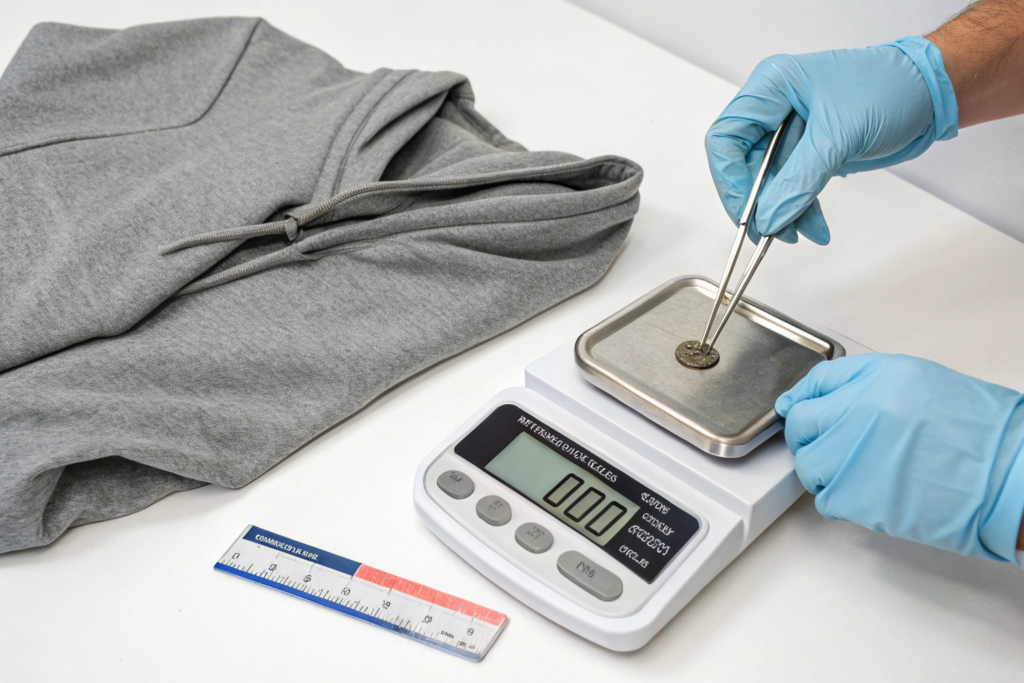
The most dangerous lie in the apparel industry is a GSM number on a sticker that has no relationship to the fabric inside the roll. A smart buyer does not trust a sticker. A smart buyer trusts a scale. You can, and should, independently verify the GSM of any pre-production sample or bulk shipment we send you. The test is simple, inexpensive, and scientifically irrefutable.
You do not need a textile degree to do this. You need a $30 digital scale and a pair of sharp scissors. The physical test transforms you from a hopeful buyer into a verified customer. It completely eliminates the supplier's ability to ship you a lighter fabric than what you approved. At Shanghai Fumao, we perform this exact test on every single batch, and we publish the results. We expect you to verify them. This is not an insult; it is the foundation of a transparent, adult business relationship.

How Do You Perform a Simple At-Home GSM Cut-and-Weigh Test?
The test is based on a simple geometric principle. You cut a precisely known area of fabric, weigh it on a precision scale, and then multiply that weight to find the weight of a full square meter. Here is the exact, step-by-step procedure I teach all our brand partners.
First, create a precise 10cm x 10cm template from stiff cardboard. This 100 square centimeter area is exactly 1/100th of a square meter. Second, lay your sweatshirt fabric flat and place the template on it. Using a rotary cutter or very sharp scissors, carefully cut exactly around the template. Do not stretch the fabric. Third, place the cut swatch on a digital scale that measures in grams, preferably to 0.1g accuracy. Record the weight. This is the weight of 1/100th of a square meter. Finally, multiply that weight by 100. The result is the fabric's actual GSM. If your 10cm x 10cm swatch weighs 4.1 grams, your fabric is 410gsm. If your purchase order specified 450gsm, and the swatch weighs 3.8 grams (380gsm), you have caught a 70gsm fraud with $30 worth of equipment. This test is scientifically valid and legally defensible. It is the single most empowering piece of knowledge you can possess as a garment buyer. It transforms GSM from a marketing claim into a personally verified physical fact. The same rigorous approach to self-verification is a key skill taught in modern quality control training.
What Is Fumao's "Certified GSM" Batch Test Protocol?
Our internal protocol is a more rigorous, statistically sampled version of the at-home test. We never test a single swatch. We test a minimum of five swatches taken from five different points across the full width and length of a fabric roll: the left selvedge, the center, the right selvedge, and at the beginning, middle, and end of the roll. This five-point sampling catches a serious problem that a single-point test misses: weight variation across the roll width caused by inconsistent tension in the knitting or finishing machines.
We then calculate the mean GSM and the coefficient of variation across these five points. Our internal standard, which we publish to our brand partners, is a maximum allowable variation of +/- 5%. If a 400gsm fabric shows a mean of 398gsm with a variation of only 2%, it passes and is certified. If the mean is correct but the left selvedge is 360gsm and the right selvedge is 440gsm, the roll is rejected. That variation will cause visible draping and shrinkage inconsistencies in the finished garments. The certified GSM test report, with the five individual measurements, the mean, the coefficient of variation, and the date and time stamp, is part of the digital quality dossier we provide for every bulk fabric batch. You receive this report before the fabric is cut. This is the difference between a factory that measures its product and a factory that stamps a sticker on it. We measure, we record, and we publish the data, a transparency practice central to our entire approach at Shanghai Fumao.
When Should You Choose French Terry, Fleece, or Loopback?
GSM is the quantity of the fiber. The knit construction is the architecture of the fiber. A 400gsm French terry and a 400gsm fleece will weigh the same on a scale, but they will feel, drape, and perform completely differently. Choosing the wrong construction for your brand's aesthetic is just as costly as choosing the wrong weight.
The back of the fabric tells the whole story. The face of the sweatshirt is usually a smooth, single jersey knit. The magic, and the weight, is in the back. This is where the loops are formed, and it is the treatment of these loops that defines the fabric's hand feel, its warmth, its breathability, and its design language. A buyer must be able to read the back of a fabric like a book.

What Is the Design Language of a Brushed Fleece for Your Brand?
Brushed fleece is the language of comfort, nostalgia, and mainstream luxury. To create fleece, the back loops of the knit are mechanically brushed with rotating wire bristles. This process tears the surface fibers, creating a raised, fluffy, voluminous nap that traps an enormous amount of warm air. It is the softest, warmest, and most commercially dominant sweatshirt fabric.
If your brand is selling a "cozy," "weekend," or "giftable" product, fleece is the correct structural choice. It maximizes the sensation of instant softness. The brushing process, however, destroys the loop structure, so the fabric has less mechanical stretch and recovery than French terry. It also adds a processing cost. A 400gsm fleece hoodie is a winter-weight statement of comfort. It is the fabric of a best-selling holiday gift item. However, because the nap can trap lint and hair, it's not the ideal choice for a household with shedding pets. The brushed finish also tends to pill more over time, although a high-quality, long-staple cotton fleece will pill significantly less. This is a maintenance reality your brand must communicate. The aesthetic payoff is the ultimate "hug in a garment" feeling, which, for the right brand, is the entire value proposition. This balance of aesthetics and performance is a constant topic in fabric development.
Why Is Unbrushed French Terry the Choice for "Quiet Luxury" Streetwear?
French terry is the language of understated, minimalist luxury. In a French terry, the back loops are left completely unbrushed, clean, and distinct. The fabric has a smooth, cool hand on both sides, a beautiful, structured drape, and a cleaner, more architectural look. It is significantly more breathable than fleece because the unbrushed loops allow air to circulate freely.
For a quiet luxury or minimalist streetwear brand, French terry is the structural signature. It says, "I am expensive because of my quality and cut, not because I'm screamingly fluffy." A 400gsm French terry hoodie will have a substantial weight and a crisp, clean silhouette. It layers beautifully under a tailored coat. It looks deliberate and sophisticated. This is the fabric of a $200 Japanese-inspired streetwear piece. The trade-off is that it lacks the instant, pillow-like softness of fleece. The customer who understands French terry is a customer who values structure and breathability over maximum plushness. The unbrushed loops are also naturally more durable and less prone to pilling, as the fiber structure hasn't been mechanically weakened by brushing. This makes a French terry garment a long-term, slow-fashion investment piece. Its beauty is in its integrity and longevity, not an immediate, superficial tactile rush. This sophisticated material choice directly reflects a deeper understanding of textile design, a field explored in depth by institutions like Central Saint Martins.
What Are the Regional and Seasonal GSM Preferences in the US?
The United States is not a single climate market. A hoodie designed for a Chicago winter is a different piece of engineering than a hoodie designed for a Los Angeles summer evening. A national wholesale strategy requires a GSM strategy that maps to geography, season, and your specific retail channel. A one-weight-fits-all approach is a recipe for regional sell-through failure.
I have analyzed the sell-through data of our brand partners across different regions and seasons for over a decade. The data reveals a clear, predictable pattern. A sweatshirt that is a top seller in Minneapolis in October will be a slow, dust-gathering markdown in Miami, and vice versa. The GSM you choose must be a deliberate decision based on the specific zip code where your customer lives and the specific month you expect them to wear the garment.

Why Does a 480gsm Hoodie Sell Best in the Northeast in Q4?
Because a 480gsm hoodie is functionally a coat. In the Northeast, during the October-through-December selling season, the average daytime temperature drops from 55°F to below freezing. The consumer is not buying a fashion statement; they are buying a primary insulation layer. They need the garment to block wind and trap body heat.
The dense structure of a heavyweight loopback or heavily brushed fleece creates a still air layer that is an excellent insulator. The rigid structure of the hood stands up to a biting wind. The sheer heft of the garment provides a physical sensation of protection and warmth that a lightweight fabric simply cannot deliver. Our retail partners in New England consistently report that their Q4 "heavyweight" hoodie programs, specified at 420gsm and above, achieve sell-through rates above 80% at full price. The customer in this region and season is not sensitive to a $20 price premium if the weight is demonstrably there, because they can feel the value of the warmth in their hands the moment they pick it up. The garment is solving a real, physical problem: the cold. This functional value proposition is what drives premium pricing power in this market.
Can a 280gsm French Terry Work as a Year-Round Seller in the Sunbelt?
Yes, and it's the core of several of our most successful California and Texas brand programs. In the Sunbelt, where winter is mild and air conditioning is aggressive, a heavyweight hoodie is a burdensome, unwearable garment for most of the year. The consumer needs a lightweight, breathable layer that provides a touch of warmth on a cool evening without causing overheating in a climate-controlled office or restaurant.
A 280gsm French terry is the perfect solution. It provides a sophisticated, structured look without the thermal weight. It layers perfectly over a t-shirt in an air-conditioned space. It is light enough to carry and tie around the shoulders. One of our Austin-based brand partners has built their entire year-round sweater and hoodie program around a 280gsm to 320gsm French terry range. They market it as "three-season weight." Their data shows consistent, stable sell-through across spring, summer nights, and fall, with no significant seasonal drop-off. The lighter fabric also carries a lower FOB cost, which allows them to maintain a healthy margin at a more accessible retail price point, broadening their total addressable market. The key is designing the garment around the fabric's inherent drape, not trying to force a heavyweight silhouette onto a lightweight material. When the design and the GSM are in harmony, a lightweight French terry can be a brand's highest-volume, highest-profit SKU. This regional product-market fit is a cornerstone of smart retail strategy.
Conclusion
GSM is the physical weight of your brand's promise. It is the number that translates directly into your customer's first, tactile impression of your product's quality and value. A 280gsm French terry is a lightweight, breathable layer for a Sunbelt spring. A 480gsm fleece or loopback is a protective, architectural winter coat for a Northeastern commute. You can, and must, verify this critical number yourself with a $30 scale and a pair of scissors, using the simple cut-and-weigh test we have outlined. When you source from Shanghai Fumao, you are not just buying a GSM number on a label. You are buying a certified, batch-tested, statistically sampled physical property, backed by a digital quality dossier that shows you the five-point mean weight and variation of the exact fabric roll being cut for your order. You are buying a transparent, verifiable material fact.
Never let a factory make your GSM a mystery. A supplier who will not tell you exactly how they measure and verify their fabric weight is a supplier who is almost certainly cheating you on it. Demand the scale. Demand the cut test. Demand the batch report. These are your rights as a buyer, and they are the standard operating procedure of a factory that is proud of its product.
Do you know the exact certified GSM of the sweatshirt you are currently selling? If there is any doubt, let's run a verification test together. Contact our Business Director, Elaine, at elaine@fumaoclothing.com. Tell her you want a set of our GSM-certified sweatshirt fabric swatches, complete with the actual, measured batch test reports for each one. Let's put the scale to your product and build a sweatshirt whose weight is a documented, undeniable physical truth.