I stood in a freezing warehouse in Minneapolis three winters ago with a brand owner who was staring at 900 returned parkas. The jackets looked beautiful on the outside. Matte nylon shell. Faux fur trim. Clean stitching. But inside, the down fill had begun to leak through the lining after just two weeks of wear. Tiny feathers were poking through the fabric like needles. The brand owner had sourced the jackets from a trading company that had promised "premium 80/20 down." What they actually shipped was 50/50 down with a poorly calendered lining. The trading company disappeared. The brand owner lost $72,000 in returns, chargebacks, and destroyed reputation. She found us six months later and asked a question I will never forget: "How do I make sure the factory actually gives me what I pay for?" The answer changed how she sourced outerwear forever.
Sourcing incredibly high quality winter jackets directly from Chinese factories requires you to bypass trading companies entirely and verify the factory’s specialized outerwear credentials through independent audits and physical inspections. You must visit the factory floor to confirm they have dedicated down-filling machines, seam-taping equipment, and cold-chamber testing facilities. You must demand third-party lab reports that verify the exact fill power, down-to-feather ratio, and waterproof rating of every batch before bulk production begins. You must establish clear material specifications that name specific insulation suppliers, specific membrane technologies, and specific zipper brands with no "or equivalent" language. And you must negotiate a DDP logistics arrangement where the factory retains responsibility for the goods until they reach your warehouse, because winter outerwear is bulky, heavy, and seasonally time-sensitive in ways that summer garments are not. The factories that can meet these requirements exist. They are clustered in specific industrial regions. Finding them is a qualification process, not a purchase transaction.
Winter outerwear is the most technically complex garment category to source. A T-shirt has five components. A technical parka has 30 to 60 components including shell fabric, lining, insulation, membrane, zippers, snaps, drawcords, toggles, velcro, and reflective tapes. Each component has a quality specification that affects the performance of the finished garment. Sourcing outerwear is not like sourcing t-shirts. The stakes are higher, the engineering is more demanding, and the cost of failure is measured in negative Amazon reviews that destroy a season’s sales. I want to share exactly how we help our brand partners source outerwear from China, from factory qualification to shipment delivery, so you can get the quality you pay for.
What Specific Factory Certifications and In-House Equipment Prove an Outerwear Factory Is Legitimate?
A brand owner once asked a trading company to provide the factory audit report for the outerwear factory they claimed to use. The trading company sent a generic social compliance audit. It mentioned nothing about down-filling equipment. Nothing about seam-sealing capability. Nothing about cold-weather testing. The brand owner pushed harder. The trading company admitted they did not actually know which factory would produce the jackets. They would "allocate the order based on availability." That is the moment the brand owner walked away. A legitimate outerwear factory is defined by specialized equipment that a general-purpose garment factory does not possess.
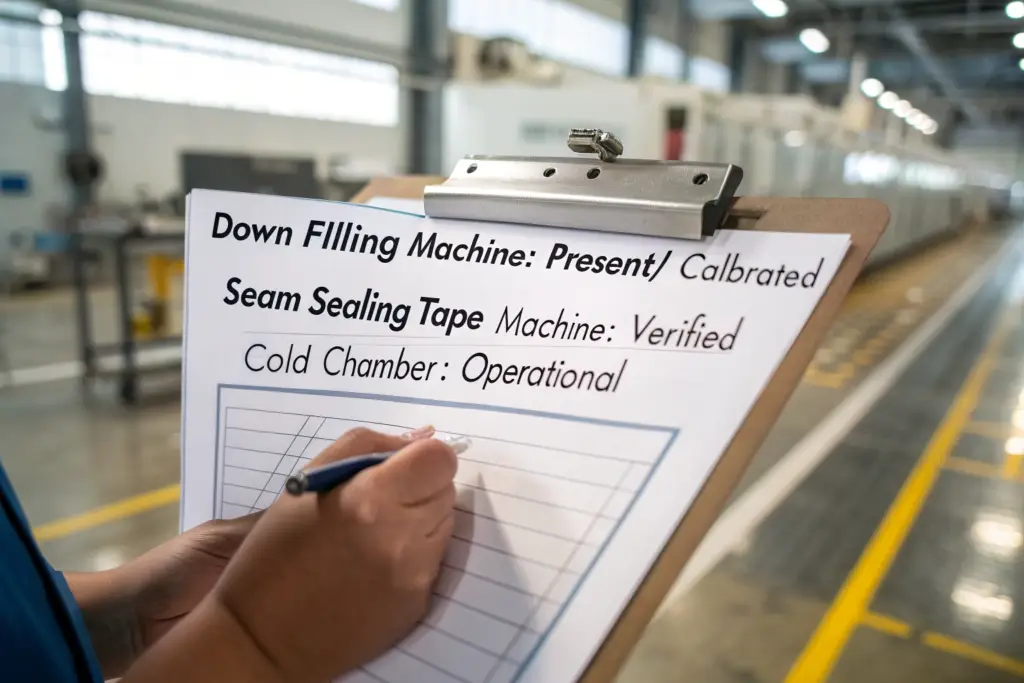
A legitimate outerwear factory must have four pieces of in-house equipment that you can physically verify. First, a down-filling machine with a computerized weight control system that fills each jacket compartment to within 1 gram of the target fill weight. Second, a seam-sealing or taping machine that applies waterproof tape to every seam in the shell fabric. Third, a fabric down-proof testing chamber, often called a "cold chamber," where finished jackets are tested for insulation performance at sub-zero temperatures. Fourth, a needle detection machine, which is standard for all garment factories but critically important for outerwear where a broken needle lodged in insulation is a serious safety hazard. You verify these machines by visiting the factory floor in person or by hiring a third-party inspector to conduct an equipment audit. A factory that outsources its down filling to a separate workshop is not an integrated outerwear factory. Quality control is fragmented, and accountability disappears when problems arise.
The equipment defines the factory’s capability. A factory that has invested $80,000 in a down-filling machine has made a strategic commitment to outerwear production. They are not going to switch to producing T-shirts next season. The equipment investment signals that the factory’s business model depends on outerwear quality. That alignment of incentives is what you want in a manufacturing partner.
Why Is an In-House Down-Filling Machine More Important Than a BSCI or WRAP Social Audit for Outerwear Quality?
A BSCI or WRAP audit verifies that the factory treats its workers fairly. That is important. It does not verify that the factory can fill a jacket evenly without leaving cold spots. An in-house down-filling machine is the direct predictor of insulation quality. Factories that outsource down filling send cut shell pieces to a separate workshop. That workshop fills the jackets and returns them. The garment factory has no visibility into whether the correct fill weight was used, whether the down was properly conditioned, or whether the filling was evenly distributed across the baffles. In-house filling keeps the process under one roof. The filling machine operator is employed by the same company that employs the sewing operators. The quality control inspector can walk from the sewing line to the filling station in 30 seconds. When a problem is detected, it is fixed immediately. The down-filling equipment standards are the critical infrastructure. A social audit is necessary. The in-house filling machine is the quality determinant.
How Can You Verify the Factory’s Cold Chamber Testing Capability During a Video or Physical Audit?
A cold chamber is a walk-in environmental testing room that can simulate temperatures as low as -30°C. The factory places a finished jacket on a thermal manikin inside the chamber. Sensors measure the insulation value, expressed in CLO units, across different body zones. The test reveals cold spots where insulation is insufficient. A legitimate outerwear factory will show you their cold chamber during a factory tour. Ask to see a recent test report. The report should show the date, the jacket style number, the target CLO value, and the actual measured CLO value. A factory that does not have a cold chamber, or claims their cold chamber is "broken" or "being repaired," is not testing their insulation performance. They are guessing. You can hire a third-party inspection company to verify the cold chamber’s existence and operational status. The thermal insulation testing standards are defined by ASTM F1291. A factory that claims to produce performance outerwear but cannot demonstrate thermal testing capability is not a performance outerwear factory.
How Do You Write an Ironclad Material Specification That Prevents Insulation and Fabric Substitutions?
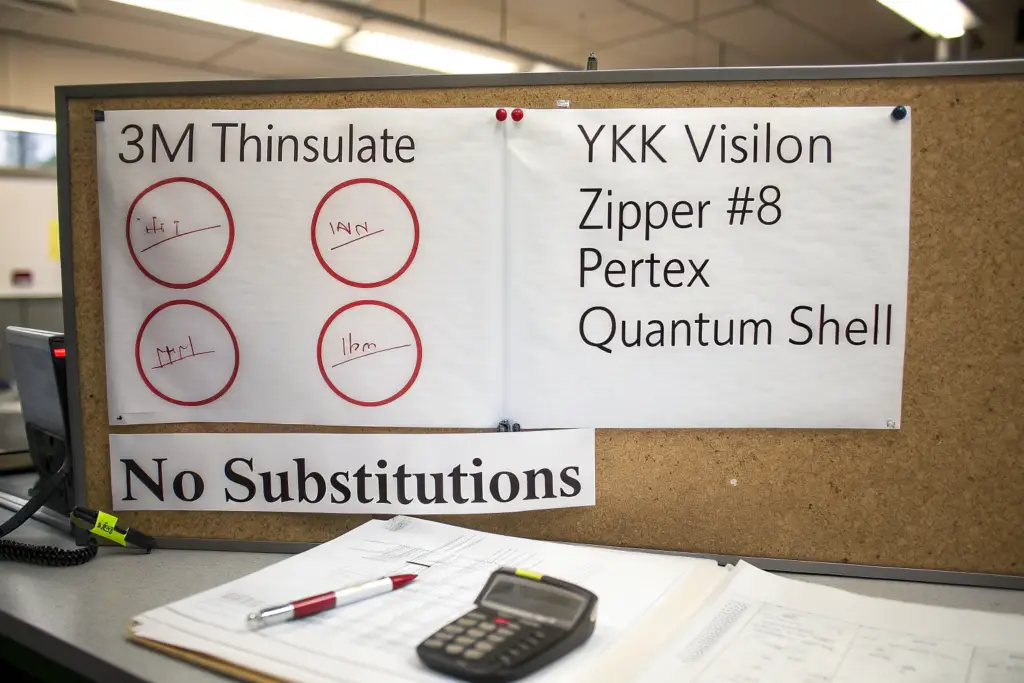
A ski apparel brand we work with learned the substitution lesson the hard way. Their tech pack specified "800 fill power goose down." They received jackets filled with 650 fill power duck down. The jackets were 20% less warm, 30% heavier, and had a noticeable odor that goose down does not produce. The factory argued that the contract said "down" and they delivered down. The brand had not specified the species, the fill power, the down-to-feather ratio, or the cleanliness standard. The contract had a loophole, and the factory drove a truck through it. The brand now writes outerwear material specs like a pharmaceutical contract. Every component has a named supplier, a product code, and a "no substitution without written approval" clause.
You write an ironclad material specification by naming specific insulation brands with their exact product codes, specific shell fabric mills with their exact article numbers, and specific trim suppliers with their exact catalog references. The word "equivalent" must be struck from your vocabulary. A spec that reads "800 fill power down or equivalent" authorizes the factory to use any down they consider equivalent, and their definition of equivalent will always favor their margin. You specify: "Allied Feather & Down 800 fill power white goose down, 90/10 down-to-feather ratio, 800+ turbidity cleanliness, product code AFD-800-90-WG." That specification cannot be misinterpreted. The factory can meet it or not meet it. If they deliver something else, the contract has been breached, and the burden of proof is clear. This level of specificity takes time to research. It protects you from the $72,000 Minneapolis parka disaster.
The material specification is the most important document in outerwear sourcing. The tech pack defines the design. The material spec defines the quality. A beautiful design with cheap insulation is a beautiful jacket that does not keep anyone warm. The customer does not see the spec. They feel the result of the spec when they are standing at a bus stop in February.
What Are the Exact Third-Party Lab Tests Required to Validate Down Fill Power Before Cutting?
Fill power measures the loft and insulating efficiency of down. It is measured in cubic inches per ounce. 800 fill power down occupies 800 cubic inches per ounce of down. 650 fill power down occupies 650 cubic inches. The difference is warmth per unit of weight. A jacket with 800 fill power down is warmer and lighter than a jacket with 650 fill power down, assuming the same fill weight. You validate fill power through IDFL testing, the international standard for down and feather analysis. You ship a sample of the bulk down to an IDFL certified laboratory before the down is filled into jackets. The lab tests for species identification, confirming goose versus duck. It tests for down-to-feather ratio, confirming the percentage of down clusters versus feathers. It tests for fill power, confirming the loft measurement. It tests for turbidity, confirming the cleanliness of the down. The lab issues a report within 48 hours of receiving the sample. If the report confirms the down matches your specification, you release the down for bulk filling. If it does not, you reject the down batch and require the factory to source compliant material. This test costs approximately $150 per sample. It is the cheapest insurance you will ever buy against a $50,000 insulation failure.
How Do You Specify Waterproof Breathable Membranes to Ensure They Survive a Customer’s Washing Machine?
A waterproof breathable membrane is a thin film laminated to the inside of the shell fabric. It blocks liquid water while allowing water vapor to escape. The membrane is the most technically sensitive component of a performance jacket. A cheap membrane delaminates after five washes. An expensive membrane survives 50 washes. You specify the membrane by naming the technology. "Gore-Tex 2-layer laminate, product code GTX-2L-150" or "SympaTex 3-layer laminate, product code STX-3L-120" are examples of specific, enforceable specifications. You also specify the wash durability requirement. "Membrane must maintain 80% of original waterproof rating after 20 home laundry cycles per AATCC Test Method 135." The factory submits a sample of the laminated fabric to a textile testing laboratory that performs the wash cycling and re-tests the waterproof rating. The lab issues a report. You approve or reject the membrane based on the data. The customer who washes their $400 ski jacket 30 times over three years will never know the lab report exists. They will know whether the jacket still keeps them dry. The spec ensures it does.
What Regional Manufacturing Clusters in China Specialize in High-End Winter Outerwear?
A brand owner once flew to Guangzhou to find a down jacket factory. He spent three days visiting factories that made beautiful woven shirts and casual trousers. None of them had down-filling equipment. None of them understood seam taping. He had gone to the wrong city. Guangzhou is a fashion apparel hub. It is not an outerwear manufacturing cluster. He wasted three days and a round-trip flight because he did not understand that Chinese manufacturing is organized into regional industrial clusters. Each cluster specializes in a specific product category. The cluster contains the fabric mills, the trim suppliers, the specialized equipment, and the skilled labor for that category. Go to the wrong cluster, and you will find factories that are willing to try but not equipped to deliver.
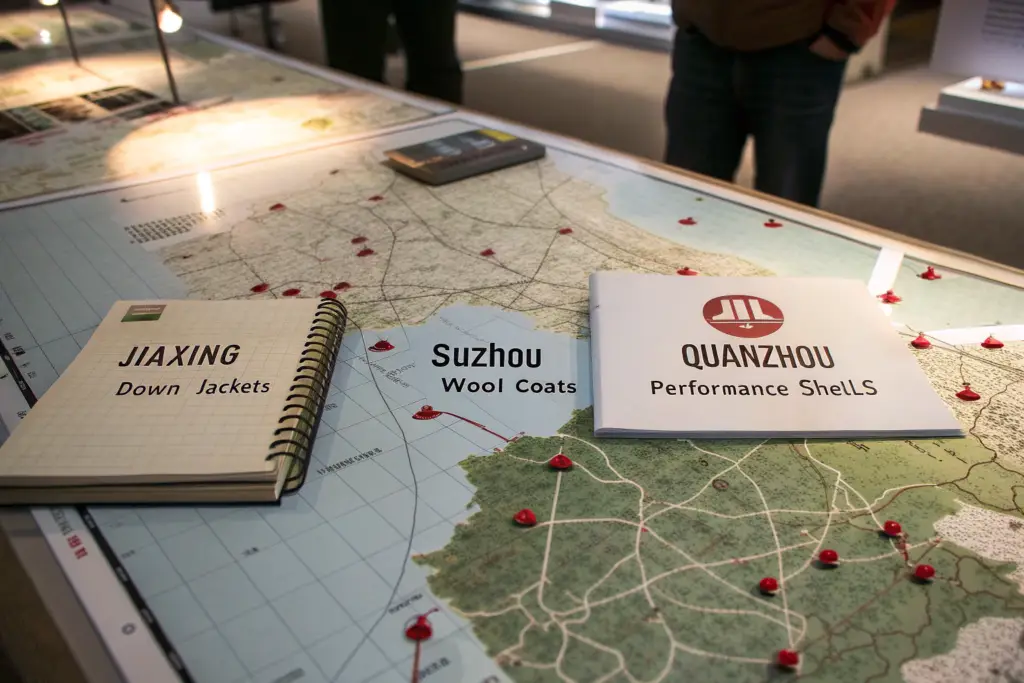
The specific regional manufacturing clusters for high-end winter outerwear in China are Jiaxing for down jackets, Suzhou for wool and cashmere coats, Quanzhou for technical performance shells and ski wear, and Xiamen for high-end waterproof breathable outerwear. Jiaxing, located in Zhejiang province, is the down capital of China. The city has hundreds of factories specializing in down filling, and the local supply chain includes down processors, feather washing facilities, and specialized fabric mills producing down-proof fabrics. Suzhou, in Jiangsu province, has a century-long history of wool and silk textile production. The factories here excel at tailored wool coats, cashmere blends, and formal outerwear construction. Quanzhou, in Fujian province, is the home of China’s sportswear and performance outerwear industry. Factories here have the seam-sealing and cold-chamber testing capabilities required for technical shells. You go to Jiaxing for down, Suzhou for wool, and Quanzhou for technical performance. The cluster dictates the factory’s capability.
The cluster strategy is the most efficient way to source outerwear. Instead of searching the entire country, you focus on the specific city that specializes in your product category. You visit multiple factories in the same industrial park. You compare their equipment, their material sourcing, and their pricing. The concentration of suppliers in one area creates competitive pressure that benefits the buyer.
Why Is Jiaxing the Undisputed Capital of Down Jacket Manufacturing in China?
Jiaxing has a complete down supply chain within a 30-kilometer radius. The city has down processing plants that wash, sterilize, and sort raw down into graded fills. It has fabric mills that produce specialized down-proof fabrics with calendered finishes that prevent feather leakage. It has factories with automated down-filling machines that can fill 5,000 jackets per day with precise weight control. It has a skilled workforce where sewing operators have decades of experience constructing down baffles and managing the unique handling requirements of slippery, lightweight shell fabrics. The cluster effect means that a factory in Jiaxing can source certified down, down-proof lining, and specialized zippers from suppliers they have worked with for 20 years. A factory in a non-down cluster would have to import these materials, adding cost, lead time, and quality risk. The Jiaxing down jacket industrial cluster is recognized globally by brands who understand supply chain density as a competitive advantage. If you are sourcing down jackets, you start your search in Jiaxing.
What Makes the Suzhou and Quanzhou Factories Superior for Wool Coats and Technical Shells Respectively?
Suzhou’s wool coat factories are descendants of the city’s silk embroidery and textile tradition. The region has a deep bench of skilled tailors who understand how to construct a structured shoulder, a rolled lapel, and a hand-felled lining. The local wool fabric mills produce high-twist worsted wools and cashmere blends that rival Italian and English mills in quality at a more accessible price point. A Suzhou factory can produce a fully canvassed wool overcoat with hand-stitched detailing. Quanzhou’s technical shell factories are built on the sportswear manufacturing infrastructure of Fujian province. These factories have the seam-taping machines, the ultrasonic welding equipment, and the cold-chamber testing facilities required for performance outerwear. They are accustomed to working with waterproof breathable membranes, laser-cut ventilation systems, and welded pocket constructions. A Suzhou factory will build a coat that looks beautiful at a formal dinner. A Quanzhou factory will build a shell that keeps you dry in a mountain storm. The regional specialization guide for Chinese garment manufacturing is a resource every serious outerwear brand should study.
What Quality Control Checkpoints Are Non-Negotiable During and After Bulk Outerwear Production?
A brand I work with now mandates a 100% lightbox inspection for every down jacket before it leaves the factory. They learned this after a batch of 500 jackets passed a standard AQL 2.5 random inspection and then generated a 12% return rate due to down leakage. The random inspection had missed the problem because the leakage was not uniform. Some jackets leaked. Some did not. The only way to catch every leaking jacket was to inspect every jacket. The factory pushed back. The brand held firm. The 100% inspection added $0.40 per unit to the production cost. The brand’s return rate for down leakage dropped from 12% to 0.3%. The $200 inspection cost saved thousands in returns and preserved the brand’s reputation. The lesson was clear: standard inspection protocols designed for general apparel are insufficient for outerwear.
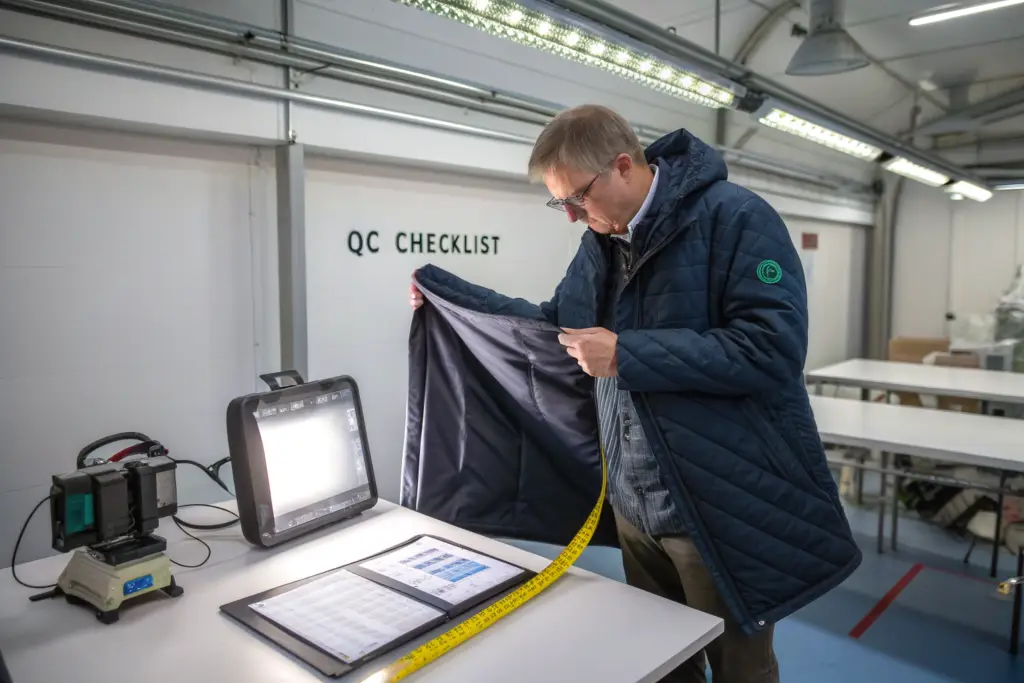
The non-negotiable quality control checkpoints for outerwear production are a 100% lightbox inspection for down leakage, a fill weight verification on a calibrated digital scale for a random sample of 10% of jackets, a waterproof spray test on every sealed seam for technical shells, and a zipper function test where every zipper is opened and closed ten times at the final inspection stage. These checkpoints are in addition to the standard AQL inspection for visual defects, measurements, and workmanship. Outerwear carries a higher customer expectation and a higher return cost than other garment categories. A customer who buys a $250 parka that leaks down or fails to block wind will return it, leave a negative review, and never buy from the brand again. The inspection cost is a fraction of the cost of a single return.
The inspection protocol must be written into the purchase order. The factory must agree to it before production begins. A factory that resists a 100% lightbox inspection is a factory that expects down leakage problems and does not want to pay for the rework. A factory that accepts the protocol confidently is a factory that knows its quality is good.
How Does a 100% Lightbox Inspection Catch the Microscopic Down Leakage That Ruins Retail Sales?
The lightbox is a backlit panel. The inspector places each finished jacket flat against the panel. Bright light shines through the shell fabric and the lining. If a feather quill has penetrated the lining, the light reveals it as a tiny dark spot. If a cluster of down is working its way through a seam, the light reveals the emerging cluster. The inspector marks the defect location with a small piece of tape. The jacket is sent to the repair station where the defect is fixed. The inspection catches leakage that is invisible under standard factory lighting. A jacket that passes the lightbox inspection will not leak down when the customer wears it. The lightbox inspection is standard practice in premium outerwear factories. A factory that does not have a lightbox, or claims their lighting is "bright enough," is not equipped for premium outerwear quality control. The lightbox inspection procedure for down garments is a documented quality control method. Your factory should know it and use it.
What Is the Correct In-Line Zipper Testing Protocol for Heavy-Duty Winter Parka Closures?
A parka zipper that fails in winter is a product failure. The customer cannot close their jacket. They are cold. They are angry. They return the jacket. The zipper testing protocol has three stages. Stage one is pre-production. The factory tests a sample of the specified zipper brand and size on a zipper test machine that opens and closes the zipper 1,000 times. The zipper must function smoothly with no tooth separation or slider failure. Stage two is in-line. The sewing operator checks every zipper after installation by running the slider up and down three times. If the zipper catches, skips teeth, or separates, the garment is flagged for repair. Stage three is final inspection. The QC inspector opens and closes every zipper on every jacket ten times at full speed. This simulates the wear the zipper will experience in the first season of use. A zipper that passes this protocol will function reliably for the life of the jacket. The protocol is simple. The discipline to execute it on every jacket is what separates premium factories from average ones.
Conclusion
Sourcing incredibly high quality winter jackets and outerwear directly from Chinese factories is a qualification process, not a purchase transaction. You do not find a factory by searching online and trusting a sales representative’s claims. You find a factory by identifying the correct regional manufacturing cluster for your product category, visiting the factory floor to verify their specialized equipment, writing material specifications that name specific brands and product codes with no substitution language, requiring third-party lab tests that validate insulation and membrane performance before bulk production, and enforcing outerwear-specific quality control protocols including 100% lightbox inspection for down leakage.
The Minneapolis parka disaster happened because a brand trusted a trading company’s verbal promises instead of verifying the factory’s equipment, the down’s fill power, and the lining’s down-proof rating. The disaster was preventable. Every outerwear quality failure I have seen in 15 years of manufacturing was preventable through a combination of factory qualification, material specification, and inspection discipline.
At Shanghai Fumao, we have invested in building relationships with specialized outerwear factories in Jiaxing, Suzhou, and Quanzhou. We connect our brand partners with the right factory for their specific outerwear category. We manage the material specification process, the third-party lab testing, and the quality control inspections. We do not produce outerwear in our own facility. We partner with the specialized factories that have the equipment and expertise our brand partners require, and we provide the sourcing management layer that ensures specifications are met and inspections are performed.
If you are ready to source outerwear for your brand, or if you have been burned by a previous outerwear sourcing experience and want to do it correctly this time, reach out to us. At Shanghai Fumao, we will help you identify the right manufacturing cluster for your product, develop a material specification that protects against substitution, and implement the quality control protocols that catch defects before they reach your customer. Contact our Business Director, Elaine, at elaine@fumaoclothing.com. She can share an outerwear sourcing checklist and connect you with the specialized factory partner that matches your product requirements. Your customers are buying your jackets to stay warm. Make sure the factory delivers what your brand promises.