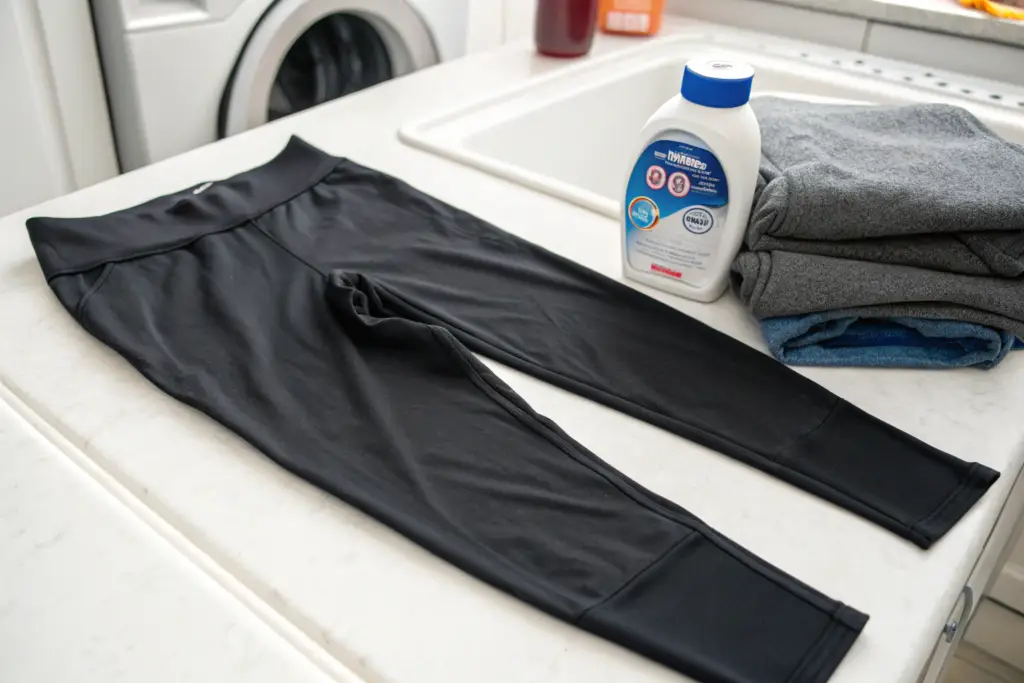
A performance activewear brand in San Diego placed a large order for premium leggings with a new supplier three years ago. The first shipment was perfect. The leggings had a firm, supportive, high-recovery stretch. The customers loved them. Six months later, the reviews turned vicious. "Waistband is completely blown out after two months." "Fabric is saggy and baggy, totally lost its shape." "I have to pull these up every five minutes." The return rate skyrocketed to 22%. The brand's customer service team was overwhelmed. The root cause was a silent, invisible material failure: the elastic in the waistband and the spandex in the fabric had undergone "elastic fatigue." The polymer chains had broken down under the repeated mechanical and chemical stress of home laundering. The supplier had used a cheap, low-grade, unprocessed elastic that was never designed to survive more than ten wash cycles. The brand learned a devastating lesson: the stretch that feels great on day one is a lie if it cannot survive the washing machine.
Shanghai Fumao's elastic stays stretchy after 50 washes because we use a dual-component, high-density elastic system: a high-tenacity, UV-stabilized spandex core that resists polymer chain degradation, encased in a tightly braided, alkali-resistant polyester sheath that physically protects the core from detergent chemicals, all validated through an in-house AATCC 135 50-cycle wash test with a 98% minimum stretch recovery requirement. Elastic is not a simple strip of rubber. It is a precision-engineered, composite textile component. Its longevity is determined at the molecular level, by the polymer chemistry of the core, and at the structural level, by the integrity of the protective sheath. Let me take you inside the polymer science, the protective braiding, and the brutal 50-cycle wash test that guarantees the elastic in your garment will not betray your customer after two months of normal wear and washing.
What Is Elastic Fatigue and Why Does Cheap Elastic Fail?
Elastic is not a permanent, unchanging material. It is a mechanical spring made of long-chain polymer molecules. When you stretch a piece of elastic, you are physically uncoiling these polymer chains. When you release it, the chains recoil back to their coiled, low-energy state. This is the molecular mechanism of stretch and recovery. Elastic fatigue is the progressive, irreversible loss of this recovery force. It is the slow death of the polymer spring.
Cheap elastic fails for two fundamental reasons: poor polymer chemistry in the core, and a cheap, unprotected construction that exposes that weak core to a hostile chemical environment. The core of a cheap elastic is made from a low-grade, low-density polyurethane or a synthetic rubber with minimal cross-linking. The polymer chains are short, loosely bonded, and contain unreacted chemical residues. The sheath is a loosely spun, low-twist polyester or nylon that does not physically contain the core when it is stretched. When this cheap elastic enters a washing machine, it is attacked on three fronts simultaneously: mechanical flexing, hot water hydrolysis, and alkaline detergent chemical attack. The polymer chains break, the core fragments, the sheath separates, and the elastic loses its spring. This is not a gradual decline; it is a catastrophic failure, often within 10 to 15 wash cycles.
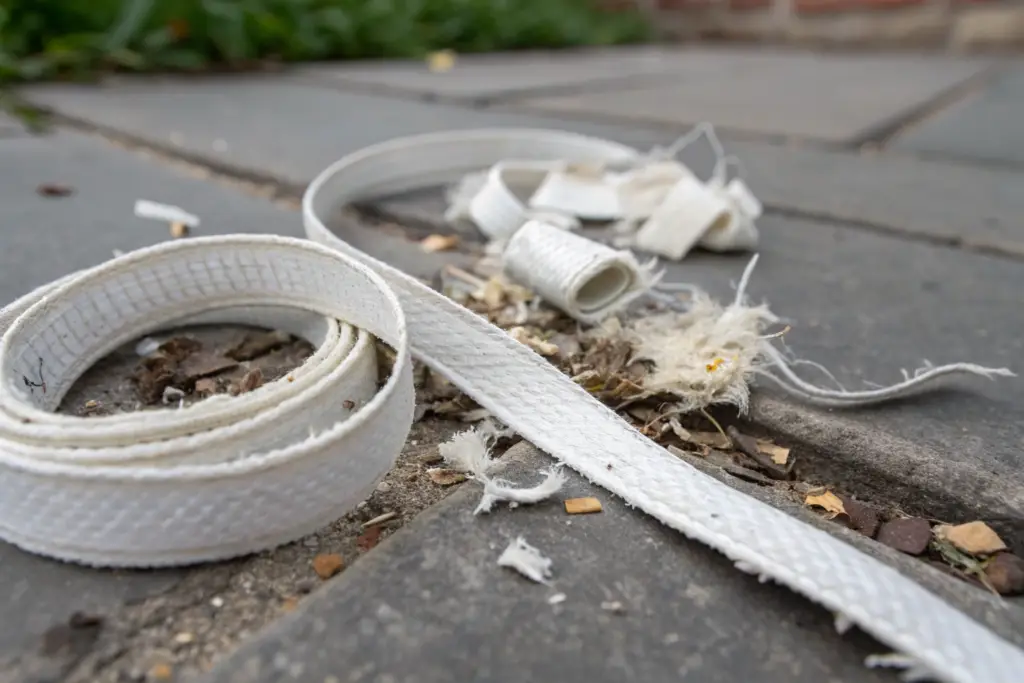
How Does a Substandard Rubber Core Disintegrate in a Washing Machine?
The core of a cheap elastic is typically made from a low-grade, lightly cross-linked polyurethane or a natural rubber latex compound with minimal stabilizers. The cross-linking is the chemical bridges between the long polymer chains. These bridges are what give the elastic its mechanical memory; they are the springs that pull the chains back to their original position. In a cheap elastic, the cross-link density is low. The chains are long, loosely connected, and vulnerable.
When this elastic enters a hot water wash cycle at 40 or 60 degrees Celsius, the water molecules attack the ester linkages in the polyurethane backbone. This is a chemical reaction called hydrolysis. The polymer chains are literally cut by water molecules. Simultaneously, the alkaline detergent, with a pH of 10 or 11, catalyzes this hydrolysis reaction and attacks the cross-link bridges directly. The mechanical flexing of the wash cycle stretches and relaxes the already-weakened chains thousands of times, causing physical fatigue cracking. The core begins to fragment into small, disconnected pieces. These fragments can no longer form a continuous, load-bearing spring. The elastic loses its retractive force. The garment's waistband sags, the cuff loses its grip, and the fabric bags out. This failure is not a manufacturing defect in the sewing; it is a fundamental, chemical and mechanical failure of the core polymer, and it is the direct result of using a material that was never engineered to survive a domestic washing machine.
Why Does a Loose Polyester Sheath Accelerate Core Decay?
The sheath of an elastic is the braided or knitted polyester or nylon cover that surrounds the rubber core. Its primary function is not decoration; it is mechanical protection. The sheath must be a tight, dense, tightly braided structure that physically contains the rubber core when it is stretched and prevents the external environment from directly attacking the core. A loose, cheap sheath does the opposite; it accelerates the core's decay.
When a loose sheath is stretched, the individual polyester yarns separate, creating large gaps that expose the rubber core directly to the wash water, the detergent, and the mechanical abrasion of the washing machine drum. The core is physically abraded against the drum holes and other garments. The alkaline detergent, now with direct access, chemically attacks the exposed core surface. Furthermore, a loose sheath does not provide mechanical constraint. When the core is stretched, it thins out. A tight sheath contains this thinning, limiting the maximum elongation and preventing the core from being over-stretched into its plastic deformation zone. A loose sheath allows the core to be stretched beyond its safe elastic limit, permanently deforming the polymer chains. The sheath is not just a cover; it is a structural exoskeleton. A poorly constructed sheath is a structural failure that condemns the core to a premature, multi-factorial death. This is why elastic quality is defined not just by the core material, but by the density and tightness of the braided sheath. The two components are a single, integrated system.
What Is Fumao's Dual-Component Elastic Construction?
Our elastic is not a commodity item purchased from a catalog. It is a custom-specified, dual-component, high-density elastic system that is engineered for our factory by a specialized elastic mill we have audited and partnered with for over a decade. The specification begins at the polymer chemistry level and extends through the braiding density, the heat-setting process, and the final finishing. Every parameter is specified, tested, and certified.
The system has two components: the core and the sheath. The core is a high-tenacity, UV-stabilized, fatigue-resistant spandex. We do not use natural rubber, which is vulnerable to ozone cracking and hydrolysis. We use a specific grade of spandex that is engineered for high-temperature, high-alkaline industrial and domestic laundering environments. The sheath is a high-density, tightly braided polyester with a minimum braid angle of 45 degrees and a minimum of 48 individual yarn carriers. This braid density is what creates the physical containment of the core. The polyester yarn is alkali-resistant, meaning it has been specifically treated to resist the hydrolytic degradation caused by standard laundry detergents. The core and the sheath are not separate components; they are heat-set together under precise tension and temperature to create a unified, integrated composite structure. The core bonds to the sheath, and the sheath mechanically locks the core.
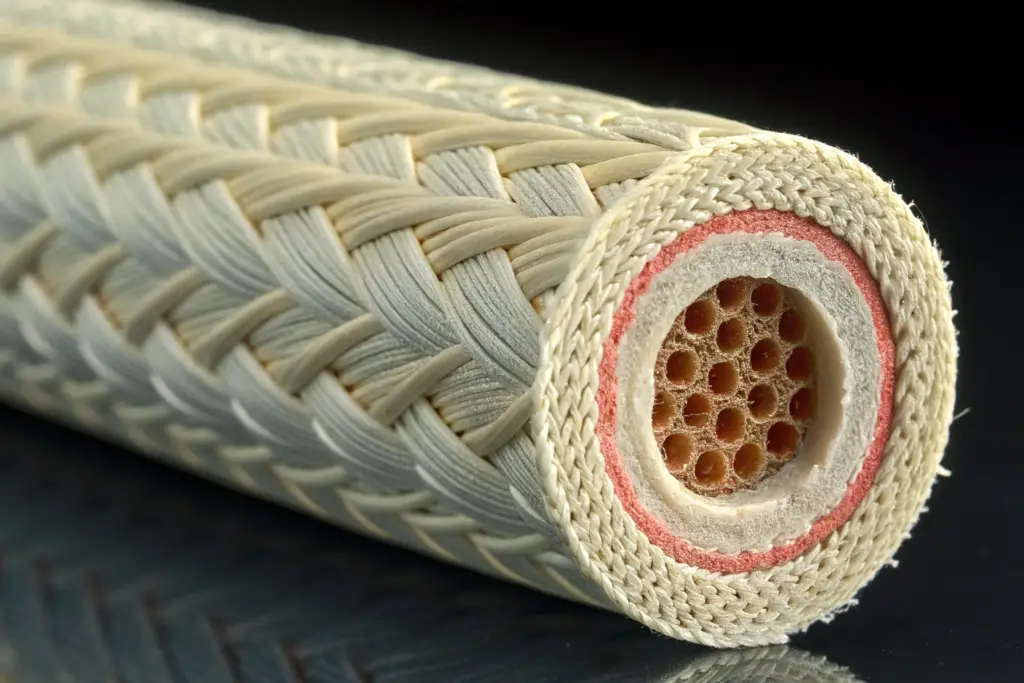
How Does a High-Tenacity Spandex Core Resist Polymer Chain Breakdown?
Spandex is a segmented polyurethane elastomer. It is composed of long, flexible "soft segments" that provide the stretch, and short, rigid "hard segments" that act as physical cross-links, holding the soft segments together. The molecular architecture of a premium, high-tenacity spandex is fundamentally different from a cheap, commodity spandex. The difference is in the length and uniformity of the soft segments and the density and strength of the hard segment domains.
Our specified spandex uses a high-molecular-weight polyether soft segment. Polyether-based spandex is inherently more resistant to hydrolysis than polyester-based spandex because the ether linkage is chemically more stable in hot, wet alkaline conditions than the ester linkage. The hard segments are based on a high-concentration aromatic diisocyanate, creating strong, dense, crystalline domains that act as robust physical cross-links. These hard segment domains are thermally stabilized during the fiber spinning process, meaning they have been heat-set to resist the relaxation and creep that occurs at washing machine temperatures. The result is a spandex fiber that has a significantly higher "stress decay" resistance. Stress decay is the laboratory measure of how much retractive force a stretched fiber loses over time under a constant extension. Our high-tenacity spandex exhibits a stress decay of less than 8% after 50 simulated wash cycles, compared to a stress decay of 25% to 40% for a standard, unstabilized commodity spandex. The polymer chains are longer, more uniform, and chemically more stable. They do not break down in the washing machine because they were designed at the molecular level not to.
Why Does a 48-Carrier Polyester Braid Protect the Core?
The number of carriers on a braiding machine determines the density of the braided sheath. A carrier is an individual spool of yarn that is woven into the braid. A higher number of carriers means more individual yarns are interwoven, creating a tighter, denser, more uniform braid structure. A typical cheap elastic might use a 16-carrier or 24-carrier braid. Our specification is a minimum of 48 carriers.
A 48-carrier braid has twice the yarn density of a 24-carrier braid. When this elastic is stretched to its maximum working elongation, the 48 individual yarns are drawn tightly together, closing any gaps between them. The core is completely encapsulated. The wash water and detergent cannot penetrate the braid to directly attack the core. The tight braid also provides a uniform, smooth surface that has low friction against the garment fabric, reducing the mechanical abrasion that can cause the elastic to wear through the casing fabric. Critically, the 48-carrier braid provides superior mechanical constraint. It limits the maximum elongation of the core, preventing it from being overstretched into its plastic deformation zone. It acts as a structural exoskeleton, sharing the tensile load with the core and distributing the stress evenly across the entire elastic cross-section. The core is not allowed to stretch to failure because the braid physically restrains it. This is the mechanical secret of a long-life elastic: the braid is not just a cover; it is a load-sharing, core-protecting, chemically shielding structural component.
How Do We Certify the 50-Wash Stretch Recovery?
A verbal claim of "50-wash durability" is marketing vapor. A certified 50-wash stretch recovery claim is a physical, measured, and auditable material property. The difference is a standardized, internationally recognized laboratory test protocol and an independent, third-party test report. We do not estimate the durability of our elastic. We physically wash it 50 times in a calibrated, industrial washing machine, and then we measure its retractive force on a calibrated tensile testing machine, comparing the result to the unwashed, original elastic. The data is the proof.
Our certification protocol follows the AATCC 135 dimensional change test standard, adapted for elastic recovery. The sample is subjected to 50 complete wash-and-dry cycles, using a standardized alkaline detergent and a 40-degree Celsius wash temperature, followed by a tumble dry at 60 degrees Celsius. This is a brutal, accelerated simulation of one to two years of normal consumer home laundering, compressed into a controlled, repeatable laboratory procedure. The test is performed on a random sample of elastic taken from the actual bulk production batch used in your order, not a pre-selected, hand-picked specimen.
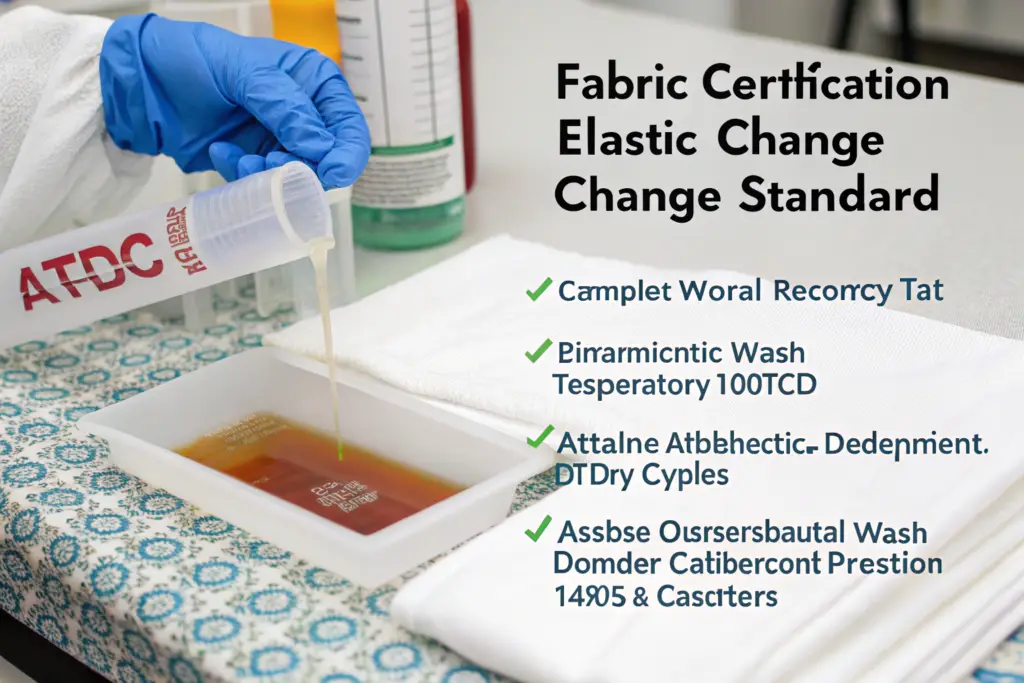
What Happens During an AATCC 135 50-Cycle Elastic Recovery Test?
The AATCC 135 test is the global standard for evaluating the dimensional stability of textiles to home laundering. For our elastic recovery test, we follow the washing and drying procedure of AATCC 135, and then apply a specific elastic stretch recovery measurement based on the ASTM D4964 standard for elastic fabrics. The test is a destructive, accelerated aging process.
A precisely measured, marked sample of our elastic is sewn into a standardized, ballast fabric loading. This simulates the elastic being inside a garment. The sample is placed in a calibrated, front-loading washing machine with a standardized, AATCC-specified alkaline detergent and a full ballast load of cotton sheeting. The machine runs a complete normal wash cycle at 40 degrees Celsius. The sample is then tumble-dried at 60 degrees Celsius. This is one cycle. The sample undergoes 50 complete cycles. After the 50th cycle, the sample is removed, conditioned in a standard atmosphere for 24 hours, and then tested on the Instron tensile testing machine. The sample is stretched to a specified percentage of its original length, typically 80% of its maximum elongation, and held for a specified time. The load is released, and the sample is allowed to recover. The recovery percentage is the ratio of the recovered length to the original length. A 98% recovery means the elastic has returned to 98% of its original, unwashed length and retains 98% of its original retractive force. This is the objective, numerical proof of the "stays stretchy" claim.
How Can a Brand Read an SGS Elastic Fatigue Test Report?
We commission an independent, third-party elastic fatigue test report from SGS or Intertek for every new elastic quality we introduce and for every major bulk production run. This report is not a marketing document; it is a detailed, technical, auditable laboratory report. A brand owner who understands how to read this report holds the objective proof of their product's quality.
The report contains six critical data fields. First, the sample identification, including the elastic lot number, which must match the lot number on your bulk production invoice. Second, the test standard used, which will be listed as "AATCC 135 / ASTM D4964." Third, the number of wash cycles, which will be "50." Fourth, the stretch recovery percentage. This is the key number. It must be a minimum of 98%. Fifth, the load decay percentage. This measures how much of the original retractive force was lost. A lower number is better. Sixth, a clear pass/fail statement against the specified standard. The report will be signed and stamped by the laboratory's authorized signatory. This report is your objective, legal-grade evidence that the elastic in your garment has been independently tested and proven to survive 50 wash cycles with near-perfect recovery. It is the document that backs up your marketing claims and protects you from a customer complaint that escalates to a legal or retail compliance challenge.
Conclusion
The stretch that feels great on day one is a cheap illusion if it cannot survive the washing machine. Elastic fatigue is a molecular death, caused by cheap polymer chemistry and a loose, unprotected construction. We defeat it at the material and structural level. Our dual-component elastic system uses a high-tenacity, polyether-based spandex core that is chemically resistant to the hot, alkaline hydrolysis of a washing machine. This core is encased in a 48-carrier, high-density, alkali-resistant polyester braid that physically shields the core from chemical attack, mechanically constrains it from overstretching, and shares the tensile load as an integrated structural exoskeleton. This system is validated through a brutal, 50-cycle AATCC 135 wash test, followed by an ASTM D4964 recovery measurement on an Instron tensile tester, with a 98% minimum recovery requirement. The result is independently certified by SGS or Intertek, and the test report is your objective, auditable proof that the elastic will not betray your customer after two months of wear.
At Shanghai Fumao, the elastic in your waistbands, cuffs, and compression panels is not a commodity trim. It is a specified, engineered, and certified material system. We test it so your customer never has to suffer a sagging waistband or a baggy cuff.
If you are a U.S. brand owner ready to build a performance or everyday garment with elastic that is certified to survive 50 washes with near-perfect recovery, we can send you a sample garment and the full, independent SGS elastic fatigue test report for your review. Contact our Business Director, Elaine, at elaine@fumaoclothing.com. Tell her you want the 50-wash elastic certification package. Let's put our elastic in your hands, stretch it, and show you the data that proves it will snap back, wash after wash, for the life of the garment.