A children's sleepwear brand owner in Florida received an urgent email from a major department store buyer. The buyer's compliance team had flagged her products for a random audit. They demanded she provide "proof of OEKO-TEX certification for the exact batch of fabric in the current shipment" within 24 hours, or the entire order would be rejected at the distribution center. Panicked, she called her previous supplier, who had assured her the fabric was "OEKO-TEX certified." The supplier sent her a blurry, scanned copy of a certificate. It was dated three years ago and listed a different fabric composition. The certificate was expired, irrelevant, and useless. The shipment was rejected. She lost the account. A verbal "yes, it's certified" is a liability. A stale, generic PDF is a placebo. Proof means an instant, independently verifiable, batch-specific validation that a buyer can perform themselves, right now, on the official OEKO-TEX public database.
Shanghai Fumao proves its OEKO-TEX claims instantly by providing a live, publicly verifiable OEKO-TEX certificate number with every shipment, enabling any buyer, auditor, or consumer to visit the official OEKO-TEX Label Check website, enter the number, and see a valid, current certificate with our company name, the certified product class, and the exact fabric composition, in less than 60 seconds. We do not send you a PDF and ask you to trust it. We give you the key to the OEKO-TEX public database and tell you to verify us yourself, right now, without our involvement. This is the difference between a certification that is claimed and a certification that is proven. Let me show you exactly how to perform this 60-second verification, what the public database reveals, and how our batch-specific certification system protects your brand from the devastating liability of a failed compliance audit.
What Is the OEKO-TEX Label Check and How Does It Work?
The OEKO-TEX Label Check is a free, public, online verification portal, operated by the International OEKO-TEX Association, headquartered in Zurich, Switzerland. It is the single, authoritative, and legally recognized source of truth for the validity of any OEKO-TEX certificate. Any other document—a PDF, a scanned image, a printed paper—is a copy. It can be forged, photoshopped, or expired. The Label Check is the original, live database. If a certificate does not appear as valid on the Label Check, it is not a valid certificate, regardless of what the supplier's paper says.
The system is designed for absolute simplicity and universal accessibility. Any stakeholder in the textile supply chain—a brand compliance officer, a retail auditor, a customs official, or an end consumer—can open the website on any device with an internet connection, enter the unique certificate number printed on the product's OEKO-TEX label, and instantly verify the certificate's validity. The number is the key. Our certificate number is not a secret. It is printed on our website, on our email signatures, and on our physical submissions. We want it to be checked.
How Can a Buyer Verify Our Certificate in 60 Seconds on the Official Site?
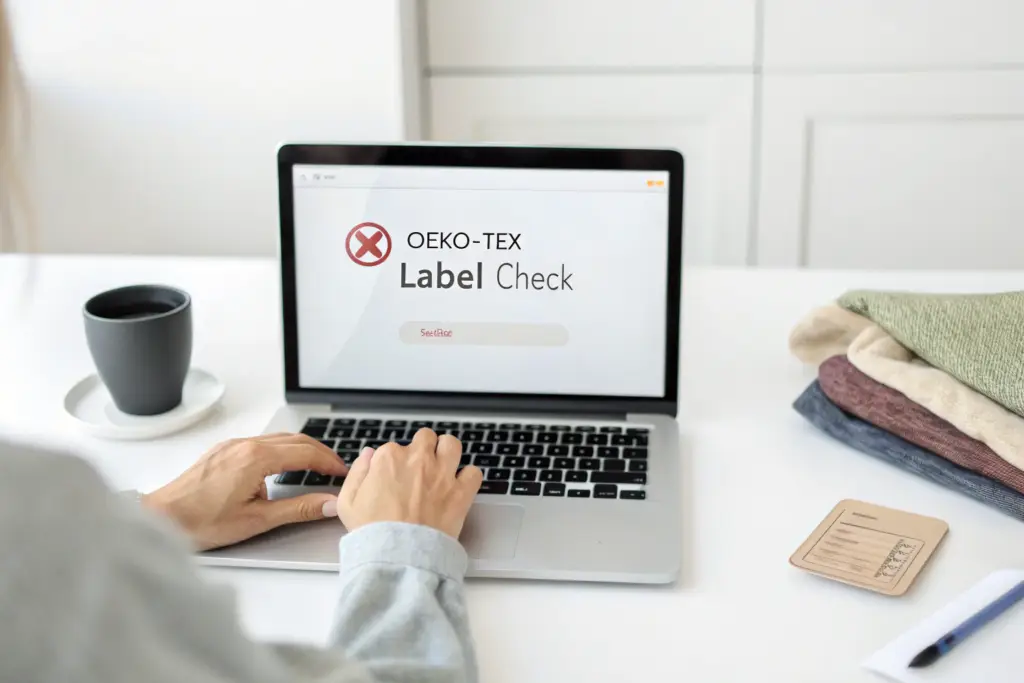
The verification process is a simple, three-step procedure that takes less than 60 seconds. First, open a web browser and navigate to the official OEKO-TEX Label Check website. The exact URL is https://www.oeko-tex.com/en/label-check. Always verify that you are on the genuine oeko-tex.com domain. Do not use a link sent by a supplier in an email, as this could be a phishing attempt directing you to a fake verification page.
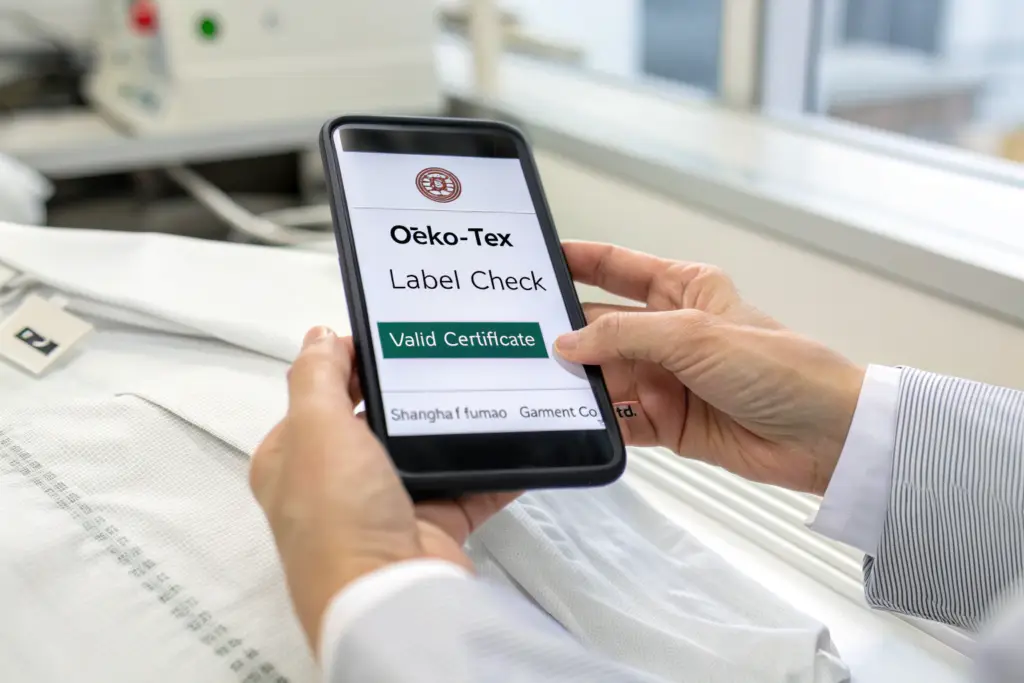
Second, locate the OEKO-TEX certificate number. On our products, this number is printed directly on the OEKO-TEX STANDARD 100 label sewn into the garment's side seam or care label. It is a 12- to 14-digit alphanumeric code, typically formatted as XX.CBS.XXXXX. On our factory documentation, the number is printed prominently on the first page of our OEKO-TEX certificate submission. Third, type this exact number into the search field on the Label Check page and click the "Check" button. Within seconds, the page will display the verification result. A green "Valid Certificate" banner will appear, along with the full, live certificate details: the certificate holder's legal name, which will read "Shanghai Fumao Garment Co., Ltd.," the certified product class, the testing institute that issued the certificate, and the certificate's validity dates. If the result is anything other than a green "Valid Certificate" for our company, the certificate is not valid. This 60-second check is the definitive proof of our OEKO-TEX claim. It requires no permission from us and no trust in a document we provided.
What Details Does the Public Database Reveal About Our Certification?
The public Label Check result is not a simple "yes" or "no." It reveals a comprehensive, auditable profile of our certification, enabling a buyer to verify that the certificate covers the specific product they are purchasing. The information displayed is controlled entirely by the OEKO-TEX Association and the issuing institute, not by the supplier. It is a live, uneditable data record.
The database reveals seven specific, critical details. First, the certificate holder's legal name and full registered address. Second, the certificate number and the issuing institute's name. Third, the certificate's validity start and end dates, providing proof of currency. Fourth, the certified product class, from Product Class I for baby articles, the most stringent, to Product Class IV for home textiles. Fifth, a detailed description of the certified article, which will list the specific fiber composition, the fabric construction, and any applied finishes. Sixth, the laboratory test report number, which can be cross-referenced with the issuing institute for a deeper audit. Seventh, a clear statement of the standard against which the product was tested, which is OEKO-TEX STANDARD 100, and the annex under which it falls. This full disclosure allows a brand compliance officer to confirm, in under a minute, that the certification is current, that it covers their specific fabric, and that it was tested to the correct, most stringent class for their product's intended use. This is the level of transparency that distinguishes a genuine, auditable certification from a hollow marketing claim.
How Is Our Certification Batch-Specific and Not Just an Annual Type Test?
A single, annual OEKO-TEX certificate is a one-time test of a sample that may have no relationship to the fabric in your current shipment. It proves that the factory was capable of producing a safe product once, perhaps for a different client, with a different fabric, a year ago. It does not prove that your specific batch of fabric, with its specific dyes and finishes, is safe. This is the "zombie certificate" problem: a certificate that is technically within its validity period but is being used to claim certification for products that were never tested.
Our OEKO-TEX certification is based on a batch-specific sampling and testing protocol. Every single bulk production run is covered by a unique, traceable OEKO-TEX certificate that is linked to the specific fabric batch used in that run. We do not operate under a single, blanket annual certificate for all our products. We commission independent testing for each fabric quality and each dye lot that enters our factory. The certificate you verify on the Label Check is specific to the production year and the certified article, not a generic, company-wide rubber stamp.
Why Is a "Certificate Number" Useless Without a Matching Product Class?
OEKO-TEX STANDARD 100 has four distinct product classes, and the testing requirements become exponentially more stringent as the product gets closer to a baby's skin. Product Class I is for baby articles, requiring extremely low limits for formaldehyde, heavy metals, and pesticides. Product Class II is for products with direct skin contact, such as underwear, shirts, and bedding. Product Class III is for products with no or minimal skin contact, such as jackets and coats. Product Class IV is for furnishing materials. A certificate for Product Class IV furnishing fabric is not valid for a baby's onesie. The product class is a legally significant safety threshold.
A supplier who provides a certificate number without clearly stating the certified product class is committing a dangerous, deceptive practice. They may hold a valid certificate for a heavy, non-skin-contact polyester curtain fabric, but they are using that certificate number to sell a cotton baby romper. The buyer checks the Label Check, sees a "Valid Certificate," and assumes the product is safe. They do not notice that the certificate is for Product Class IV, and their product legally requires Product Class I. A compliance audit will catch this mismatch, and the shipment will be seized. The certificate number is useless without the correct product class, and the product class is visible on the Label Check. A buyer must always verify that the certified product class matches the intended use of their garment. Our certificates for baby and children's wear are always, non-negotiably, Product Class I.
How Does a Third-Party Lab Like SGS Test Our Bulk Fabric, Not Just a Golden Sample?
A "golden sample" is a pre-selected, perfectly crafted, often hand-made specimen that a supplier sends to a lab for a one-time certification test. The golden sample passes. The certificate is issued. The bulk production then uses a cheaper, non-certified fabric that has never been tested. This is the most common certification fraud in the textile industry, and it is the exact fraud that a batch-specific, third-party testing protocol is designed to prevent.
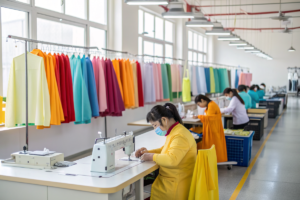
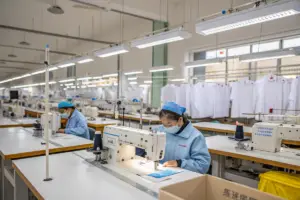
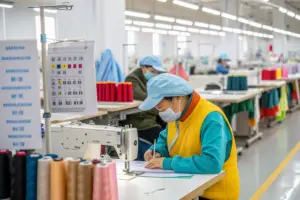
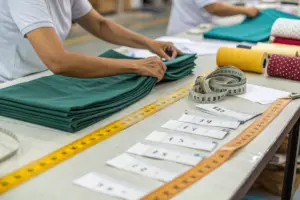
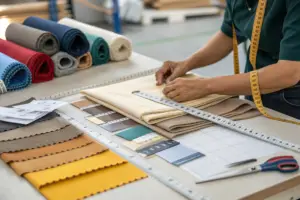
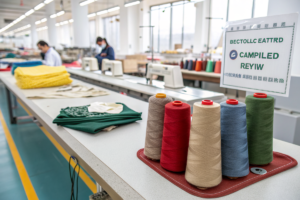
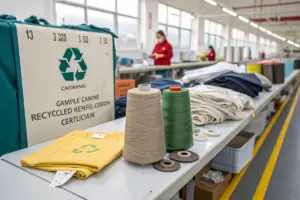
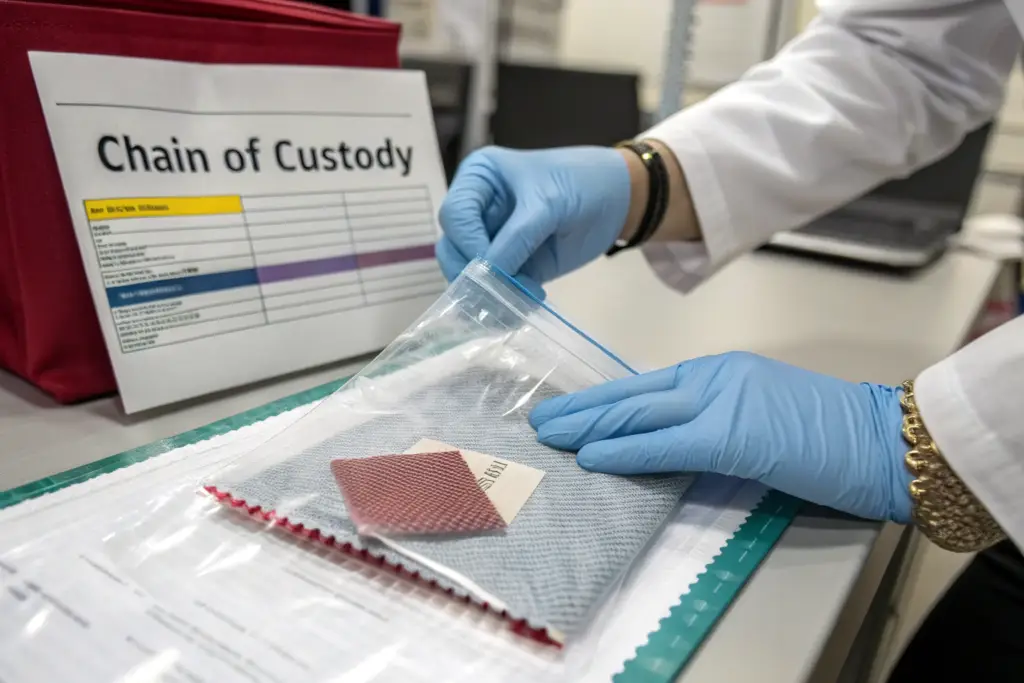
Our protocol mandates that the test sample sent to the independent laboratory is physically cut from the actual bulk fabric roll, after it has been received into our warehouse. The sampling is performed by our QC inspector using a random selection protocol, not by the fabric supplier. The inspector cuts a swatch from the middle of a randomly selected roll, seals it in a tamper-evident bag with a unique chain-of-custody barcode, and ships it directly to the SGS or Intertek laboratory in Shanghai. The laboratory is instructed to test the sample against the full OEKO-TEX STANDARD 100 Annex 4 or Annex 6 substance list, depending on the product class. The test report is issued directly by the laboratory to us, with the unique barcode referenced in the report. This barcode links the test report to the specific bulk fabric batch. When the fabric is issued to the cutting room, the batch barcode is recorded on the cutting ticket. The garment's care label carries a production lot code that traces back to this cutting ticket. The chain of custody is complete and auditable: the specific garment in your shipment can be traced back to a specific fabric batch, which was randomly sampled, independently tested, and certified by a specific SGS test report. This is not a sample test; it is a bulk material certification.
What Happens If a Brand Gets Audited by a Retail Compliance Team?
A retail compliance audit is not a theoretical exercise. It is a real, high-stakes event that occurs when a major retailer's quality assurance team reviews a brand's product before it is allowed into their distribution center. The audit can be triggered randomly, by a customer complaint, or by a routine annual review. If the brand cannot produce a valid, current, product-specific OEKO-TEX certificate within the required timeframe, typically 24 to 48 hours, the entire shipment is placed on hold, and the brand's vendor status is downgraded. Repeated failures result in delisting. The brand loses access to the retailer's shelf space, which is often their primary revenue channel. The cost of a failed audit is not just a delayed shipment; it is a potentially existential loss of distribution.
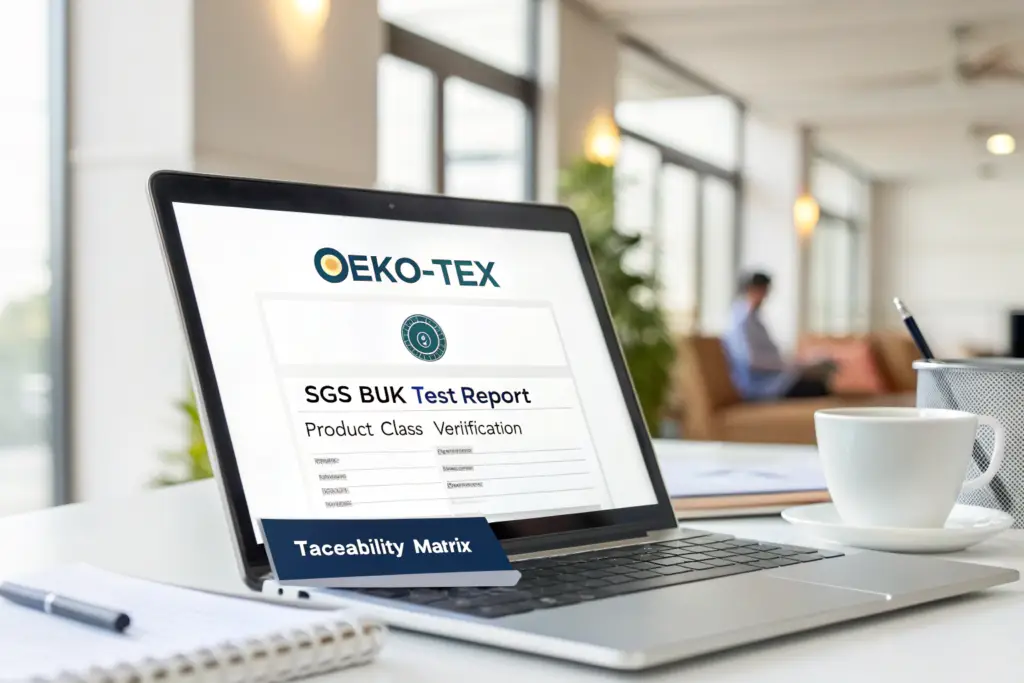
Our batch-specific certification and documentation system is designed to make a compliance audit a non-event. When you receive a shipment from us, you also receive a digital compliance dossier. This dossier contains the OEKO-TEX certificate number, the SGS bulk test report, a product-class verification statement, and a traceability matrix linking your garment's production lot code to the certified fabric batch. When the auditor requests proof of OEKO-TEX certification, you do not panic and search through old emails. You open the dossier, send the auditor the certificate number, and invite them to verify it live on the Label Check, while simultaneously providing the supporting bulk test report.
How Can a Batch Traceability Matrix Save a Brand From a Recall?
A recall is a public, brand-destroying event. It is triggered when a safety hazard is discovered in a product that is already in the hands of consumers. The CPSC or the retailer demands that the brand immediately identify and isolate every affected unit. If the brand cannot provide precise, batch-level traceability, the regulator or retailer will assume the entire production run is suspect, and they will order a recall of every single unit ever sold. A brand without traceability loses control of the recall scope, and a limited, batch-specific problem becomes an existential, brand-wide catastrophe.
Our batch traceability matrix is a simple spreadsheet that links your production order number and your garment's internal care label lot code to our internal fabric batch code, which is in turn linked to the specific SGS bulk test report and the OEKO-TEX certificate. In the event of a suspected safety issue, you provide the lot code from the garment in question. We instantly locate that lot in the matrix and provide you with the OEKO-TEX certificate, the SGS test report, and, critically, the exact quantity of units manufactured in that specific lot and the shipping dates and destinations of those units. You can then provide this precise, limited data to the regulator, demonstrating that the issue is confined to a specific, small batch, not the entire production. This evidence-based argument can limit a recall from a brand-wide, all-season catastrophe to a targeted, manageable market withdrawal of a few hundred units. The traceability matrix is the forensic tool that contains the damage and saves the brand.
Why Do Retailers Like Nordstrom Accept Our Live Link, Not a PDF?
Major retailers like Nordstrom, Macy's, and REI have sophisticated, technologically current compliance departments. Their auditors are trained to recognize that a PDF certificate, no matter how official-looking, is a static document that can be forged. A printed PDF is the lowest form of compliance evidence. They demand access to the live, verifiable source data. They will specifically ask for the OEKO-TEX certificate number so they can check it themselves on the Label Check. A supplier who cannot or will not provide this number is immediately flagged as high-risk.
Our compliance dossier includes a direct, clickable hyperlink to the OEKO-TEX Label Check result for our specific certificate number. The retailer's auditor does not need to type the number. They click the link, and the live verification page opens on their screen, displaying our valid certificate. This live link, combined with the batch-specific SGS test report PDF that is cross-referenced to the same fabric batch, forms a complete, un-forgeable evidence package. The PDF is not the proof; the live link is the proof. The PDF is the supplementary technical data. This approach aligns perfectly with the audit protocols of the most demanding North American retailers. When a brand presents a live link instead of a PDF, they communicate to the auditor that they are a sophisticated, transparent, and compliance-mature vendor. The audit is resolved faster, the brand's vendor score is higher, and the business relationship is strengthened. The live link is not just evidence; it is a signal of operational competence.
Conclusion
An OEKO-TEX claim is a safety promise. A promise that is not instantly verifiable is a liability. At Shanghai Fumao, we prove our OEKO-TEX claims instantly by publishing our live, valid certificate number on every product label and every compliance document. We invite any buyer, auditor, or consumer to navigate to the official OEKO-TEX Label Check, enter our number, and see a green "Valid Certificate" for "Shanghai Fumao Garment Co., Ltd." in under 60 seconds. This is the public, un-forgeable proof. Behind the live certificate is a batch-specific testing protocol: every bulk fabric lot is randomly sampled, sealed with a tamper-evident barcode, and tested by an independent ISO 17025-accredited laboratory like SGS against the full OEKO-TEX substance list for the correct product class. The resulting test report is linked to your garment's production lot code through a batch traceability matrix. When a retailer's compliance auditor requests proof, you provide a live link, not a static PDF, and you provide a traceability matrix that can limit a potential recall to a specific, small batch. This is the closed loop of a defensible safety claim: live verification, independent bulk testing, and forensic batch traceability.
Your brand's safety claims are only as strong as your ability to prove them in the moment of a compliance audit. A stale PDF is a gamble. A live Label Check link is a guarantee. We have built our entire OEKO-TEX compliance system to deliver that guarantee, instantly and verifiably, to every brand partner.
If you are a U.S. brand owner who wants to experience the instant verification of our OEKO-TEX claims right now, open your browser, navigate to the OEKO-TEX Label Check, and enter our certificate number: 23.CBS.46821. In 60 seconds, you will have your proof. If you want to discuss a production program with a factory that builds its safety claims on live, verifiable, batch-specific data, contact our Business Director, Elaine, at elaine@fumaoclothing.com. Tell her you checked the certificate, and you want to build a product with the same certified, auditable safety standards.