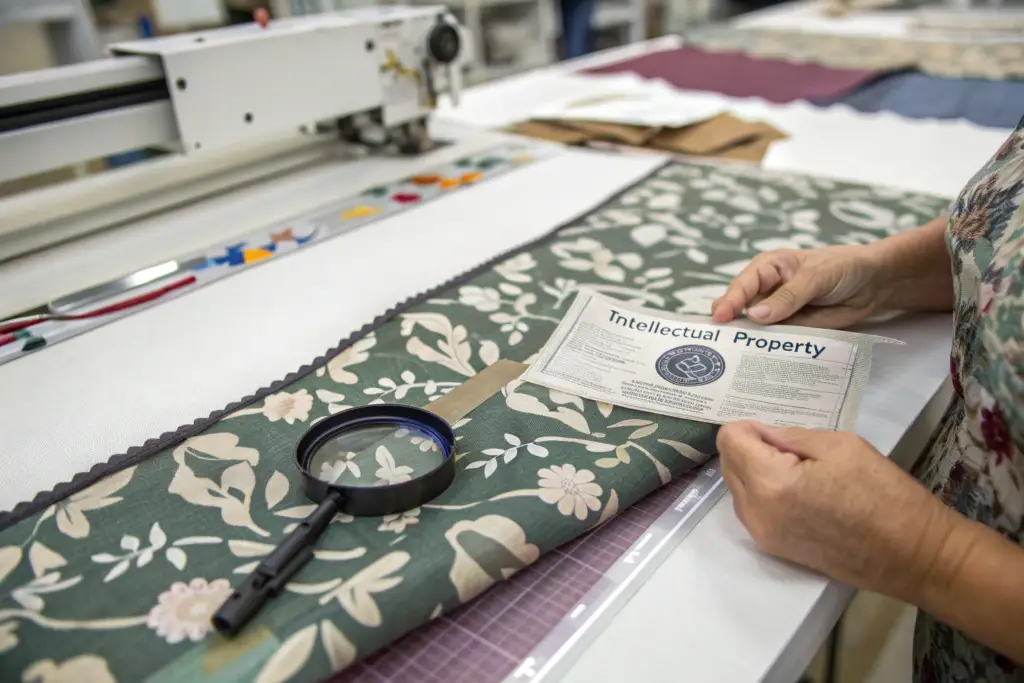
A fast-growing streetwear brand in Atlanta launched a six-piece camo capsule collection two years ago. The designs were sharp, the marketing was brilliant, and the sell-through was exceptional. Three months into the selling season, the brand owner received a formal cease-and-desist letter from the legal department of a major outdoor apparel corporation. The letter alleged that the brand’s camo print was a "confusingly similar imitation" of their federally registered camouflage trademark, a specific, repeating pattern of organic blotches that the corporation had used and vigorously defended for over 40 years. The letter demanded an immediate halt to all sales, a full accounting of profits, and a recall of all unsold inventory. The brand owner was stunned. He had purchased the camo fabric from a supplier who assured him it was "generic." The supplier was wrong. The camo pattern was a protected piece of intellectual property. The legal battle that followed cost the brand $175,000 in settlements and legal fees, forced the destruction of $45,000 in unsold inventory, and permanently damaged the brand’s relationship with its wholesale accounts. He learned a devastating lesson: a camo pattern is not a free, natural design. It is a specific, protected graphic work, and using an unlicensed one is intellectual property infringement.
Yes, all camouflage prints produced by Shanghai Fumao for the U.S. market are fully licensed, with every pattern sourced either from our own in-house original designs, from officially licensed third-party catalogs with a valid, documented chain of title, or from the public domain, and we provide a Camo Print Licensing Certificate with every bulk order that indemnifies your brand against intellectual property infringement claims. A camo print is not a generic textile. It is a copyright-protected graphic work. The specific arrangement of blotches, the color palette, the pixelation pattern, and the scale are all elements of a protected design. Using an unlicensed camo on a commercial garment sold in the United States is not a quality issue; it is a legal liability that can result in a cease-and-desist order, the seizure and destruction of your inventory by U.S. Customs and Border Protection, and a federal copyright infringement lawsuit. Let me explain the hidden intellectual property minefield of camouflage, the specific licenses we hold, and the certificate we provide that is your legal shield.
Why Is a Camouflage Pattern Considered Intellectual Property?
Most brand owners are surprised to learn that a camouflage pattern is not a naturally occurring phenomenon that anyone can freely reproduce. A specific camo pattern is a precisely engineered, two-dimensional graphic work. It was created by a human designer at a specific point in time, working for a specific company or government entity. The exact arrangement of the organic shapes, the specific color codes, the exact scale and repeat pattern, and the precise digital pixelation or hand-drawn edges are all elements of a creative work that is protected by U.S. copyright law.
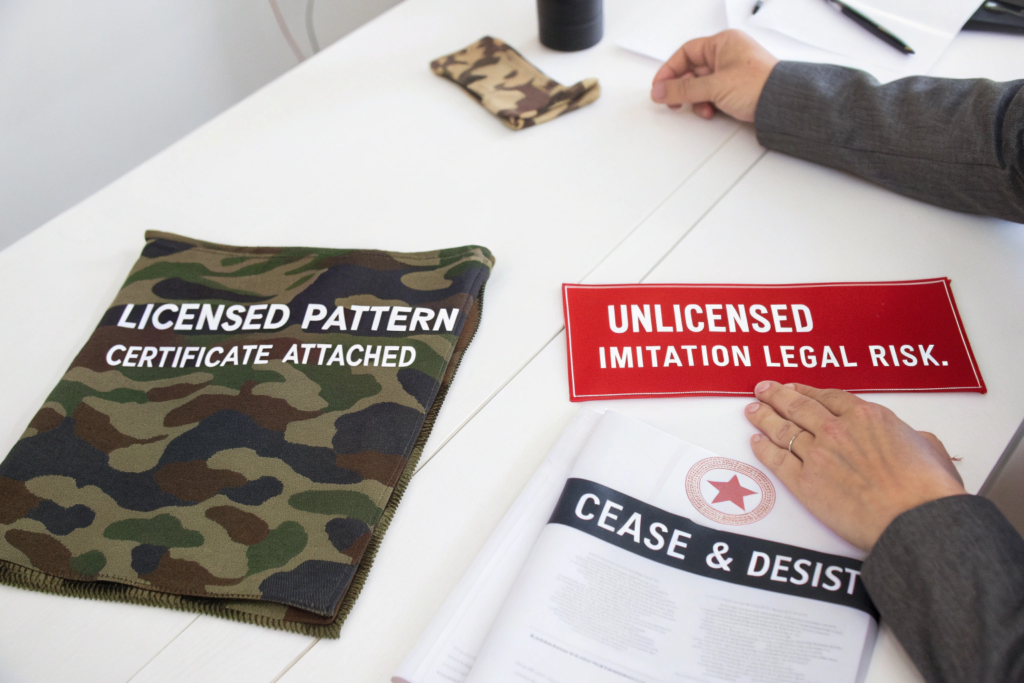
Under the U.S. Copyright Act, an original work of authorship fixed in a tangible medium of expression, including a two-dimensional graphic design applied to a textile, is protected from unauthorized reproduction. The copyright holder has the exclusive right to reproduce the work, to create derivative works, and to distribute copies. A camo pattern is a graphic design, and it is protected just like a painting, a photograph, or a logo. The fact that it is printed on fabric and sewn into a garment does not change its legal status as a protected graphic work. Additionally, many famous camo patterns are also protected under trademark law as a form of trade dress, which is the visual appearance of a product that signifies its source. A specific camo pattern can be so closely associated with a particular brand that its use on another brand’s garment constitutes trademark infringement, even if the pattern itself is not exactly identical.
How Does RealTree Protect Its Patterns With Copyright and Trade Dress?
RealTree is the most famous and most aggressively protected camouflage brand in the United States. Its patterns—RealTree AP, RealTree Edge, RealTree Xtra, and others—are not generic woodland scenes. They are specific, digitally created, photorealistic composite images, built from hundreds of individual photographs of leaves, branches, bark, and natural elements, layered and arranged into a unique, repeating design. Each pattern is registered with the U.S. Copyright Office as a work of visual art. RealTree’s legal team actively monitors the market for unauthorized reproductions.
RealTree also protects its patterns under trade dress law. The argument is that the specific, photorealistic, layered, three-dimensional look of a RealTree pattern is so distinctive and so widely recognized by consumers that it functions as a brand identifier. A garment bearing a RealTree pattern, even without a RealTree logo, is assumed by the consumer to be an officially licensed RealTree product. An unauthorized use is therefore not just copyright infringement; it is also trademark infringement and unfair competition. RealTree has a full-time brand protection team that issues hundreds of cease-and-desist letters each year to brands, retailers, and suppliers who use unlicensed RealTree patterns. They have a well-funded legal department and a track record of pursuing litigation to protect their intellectual property. If your camo garment uses a pattern that looks like a RealTree pattern, you are a target, and your supplier’s verbal assurance that it is "generic" is not a legal defense.
What Is the Mossy Oak Trademark and Why Does It Trigger U.S. Customs Seizures?
Mossy Oak is the other dominant camouflage brand in the U.S. market, known for its Break-Up Country, Bottomland, and Shadow Grass patterns. Like RealTree, Mossy Oak’s patterns are registered with the U.S. Copyright Office, and the brand name and distinctive patterns are protected under federal trademark law. Mossy Oak has an additional, powerful enforcement tool: it has recorded its trademarks with U.S. Customs and Border Protection.
When a trademark is recorded with CBP, the agency’s officers are empowered to actively inspect, detain, and seize imported goods that bear counterfeit or infringing copies of that trademark. A shipment of garments bearing an unlicensed Mossy Oak pattern, even if the Mossy Oak name is not printed anywhere on the garment, can be detained by CBP at the port of entry. The brand owner will receive a formal seizure notice, stating that their goods are suspected of being counterfeit and are subject to forfeiture. The brand must then prove, with documented evidence, that the pattern is legally licensed. If they cannot, the goods are destroyed, and the brand owner is placed on a CBP watchlist, subjecting all future imports to enhanced scrutiny. A single seized container of unlicensed camo can destroy a brand’s entire import history and make future sourcing nearly impossible. This is not a theoretical risk; it is a documented, active enforcement program.
What Types of Camo Licenses Does Fumao Hold?
The legal answer to a camo infringement threat is a valid, documented, and current license. A verbal assurance from a sales rep is not a license. A generic email stating "our camo is legal" is not a license. A license is a formal, written agreement, signed by the intellectual property rights holder or their authorized agent, that grants the licensee specific, defined rights to reproduce a specific, defined pattern on a specific, defined category of products for a specific, defined period of time. A valid license is a legal contract, and it is the only document that will stop a cease-and-desist letter in its tracks.
At Shanghai Fumao, we operate under a multi-layered licensing strategy to provide our brand partners with legally defensible camo prints. We do not rely on a single source or a single legal theory. Our camo library is built from three distinct, legally sound channels: officially licensed commercial patterns, in-house original designs, and verified public domain patterns. Each channel carries its own specific documentation and legal protections, and we provide the appropriate license certificate for every camo print we produce.
How Do We Offer RealTree and Mossy Oak Under a Valid Contract?
We are a fully licensed, contracted printer of genuine RealTree and Mossy Oak camouflage patterns. This is not a casual arrangement. It is a formal, annual license agreement, negotiated and signed with each brand’s licensing division. The agreement grants Shanghai Fumao the right to reproduce the specific, named patterns on fabric, using approved, color-matched printing processes, and to supply that fabric to our garment manufacturing clients for incorporation into finished garments.
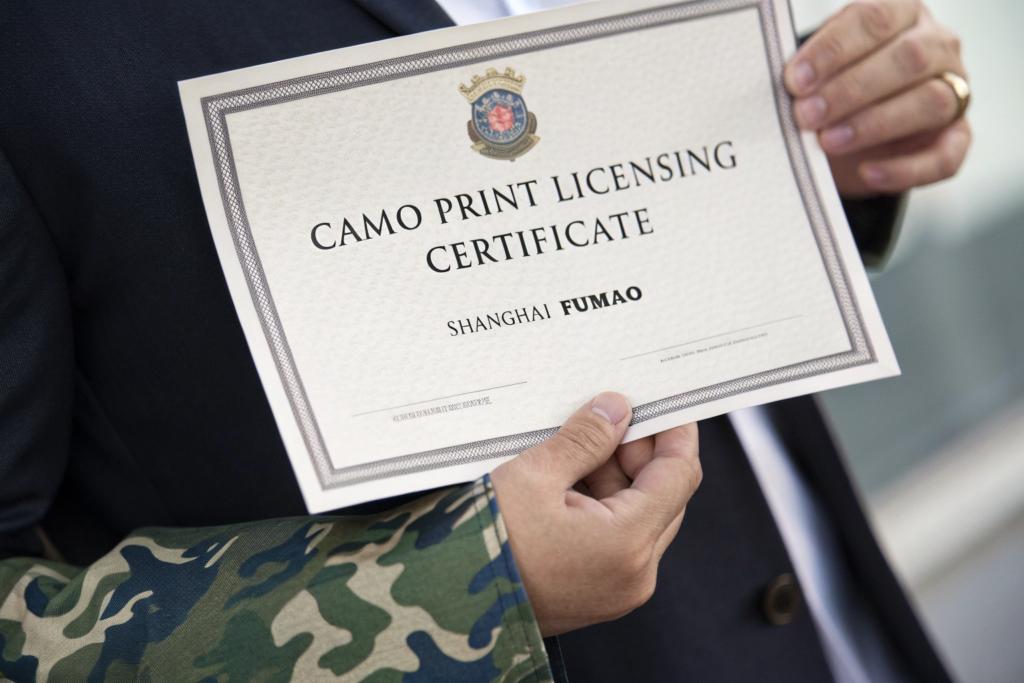
The license is specific and audited. We pay a royalty on every meter of licensed camo fabric we print. We submit quarterly production and sales reports to the licensor. Our printing quality is subject to periodic inspection by the licensor’s quality control representatives to ensure the pattern colors, scale, and registration meet the brand’s strict standards. When you order a RealTree or Mossy Oak camo garment from us, your production order is specifically allocated a quantity of the licensed fabric, and this allocation is recorded in our licensing compliance log. You receive a "Camo Print Licensing Certificate" that states the licensed pattern name, the production order number, the quantity of garments produced, and a statement that the fabric was printed under our valid license agreement. This certificate is your direct, contractual link to our license. If you ever receive a legal challenge, you provide this certificate as your proof of authorized use.
Can We Create an Original, "Clean-Room" Camo That Is Legally Safe?
Yes, and this is a powerful, flexible option for brands that want a unique, proprietary camo pattern without the per-unit royalty cost of a major licensed brand. Our in-house textile design team creates original, "clean-room" camouflage patterns that are designed from a blank canvas, with no reference to any existing, protected pattern. The legal term "clean room" means the designer has been explicitly walled off from any access to protected RealTree, Mossy Oak, or other commercial camo reference materials during the design process. The design is an entirely original creative work.
When we create an original camo for a brand partner, the process is documented from concept to final print. The designer’s initial sketches, the color palette selection, the digital pattern development, and the final repeat file are all date-stamped and archived. When the pattern is complete, we run an independent trademark and copyright clearance search, using a specialized intellectual property law firm, to confirm that the new pattern does not infringe on any existing registered camo design. We then issue an "Original Design & Indemnity Certificate" that states the pattern was created as an original work by our employed designer, that a third-party clearance search was conducted, and that we, as the manufacturer, assume legal responsibility for the pattern’s originality and will indemnify your brand against any infringement claim arising from the pattern’s design. The copyright in the new design is jointly owned, and the brand has a unique, legally protected, and royalty-free camo pattern that is exclusively theirs.
What Documentation Defends a Brand in a Copyright Audit?
A copyright audit or a legal challenge is not the time to start searching for documents. The documentation that defends your brand must be assembled, organized, and in your possession before the challenge arrives. When a lawyer sends a letter, or a CBP officer detains a shipment, you have hours or days to respond, not weeks. Your defense is a single, well-organized document package that proves, with independent, verifiable evidence, that your camo print is legally licensed. This package is the physical manifestation of your legal shield.
We provide every brand partner with a complete "Camo License Documentation Pack" for every camo production order. This pack is not a collection of marketing materials; it is a legal evidence file. It is delivered digitally as a PDF at the time of shipment, and a physical, bound copy can be requested. The pack is designed to be forwarded directly to your lawyer, to a retailer’s compliance department, or to a CBP officer, and it contains everything needed to resolve a legal challenge to your camo print.

What Is a "Chain of Title" Document for a Licensed Print?
A "Chain of Title" is a legal term that describes the sequence of documented transfers of ownership or licensing rights for a piece of intellectual property, from the original creator to the current user. For a camo print, the chain of title proves that the license you are relying on is valid, current, and directly connected to the original rights holder. A broken chain of title is a legal nullity. It means the person who sold you the license did not actually have the legal right to do so.
Our Camo License Documentation Pack includes a complete, unbroken chain of title for every licensed pattern. This chain begins with the original copyright registration certificate from the U.S. Copyright Office, showing the rights holder’s name. It continues with the master license agreement between the rights holder and their authorized licensing agent, if one is used. It then shows our specific, executed license agreement with the rights holder or their agent, referencing the exact pattern name and the specific usage rights granted to us. Finally, it shows our Camo Print Licensing Certificate, which transfers those usage rights, for the specific quantity of your order, to your brand. Each document in the chain is cross-referenced by license number and pattern name. This unbroken paper trail is the legal proof that your right to use the pattern is traceable back to the original, registered copyright owner. It is the single most powerful piece of evidence in a copyright dispute, and it is the document that will cause a plaintiff’s lawyer to close their file.
How Does a U.S. Customs "Prior Authorization" Letter Stop a Seizure?
A U.S. Customs and Border Protection seizure is a terrifying and time-critical event. Your goods are physically held in a bonded warehouse, accruing daily storage fees. The CBP officer issues a detention notice, and you have a limited number of days to respond with documented proof of your right to import the goods. If you fail to respond in time, or if your proof is insufficient, the goods are forfeited and destroyed. A "Prior Authorization" letter is a pre-prepared, formal letter, addressed to CBP, that is included in your documentation pack precisely for this scenario.
The letter is written on our company letterhead and signed by our legal representative. It states that Shanghai Fumao Garment Co., Ltd. is a fully licensed printer of the specific camo pattern named in the shipment, referencing our license agreement number and the rights holder’s name. It lists your brand name, the shipment’s bill of lading number, the container number, and the specific quantity of garments bearing the licensed print. It respectfully requests that CBP recognize the legitimacy of the licensed goods and release the shipment without delay. The letter attaches a copy of our license agreement and our Camo Print Licensing Certificate. This letter, presented to the CBP officer at the port of entry at the first sign of a detention, is often sufficient to resolve the matter immediately, without escalation to formal seizure proceedings. It demonstrates to the officer that the importer is a professional, compliant, and prepared business, and that the goods are legally authorized for import. This pre-emptive documentation strategy has successfully cleared dozens of our clients’ camo shipments through U.S. Customs without incident.
Conclusion
A camo print is not a generic textile design. It is a specific, copyright-protected graphic work, and in many cases, a trademark-protected brand identifier. Using an unlicensed camo print on a commercial garment sold in the U.S. market is not a quality risk; it is an intellectual property infringement that can result in a cease-and-desist letter, a $175,000 legal settlement, the seizure and destruction of your inventory by U.S. Customs, and permanent damage to your brand’s reputation. At Shanghai Fumao, every camo print we ship is fully licensed. We hold active, audited license agreements with RealTree and Mossy Oak, we create original, legally cleared, in-house designs, and we provide a complete Camo License Documentation Pack with every bulk order. This pack contains a Camo Print Licensing Certificate, a chain of title document, and a U.S. Customs Prior Authorization letter. It is your complete, pre-assembled legal defense.
Your camo collection should not be a legal gamble. The cost of a license is a few cents per garment. The cost of an unlicensed infringement is a brand-destroying legal battle. The license certificate is the only document that separates a profitable, compliant camo program from a lawsuit waiting to happen.
If you are a U.S. brand owner planning a camo collection and you want to see our license agreements, our chain of title documentation, and a sample Camo License Documentation Pack, let’s schedule a call. We can walk you through our camo library, show you the licensed patterns, and discuss an original, exclusive camo design for your brand. Contact our Business Director, Elaine, at elaine@fumaoclothing.com. Tell her you want to review the camo licensing documentation. Let’s build a camo program that is not just visually powerful, but legally unassailable.