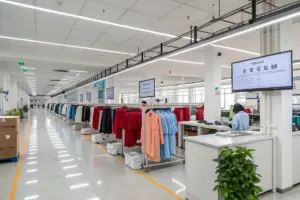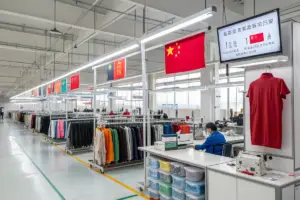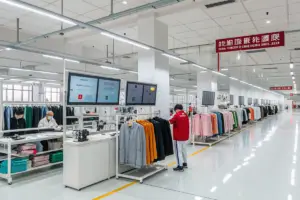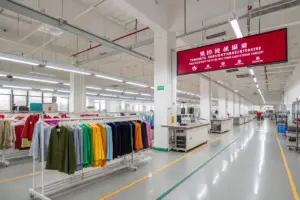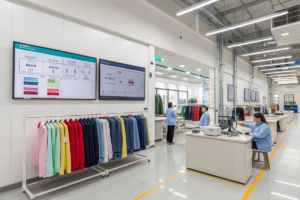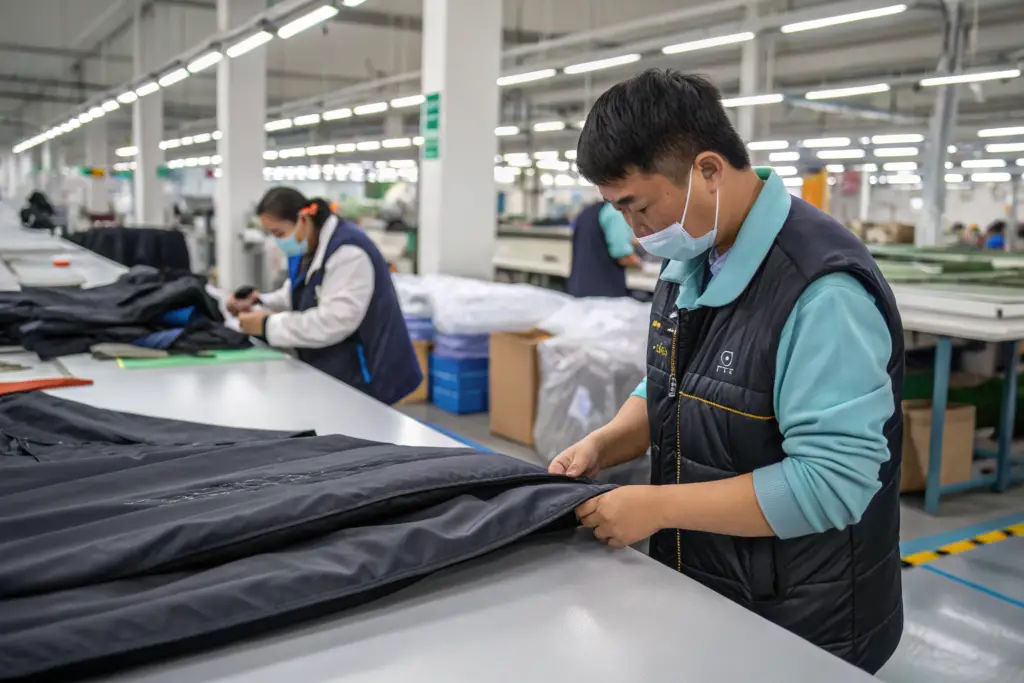
A golden sample sits on your desk. It drapes perfectly. The stitching is immaculate. The buyer from the department store loves it, and they place an order for 8,000 units. Then the nightmare begins. Twelve weeks later, the container arrives. You unzip the first polybag, and your stomach drops. The fabric feels thinner. The color is half a shade off. The buttons are hanging by a thread. The customer rejection rate spikes to 15%, and you are stuck with 7,500 units of a summer coat no one wants to touch. I have seen this tragedy destroy small brands. The mismatch between a beautiful sample and a mediocre bulk shipment is the single biggest source of financial loss in our industry. But it is entirely preventable if you control three specific checkpoints in the production chain.
You ensure your summer coat samples match bulk production by locking a physical "reference standard" that includes not just the garment, but the exact fabric swatch, thread tension gauge, and trim finish approved by the buyer. At Shanghai Fumao, we do not let the sample room touch the bulk fabric until the reference standard has been cut, measured, and sealed in an airtight bag. The bulk cutting begins only after the production line supervisor, the quality manager, and the merchandiser all sign off on a "pre-production sample" that is constructed under the exact same time pressure and machine settings as the main order.
A sample sewn slowly by a master tailor in the development room will always look better than a bulk unit sewn by thirty different operators on a tight deadline. The goal is not to make the sample perfect. The goal is to make the sample replicable. You need to engineer the consistency before you cut the first meter of fabric. I will walk you through exactly how we close the gap between the one-off masterpiece and the mass-produced reality.
What Is A Pre-Production Sample And Why Is It Non-Negotiable?
Most small brands skip the pre-production sample, or PP sample, to save ten days. This is like skipping the dress rehearsal for a Broadway show. The golden sample, or fit sample, is sewn in the sample room. The sample room is quiet. The machines are calibrated daily. The sewer has been making prototypes for twenty years. None of these conditions exist on the main production floor, which is loud, fast, and relies on a team of sewers with varying skill levels. The PP sample is the bridge between these two worlds. It is a single garment made on the actual production line, using the actual bulk fabric roll, and cut with the actual mass-production markers.
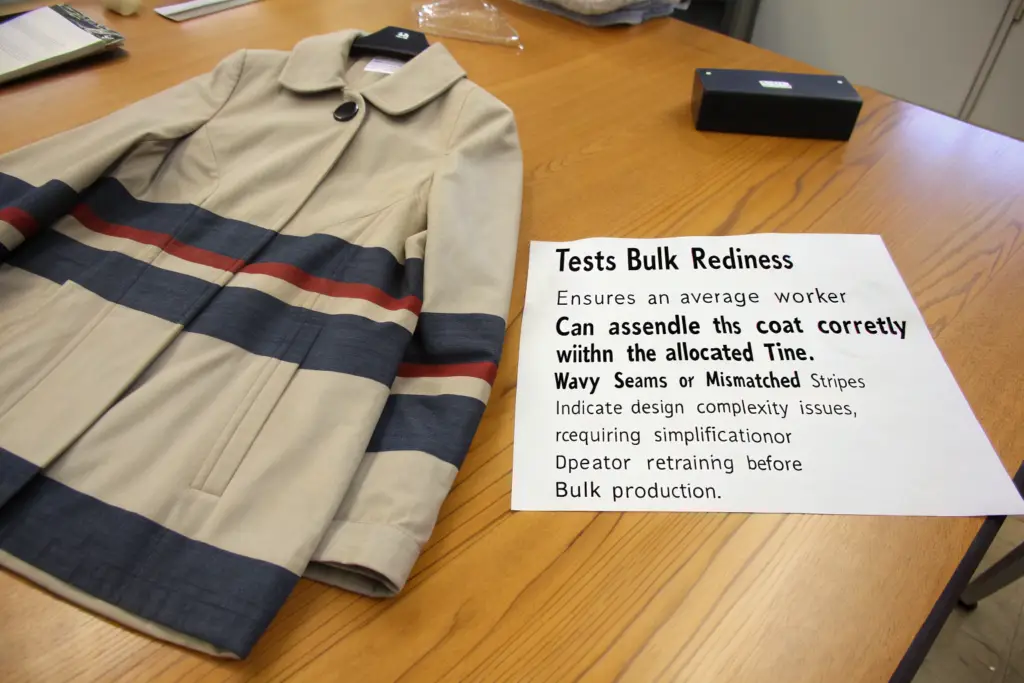
A pre-production sample is a non-negotiable quality gate because it tests the "bulk readiness" of your design. It answers the question: can an average sewer on our assembly line make this coat correctly in the allocated Standard Minute Value? If the PP sample comes back with wavy seams or mismatched stripes, the design is too complex for the factory’s current capability, and you must either simplify the design or retrain the operators before bulk starts. Skipping this step means you are using your customer’s 8,000-unit order as the training exercise.
You do not want to pay for 8,000 meters of expensive lightweight linen only to discover that the fabric slips during automated cutting. The PP sample is where you discover these sins. It costs maybe $150 to produce a PP sample. A bulk recall costs $15,000. The math is simple.
How Does A Pre-Production Sample Differ From A Fit Or Counter Sample?
These three terms get thrown around in emails constantly, and confusion here creates legal problems. Let me define them clearly from the factory floor perspective.
A fit sample is the first prototype. It checks the block pattern against a human body. It is often made from a similar, but not identical, fabric if the real fabric is not in stock yet. Its purpose is to check the silhouette. The stitching quality is not a priority. A counter sample, or approval sample, is the "golden seal." It represents the aesthetic standard. A master tailor sews it perfectly. You sign it, and we both keep one. But it is not made under bulk conditions. The PP sample is different. The PP sample is exactly one unit pulled from the trial cutting. I always tell my clients to cut open the PP sample. Look at the interior. A fit sample might have a messy fusing job inside the collar because the tailor just wanted to show the outside shape. The PP sample must have the exact same fusing machine setting that will be used for all 8,000 coats. If the fabric shrinkage was not accounted for, or if the interlining bubbles after a standard pressing cycle, you will only see it in the PP sample. We treat the PP sample as the legal contract of construction. If the buyer signs off on the PP sample, we are contractually bound to make every bulk coat exactly to that specification, complete with all the minor imperfections that are inevitable in mass production.
What Specific Checks Must You Perform On A PP Summer Coat Sample?
A summer coat is a special animal. It is often unlined or half-lined. There is no hiding place for sloppy work. Your checks must be brutal and systematic.
I use a 5-point check on every PP summer coat that leaves Shanghai Fumao. Point one is the buttonhole and button attachment test. For a lightweight summer coat, a pulled thread on a buttonhole ruins the whole front panel. We use a spring-loaded pull tester on the PP sample to ensure the button doesn’t pop off at 15 pounds of force. Point two is the zipper insertion on thin fabric. A heavy metal zipper on a light cotton-linen blend creates a wavy seam unless the tape is pre-shrunk. I check the zipper teeth alignment and the flatness of the tape. Point three is the pocket bag depth and reinforcement. Many designers want shallow, fashionable pockets. But in bulk, a sewer who cuts the pocket bag even 1mm smaller creates a hole that swallows keys and rips. I measure the pocket bag with a ruler against the approved spec sheet. Point four is the collar roll and re-fusing. Summer heat melts cheap interfacing. I put the PP sample collar in a steam chamber for 30 seconds. If the collar bubbles or de-laminates, we stop production and switch to a higher-grade fusible. Point five is the overall symmetry under tension. I hang the coat on a mannequin and clip light weights to the hem. This simulates how the coat hangs on a moving body. If the front panels swing open or the back rides up, the balance of the pattern is off. These checks are all about predicting what happens when a customer wears the coat in the real world, not just how it looks in a flat lay photo for an online store. The garment fit and construction must survive this stress test.
How Do You Lock The Fabric Shade And Hand Feel Before Bulk Cutting?
Fabric is a liquid. I know that sounds strange, but it is true. Textiles shift. The color you approved six weeks ago on a lab dip will not look exactly the same as the color that arrives in the bulk dye lot. The hand feel, the softness or crispness of the summer coating, will change slightly depending on the humidity when the yarn was spun. If you do not lock the fabric specification before the cut ticket is released, you are essentially gambling with your brand’s reputation. I have walked into our warehouse and rejected entire rolls of fabric that looked "close enough" to the standard but were 5% lighter in weight. That 5% difference makes a summer trench coat look like a cheap bathrobe.
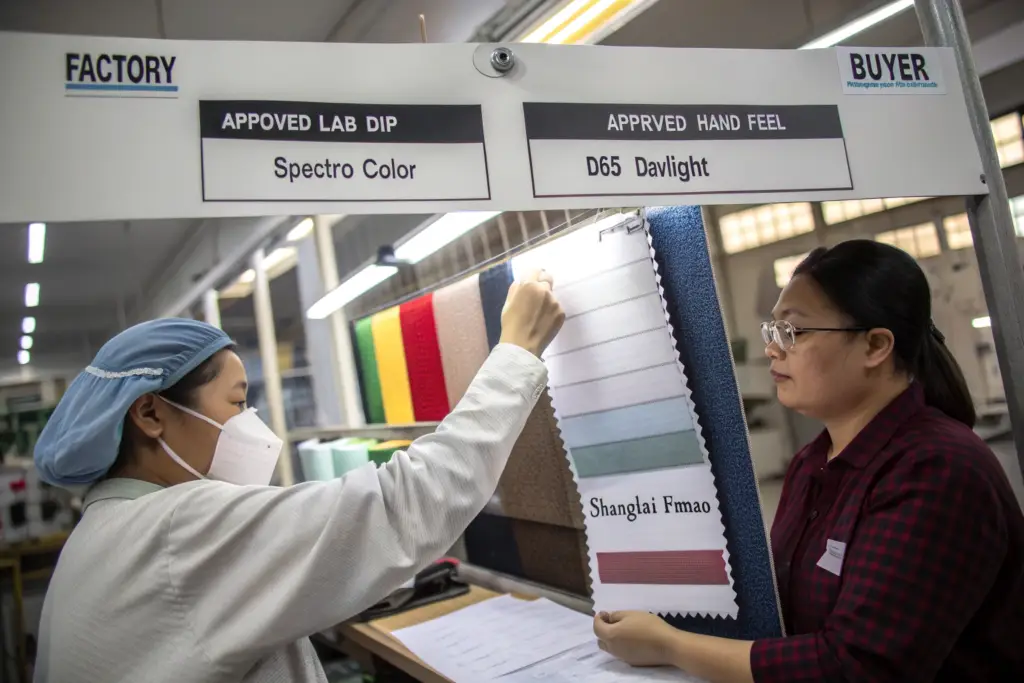
You lock the fabric shade and hand feel by creating a "fabric reference header" that includes the approved lab dip, a swatch of the approved hand feel, and a spectro reading of the color. This header is signed by both the factory and the buyer. Before cutting, our quality team at Shanghai Fumao cuts a small swatch from every single roll of fabric and tapes it next to the signed header under a D65 daylight lamp. If the roll does not match the header, that roll is quarantined. No exceptions are made for tight deadlines.
The factory must prove the fabric is right before the knife hits the spread. Once the fabric is cut into 5,000 sleeves, you own the problem. Before that, the problem belongs to the fabric mill.
What Is A Lab Dip And Why Is A Digital Photo Not Enough To Approve It?
A lab dip is a tiny swatch of fabric dyed in a beaker to match your target color. It is the first step in color management. The critical mistake modern buyers make is approving a lab dip based on a photo taken on an iPhone and sent via WhatsApp.
Phone screens lie. They over-saturate blues. They wash out beige. Your screen brightness is not calibrated to the factory’s screen. I insist that every client physically receives the lab dip via courier. But even a physical lab dip is tricky. The lab dip is a small, perfectly dyed piece of cloth. The bulk production is a massive rope of fabric dyed in a huge vat. The color can "flare." This means the color looks perfect under the store’s halogen lights but turns a nasty green under the office fluorescent lights. This is called metamerism. To prevent this, I ask the client to check the lab dip in three different light sources: daylight near a window, standard indoor light, and the specific lighting of their retail environment. We use a spectro to give the color a digital fingerprint, reading the Delta E value which tells us mathematically how close the bulk is to the standard. We aim for a Delta E of less than 1.0 for the base fabric of a summer coat. Anything above 1.5 is visible to the naked eye and will cause a mismatch between the coat and the matching trousers or dress. The physical lab dip, signed by the owner, becomes the legal standard. We attach that swatch to the production file, and the cutter uses it as the "go/no-go gauge" for every single roll. The color consistency across textiles must start here.
How Can You Test The Bulk Fabric Roll For Weight And Shrinkage Before Cutting?
A fabric mill can ship you a roll that is labeled "180 GSM" but is actually 165 GSM. They might have stretched the fabric on the tenter frame too much during finishing, making it feel thinner and cheaper. You need to catch this before the spreading machine starts.
We conduct a roll-by-roll inspection for summer shells. We have a small laboratory attached to the cutting room, not halfway across the factory floor. We cut a 10cm x 10cm square from the head end of every fifth roll. We weigh it on a digital scale to check the grams per square meter against the spec. We also do a quick boil test for shrinkage. We mark a 50cm line on the swatch, boil it in a beaker for 10 minutes, and measure it again. A summer viscose coat can shrink 5% if not treated properly. If the shrinkage on the bulk roll exceeds the tolerance we agreed with the buyer, we refuse the roll. I recall a specific case with a peach-skin finish summer jacket. The finish felt amazing on the header, but the bulk rolls felt stiff. The problem was the silicone softener concentration in the final bath. The mill had cut the softener by 20% to save money. We caught it because we do a "hand feel panel test." Three experienced technicians, blindfolded, compare the bulk swatch against the reference swatch. If two out of three reject the hand feel, the fabric goes back. This costs me time, but it saves the brand owner from a flood of returns because the coat feels "scratchy." The objective data from a fabric weight and construction analysis combined with a subjective hand feel panel is the golden standard. You cannot skip the human touch because machines can’t tell you if the fabric feels "cheap."
What Information Must Your Tech Pack Contain To Avoid Bulk Errors?
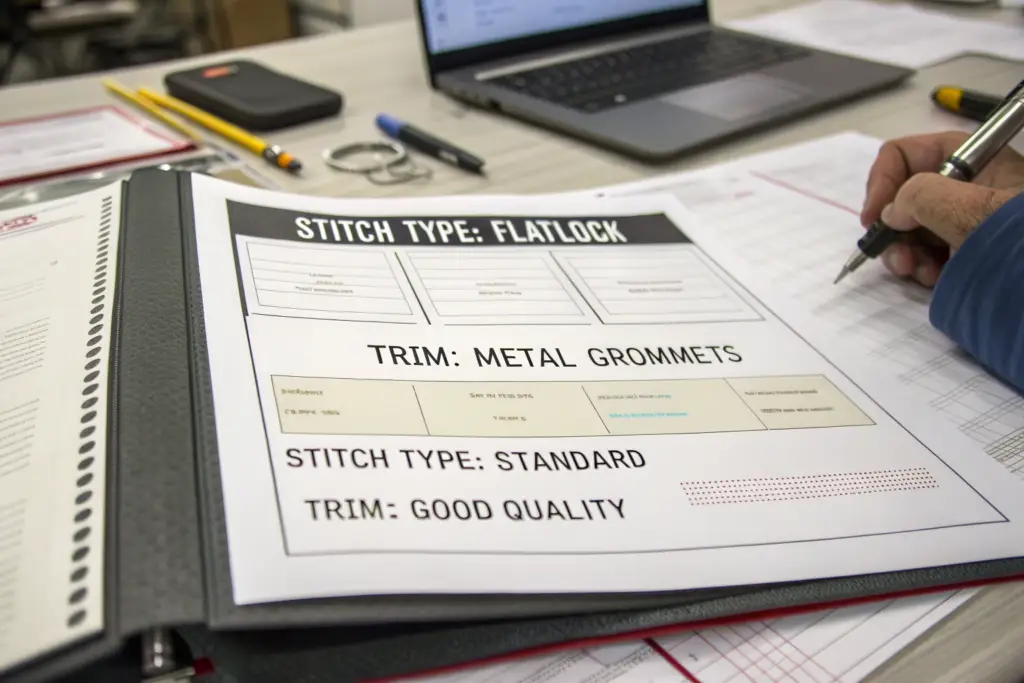
The tech pack is the bible. A vague tech pack creates a disaster. I have received tech packs that say "stitch type: standard" or "trim: good quality." These words mean absolutely nothing to a production manager. A weak tech pack forces the factory to guess. And when a factory guesses, they will guess in the cheapest possible way to protect their own margin. This is not malice. This is survival. If you do not specify the exact seam construction for the armhole of your summer coat, the factory will use the cheapest single-needle chain stitch that unravels in the wash.
Your tech pack must contain these seven critical control points to avoid bulk errors: a complete Bill of Materials with mill names and reference numbers, a point-of-measurement diagram with tolerances in inches, a stitch-by-stitch seam construction code, the SPI for every sewing operation, the exact trims supplier code, the label placement measured from a fixed grid point, and the folding and packing instruction with the maximum weight per carton. At Shanghai Fumao, our merchandising team refuses to issue a cut ticket until every one of these seven fields is filled in and signed off by the buyer.
A comprehensive tech pack is not a suggestion. It is the instruction manual for a machine that has to replicate your design 10,000 times without your physical presence.
Which Seam Construction Codes Are Best For Lightweight Summer Coats?
Seam construction is invisible to the customer, but it is the skeleton of the coat. For summer fabrics, you need seams that are strong but do not add bulk.
I recommend three specific seam types for summer outerwear, and I reference them by their international ISO 4916 codes so there is zero confusion. First, the French Seam (1.01.01) for sheer or unlined fabrics. This seam encloses the raw edge within itself. It is clean, light, and absolutely requires a skilled operator because the first seam must be trimmed perfectly to 3mm before the second seam is folded over. Second, the Flat-Felled Seam (2.04.01) for the side seams of a structured summer utility jacket. This is the seam you see on denim jackets. It is incredibly strong and lies perfectly flat. It requires a specialized felling machine. If your tech pack just says "side seam," you might get an overlock seam, which is bulky and looks cheap on a $98 retail coat. Third, the Bound Seam with a bias tape (3.05.01) for unlined linen jackets. This seam finishes the internal edge with a thin strip of cotton binding. It looks beautiful and prevents fraying. In the tech pack, you must specify the SPI, or stitches per inch. For a summer weight fabric, I specify 10 to 12 SPI. A high SPI on a thin fabric creates a "laser-cut" perforation effect that actually weakens the seam. The stitch classification for apparel must be paired with the correct needle size. For a 90-gram nylon summer shell, I use a size 70 ballpoint needle. A size 90 sharp needle, which is standard for denim, will cut the yarns and create runs in the fabric after three washes. The detail of the needle size must be in the tech pack. This is the kind of manufacturing knowledge that separates a professional brand from an amateur one.
How Does A Detailed BOM Prevent Trim Substitutions During Bulk Production?
BOM stands for Bill of Materials. It is the shopping list for every single component that goes into the coat, down to the last stitch. A trim substitution is the most common trick an unethical supplier uses to increase their own margin. They show you a sample with a branded YKK zipper. Then the bulk arrives with a generic local zipper that jams after a week. You complain. They say, "Oh, the BOM just said ‘nylon zipper.’ You didn’t specify the brand."
A bulletproof BOM has no generic words. It has brand names and product codes. For a summer anorak, the BOM should read something like: "YKK #5 Vislon AquaGuard zipper, color: Mat Navy, code VZ-552-DN, center front closure." It should also list the approved alternate in case of stock-outs. "Alternate: Riri M6 Aquazip, code M6-NAV." This gives us pre-approved options. The BOM must also list the exact thread. A summer coat needs a high-tenacity polyester core-spun thread, not cotton thread, which rots in the sun and sweat. I specify the thread ticket number, like "Coats Epic 120, Tex 24." If the BOM just says "poly thread," the factory will use whatever is lying around, and the seams might burst during a summer breeze. The BOM should also include the interlining for the collar and placket. This is the hidden skeleton. I always specify the exact brand and code for the fusible, like "Freudenberg Vilene V205, white, 38gsm." A cheaper fusible will bubble after a summer of dry cleaning. The BOM is a legal document. If a supplier deviates from an agreed BOM without written authorization, they are in breach of contract. This is how you protect yourself from the "bait and switch" that poisons this industry. The raw material sourcing strategy must be locked at the BOM level.
Why Is An On-Site Inline Inspection Better Than A Final Random Check?
The traditional model is dead. The old way was: the factory produces the order, a third-party inspector shows up at the end, checks 10% of the cartons, and gives a pass or fail. This is too late. If the inspector finds a critical defect in the final inspection, 10,000 coats are already packed. The factory has to re-open every carton, repair the defect, re-pack, and re-ship. The delay misses the summer selling season. The relationship between the buyer and the factory is poisoned. The inline inspection model solves this by putting the inspector directly on the sewing line, while the coats are being made.
An on-site inline inspection is better than a final random check because it catches defects at the source, not at the finish line. The inspector checks the first 50 units off the line on Day 1 of production. If the armhole puckering is a 3mm problem, we adjust the machine tension that same morning. At Shanghai Fumao, we mandate an inline inspection station at three critical points: the cutting room output, the sewing line after the collar attachment, and the finishing station before the steam iron. This reduces the final defect rate to below 2%, whereas a final-only inspection typically allows a defect rate of 4% to 6% to pass through.
You want the problem solved before it becomes a statistic. Inline inspection is not a cost adder. It is a cost saver.
How Does The Inline Process Catch A Collar Mismatch Before 10,000 Units Are Cut?
The collar is the soul of a summer coat. It frames the face. A collar that is slightly twisted or uneven destroys the whole garment. This defect usually starts in the fusing press, not the sewing machine. If the fusible interlining is applied slightly off-grain or at the wrong temperature, the collar will twist after the first wash, but it might look fine on the hanger.
In a final inspection, the inspector might check 50 coats. They might miss the twist if they don’t hang the coat on a mannequin for five minutes. By the time the brand discovers the twist, it’s on the retail rack, and a customer is trying it on in a fitting room with bad lighting. The customer buys it, washes it once, and the collar rolls like a wave. The return comes back. The brand checks their stock and realizes all 10,000 units are twisted. This is a catastrophic recall. The inline inspection stops this at unit number 50. Our inline inspector physically takes the first 50 collars fresh from the fusing press and performs a garment twist test. They lay the collar on a grid mat. They measure the skew. If it’s off by more than 2 millimeters, they halt the fusing machine and recalibrate the temperature and pressure. They don’t just check the collar; they check the cutting die. A dull die stretches the fabric as it cuts. An inline inspector checks the die sharpness daily. This kind of deep manufacturing defect analysis can only happen when the inspector is embedded with the production team. By catching the collar twist on the first day, we salvage 9,950 collars from being cut and fused incorrectly. The fabric saved pays for the inline inspector’s salary for a year.
Can A Factory’s Own QC Team Replace A Third-Party Inspection Service?
This is a question of trust and incentive. A factory’s internal QC team reports to the production manager. The production manager is measured on output, not quality. The production manager wants to ship the order and invoice the client. If the internal QC inspector rejects a lot, the production manager gets angry because the shipping deadline is threatened. This conflict of interest exists in every factory, including good ones.
At Shanghai Fumao, we have solved this by creating a Quality Assurance department that reports directly to the General Manager, bypassing the production manager entirely. The QA team’s bonus is tied to the customer’s return rate, not to the shipping volume. This aligns our internal incentives with the buyer’s interests. However, I still encourage my brand partners to send their own third-party inspector for complex summer coats, especially if the order value exceeds $50,000. An independent inspector provides the "no relationship" objectivity. The ideal system is a hybrid: our internal QA stops the obvious defects on the line, and the external inspector validates the system at the AQL 2.5 level before shipment. This is not about distrust. It is about double safety. A third-party inspection service like SGS or Bureau Veritas provides a level of formal documentation that big retailers require for their vendor compliance portals. The combination of an honest internal system and an objective external audit is the strongest quality defense you can build. The third-party quality control process acts as the final gatekeeper, ensuring that the factory’s internal checks have not drifted due to the pressure of peak season.
Conclusion
The gap between a sample and the bulk production is where brands lose their reputation. It is where beautiful designs go to die. But it is a gap you can seal shut with a methodical, engineering-based approach to garment manufacturing. It starts with a pre-production sample that tells you the brutal truth about your design’s readiness. It continues with a fabric header that locks the color and the hand feel with scientific precision. It is guided by a tech pack that is so specific it could be used as a legal contract. And it is enforced by an inline inspection system that kills defects in the crib, not at the grave.
Summer outerwear is particularly unforgiving. The fabrics are light, the colors are bright, and the margins are thin. You cannot afford a 10% rejection rate. You need a manufacturing partner who treats the bulk production order with the same reverence that the master tailor treats the sample.
At Shanghai Fumao, this is exactly what we do. We do not hide our production floor behind a sample room door. We invite you into the process. We share the inline inspection reports with you daily. We approve the lab dips physically before we cut. We are not just a vendor; we are the production arm of your brand, sitting in China and thinking like an American retailer.
If you are tired of beautiful samples that turn into mediocre shipments, let’s fix that. Reach out to our Business Director, Elaine, at elaine@fumaoclothing.com. We will walk you through our PP sample protocol and show you how we close the gap between the dream and the delivery.