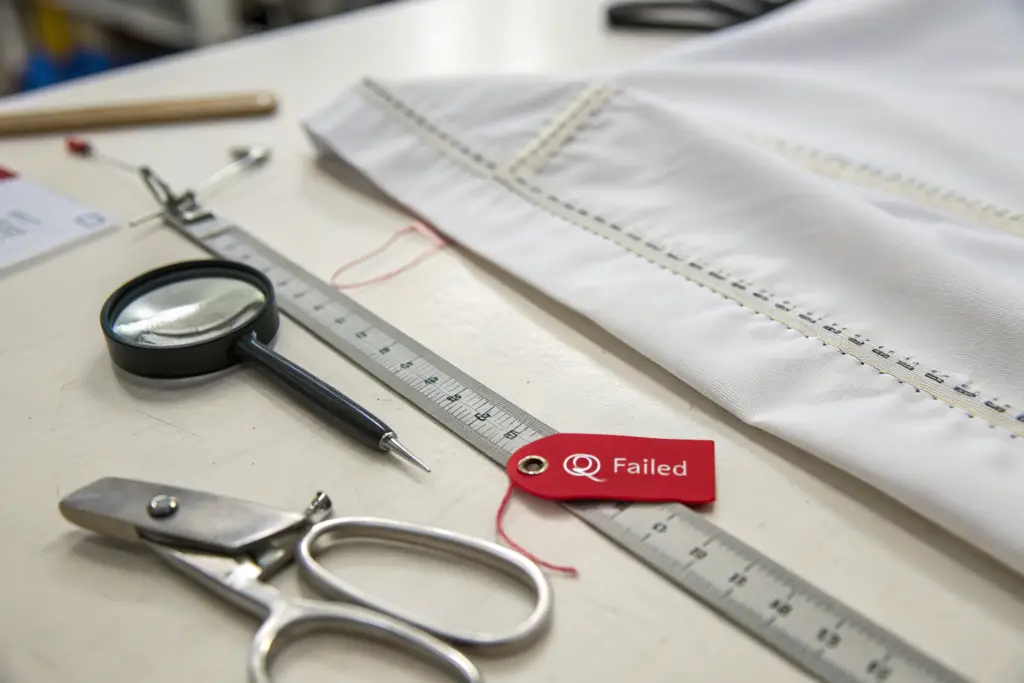
You are holding a sample from a promising new factory. The silhouette looks good on the mannequin. From a distance, the stitching looks... fine. But a quiet, professional voice in your head knows that "fine from a distance" is a ticking time bomb of customer returns. A seam that looks acceptable today can unravel, pucker, or tear after a few washes, permanently damaging your brand's reputation. A master tailor and quality auditor once told me, "Your customer will never measure the GSM of your fabric, but they will feel a scratchy seam. They will see a crooked topstitch. The quality of a garment is not judged by its overall look, but by its worst seam. You must learn to look at a garment the way an auditor does: at the individual stitch, not the overall silhouette."
To accurately assess a factory's stitching quality, you must move beyond a casual visual glance and conduct a specific, three-part forensic audit of their sample. You must: 1) Perform a "Micro-Measurement Audit" using a pick glass to count the exact Stitches Per Inch (SPI) and a measuring tape to verify the seam allowance against the spec, 2) Conduct a "Destructive & Physical Stress Test" by pulling hard on the seam to check for "grinning" and stretching the seam to its limit to test the stitch type's elasticity, and 3) Inspect the "Invisible Truths" by turning the garment inside out and evaluating the internal seam finishing, the back of the embroidery, and the thread trimming. These three tests will tell you everything you need to know.
At Shanghai Fumao, we welcome this level of forensic scrutiny. Our entire quality control system is built to meet the most demanding stitch-by-stitch standards of our B2B partners. Let me give you the exact, simple, and powerful hands-on tests you can use to evaluate any factory's sample, turning a subjective impression into an objective, professional assessment.
How to Perform a "Micro-Measurement Audit" That Reveals the True Precision of a Seam?
The most basic and damning flaw in a garment is a seam that is simply not stitched correctly. It is either too weak (too few stitches per inch) or it is poorly constructed (an uneven or incorrect seam allowance). These are not subtle flaws; they are objective, measurable failures of the factory to follow a basic specification. The first, and most powerful, test you can perform is a simple "Micro-Measurement Audit" using two cheap, essential tools: a pick glass and a measuring tape.
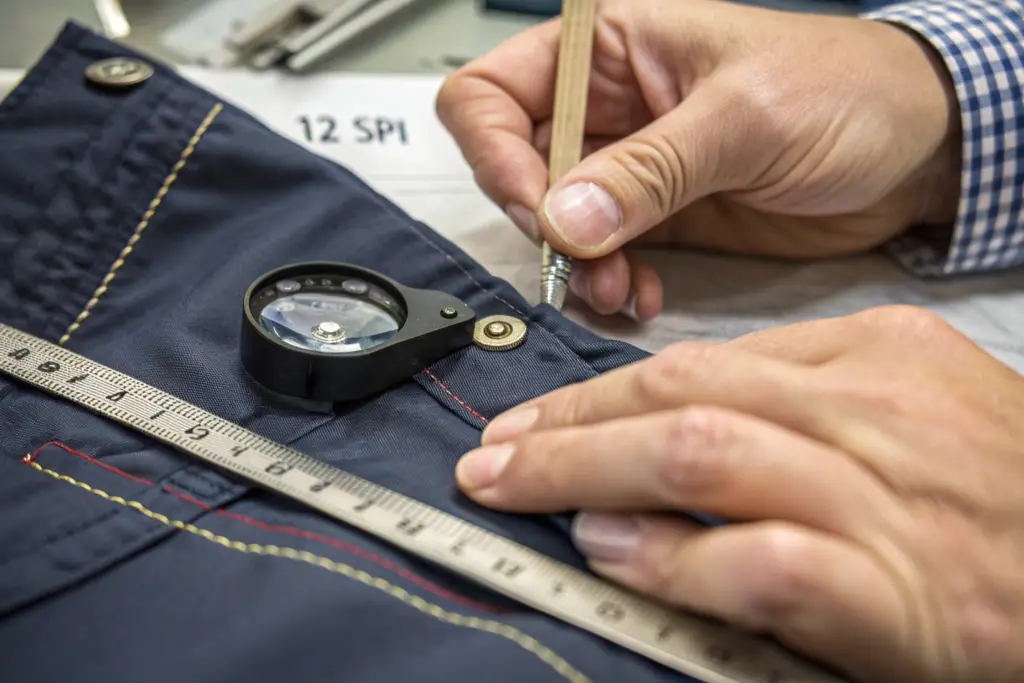
A "Micro-Measurement Audit" turns a subjective glance into an objective, data-driven assessment. The two essential tools are a pick glass (an 8x-10x magnifying loupe, costing a few dollars) and a metal measuring tape. Use the pick glass to count the exact number of stitches within a one-inch span. A premium garment should have a consistent 12-14 SPI (Stitches Per Inch) on main seams. Fewer than 10 SPI is a sign of a cheap, weak construction. Then, use your measuring tape to measure the actual seam allowance. If the spec calls for 1.0 cm, it must be exactly 1.0 cm, not 0.8 cm or 1.2 cm. A professional factory will hit these numbers exactly.
A brand owner I mentor was evaluating two potential factories. He asked both for a sample. Factory A's sample looked decent from a distance. Factory B's sample looked similar. He then performed the "pick glass test." Factory A's topsticking was a sloppy 8 SPI with an inconsistent distance from the edge. Factory B's was a tight, perfectly uniform 13 SPI, exactly to the spec. He chose Factory B. He told me, "That $5 pick glass told me more about the factory's culture of precision than a thousand emails ever could." This is the power of this simple, scientific audit. This is the level of scrutiny we welcome on our quality control samples .
What Is the Simple "Pick Glass Test" and How Does It Instantly Reveal the Density of a Stitch?
A pick glass is a small, folding magnifier that you can buy online for a few dollars. Lay the garment flat. Place the pick glass on the seam. The individual stitches will be magnified, allowing you to easily count how many stitches are in a one-inch span. A tight, dense, high-SPI seam looks and feels premium. A loose, low-SPI seam is a sign of a factory that is prioritizing speed over quality. This 10-second test is the single most powerful quality audit you can do.
How Do You Measure a Seam Allowance and Why Is a 1-2 Millimeter Variance a Critical Failure?
Use your metal measuring tape. Measure from the edge of the fabric to the stitch line. A consistent, 1-2 millimeter error might seem tiny, but it has a massive cumulative effect on the fit of the garment, especially across multiple seams. If the spec calls for a 1.0 cm seam allowance, the measured seam allowance must be exactly 1.0 cm. A factory that cannot control this basic dimension is a factory that will have sizing inconsistency problems in bulk.
How to Conduct a "Physical Destructive & Stress Test" That Simulates Years of Wear in Seconds?
A seam can look perfect on a flat table but fail catastrophically when subjected to the real-world stress of a human body bending, stretching, and moving. A static, visual inspection is not enough. You must put the seam under physical, dynamic stress to test its fundamental structural integrity. This is not about being destructive; it's about being predictive. A simple, hands-on stress test can simulate years of wear in a matter of seconds and reveal critical weaknesses that a passive glance can never detect.
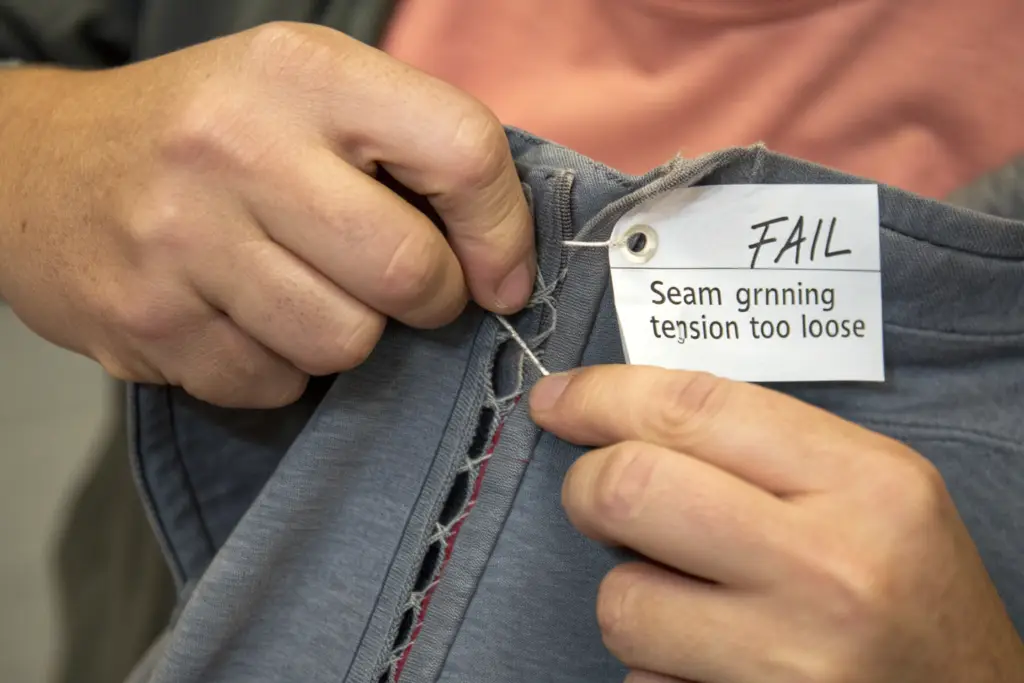
A "Physical Stress Test" is a hands-on, real-world simulation of garment use. The most critical test is for "seam grinning." Grip the fabric firmly on both sides of a main seam and pull it apart with moderate force. If the stitches hold but the fabric panels pull apart, exposing the bare thread, the seam is "grinning." The thread tension is too loose, and the seam is weak and unsightly. Next, if the garment is a knit or activewear piece, stretch the seam to its expected limit. The stitch must stretch with the fabric and not "pop" or break. A straight lockstitch on a stretch fabric will fail instantly.
A brand that produces premium leggings always performs the "stretch test" on a sample from a new factory. They pull the seam to its maximum realistic extension, mimicking a deep squat. A factory that uses a simple lockstitch on their stretch fabric will have their seam pop on this first test. A professional factory, like ours, will use a 5-thread safety stitch, which is inherently elastic and will stretch smoothly with the fabric without breaking. This single, physical test is an instant, decisive filter for activewear manufacturing competency. This is the standard of our performance seam engineering .
What Is "Seam Grinning" and Why Is It a More Dangerous Flaw Than a Broken Stitch?
A broken stitch is an obvious failure. Seam grinning is an insidious, hidden weakness. The seam is technically still closed, but the fabric panels have separated, exposing the thread. This not only looks terrible, but the exposed thread is now vulnerable to abrasion and will eventually fail completely. It is a sign of incorrect thread tension and a fundamental lack of quality on the sewing floor.
How Can a Simple "Stretch Test" on a Legging Seam Reveal If a Factory Understands Activewear?
Grip a short section of the legging's main side seam. Stretch it powerfully, as if squatting. A correct, elastic 5-thread safety stitch will stretch smoothly with the fabric. An incorrect, inelastic lockstitch will "pop" and break instantly. If a factory's sample fails this test, they do not have the fundamental technical knowledge to manufacture performance activewear. This test takes five seconds and is 100% definitive.
How to Inspect the "Invisible Truths": The Inside Story of a Garment's Quality?
The most revealing quality inspection you can perform is the simplest: turn the garment inside out. The outside is the factory's showroom; the inside is their workshop. A factory that cares about quality will obsess over the internal finish, the seams, the trims, and the cleanliness of the construction. A factory that only cares about a cheap, passing look from the outside will hide a mess of raw edges, loose threads, and sloppy finishing on the inside.
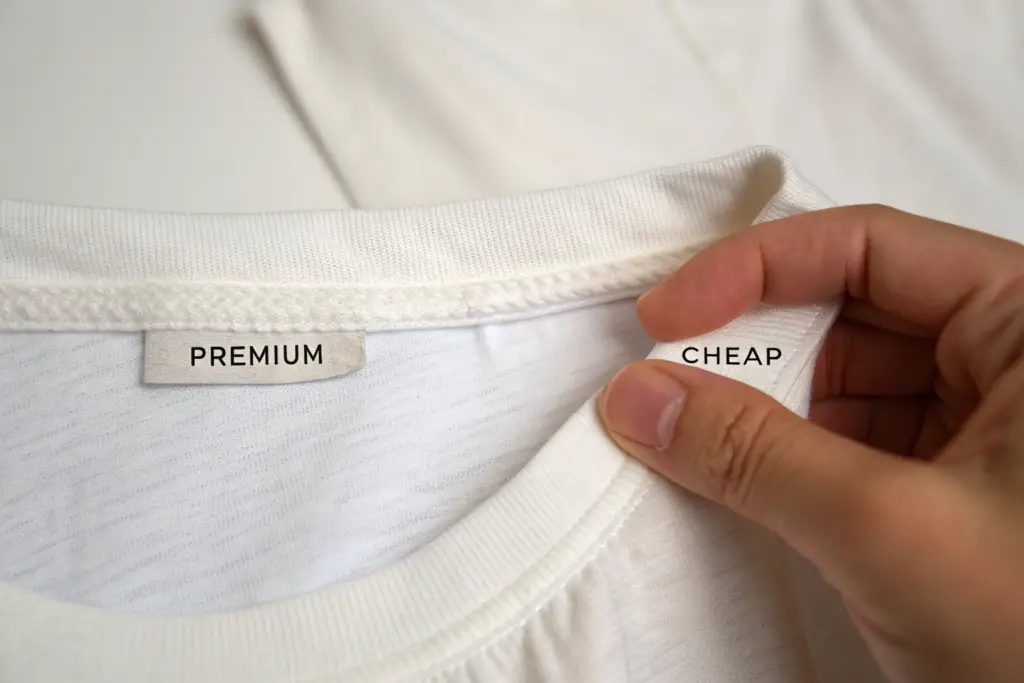
The "Inside-Out Inspection" reveals the invisible truths of a factory's quality culture. Look for the internal seam finishes. A premium garment will use clean, enclosed seams like a flat-felled or French seam to prevent fraying and add durability. A cheap garment will have raw, unfinished overlocked edges that will unravel. Run your hand along every internal seam; it should feel smooth and flat, not scratchy. Inspect the back of any embroidery; the "underlay" stitches should be clean, even, and well-tensioned. A sloppy back is a sign of an amateur. Finally, look for loose threads; a clean, well-made garment should be virtually free of them.
A men's wear brand owner I know always judges a new shirting factory by turning the sample inside out and looking at the side seam. If he sees a clean, perfectly flat-felled seam, he knows he's dealing with a serious, quality-focused partner. If he sees a raw, overlocked edge, he puts the sample down and ends the meeting. He told me, "A factory that hides a messy inside is a factory that will cut every corner imaginable. The inside doesn't lie." This is the final, un-fakeable test of a factory's commitment to true quality. This is the standard we build into every garment we manufacture .
What Is the Difference Between a "French Seam," a "Flat-Felled Seam," and a Raw Overlocked Edge?
This is the language of internal quality.
- Raw Overlocked Edge: The cheapest, fastest finish. The edge is simply wrapped in thread but remains exposed and will fray over time.
- French Seam: A delicate, self-enclosed seam where the raw edge is completely hidden. It is beautiful, soft, and ideal for lightweight, sheer, or delicate fabrics.
- Flat-Felled Seam: A strong, durable seam where the raw edge is folded and double-stitched flat. It is the hallmark of a well-made, durable garment, like a premium shirt or jean.
How Can the "Embroidery Back Test" Reveal if a Logo Is the Work of an Amateur or a Master?
Turn the garment inside out and look at the back of any embroidery. A professionally executed logo will have a clean, even, and well-tensioned "underlay" of stitches. It will look almost as neat as the front. An amateur job will have a chaotic, loopy, and messy back with broken threads. This single, hidden detail reveals the skill level of the factory's digitizer and embroidery team. This is the standard of our premium embroidery finishing .
How Does Fumao's Obsession with Stitching Make These Forensic Tests Unnecessary?
Our goal is that by the time a sample reaches your hands, it has already passed these exacting forensic tests internally. Our entire quality system is built on the principle that stitching consistency is not an outcome to be inspected at the end, but a process to be engineered and continuously verified at every stage. We obsess over the stitch-by-stitch quality so that you can focus on the design and the brand.
Fumao's obsession with stitching quality makes these forensic tests a formality, not a gamble. We perform the "pick glass test," the "seam measurement audit," and the "stress test" on our own production lines every single day. Our in-line QC inspectors are equipped with the tools and the training to catch a stitch density drift or a tension error in real-time. We provide a culture of precision that guarantees a flawless seam, from the first stitch to the last.
A new brand partner who came to us after a disaster with a previous factory's stitching quality told me, "I performed my usual forensic tests on your sample, and for the first time, I had nothing to write down. The SPI was perfect, the internal finish was clean, and the seam didn't grin when I pulled it. I realized I had been fighting a quality war with my previous suppliers, and you had already won it on your factory floor before I ever saw the garment." That is our standard. We are the partner who obsesses over the stitches so you don't have to. This is the value of a true quality-focused manufacturing partnership .
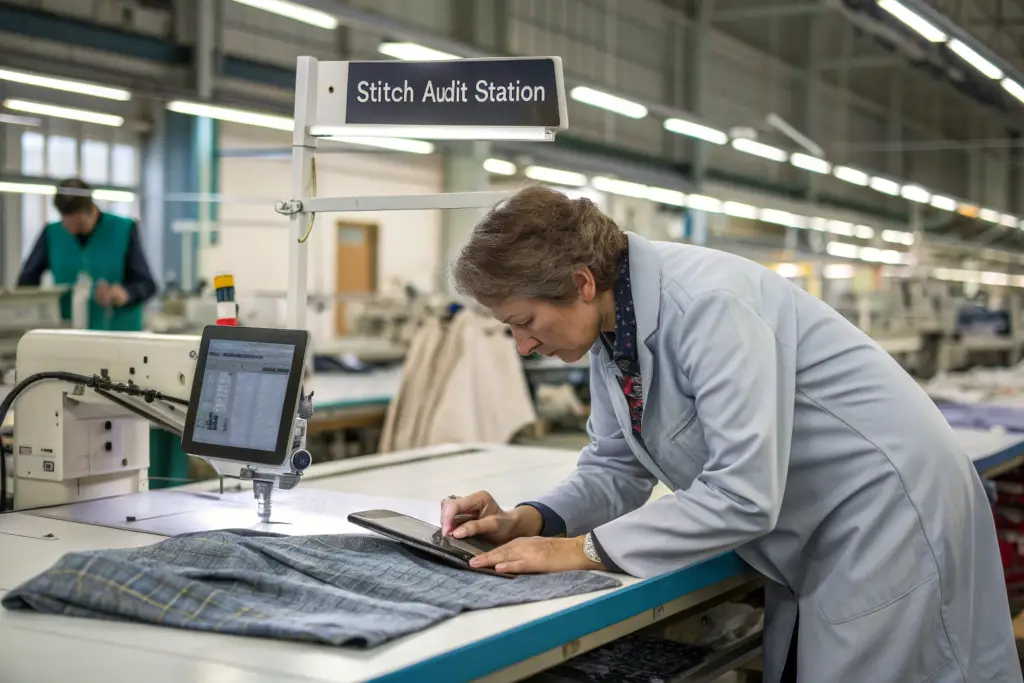
How Do Our In-Line QC Inspectors Use the Same Forensic Auditing Tools Daily?
Our roving in-line QC inspectors are equipped with pick glasses, metal measuring tapes, and digital calipers. They are trained to pull samples from every operator's output hourly and perform the exact SPI, seam allowance, and tension checks that a brand's auditor would do. This is not a final inspection; it's a continuous, proactive quality control embedded in the production process. This is our in-line quality system .
How Do We Guarantee That the Perfect Sample You Approve Is the Exact Quality You Receive in Bulk?
We use the approved, sealed PP Sample as the physical, legal standard on the factory floor. Our sewers and QC team constantly compare the bulk output against this physical reference point. We do not rely on memory. The stitch density, the seam type, and the internal finish must be an exact, identical match to the approved sample. This is how we guarantee sample-to-bulk consistency .
Conclusion
Accurately assessing the final stitching quality of a prospective overseas clothing manufacturer is not a subjective art; it is a precise, forensic science. By performing a "Micro-Measurement Audit" with a pick glass and a tape measure, conducting a "Physical Stress Test" to simulate real-world wear, and inspecting the "Invisible Truths" of the garment's interior, you can transform a hopeful guess into an objective, professional, and data-driven decision.
At Shanghai Fumao, we are masters of this science. Our entire quality culture is built on an obsessive, stitch-by-stitch commitment to precision, which we verify daily on our own factory floor. We provide our B2B partners with the confidence that the flawless sample they approve is the exact quality they will receive in every single unit of their bulk order.
If you are ready to partner with a manufacturer whose stitching quality you can trust completely, let's talk. Our Business Director, Elaine, can arrange for you to receive a sample that speaks for itself. Please email Elaine at: elaine@fumaoclothing.com.