In 2021, a children's wear brand owner from Florida called me in a panic. The U.S. Consumer Product Safety Commission had just issued a Section 15 recall on one of his best-selling hoodies. The reason? A single snap button detached from the fabric during a toddler's nap. The child put it in her mouth. She was fine, thank God. But the recall notice was public. His entire inventory was pulled from shelves. His brand was associated with "choking hazard" in every parent's mind. He lost $400,000 in revenue, and his brand took two years to recover any retail trust. The button hadn't "looked" loose. It hadn't "felt" loose. It had simply failed a mechanical test that his previous factory had never even performed.
Shanghai Fumao's multi-stage button attachment test is a pre-shipment quality assurance protocol that physically verifies every component can withstand forces well beyond the CPSC's 15-pound small parts requirement, effectively preventing a mechanical choking hazard recall before the container leaves our factory. Our protocol doesn't just test a sample. It embeds destructive testing, wash-cycle simulation, and production-line sampling into a single, documented, unbreakable chain of custody.
Most buyers don't see this invisible layer of our manufacturing. They see a price quote and a lead time. But the real value of a factory is in the disasters it prevents, not just the clothes it ships. A recall is not a quality problem. It's a business-ending event. Let me show you the exact, unglamorous, brutal testing regime we have built to stand between your brand and a CPSC catastrophe.
What Is the CPSC Small Parts Regulation for Children's Clothing?
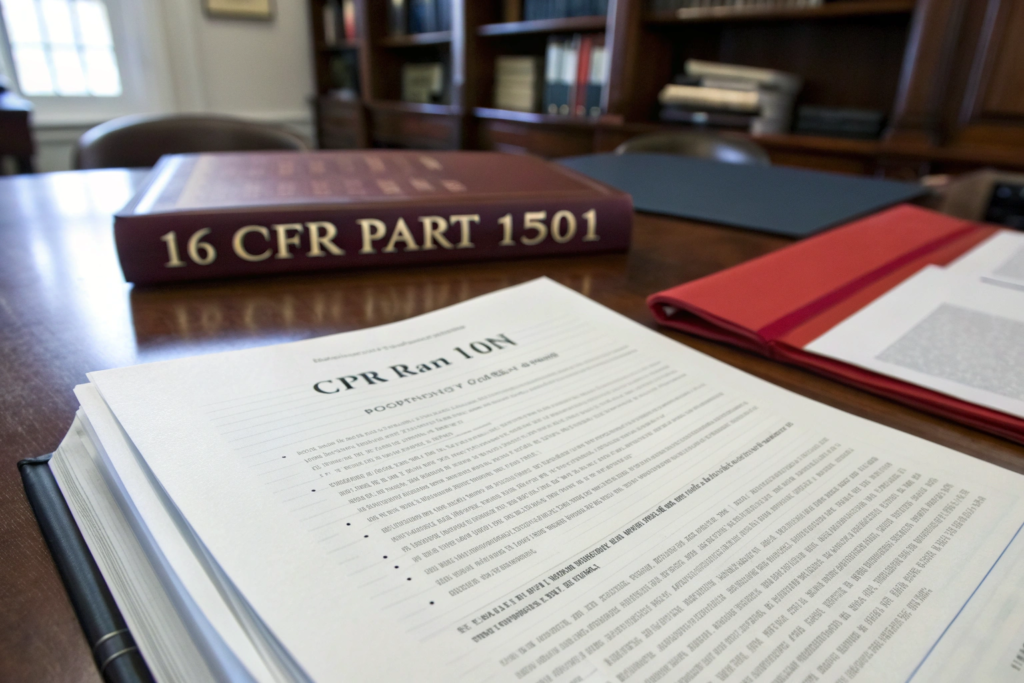
Before I explain our test, you must understand the legal weapon the CPSC wields. The regulation is not a suggestion. It's federal law, codified in 16 CFR Part 1501, and it applies with zero tolerance to any garment intended for children under three years old. The definition of "small part" is perfectly precise.
The law exists because the anatomy of a child's throat is a fixed, measurable thing. A button, a snap, a decorative rhinestone, a zipper pull—any component that detaches and fits entirely into the official test cylinder is legally defined as a choking hazard. The manufacturer and the importer of record, that's you, the brand owner, are strictly liable.
How Does a 15-Pound Force Test Stop a Choking Hazard?
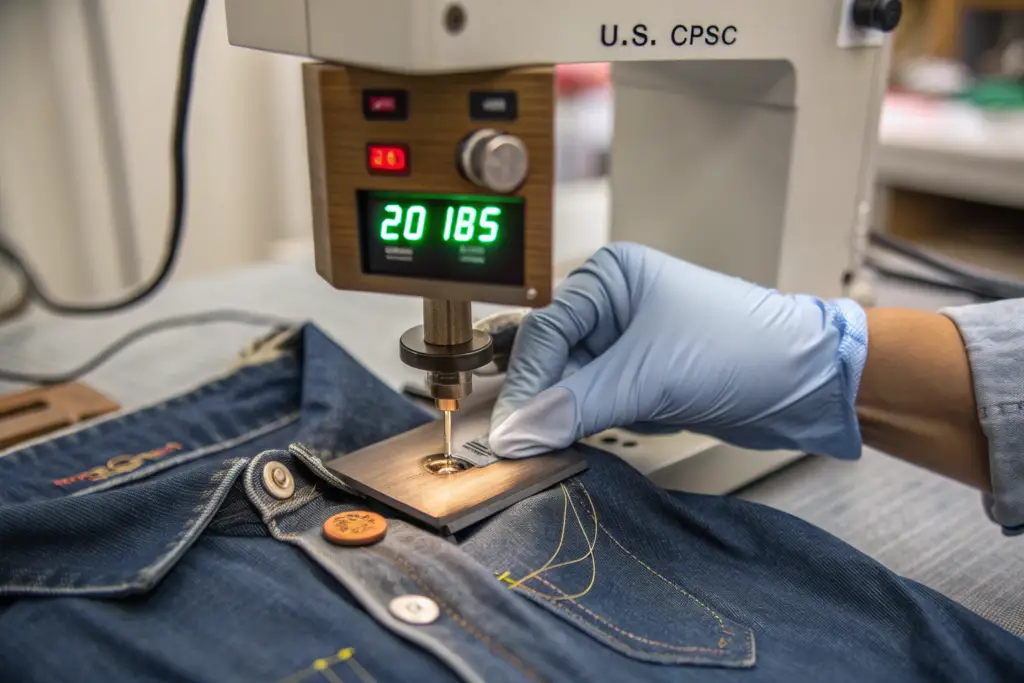
The 15-pound force test is a direct mechanical simulation of a child's grip. A toddler's hand, in a reflexive or stubborn moment, can exert roughly 10 to 12 pounds of pull. The CPSC set the standard higher, at 15 pounds, to create a safety margin. The test is brutally simple. A calibrated force gauge is attached to the button. The gauge is pulled steadily for 10 seconds. If the button snaps off, cracks, or detaches in any way at a force less than 15 pounds, the entire garment shipment is legally banned from U.S. commerce.
A component that fails this test is a banned hazardous substance. Our team has seen factories treat this test as a one-off pre-production check. They test a sample, get a pass, and ignore the variance in bulk production. That is professional negligence. Button sewing tension can drift. A thread batch can be slightly weaker. A brass shank can have a micro-fracture. A single test on a golden sample is not a defense. It's a gamble. The CPSC does not care about your sample test. It cares about the product in the consumer's home. Our whole testing philosophy at Shanghai Fumao is built on the understanding that a 14.9-pound failure on a bulk garment is the same legal and commercial disaster as a total absence of testing. We enforce the standard ruthlessly, across every production line, not as a sampling exercise but as a continuous, in-line responsibility. If you want to understand the deeper mechanics of product safety law, the CPSC's official guide is your primary legal reference.
Why Are Snaps and Rivets the Biggest Hidden Danger?
They feel strong, so buyers trust them. This trust is a trap. A sew-on wooden button is visually and physically inspected by a sewing operator with every cycle. A snap fastener, however, is attached by a mechanical press in a single, high-pressure stroke. The operator loads the fabric, presses a pedal, and the metal prongs pierce the fabric and curl inward. If the setting die is fractionally worn, or if the pressure is off by a few PSI, the snap looks perfect but the prongs haven't fully curled.
This is an invisible failure. The snap feels solid. It functions. But under a 10-pound load, the sharp, uncurled prongs can slide right out of the fabric. We have performed destructive autopsies on failed snaps under our digital microscope. The failure is always the same: an incomplete mechanical clinch. A rivet, similarly, is a two-part assembly. If the post and cap are not perfectly aligned and compressed, the internal bond is weak. These metal fasteners are the most dangerous components on a child's garment precisely because their failure mode is silent and catastrophic. A button might hang by a thread, giving a visual warning. A snap pops off cleanly, leaving a perfect, swallowable metal disc. This is why our testing protocol for snaps and rivets is more intensive, with a higher sampling rate and a slower, more deliberate production speed that allows for in-line visual inspection of the clinched prongs on the underside of every single snap. This is not standard practice in high-speed factories. It is a deliberate choice we make to prioritize safety over raw unit output, a choice that directly protects your brand from the hidden dangers of the global supply chain.
How Is Fumao's Pre-Shipment Test More Rigorous Than a Standard AQL?
Standard AQL inspection is a census of defects. It is a good system for measuring hem symmetry and loose threads. But a safety-critical defect like a loose button is a statistical outlier that a random AQL sample can easily miss. Standard protocols are not designed to catch a single, lethal failure in a shipment of 5,000 units.
Our pre-shipment process doesn't replace AQL. It adds a separate, parallel, safety-specific testing layer. We don't just look at the garment. We physically assault a statistically valid sample of the components. Our protocol is designed to catch the non-obvious, the mechanically weak, the failure waiting to happen in a customer's home.
What Does a 40-Pound Destructive Wash Test Prove?
It proves that a button can survive not just the shipping box, but years of aggressive home laundering. The CPSC standard applies to the product "as sold" and "as used." A button that passes the 15-pound pull test on a new, unwashed garment is not guaranteed to pass after 20 laundry cycles where hot water, detergent, and mechanical tumbling have degraded the thread's tensile strength.
Our destructive wash protocol is simple. We take a random sample of 20 finished garments from your bulk production run. We attach a 40-pound weight to a test fixture, but this is not a pull test. We run these garments through a commercial washer and dryer for 10 full cycles, simulating roughly 30 to 40 home washes. Then, after the fabric has shrunk, the thread has been chemically stressed, and the metal components have been thermally shocked, we perform the 15-pound pull test on every single button and snap. We want to see the failure mode after aging. If the thread holds at 22 pounds after this torture test, we know the garment will survive a real child's lifetime. This is not a CPSC requirement. It is a Shanghai Fumao internal standard, designed because we know that a recall two years after sale is still a recall, and your brand’s liability does not expire when the season ends. This level of aging simulation is what builds a bulletproof supply chain.
How Does Our In-Line Force Sampling Catch a "Monday Morning" Failure?
Factory workers are human. A machine setting can drift. A new operator on a Monday morning can set a snap press slightly off-tension. A batch of thread from the dye house might have a slightly lower breaking strength. These are not theoretical risks; they are daily realities on a production floor.
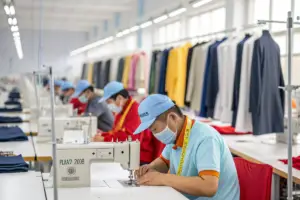
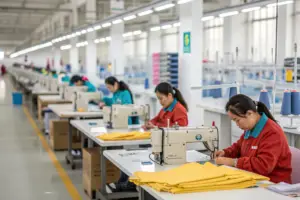
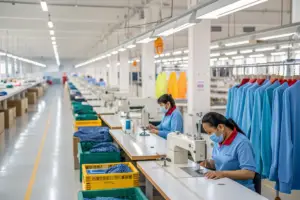
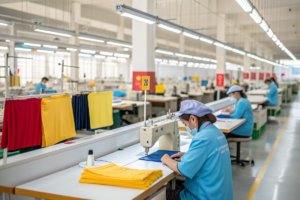
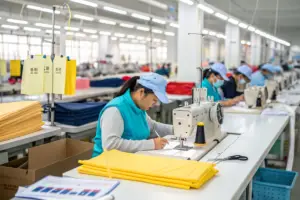
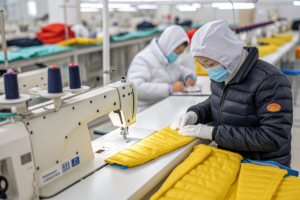
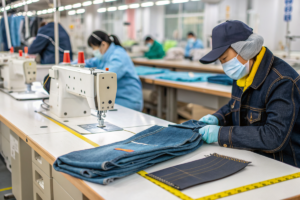
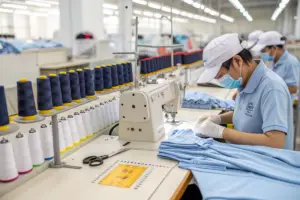
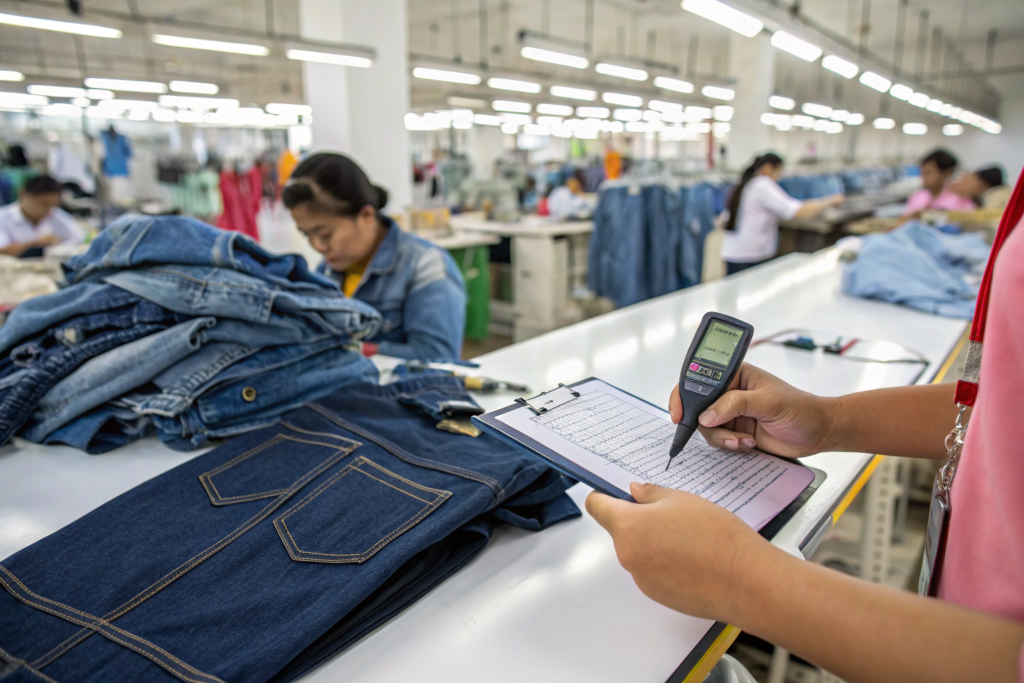
To catch this variability, we have moved the pull test from the end of the line to every station, every day. Our in-line QC technicians carry a portable, calibrated digital force gauge. At random intervals, during the production run itself, they pull a garment off the sewing line, just seconds after the button or snap is attached. They perform the 15-pound test right there, on the factory floor, with the sewing operator watching. If the component fails, the entire batch from that station since the last successful check is immediately quarantined and 100% re-inspected. The operator’s machine is recalibrated on the spot. This is real-time process control, not a final audit. We caught a failure just last month. A new snap-setting machine had been incorrectly calibrated by a night-shift technician. The snaps looked perfect. Our 10:00 AM in-line check caught a 14-pound failure on the third pull. We quarantined 85 jackets. Without that in-line check, those 85 jackets would have passed a standard end-of-line AQL visual and entered the shipment. This is the difference between a controlled process and a gamble. It is a level of operational discipline that we are proud to share transparently with any potential brand partner who visits our floor.
Can a Shank Failure Really Trigger a Full CPSC Recall?
Yes, a shank failure can trigger a full recall, and it is one of the most difficult defects to catch without destructive testing. A shank is the small, hollow loop on the back of a button, usually made of brass or steel. It is the structural link between the decorative face and the thread. When it breaks, the button separates not from the thread pulling out, but from the metal itself snapping.
This is a material science failure, not a sewing failure. It happens at a microscopic level. A poorly extruded brass shank can have internal voids. A steel shank can be over-hardened and become brittle. The button looks perfect. The thread is intact. But the metal itself is a ticking clock, waiting for a thermal shock from a hot dryer or a sudden mechanical impact from a child's fall to shatter.
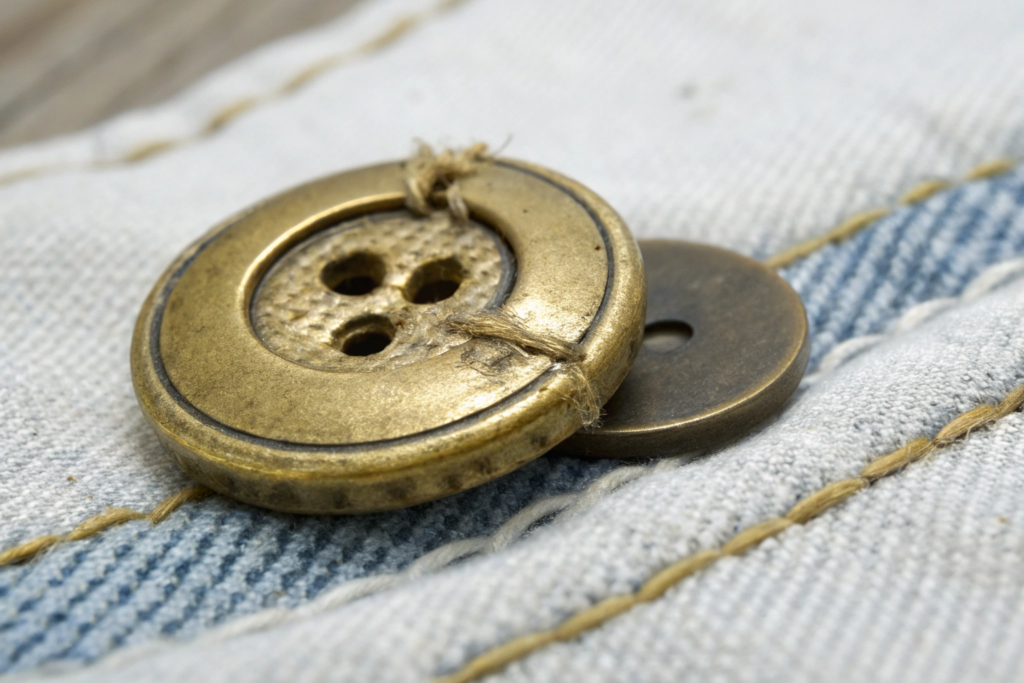
What Metallurgical Defect Causes a Shank to Snap Under 15 Pounds?
Stress corrosion cracking, or a simple manufacturing defect called hydrogen embrittlement. In brass shanks, we have seen failures caused by residual ammonia from a poorly controlled dyeing process attacking the stressed grain boundaries of the metal. The metal literally rots from the inside while the outside remains polished and shiny. It loses its ductility. Instead of bending under load, it snaps like a twig.
Our solution is not just to trust a metal component certificate. We conduct a simple, brutal batch-verification test on every incoming shipment of buttons. Our QC team takes a random sample of 20 buttons from each new batch, clamps the button head in a vice, and uses needle-nose pliers to grip the shank. They apply a sharp, sudden lateral force. A properly manufactured brass shank will deform and bend before breaking. A brittle, defective shank will snap with a clean, glass-like fracture surface. If a single shank in the batch exhibits brittle fracture, the entire button batch is rejected and returned to the supplier. This is not a standard textile QC test. It's a material hardness and ductility assessment that we learned from studying recall case files where the CPSC trace investigation found a microscopic manufacturing defect in a single batch of metal components. A single batch of bad shanks can destroy a whole season. Our incoming materials testing is your firewall against a latent metallurgical defect that no amount of sewing skill can fix.
How Do We Source Certified Brass to Eliminate This Risk?
We source only from audited, certified trim suppliers who provide a material composition certificate with every shipment. The brass must be lead-free, meeting the CPSC’s total lead content requirement of 100 parts per million for children's products, which is another layer of chemical compliance beyond the mechanical test. The certificate must specify the exact alloy, typically a copper-zinc composition with no added lead, cadmium, or nickel release above the EU REACH limits, which are stricter in many cases.
This certificate is cross-referenced against the physical test. We don't file the paper and forget it. We match the lot number on the certificate to the physical box of buttons in our warehouse. Our sourcing team in Shanghai has personally visited the factories that produce our metal trims, auditing their smelting and stamping processes. We look at their scrap metal recycling protocols to ensure no lead-contaminated scrap enters their supply chain. This is the invisible, tedious, expensive work of true compliance. It is not just about the final test. It is about controlling the raw material inputs so that the final test is a confirmation of a known material, not a blind screening of an unknown one. When a brand partners with Shanghai Fumao, they are tapping into a pre-audited, closed-loop metal trim supply chain that has been built specifically to withstand the documentary demands of a CPSC follow-up investigation. You are buying the paper trail as much as the product. This is what allows you, as a U.S. importer, to stand confidently behind your product, knowing that your supply chain for every single component is documented, verified, and defensible under the strict liability regime of the Federal Hazardous Substances Act.
What Documentation Defends a Brand During a CPSC Investigation?
If a child is harmed, the CPSC does not just test the product. They investigate the design, the manufacturing process, and the quality control system. They ask for documents. In that moment, your defense is not your memory. Your defense is the paper you kept. If you cannot produce a signed, dated test report, you are defenseless.
A recall is a legal process with evidence. The most important product we ship alongside your garments is a documentary package that proves due diligence. This package is your seatbelt. It won't prevent a crash, but it will prove you did everything in your power to prevent it, which can be the difference between a company-saving corrective action plan and a company-ending civil penalty.

Why Is a "Safety Test Certificate" Not Enough for CPSC?
A generic "Safety Test Certificate" from an unknown lab is worse than nothing. It gives a false sense of security. The CPSC requires that children's product testing be performed by a CPSC-accepted, third-party laboratory. The certificate must include the specific regulation tested, the exact test method, the sampling plan used, and the full contact information of the responsible party.
We provide our brand partners with a Children's Product Certificate (CPC) for each shipment that is compliant with 16 CFR Part 1110. This is not a template. It is a legal document. It lists every applicable regulation: 16 CFR Part 1501 for small parts, 15 U.S.C. § 1278a for lead content, and 16 CFR Part 1307 for phthalates. It lists the specific batch numbers of the garment and the buttons. It states the name of the CPSC-accepted lab that did the final verification, which is often SGS or Bureau Veritas for our U.S.-bound shipments. This CPC is your first line of defense. When a CPSC investigator asks for your compliance documentation, you send this CPC, and you send the full technical file behind it, which we maintain as part of our standard quality assurance package. A vague certificate is not a defense; it is an admission that you didn't know the rules. A specific, regulation-by-regulation CPC is the basic, non-negotiable entry ticket to U.S. commerce for children's clothing.
How Can a Batch-Specific Test Report Save My Business?
It limits the damage. A recall is an all-or-nothing event only if you cannot prove the defect is confined to a single batch. If you only have a one-time, annual "type test" on a golden sample, the CPSC will assume your entire production for that year is suspect. They will recall everything.
A batch-specific test report, linked to a specific production lot by a unique identifier, is your containment tool. We laser-print a subtle, internal production batch code onto the back of every care label. This code corresponds to a specific testing record in our database. That record contains the date of production, the button batch number, the results of the in-line force testing, and the final third-party CPC. If a single garment from batch "0523-27" fails in the field, we can pull that specific test report. We can show the CPSC exactly how many units were in that batch, exactly where they were shipped, and what testing they passed before leaving our factory. This precise, granular traceability can limit a recall from a brand-wide catastrophe to a targeted, manageable market withdrawal of a specific, small batch. It transforms an existential threat into a logistical problem. This is the ultimate purpose of all the testing: to give you the forensic evidence to surgically remove a problem without killing the patient. It is the most valuable piece of operational resilience that a manufacturer can provide to a U.S. brand owner, and it is built into every order we ship.
Conclusion
A CPSC recall is a brand's worst nightmare, but it is a nightmare born from a specific, preventable mechanical failure. The 15-pound pull test is not a piece of bureaucratic paperwork. It is the exact force a child's hand can exert, and the law is an absolute, strict-liability barrier. At Shanghai Fumao, we do not gamble with your brand's life. Our protocol integrates a 40-pound destructive wash simulation to guarantee long-term durability, in-line force sampling to catch the human and machine variability that AQL misses, and a metallurgical incoming inspection on our metal shanks to prevent a material science failure before it ever reaches a garment. The result is a fully documented, batch-specific Children's Product Certificate that transforms your compliance from a blind hope into a verifiable, defensible legal shield.
The cost of this testing is measured in cents per unit. The cost of a recall is measured in hundreds of thousands of dollars and a permanently damaged reputation. The choice is not between a cheap factory and an expensive one. It is between a factory that protects your brand with a systematic, documented safety process and one that leaves you legally exposed, holding a failed snap and a CPSC notice.
Don't let your next shipment be the one that puts a child at risk and your company in the headlines. Protect your brand with the same rigor we use on our own factory floor. To discuss your children's wear production, to audit our testing protocols yourself, or to receive a sample of our full technical compliance dossier, contact our Business Director, Elaine, at elaine@fumaoclothing.com. Let her show you the unglamorous, invisible, non-negotiable safety infrastructure that stands between your brand and a recall. Let's build a product that protects both the child who wears it and the company that stands behind it.