I was in a product review meeting with one of our longest-standing wholesale partners last January. He is a distributor who supplies about two hundred boutiques across the Southeast. He had our entire summer line sheet spread across the table. He was not looking at the designs first. He was running his finger down the wholesale price column. "I do not care how beautiful it is," he said, looking at me over his glasses. "I care about my margin. Show me the styles where I make the most money." He was not being difficult. He was being a smart businessman.
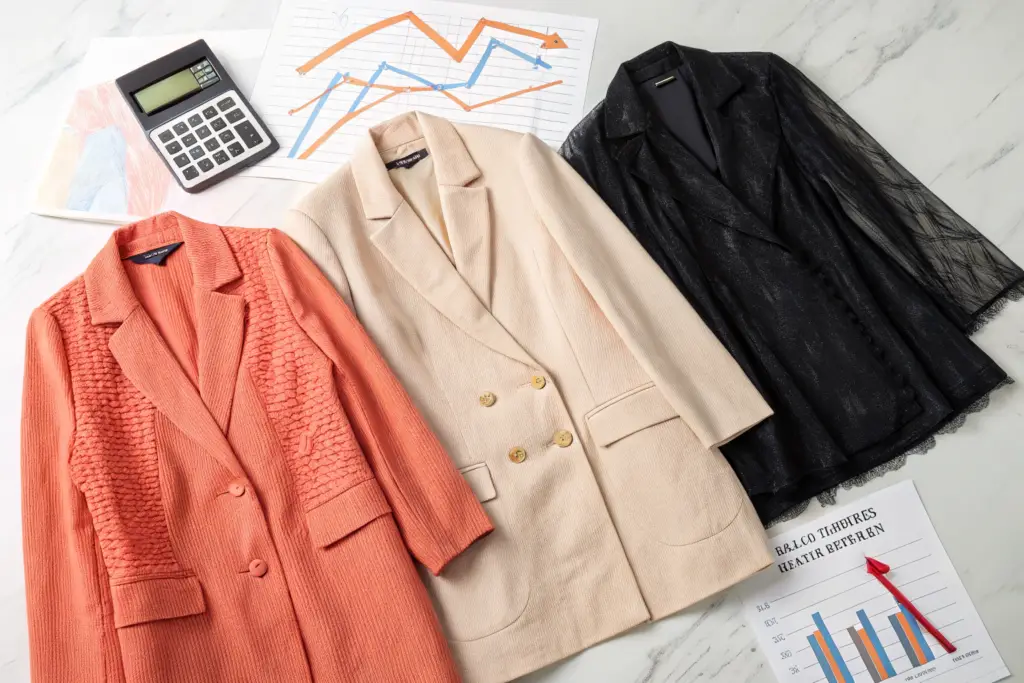
The summer coat styles offering the highest profit margins in 2026 are the crochet duster, the soft-tailored linen blazer, and the sheer organza coat, each delivering exceptional margins through high perceived value, production efficiency, and premium pricing power.
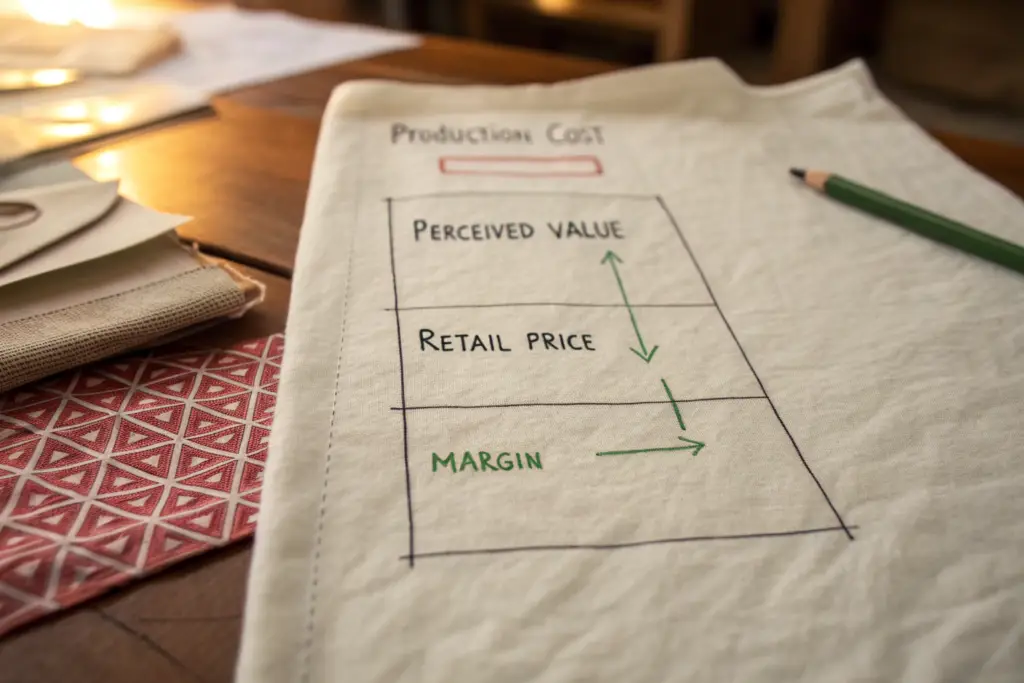
Margin is not just about finding the cheapest factory price. It is about understanding the relationship between production cost, perceived value, and the retail price your customer is willing to pay. At Shanghai Fumao, we analyze this margin equation for every style we develop. I want to pull back the curtain and show you exactly which styles are delivering the strongest returns for our partners and why.
What Makes a Summer Coat Style Inherently High-Margin?
A high-margin garment is not necessarily a cheap garment to produce. It is a garment where the gap between the cost of production and the customer’s willingness to pay is the widest. The two key levers are production efficiency and perceived value. Production efficiency is about smart design that minimizes labor and material waste without compromising quality. Perceived value is about creating a product that looks, feels, and is communicated as being worth far more than its component costs.
A summer coat style is inherently high-margin when it combines efficient, simplified production with a high perceived value driven by visible texture, intricate-looking detail, or a compelling sustainability or craftsmanship story.
These two forces work together. If you cut cost but kill the perceived value, you have a cheap coat you have to discount. If you create huge perceived value but the production is wildly complex, your cost eats your margin. The magic happens when both forces align. At Shanghai Fumao, we design for this alignment. We ask two questions about every new style. How can we engineer this to be efficient to produce? How can we design it to look and feel significantly more expensive than it is?
How Does Perceived Value Justify a Premium Retail Price?
Perceived value is the silent salesperson. It is the reason a customer will pay $250 for one linen blazer and $89 for another that looks similar in a thumbnail image. The difference is in the details she discovers when she touches it, tries it on, and wears it. The weight of the fabric. The texture of the weave. The soft, fluid drape. The elegant roll of the lapel. The beautiful, natural buttons. These details communicate an unspoken promise of quality and luxury.
A garment with high perceived value triggers an emotional response. The customer feels more elegant, more successful, more put-together. She is not buying a coat. She is buying that feeling. That feeling is what justifies the premium price. We focus obsessively on the hand feel of our fabrics. A Tencel-linen blend that feels like silk. An enzyme-washed cotton that feels like a favorite old shirt. The customer feels the quality instantly. Her price resistance dissolves. The premium price is no longer an obstacle. It is a confirmation of the value she already feels in her hands.
What Production Efficiencies Boost Margin Without Sacrificing Quality?
Margin is also built on the factory floor. It is about smart, efficient design that reduces labor time without the customer ever noticing. An unlined coat, for example, eliminates the entire process of cutting, sewing, and attaching a lining. If the internal seams are cleanly finished with a beautiful binding, the unlined coat can look even more premium than a lined one. It feels lighter and more breathable for summer. The customer perceives added value. The production cost is lower.
A single-button closure versus a complicated double-breasted front with six buttons and reinforced buttonholes. A clean, open front versus a full zip with a storm flap. These are not design compromises. They are design decisions that create a modern, minimalist aesthetic that is highly fashionable right now. The customer loves the clean look. The production cost is lower. We also engineer our patterns to minimize fabric waste. A well-nested pattern can save a surprising amount of fabric cost per unit. These efficiencies add up across a production run of hundreds of units, delivering a healthier margin without touching the customer-facing quality.
Which Specific Styles Are the Top Margin Performers for 2026?
Based on our production data and sell-through reports from partners across North America, three specific styles are consistently delivering the strongest margin profiles for Summer 2026. These styles are not accidental winners. They are the result of the perfect alignment between production efficiency and high perceived value. They each tell a slightly different margin story, offering different opportunities depending on your brand’s market position.
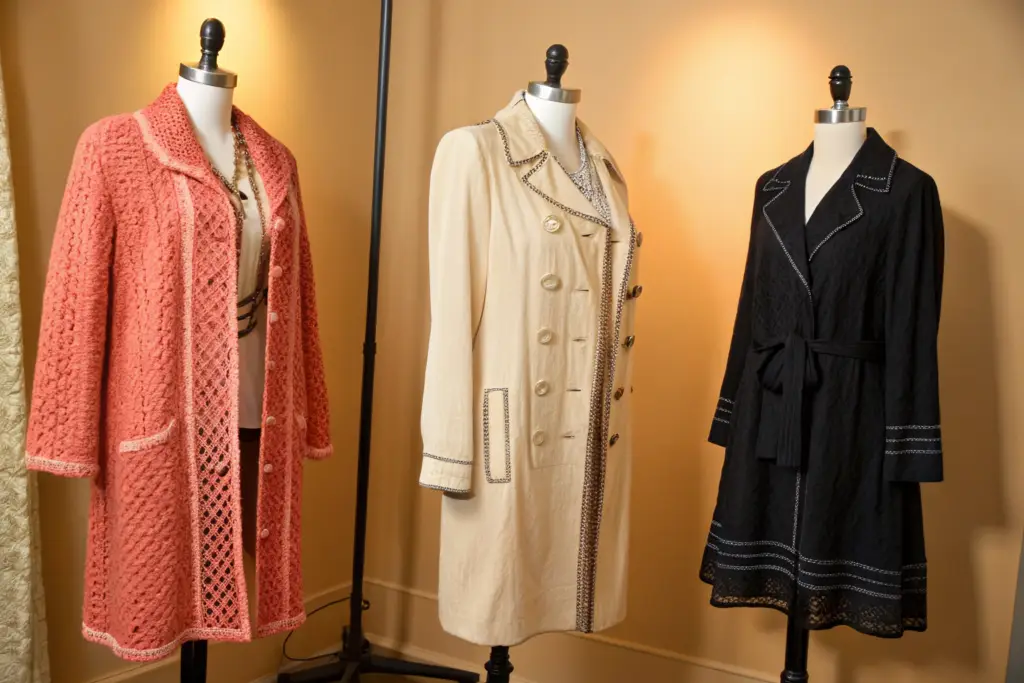
The crochet duster, the soft-tailored linen blazer, and the sheer organza coat are the three highest-margin summer coat styles, each leveraging a unique combination of perceived value and production efficiency.
These three styles should be at the top of your consideration list when you are allocating your open-to-buy budget for maximum profitability. They are the profit engines of a summer outerwear assortment.
Why Is the Crochet Duster a Margin Superstar?
The crochet duster is a margin phenomenon. To the customer, it looks like an intricate, labor-intensive, hand-crafted artisanal piece. She perceives dozens of hours of skilled handwork. She is willing to pay a significant premium for this perceived craftsmanship. In reality, modern warp-knitting technology has advanced to the point where we can produce fabrics that perfectly mimic the look of hand crochet at a fraction of the cost. The fabric is produced by a machine in continuous rolls, then cut and sewn with standard construction methods.
This gap between the perception of artisanal handwork and the reality of efficient machine production is where the extraordinary margin lives. A crochet duster can be produced for a cost comparable to a standard cotton coat, but it commands a retail price 40% to 60% higher. We developed a crochet-look duster for a contemporary brand using a proprietary knit stitch we engineered with our mill. The wholesale price was $42. The brand retailed it for $148, a 71% margin. It was their most profitable summer SKU across their entire collection. The product imagery focused on the intricate stitch detail. The customer saw the value immediately.
What Makes the Soft-Tailored Linen Blazer a Reliable Profit Engine?
The soft-tailored, unlined linen blazer is a more subtle margin story, but it is arguably the most reliable profit engine in the summer coat category. It is a high-volume piece. It sells in quantity. The margin per unit may be slightly lower than a crochet duster, but the total profit generated across hundreds of units is substantial. The efficiency comes from the simplified construction. Unlined, with soft tailoring that requires less internal structure and less hand-finishing than a fully canvassed blazer.
The perceived value comes from the fabric and the fit. A high-quality, pre-washed European linen has an unmistakable luxury hand feel. A relaxed but impeccably proportioned fit makes the customer feel instantly elegant. This blazer is often purchased as part of a suit, which further boosts the average order value. One of our wholesale partners sells a matching linen blazer and wide-leg trouser set. The bundled suit offers a slightly better margin for them, and the customer perceives the matching set as a premium, coordinated look. The blazer anchors the sale.
How Does the Sheer Organza Coat Deliver High Margins at Low Complexity?
The sheer organza coat is a masterclass in minimalist production. It is often an open-front design with no buttons, no zippers, and no complex closures. It is unlined. The seams are simple, often heat-sealed or cleanly stitched with a French seam. The construction is, in many ways, the simplest of any coat style. The fabric, a fine polyester organza or a silk blend, is relatively inexpensive compared to heavy wool or premium linen.
The perceived value, however, is enormous. A sheer coat has a dramatic, editorial, high-fashion presence. It looks like a piece straight off the runway. It photographs incredibly well. It is the piece that elevates a brand’s entire image. A black sheer organza trench can be produced for a very low cost, yet it routinely retails for $120 to $180. A fashion-forward DTC brand we work with made the sheer trench the centerpiece of their summer campaign. They sold it at a 75% margin. The piece generated massive social media buzz and drove traffic that converted on their higher-volume basics. It was a profit center in its own right and a powerful marketing asset.
How Do You Calculate and Protect Your Margin on Summer Coats?
Knowing which styles are high-margin is step one. Step two is calculating your specific margin accurately and protecting it throughout the process. Many brand owners make the mistake of calculating margin only on the factory’s FOB price. This is a dangerous oversimplification. The true margin is calculated on the fully landed cost of the goods, including all shipping, duties, and fees. An unexpected charge at the port can wipe out a third of your anticipated profit.
Accurate margin calculation requires using the fully landed DDP cost as your cost basis, and protecting that margin involves locking in prices, verifying fabric content, and conducting pre-shipment quality inspections.
This financial discipline is what separates a profitable brand from a busy brand. At Shanghai Fumao, we work with our partners on a fully transparent DDP basis. The price we quote is the price you pay, delivered to your door. No surprises.

What Is the Correct Formula for Calculating Your True Landed Cost?
The formula is straightforward, but every component must be accurate. Your true cost per unit is the DDP price. This single price includes the ex-factory cost, the export clearance, the ocean or air freight, the US customs duty, and the final trucking to your warehouse. Divide that total DDP price per unit by your target markup to determine your wholesale or retail price. If your DDP landed cost is $40 per coat and you use a standard keystone markup, your wholesale price is $80.
If you sell direct-to-consumer, you would likely apply a higher markup. A coat with a $40 landed cost might retail for $120 or $140, depending on your brand positioning. The beauty of the DDP model is that the cost is fixed and known upfront. You can set your retail prices with total confidence. You are not waiting for a customs bill to arrive two weeks after delivery. Your margin projection is accurate from the start.
How Can You Protect Your Margin from Quality and Compliance Failures?
A margin calculated on a spreadsheet is theoretical. It only becomes real when the goods arrive in perfect condition and sell through at full price. A quality failure is a direct hit to your margin. Defective coats must be returned, discounted, or destroyed. The cost of the quality failure is far greater than just the production cost. It includes the lost revenue, the cost of processing the return, and the damage to your brand reputation. Protecting quality is protecting margin.
Conduct a pre-shipment inspection on every order. An AQL inspection by a third-party service will catch defects before the goods leave the factory. Verify the fabric content. A coat labeled as 100% linen that actually contains polyester will result in returns and chargebacks. Request a lab test report. We provide independent SGS or Intertek test reports with every shipment to our partners. This documentation proves the fabric content and protects against disputes. These steps cost a small amount upfront but protect the much larger margin investment.
Conclusion
Profit margin is not an accident. It is a deliberate outcome of smart design, strategic sourcing, and disciplined financial management. The summer coat styles delivering the highest margins in 2026, the crochet duster, the soft-tailored linen blazer, and the sheer organza coat, each achieve this by brilliantly aligning efficient production with the customer’s willingness to pay a premium. The crochet duster trades on the perception of artisanal handwork. The linen blazer trades on luxurious fabric and impeccable, relaxed fit. The sheer coat trades on high-fashion drama with minimalist construction.
The opportunity for your brand is to build your summer assortment around these profit engines. Calculate your margins on a fully landed DDP basis so you know your numbers are real. Protect those margins with rigorous quality control and verification. At Shanghai Fumao, our entire business model is built on helping our partners achieve healthy, sustainable margins. If you would like to review our high-margin summer coat styles and run the numbers together, I invite you to reach out to our Business Director, Elaine. She can prepare a detailed DDP costing sheet for your specific requirements. You can contact her at elaine@fumaoclothing.com. Let’s build a collection that is as profitable as it is beautiful.