About five years ago, a brand owner I had worked with for several seasons came to me with a problem. He had developed a unique shorts pattern with our factory, a specific combination of a contoured waistband, a particular pocket angle, and a proprietary fit block that he had refined over three seasons of customer feedback and returns data. It was his brand's signature. He had just discovered that another brand, a direct competitor, was selling a short with an almost identical fit, made in the same factory. He was furious. He believed his pattern had been used for another client. I investigated. The factory had not stolen his pattern. The factory owner had simply treated the pattern as a factory asset, developed with the buyer's input, but not legally belonging to the buyer. There was no contract assigning the pattern rights. There was no exclusivity agreement. The brand owner had assumed the pattern was his. The factory owner had assumed it was shared. Both were operating on assumptions, not on a signed agreement.
Securing exclusive rights to a factory's rare classic shorts pattern in China is achieved through a legally binding Exclusive Development and Supply Agreement that explicitly states that the pattern, the design, and all associated intellectual property developed during the collaboration are the sole property of the buyer, combined with a practical, mutually beneficial exclusivity clause that compensates the factory for the opportunity cost of not using the pattern for other clients, and supported by physical control measures including the secure storage of the physical pattern and the digital pattern files, regular audits of the factory's production for other clients, and the registration of the design with the appropriate intellectual property authorities.
At Shanghai Fumao, I have seen the consequences of both well-structured and poorly structured pattern ownership arrangements. A rare, proprietary pattern is a competitive advantage. Protecting it requires a combination of legal, commercial, and practical measures. Let me walk you through each layer of protection.
What Legal Agreements Actually Protect a Pattern in China?
The foundation of pattern protection is a written, signed contract. In China, as in most jurisdictions, the contract is the primary document that establishes who owns what. Without a contract, the pattern is in a legal gray area. The buyer may have a moral claim to the design they developed, but enforcing that claim without a written agreement is difficult, expensive, and uncertain. The contract must be specific, bilingual, and enforceable under Chinese law.
The legal protection of a classic shorts pattern in China rests on a comprehensive OEM or Product Development Agreement that includes specific clauses covering Design Ownership, which explicitly states that all patterns, designs, and specifications developed for the buyer are the buyer's exclusive property; Non-Use, which prohibits the factory from using the pattern for any other client; Non-Disclosure, which prohibits the factory from sharing the pattern with any third party; and a Dispute Resolution clause specifying arbitration in a neutral jurisdiction, with the entire agreement executed in both English and Chinese to ensure mutual understanding and enforceability under Chinese contract law.

What Specific Clauses Must a Pattern Ownership Contract Include?
A generic manufacturing agreement is not sufficient to protect a proprietary pattern. The contract must include several specific, clearly worded clauses. The Design Ownership clause should state: "All patterns, designs, technical specifications, fit blocks, and intellectual property developed by the Factory for the Buyer under this Agreement shall be the sole and exclusive property of the Buyer. The Factory assigns all rights, title, and interest in such intellectual property to the Buyer." This language establishes a clear legal transfer of ownership.
The Non-Use clause should state: "The Factory shall not, for the duration of this Agreement and for a period of five years following its termination, use the Buyer's patterns, designs, or any derivative thereof, for any purpose other than fulfilling the Buyer's purchase orders, including but not limited to manufacturing goods for any other client." The Non-Disclosure clause should prohibit the factory from sharing the pattern, the tech pack, or any related information with any third party. These clauses, taken together, establish the buyer's legal ownership and restrict the factory's ability to use or share the pattern. This intellectual property protection for apparel designs in China provides an overview of the legal framework.
Why Must the Contract Be in Both English and Chinese?
Chinese courts and arbitration panels give primary weight to the Chinese-language version of a contract. If a contract is signed only in English, the factory may later claim that it did not fully understand the terms. The enforceability of the contract is weakened.
A bilingual contract, with both the English and Chinese versions signed and with a clause stating that both versions are equally authentic, eliminates this risk. The translation must be accurate. It is not sufficient to use a machine translation. The contract should be translated by a legal professional who is fluent in both languages and familiar with Chinese contract law. The investment in proper translation is a fraction of the cost of litigating a contract dispute. This bilingual contract requirements for international trade with China explains the importance of bilingual documentation.
How Can You Structure a Win-Win Exclusivity Clause?
A legal contract that demands exclusivity but offers nothing in return is a contract that the factory may sign reluctantly, but will not feel invested in honoring. The factory is a business. The pattern represents a potential revenue stream. If the buyer simply demands that the factory give up that revenue stream without compensation, the relationship is adversarial from the start. The factory may look for ways to circumvent the agreement. A win-win exclusivity clause compensates the factory for the opportunity cost of exclusivity, aligning the factory's financial interests with the buyer's interest in protection.
A win-win exclusivity clause compensates the factory for the business it is giving up by agreeing not to use the buyer's pattern for other clients, through mechanisms such as a negotiated Exclusivity Premium added to the per-unit FOB price, typically $0.50 to $1.00, a volume commitment that guarantees the factory a minimum annual order quantity that justifies the dedicated capacity, or a multi-year supply agreement that provides the factory with revenue certainty in exchange for the exclusivity commitment, transforming the legal restriction from a burden into a valued, compensated term of the partnership.

What Is an Exclusivity Premium and How Is It Negotiated?
An exclusivity premium is a small additional amount, typically $0.50 to $1.00 per unit, added to the FOB price of the shorts in exchange for the factory's agreement not to use the buyer's pattern for any other client. The premium compensates the factory for the opportunity cost of the exclusivity. It is not a large amount per unit, but multiplied across a season's order, it represents a meaningful revenue stream for the factory.
The buyer should frame the premium as a fair compensation for a valuable commitment. "We understand that agreeing not to use this pattern for other clients means you are giving up potential business. We are committed to this partnership, and this premium reflects that commitment." The premium transforms the exclusivity clause from a demand into a negotiation. The buyer is not just taking something away. They are offering something in return. This negotiating exclusivity clauses in manufacturing contracts explains the commercial logic.
How Does a Volume Commitment Justify Exclusivity?
A factory's primary concern is maintaining its production volume and revenue. A buyer who places a small, irregular order and demands exclusivity is asking the factory to sacrifice potential revenue for a very uncertain return. The factory is unlikely to agree, and if it does agree, it is unlikely to honor the agreement enthusiastically.
A buyer who commits to a guaranteed minimum annual volume provides the factory with the revenue certainty that justifies the exclusivity commitment. The contract specifies that the buyer will purchase a minimum of, for example, 10,000 units per year for three years. The factory knows that this client alone will provide a stable, predictable base of revenue. The exclusivity clause is no longer a restriction on the factory's ability to seek other business. It is a term of a valuable, guaranteed revenue stream. This volume commitment and exclusivity in manufacturing agreements explains the strategic use of volume commitments.
What Physical and Practical Measures Protect a Pattern Beyond the Contract?
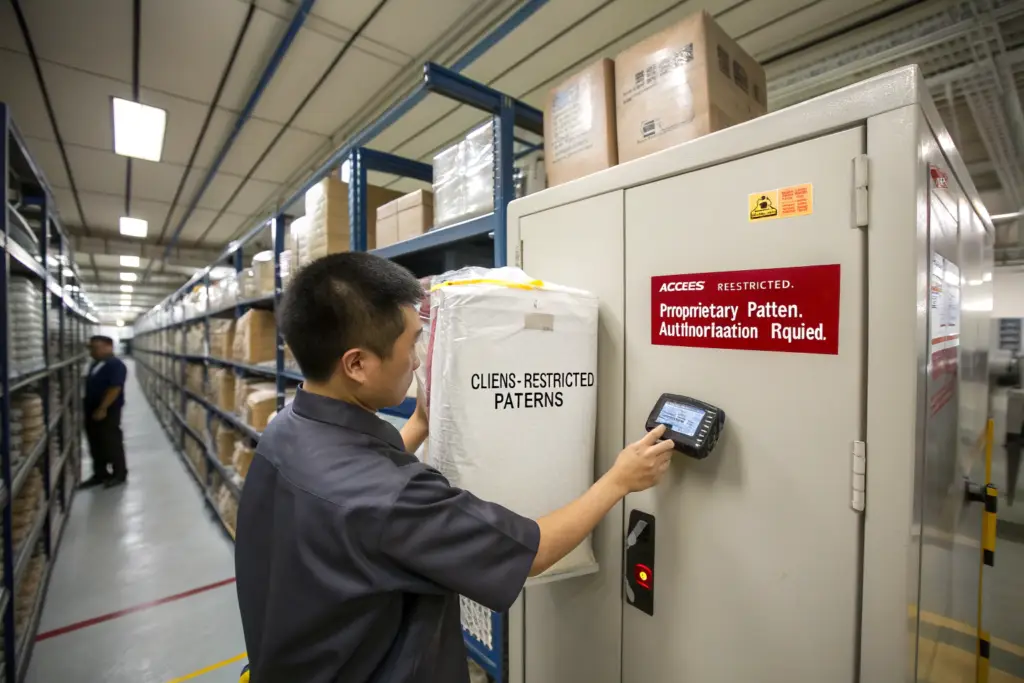
A contract is a piece of paper. It is essential, but it is not sufficient on its own. Practical, physical measures must be in place to control access to the pattern and to monitor compliance. A factory that has signed an exclusivity agreement but stores the buyer's pattern in an open rack where any pattern maker can access it is not providing meaningful protection. The pattern must be physically secured, access must be controlled and logged, and the buyer should periodically verify that the agreement is being honored in practice.
Physical and practical protection of a proprietary classic shorts pattern requires that the factory maintain a secure, access-controlled storage system for the buyer's physical patterns and digital pattern files, that the buyer's production be run on a dedicated or semi-dedicated production line that is not used for other clients with similar products, and that the buyer or a trusted third-party agent conduct periodic, unannounced compliance audits of the factory's cutting room and production lines to visually verify that the buyer's pattern is not being used for any other client's orders.
How Should Physical Patterns and Digital Files Be Secured?
The physical master pattern, the paper or cardboard pieces from which the production markers are made, should be stored in a locked cabinet or a locked room to which only authorized personnel have access. The pattern should be sealed in a tamper-evident bag with a dated signature across the seal. When the pattern is removed for production, the seal is broken, and a new seal is applied when the pattern is returned. Any unauthorized access is immediately visible.
The digital pattern files, the CAD files from which the markers and the cutting instructions are generated, should be stored on a password-protected server or a secure cloud platform with access restricted to authorized personnel. The files should not be stored on individual employee computers. The access log should be reviewed regularly to identify any unauthorized access attempts. This digital asset management and security in manufacturing explains best practices for securing digital production files.
What Does a Compliance Audit of the Factory Floor Look Like?
A compliance audit is a physical verification that the exclusivity agreement is being honored. The buyer, or a trusted third-party agent, visits the factory, ideally with limited advance notice. The auditor walks the cutting room, examining the markers on the cutting tables. The auditor walks the sewing lines, examining the garments in production. The auditor checks the finished goods area and the shipping area.
The auditor is looking for evidence that the buyer's pattern is being used for any order other than the buyer's own. A cutting table with a marker that matches the buyer's pattern but with a different brand's labels. A sewing line producing shorts with the buyer's distinctive pocket shape but with different fabric or trim. A carton in the shipping area addressed to a different client but containing shorts with the buyer's pattern. A clean audit provides confidence that the agreement is being honored. An audit that discovers a violation provides the evidence needed to enforce the contract and terminate the relationship before further damage is done. This factory audit and compliance verification for supply chains explains the audit process.
Conclusion
Securing exclusive rights to a factory's rare classic shorts pattern in China is not a single action. It is a multi-layered strategy that combines legal, commercial, and practical protections. The legal layer is a well-drafted, bilingual contract that explicitly assigns ownership of the pattern to the buyer and restricts the factory from using or sharing it. The commercial layer is a win-win exclusivity clause that compensates the factory for the opportunity cost of exclusivity, through a per-unit premium, a volume commitment, or a multi-year agreement, aligning the factory's interests with the buyer's. The practical layer is the physical security of the pattern, the controlled access to the digital files, and the periodic compliance audits that verify the agreement is being honored on the factory floor.
A buyer who relies on a handshake, a verbal promise, or a generic contract is not protected. A buyer who invests in all three layers of protection is as protected as it is possible to be in a global supply chain. The proprietary pattern is an asset. Protecting it requires the same diligence as protecting any other valuable asset.
At Shanghai Fumao, I understand the value of a unique, proprietary pattern. I work with my brand partners to establish the legal, commercial, and practical protections that give them confidence that their designs are secure. If you are developing a rare, signature shorts pattern and want to ensure it is protected, contact our Business Director, Elaine, at elaine@fumaoclothing.com. Let's build a partnership that protects your intellectual property as carefully as it manufactures your product.