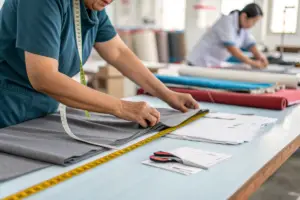
About four years ago, I received an inquiry from a brand owner who had been burned by his previous factory. He was gun-shy. He wanted to start a new manufacturing relationship, but he was not willing to commit his entire seasonal order to a factory he had not tested. He asked me a question I had never been asked in quite that way. "What is the best product to test a factory's quality? Not the easiest product. Not the cheapest. The one that will reveal the most about how the factory actually operates." I thought about it for a moment. The answer was obvious once I said it out loud. "A classic pair of shorts." He looked surprised. "Not a t-shirt? Something simpler?" I shook my head. "A t-shirt will tell you almost nothing. A classic short will tell you everything."
A classic pair of shorts is the ideal diagnostic product for testing a new factory's quality and consistency because it demands mastery of a wide range of construction techniques including curved seams, a zipper fly, a structured waistband, and reinforced stress points, each of which reveals a specific aspect of the factory's technical capability, while the garment's relatively simple bill of materials and modest fabric consumption keep the test order affordable and the evaluation focused on the factory's sewing and finishing skills rather than on complex material sourcing.
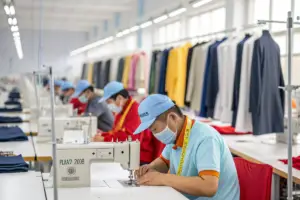
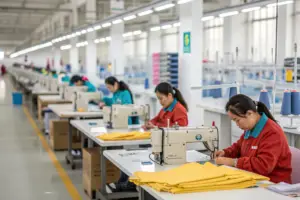
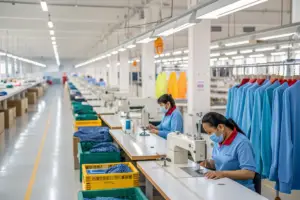
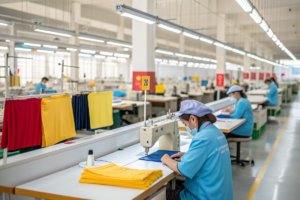
At Shanghai Fumao, I have on-boarded many new clients who came to me after being disappointed by other factories. The classic short is the product I recommend for a test order. It is not the simplest garment we make, but it is the most revealing. Let me explain exactly what a classic short will tell you about a factory, and how to read the results.
What Specific Construction Details Reveal a Factory's True Skill Level?
A pair of classic shorts is a surprisingly complex garment. It contains a zipper fly, which is one of the most technically demanding operations in garment construction. It contains a structured waistband, which tests the factory's ability to handle interlinings, to sew clean curves, and to attach a component that must bear tension without distorting. It contains pockets, which test the factory's ability to construct a sub-assembly and attach it cleanly to the main garment. It contains stress points, the pocket corners, the fly base, and the belt loops, that must be reinforced with bartacks or the garment will fail in the customer's hands. A factory that can execute all of these operations correctly and consistently is a factory that can handle more complex garments. A factory that struggles with a classic short is a factory that will fail on a tailored jacket or a detailed dress.
A classic short serves as a comprehensive diagnostic tool because each of its key construction elements tests a different aspect of the factory's technical capability: the zipper fly tests precision assembly and the ability to handle small, intricate operations; the contoured waistband tests the ability to sew clean, consistent curves without puckering; the pocket construction tests sub-assembly and attachment skills; and the stress-point reinforcements test whether the factory understands garment engineering and durability, not just basic sewing.
What Does the Waistband Construction Tell You About the Factory?
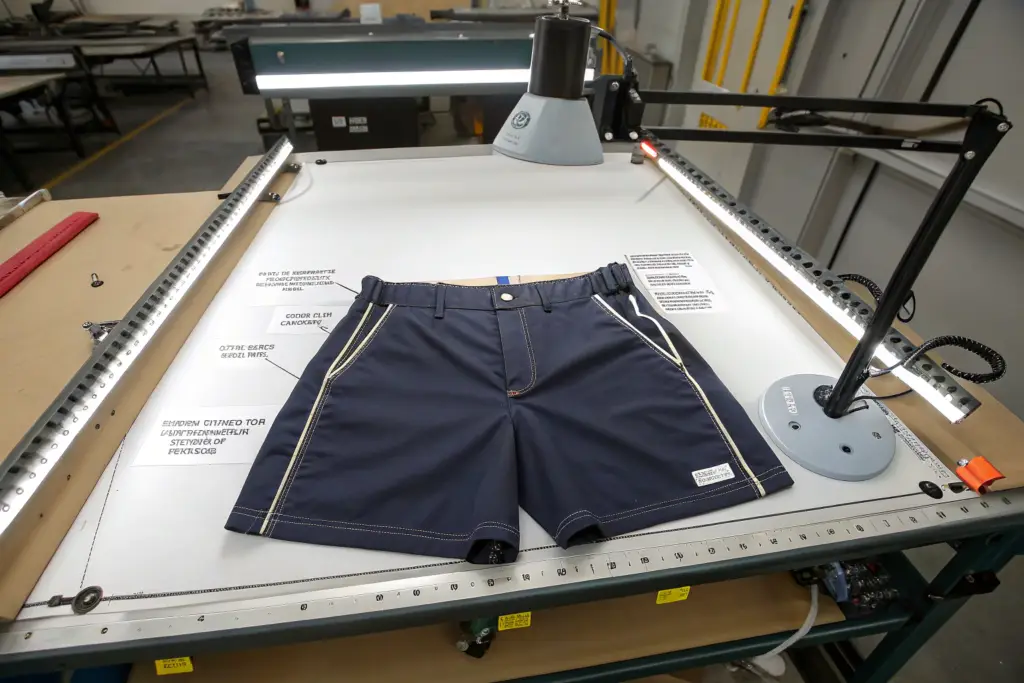
The waistband on a classic short is a deceptively complex component. It must be cut on a curve, not as a straight strip, if it is to fit the body correctly without gaping at the back. It must be fused with an interlining that gives it structure without making it stiff or prone to bubbling after washing. It must be attached to the body of the short with a clean, consistent seam that follows the curved edge without puckering or gathering. The topstitching along the waistband must be perfectly parallel to the edge, with a consistent distance of approximately one-eighth of an inch.
A factory that produces a waistband with a clean, flat front, a smooth curve, and no puckering along the attachment seam has demonstrated a high level of skill. A factory that produces a waistband that is a straight strip, forced into a curve, with ripples and puckers along the seam, has revealed that it does not understand, or does not care about, proper waistband construction. This single component is a reliable indicator of the factory's overall quality standards. This waistband construction quality in garment manufacturing guide explains the technical details.
Why Is the Zipper Fly Installation a Critical Test?
The zipper fly is the most challenging single operation on a pair of shorts. It requires precision sewing of a small, intricate assembly. The zipper tape must be attached cleanly. The fly facing must be folded and sewn precisely to conceal the zipper teeth. The J-stitch, the curved line of topstitching that secures the fly and creates the distinctive shape on the front of the shorts, must be smooth, symmetrical, and properly positioned. The base of the zipper must be secured with a bartack that prevents the tape from separating under tension.
A factory that can execute a clean, flat, properly functioning zipper fly has demonstrated mastery of precision sewing. A factory that produces a fly with a wavy J-stitch, exposed zipper teeth, or a zipper that catches on the fabric has revealed a lack of skill or a lack of attention to detail. The zipper fly is a non-negotiable quality indicator. The customer interacts with the zipper every time they wear the shorts. A poorly executed zipper fly will generate returns and complaints. This zipper fly construction and quality assessment provides the technical standard.
How Can a Trial Order of Shorts Evaluate Consistency, Not Just Sample Quality?
A single beautiful sample proves only that the factory has a skilled sample maker. It does not prove that the factory can produce a thousand units, or ten thousand units, each identical to that sample. The test of a factory is not whether it can make one perfect pair of shorts. It is whether it can make a shipment of shorts where the thousandth unit is indistinguishable from the first. A trial order is the only way to evaluate this consistency.
A trial order of classic shorts evaluates a factory's consistency by providing a statistically valid sample of the factory's bulk production capability, allowing the buyer to measure key dimensions across multiple units from different cartons to calculate the dimensional variation, to inspect the stitching quality, the hardware attachment, and the fabric handling across a range of units, and to wash and wear a sample of the units to assess their durability, all before committing to the large-volume orders that are the lifeblood of a brand.
How Should You Measure Dimensional Variation Across the Trial Order?
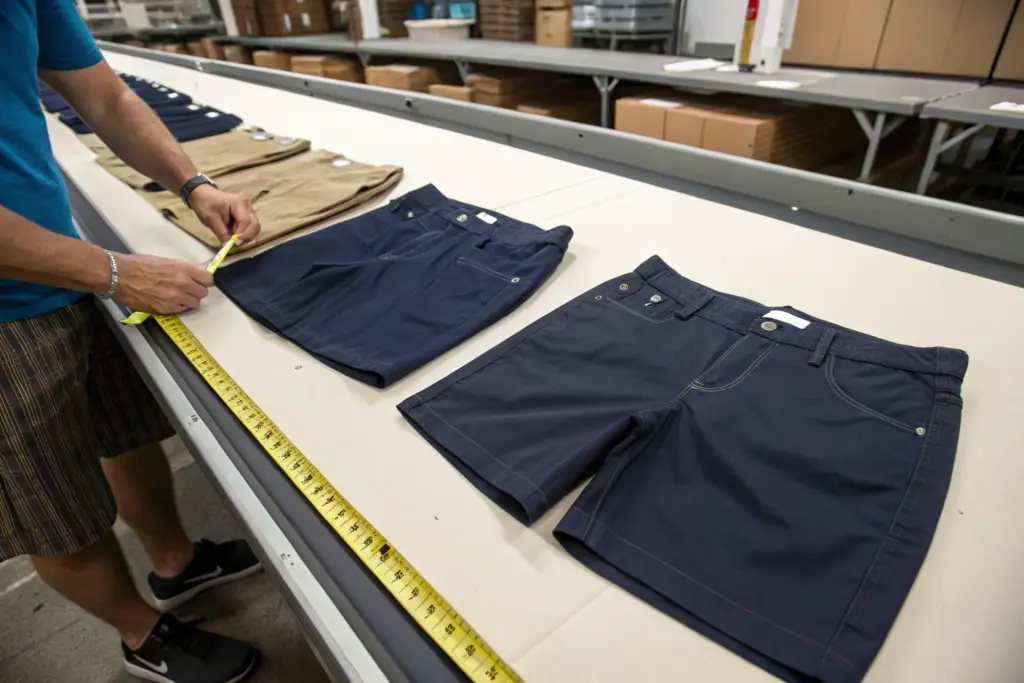
The buyer should randomly select a sample of units from the trial order, typically twenty to thirty units from different cartons. Each unit should be measured at the key points. The waistband circumference, the front rise, the inseam length, and the leg opening. The measurements should be compared to the approved specification and to each other.
A factory with good process control will produce units with very low dimensional variation. The waistband measurement will be within plus or minus a quarter of an inch of the specification across the entire sample. A factory with poor process control will produce units with significant variation. Some units will be on spec. Some will be a half-inch small. Some will be a half-inch large. This variation is a sign that the cutting room, the sewing line, or both are not operating with consistent discipline. A trial order that reveals high dimensional variation is a trial order that has saved the buyer from a much larger, much more expensive problem down the line. This dimensional variation in garment production and quality control explains the standards and the measurement methods.
Why Should You Wash and Wear the Trial Units Before Placing a Bulk Order?
The trial order should not just be measured and inspected. It should be used. The buyer should take a few pairs of the shorts, wash them according to the care label instructions, and wear them. Multiple times. The buyer should observe how the fabric behaves after washing. Does it shrink? Does it pill? Does the color fade? The buyer should observe how the construction holds up during wear. Does the waistband curl? Do the seams twist? Does the zipper slip?
These real-world tests reveal problems that a visual inspection on a table cannot. A short that looks perfect out of the polybag may shrink a full size after the first wash because the fabric was not properly pre-shrunk or tested. A short with a beautifully flat waistband may develop bubbling after three washes because the interlining was not correctly fused. Washing and wearing the trial units before committing to a bulk order is the most valuable quality test available, and it costs almost nothing. This garment wash and wear testing for quality assurance is a standard practice among the most successful brands.
What Does the Trial Order Reveal About Communication and Problem-Solving?
The quality of the shorts is not the only thing the trial order tests. It also tests the factory's communication and problem-solving culture. During the sampling and production of the trial order, problems will arise. A fabric delivery will be slightly delayed. A measurement will be slightly off. A construction detail will need clarification. How the factory communicates about these problems, when it communicates about them, and how it resolves them, reveals as much about the factory's suitability as a long-term partner as the quality of the finished shorts.
A trial order serves as a test of the factory's communication and problem-solving capability by forcing a series of interactions that reveal the factory's true operating culture: how quickly does the factory respond to questions, measured in hours, not days? Does the factory proactively communicate problems, or does it hide them until they become crises? When a problem is identified, does the factory present a proposed solution, or does it simply report the problem and wait for the buyer to solve it? The answers to these questions, observed during the low-stakes environment of a trial order, predict how the factory will behave during a high-stakes, time-critical bulk production run.

What Specific Communication Behaviors Should You Track During the Trial?
The buyer should track objective, observable metrics during the trial order process. The response time to emails, measured in hours. A factory that consistently responds within 24 hours is acceptable. A factory that consistently responds within 4 to 6 hours is exceptional. A factory that takes two or three days to respond to a simple question is a warning sign. The quality of the responses. Are the answers clear, complete, and technically accurate, or are they vague, partial, and evasive? Does the factory answer the specific question that was asked, or does it answer a different, easier question?
The proactiveness of the communication. Does the factory wait for the buyer to ask for an update, or does it provide updates on its own initiative? When a problem occurs, does the factory inform the buyer immediately, or does it wait, hoping the problem will resolve itself or that the buyer will not notice? These behaviors, tracked over the course of a trial order, form a reliable profile of the factory's communication culture. This supplier communication and performance evaluation framework provides a structured approach to assessing supplier communication.
How Should the Factory Handle a Problem That Arises During the Trial?
The most revealing moment in any trial order is the moment when something goes wrong. The fabric lot has a slight shading variation. The zipper delivery is delayed. The waistband measurement on the pre-production sample is off by half an inch. The factory's response to this problem is the single most valuable piece of information the trial order will produce.
A good factory informs the buyer of the problem immediately, before the buyer discovers it independently. A good factory presents a proposed solution along with the problem description. "The zipper delivery has been delayed by one week. We have adjusted the production schedule and the ship date will not be affected. We will keep you updated." A good factory takes ownership of the problem, even if the root cause was with a supplier. A poor factory hides the problem, makes excuses, blames the supplier, and waits for the buyer to propose a solution. The trial order reveals which type of factory the buyer is dealing with. This supplier problem-solving assessment in procurement explains why this is such a critical evaluation criterion.
Conclusion
A classic pair of shorts is a smart way to test a new factory's quality and consistency because the garment itself is a comprehensive diagnostic instrument. The waistband tests the factory's ability to handle curved seams and structural interlinings. The zipper fly tests precision assembly. The pockets test sub-assembly and attachment. The stress-point reinforcements test the factory's understanding of garment durability and engineering. A trial order of a few hundred units allows the buyer to measure dimensional variation, to assess consistency, and to observe how the factory communicates and solves problems in a low-stakes environment before committing to a large-volume, high-stakes production run.
The brands that invest in a proper trial order are the brands that avoid the catastrophic quality failures that can destroy a season and a reputation. The trial order is an insurance policy. The premium is the modest cost and time of a small production run. The coverage is the avoidance of a large, defective shipment that cannot be sold.
At Shanghai Fumao, I welcome trial orders. A buyer who wants to test our quality, our consistency, and our communication before committing to a large program is a buyer who is serious about their business. We are confident in our ability to pass that test. If you are considering a new manufacturing partner for your classic shorts, contact our Business Director, Elaine, at elaine@fumaoclothing.com. Let's start with a trial order and build the trust that underpins a lasting partnership.