I remember a phone call I received about seven years ago from a frustrated buyer. He had been sourcing classic chino shorts from a factory he found online. The sampling process had taken fourteen weeks and six rounds of revisions. The production had been delayed three times, with a different excuse each time. The final shipment arrived six weeks late, with a defect rate that forced him to discount the entire order. He was exhausted, not from the design work or the marketing, but from managing a supplier that seemed incapable of managing itself. He said to me, "I spend more time chasing my factory than I spend running my business. There has to be a better way." I told him there is. I had built Shanghai Fumao specifically to be that better way.
Fumao Clothing solves the supplier inefficiency problem for classic shorts buyers by replacing the industry's default model of fragmented, reactive communication with an integrated, proactive manufacturing system built on three structural pillars: a dedicated project pod that gives the buyer direct, simultaneous access to the merchandiser, the pattern maker, and the quality control supervisor, a live production tracker that provides real-time visibility into the status of every order, and a rigorous quality management system that catches defects at inline inspection stations rather than at the final audit, eliminating the communication delays, the production black holes, and the quality surprises that are the primary sources of buyer frustration.
At Shanghai Fumao, I have spent twenty years identifying and eliminating the specific points of inefficiency that drive buyers to despair. The problems are well-known to anyone who has sourced from overseas. The solutions are not complicated, but they require a factory to be willing to invest in systems, in people, and in transparency. Let me walk you through exactly how we have solved the three most common and most damaging supplier inefficiencies.
How Does the Project Pod Eliminate the Endless Email Chain?
The most common and most frustrating inefficiency in supplier communication is the relay model. The buyer asks a question. The question goes to the sales representative. The sales representative does not know the answer because they do not work on the production floor. They walk to the pattern maker's office. The pattern maker is busy. The sales representative leaves a note. The pattern maker responds the next day. The sales representative translates the technical answer into buyer-friendly language. The sales representative emails the buyer. Three days have passed. The answer, when it finally arrives, may have been mistranslated. This is the standard operating procedure for most factories. It is the reason buyers spend weeks chasing simple answers.
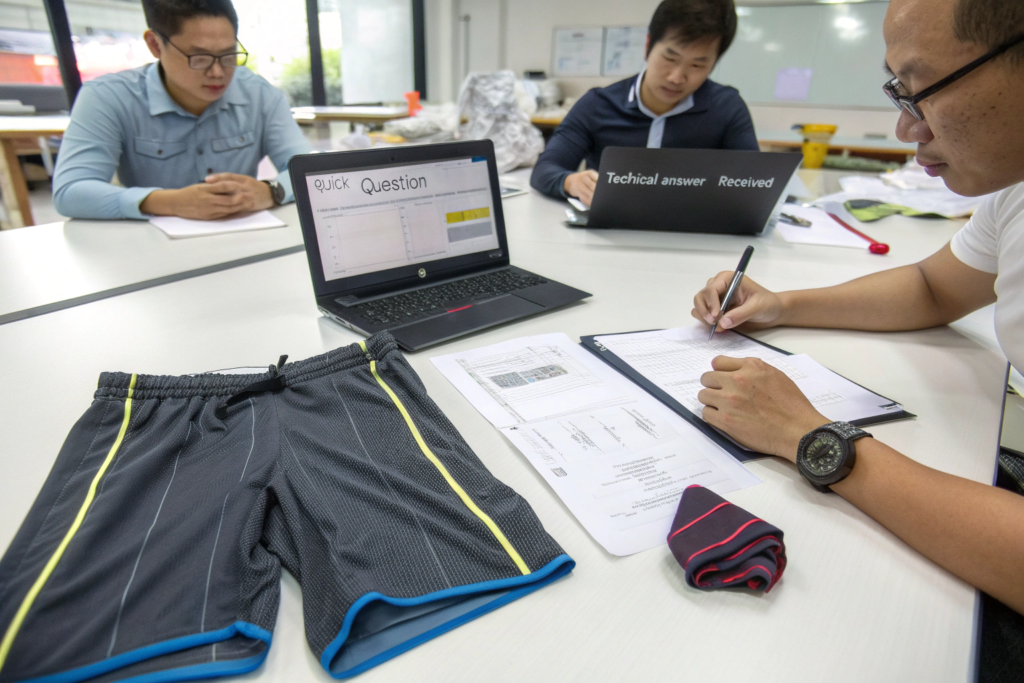
Fumao Clothing's project pod structure eliminates the relay inefficiency by assigning each buyer a dedicated team of three professionals who are all copied on every email and who can all respond directly: the bilingual merchandiser who manages the commercial relationship, the pattern maker who cuts the buyer's patterns, and the quality control supervisor who inspects the buyer's finished shorts, meaning that when the buyer asks a technical question about stitch density or pocket construction, the pattern maker answers it directly, in functional English, within hours, not days.
Who Is in the Pod and What Is Their Specific Role?
The project pod consists of three people, each with a distinct role and a direct line of communication to the buyer. The merchandiser is the commercial lead. They manage the order timeline, the pricing, the shipping logistics, and the overall relationship. They are bilingual and experienced in both the commercial and the technical aspects of garment production. The pattern maker is the technical lead. They translate the buyer's design into a production-ready pattern. They are responsible for the fit, the sizing, and the construction details. They can answer technical questions directly because they are the person doing the work. The quality control supervisor is the quality lead. They are responsible for the inline inspection, the final audit, and the quality documentation. They see every communication between the buyer and the pod, so when the shorts hit the inspection table, the inspector already knows that the buyer specifically flagged the side seam straightness or the pocket bartack as critical inspection points.
This structure means the buyer never has to wait for a sales representative to relay a question to an unknown person in an unknown department and then relay the answer back. The buyer asks the pattern maker directly about the waistband construction. The pattern maker answers. The time from question to answer is measured in hours, not days. This project pod structure in garment manufacturing is based on the cross-functional team model used in lean manufacturing.
How Does Direct Technical Access Speed Up the Sampling Process?
The sampling process is the most communication-intensive phase of garment production. Every sample round generates questions. The fit is off. The pocket placement is wrong. The fabric is not behaving as expected. In the traditional relay model, each question triggers the multi-day relay cycle. Three rounds of sampling, each with multiple questions, can easily consume six to eight weeks of communication time alone.
In the project pod model, the buyer and the pattern maker communicate directly. The buyer sends a fit comment. "The front rise is too low by half an inch." The pattern maker receives the comment, makes the adjustment to the digital pattern, cuts a new sample, and responds. "Front rise adjusted. New sample will be ready Friday." The communication cycle is compressed from days to hours. The total sampling timeline is reduced by weeks. This direct technical communication in apparel development is one of the primary reasons our sampling process is consistently faster than the industry average.
How Does the Live Production Tracker End the "Black Hole" of Production?
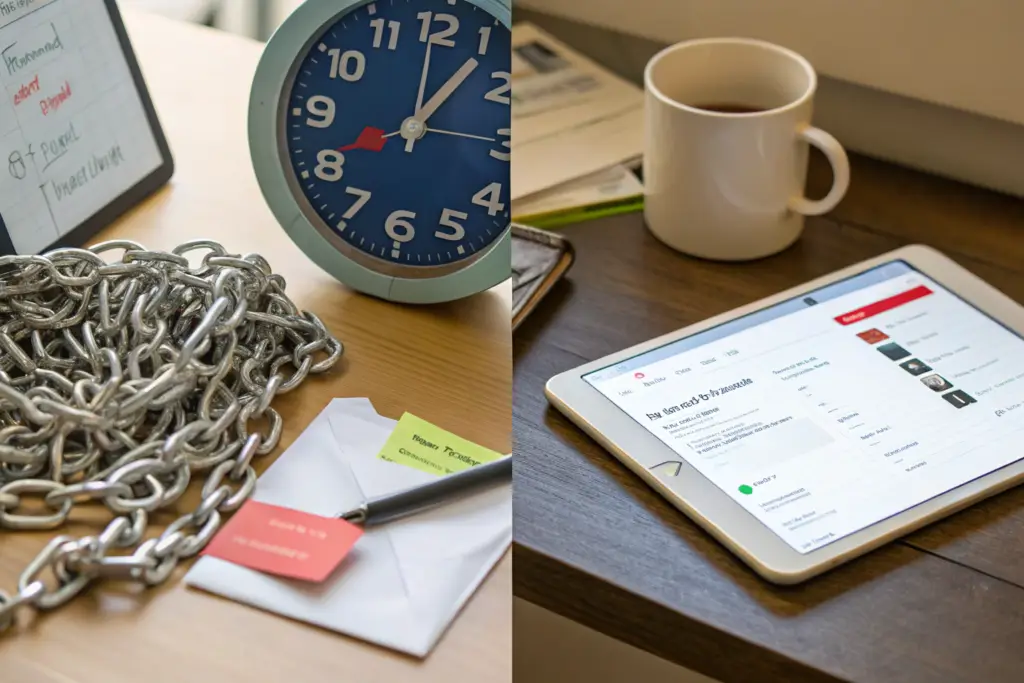
After the purchase order is placed and the deposit is paid, the buyer enters what is commonly known as the production black hole. The factory has the order. The buyer has no visibility into what is happening. Six weeks of silence. The buyer emails for an update. "On schedule, no issues." The buyer has no way to verify this. The buyer is betting that the factory is telling the truth. Sometimes the factory is telling the truth. Sometimes the factory is hiding a two-week delay that will only be revealed when the shipping deadline has already passed and the buyer's selling season is at risk.
Fumao Clothing's live production tracker eliminates the production black hole by providing the buyer with a real-time, cloud-based view of the exact status of their order at every stage of production, from fabric receipt through cutting, sewing, finishing, and packing, with each status update made by the production team on the factory floor, not by a salesperson in an office, giving the buyer the same visibility into their order's progress as the factory's own production manager, accessible from any device, at any time, without ever having to send a "just checking in" email.

What Specific Information Does the Production Tracker Display?
The tracker is a shared online spreadsheet or a cloud-based project management board. It is simple, visual, and updated in real time. For each purchase order, the tracker displays the key milestones and their current status. Fabric received and inspected. Cutting started and percentage complete. Sewing started and percentage complete by production line. Finishing and pressing started and percentage complete. Final QC inspection scheduled and result. Packing started and percentage complete. Ready for shipment.
Each milestone has a planned date and an actual date. If the cutting is scheduled to be completed by March 15th, and the tracker shows cutting at 60% on March 14th, the buyer can see that the order is slightly behind schedule before it becomes a crisis. The buyer does not need to email the factory to ask for an update. The update is on the tracker. The buyer can ask a specific, informed question. "I see cutting is running two days behind. Will this impact the ship date, or can the sewing team recover the time?" This production tracking and visibility in apparel manufacturing is the standard we provide to every client.
How Does the Tracker Change the Buyer-Factory Relationship?
The traditional relationship is adversarial. The buyer demands information. The factory withholds information, either because it is too busy to provide it or because it is hiding a problem. The buyer does not trust the factory. The factory resents the buyer's constant checking.
The tracker transforms this dynamic. The information is freely available to both parties. The buyer and the factory are looking at the same data. The conversation shifts from "Where is my order?" to "How do we solve this scheduling issue together?" The tracker creates a foundation of transparency that enables a genuine partnership. The buyer who can see that the factory is proactively managing a delay is a buyer who is far more likely to be understanding and collaborative than the buyer who discovers the delay only when the shipping deadline is missed. This supplier relationship management through transparency is the foundation of our long-term client partnerships.
How Does Inline Quality Inspection Prevent the Dreaded Final Audit Surprise?
The most devastating supplier failure is the quality surprise. The buyer approves a beautiful pre-production sample. The factory produces the bulk order. The buyer's third-party inspector arrives for the final audit and finds a major defect rate that exceeds the AQL limit. The entire shipment is placed on hold. The factory must rework thousands of units. The shipping deadline is missed. The buyer's selling season is lost. This disaster occurs because the factory's quality control system is reactive, not proactive. The defects are caught at the end, when correction is most expensive and most disruptive.
Fumao Clothing prevents the final audit surprise through a system of inline quality inspection, where dedicated QC inspectors are stationed at multiple points directly on the production line, not in a separate room, checking the garment at each major stage of assembly before it moves to the next stage, catching defects when they are created and when they can be corrected in seconds by the operator who made them, rather than at the end of the line when correction requires opening a finished garment and re-sewing it, a process that is slower, more expensive, and more likely to damage the fabric.

Where Are the Inline Inspection Stations Located on the Line?
In a standard factory, quality control is a final gate. The inspector checks the finished, packed shorts. This is too late. The defect was sewn into the garment hours or days earlier. The operator who made the defect has moved on to another operation, perhaps another order. The correction requires pulling the garment from the line, opening it, re-sewing it, and re-pressing it.
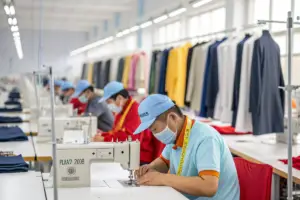
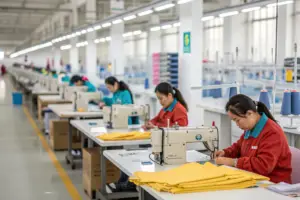
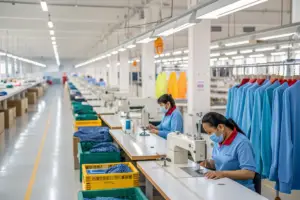
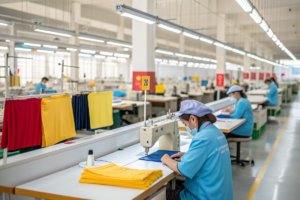
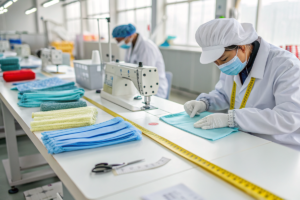
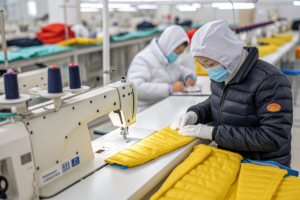
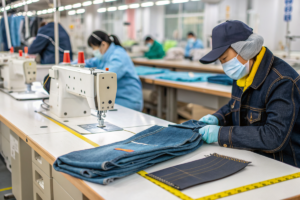
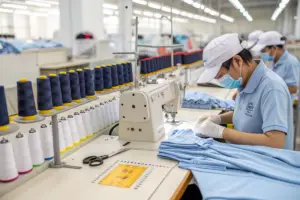
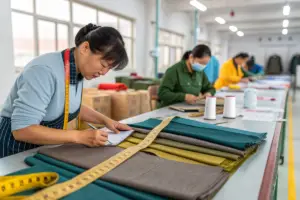
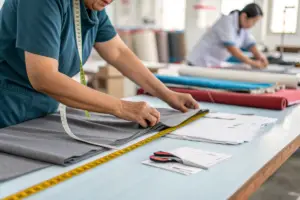
In our factory, the inspection stations are embedded directly on the production line. The first station checks the cut panels before they reach the sewing machines, verifying the correct shape, grain line, and absence of fabric flaws. The second station checks the initial sub-assembly, the pocket construction and attachment, before the side seams are closed. The third station checks the main construction, the side seams, the rise, and the fly installation. The fourth station checks the waistband attachment and the hem finishing. Each inspector has a checklist specific to their station and the approved sealed sample. A defect caught at the pocket station is handed back to the pocket operator and corrected in seconds. The garment proceeds down the line with the defect resolved. This inline quality control in garment manufacturing system is the structural reason our defect rates are consistently low.
What Happens When a Defect Is Found at an Inline Station?
The process is immediate and localized. The inspector marks the defect with a small, colored tag or a piece of tape and places the garment back at the operator's station. The operator sees the tag, understands the issue, and corrects it on the spot. The inspector re-checks the correction. The garment continues down the line.
There is no defect log filled out in triplicate. There is no meeting with the production manager. There is no delay. The defect is caught, corrected, and verified in the flow of production. The operator learns from the correction and is less likely to repeat the same mistake. This immediate feedback loop is impossible in a final-inspection-only system, where the operator who made the defect may never even learn about it. This defect correction and continuous improvement in garment production is the daily practice that builds quality into the product rather than inspecting it in at the end.
What Preventative Measures Eliminate Issues Before Cutting Begins?
The best defect is the one that is never created. The most efficient quality system is the one that prevents problems before the first piece of fabric is cut. A significant percentage of production issues, fabric shrinkage, color shading, construction difficulties, and fit inconsistencies, are caused by problems that existed in the raw materials or in the pre-production planning stage. Catching these problems before cutting is dramatically cheaper and faster than catching them after the shorts are sewn.
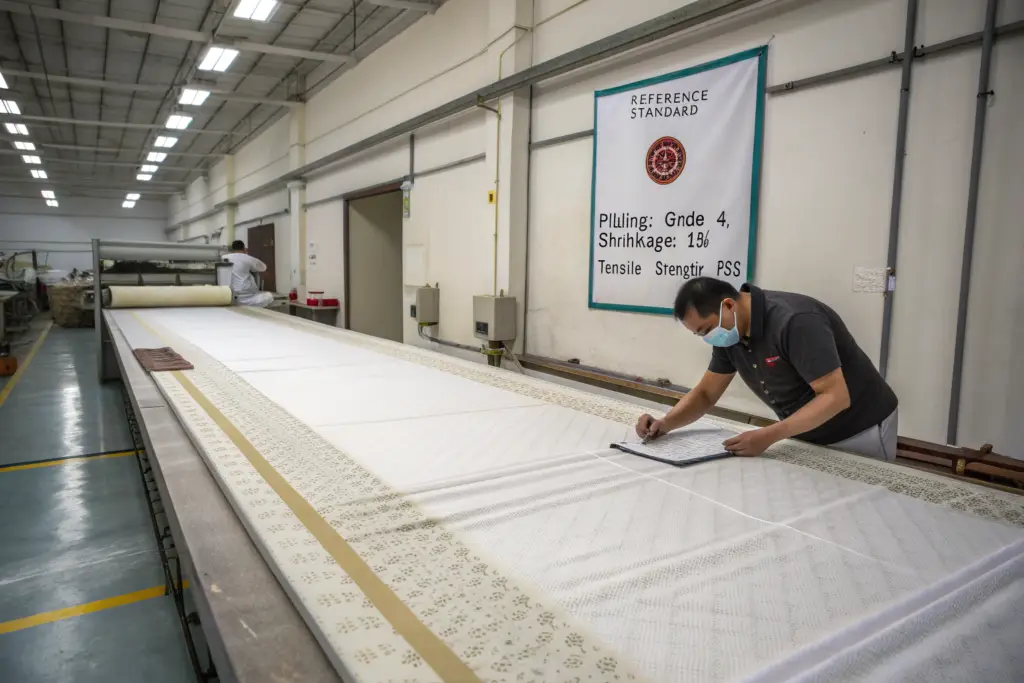
Fumao Clothing prevents pre-production issues through a mandatory fabric testing protocol that evaluates every incoming fabric lot for shrinkage, pilling resistance, tensile strength, and colorfastness before it is released to the cutting room, a sealed sample process that creates a physical, signed reference standard that is displayed at every inspection station, and a pre-cutting meeting where the production manager, the pattern maker, and the QC supervisor review the specification, identify potential issues based on the specific fabric properties, and agree on the necessary process adjustments, ensuring that every preventable problem is addressed before the first cut is made.
What Fabric Tests Are Performed Before the Fabric Is Accepted?
When a new fabric lot arrives at our factory, it does not go directly to the cutting room. It goes to the quality control lab. A sample is cut from the roll and subjected to a panel of physical tests. Dimensional stability, the fabric is washed and dried according to the care label instructions, and the shrinkage percentage is measured. Pilling resistance, the fabric is abraded using a Martindale machine for a specified number of cycles, and the surface is evaluated against the standard pilling scale. Tensile and tear strength, the fabric is pulled apart using a tensile testing machine to ensure it meets the minimum strength requirements. Colorfastness to washing, crocking, and light, the fabric is tested to ensure the dye will not bleed, transfer, or fade.
If the fabric fails any of these tests, it is rejected. The mill is notified, and a replacement lot is ordered. The cutting room does not receive the fabric until it has passed every test. This testing protocol prevents the catastrophic scenario where a production order is cut and sewn from fabric that shrinks excessively, pills after three washes, or bleeds dye onto the consumer's other clothing. This fabric testing and quality assurance in garment manufacturing is our first line of defense against quality failures.
How Does the Sealed Sample Function as the Ultimate Reference?
The sealed sample is the physical contract between the buyer and the factory. After the final pre-production sample is approved by the buyer, two identical samples are produced. Both are signed, dated, and sealed in tamper-evident bags. One is shipped to the buyer. One is hung on the wall of our production floor, at the first inspection station.
Every operator and every inspector on the line can see the sealed sample. It is the reference standard against which every production unit is compared. The waistband is checked against the sealed sample. The pocket placement is checked against the sealed sample. The hem finish is checked against the sealed sample. There is no ambiguity, no reliance on memory, and no debate about what was approved. The sealed sample answers every quality question with objective, physical evidence. This sealed sample process in garment quality management is the anchor of our quality system.
Conclusion
Supplier inefficiency is not a mystery. It is a specific set of solvable problems that most factories have not invested in solving. The communication delays are caused by the relay model, where the salesperson is a bottleneck between the buyer and the production floor. The production black hole is caused by a lack of systems for sharing real-time production data with the client. The quality surprises are caused by a reactive, final-inspection-only approach that catches defects too late. The pre-production failures are caused by a lack of rigorous material testing and reference standards.
At Shanghai Fumao, we have invested in solving each of these problems systematically. The project pod eliminates the communication relay. The live production tracker eliminates the black hole. The inline inspection system eliminates the final audit surprise. The fabric testing protocol and the sealed sample process eliminate the pre-production failures. The result is a manufacturing experience that is faster, more transparent, and more reliable than the industry standard.
If you are a buyer who is tired of chasing your factory, of waiting for answers, of wondering where your order is, and of dreading the final inspection report, we invite you to experience a different kind of manufacturing partnership. Contact our Business Director, Elaine, at elaine@fumaoclothing.com. Let's show you how a factory should work.