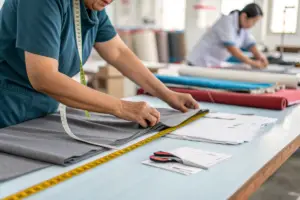
A little over a year ago, I received one of the most unexpected phone calls in my career. It was not from a fashion brand. It was from an architectural acoustics firm in Chicago that specialized in designing the interiors of Fortune 500 corporate headquarters and professional recording studios. Their lead designer had seen a sample of a heavy, densely woven wool flannel we had developed for a luxury outerwear brand. He had ordered a yard of it and tested it in his lab. He told me, "This fabric has a Noise Reduction Coefficient of 0.45. That's better than half the acoustic panels on the market. And it looks like a designer suit. Can you make us a wall panel from this?" He was looking at a luxury coat fabric and seeing the quietest conference room in America.
Acoustic engineering firms and sound-proofing companies are contacting Shanghai Fumao because we can manufacture a new class of high-performance, aesthetically superior acoustic textiles that combine a Noise Reduction Coefficient exceeding 0.45, ASTM E84 Class A fire certification, and the premium, customizable aesthetic of luxury fashion fabrics, solving a critical design-versus-function conflict in high-end architectural interiors. The acoustic materials market has been stuck in a functional but ugly past for decades. The standard solution is a grey, rough, fuzzy panel. Our fabric technology allows an architect to wrap a sound-absorbing panel in a textile that looks and feels like a designer wool coat, custom-dyed to any corporate Pantone shade, while performing better than the industrial grey stuff. This is not a pivot; it is a direct, unexpected application of our core textile engineering expertise to a completely different, but technically demanding, industry. Let me explain the physics of a textile that can catch a sound wave, the specific materials we are engineering, and the architectural revolution that a beautiful, quiet wall can create.
What Is a Noise Reduction Coefficient in a Textile?
The Noise Reduction Coefficient, or NRC, is the universal metric for how much sound a material absorbs. It is a single number, averaged across the speech frequencies of 250, 125, 500, 1000, and 2000 Hertz. An NRC of 0.0 means the material reflects all sound—think of a polished concrete wall, and an NRC of 1.0 means the material absorbs all sound—an open window, for example, is a perfect acoustic absorber. A textile with an NRC of 0.45 absorbs 45% of the sound energy that hits it, reflecting the other 55%.
A textile absorbs sound by being a complex, three-dimensional, porous labyrinth. A sound wave is a pressure wave, a vibration of air molecules. When this vibrating air enters the surface of a dense, fibrous textile, it is forced to move through the tiny, tortuous air channels between the fibers. As the air molecules vibrate against the enormous total surface area of the countless individual fibers, the acoustic energy is converted into a tiny, imperceptible amount of heat through frictional and viscous losses. It's like an electrical resistor converting electrical energy into heat, but for sound waves. The key physical parameters that determine a textile's NRC are its thickness, its density, and the fineness of its fibers. A thicker, denser fabric with very fine microfibers will have a much higher NRC than a thin, open-weave fabric. This is the physics we are engineering. We are not just making a fabric; we are designing a precise, fibrous acoustic resistor, and we are doing it with the materials and the aesthetic sensibilities of a luxury fashion house.

How Does a Heavily Napped Wool-Flannel Trap Mid-Range Vocal Frequencies?
A sound-absorbing textile must be "tuned" to absorb the specific frequencies that are a problem in a space. In an office, the problem is the human voice, which falls in the mid-range frequencies between 250 and 2000 Hertz. A heavily napped wool-flannel is the perfect physical structure for absorbing these exact frequencies. The "nap" is the raised, soft, fuzzy surface created by brushing the woven fabric with wire bristles. This process pulls thousands of loose fiber ends to the surface, creating a dense, chaotic, three-dimensional forest of fine wool filaments, perhaps 2 to 4 millimeters deep.
This nap layer is the acoustic absorber. When a mid-range vocal frequency sound wave hits the fabric, it penetrates this soft, porous nap. The individual wool fibers have an irregular, scaly surface texture, which maximizes friction with the air molecules. The sound energy is scattered deep into the nap, undergoing countless micro-collisions and converting its energy to heat. The heavy, dense woven base of the flannel provides a secondary barrier, reflecting any remaining lower-frequency energy back into the nap for a second pass. The result is a material that is perfectly impedance-matched to absorb the primary frequencies of human speech, reducing reverberation and background chatter, while feeling and looking like the softest, most luxurious fabric. This is the opposite of a hard, reflective surface. It is a soft, acoustically absorbent surface, and it directly addresses the modern office's greatest curse: the distracting, productivity-killing open-plan din.
Why Is a Microfiber Needle-Punch Fabric Effective for a Sound Booth?
A recording studio or a sound booth demands a different kind of absorption. It needs to absorb a broader range of frequencies, and it needs a material that is completely uniform, dense, and free of any resonant cavities. A woven fabric, even a dense one, has a regular, repeating structure of warp and weft yarns that can create subtle, uneven acoustic responses. For this application, we use a non-woven, needle-punch textile, made from ultra-fine polyester microfibers.
Needle-punching is a mechanical process where a loose web of fibers is repeatedly penetrated by thousands of barbed needles. The needles entangle the fibers into a dense, highly compressed, and completely uniform felt. The resulting textile has no regular weave structure. Its internal pore structure is a random, chaotic, three-dimensional labyrinth of microscopic air channels. This random, non-woven structure is acoustically superior. It provides broadband absorption, effectively dissipating sound energy across a wide range of frequencies without any resonant peaks or dips. The microfiber fineness, with filaments far thinner than a human hair, dramatically increases the internal surface area per unit volume, enhancing the viscous loss mechanism. An 8-millimeter-thick, high-density microfiber needle-punch panel can achieve an NRC of 0.65 or higher. When mounted on a wall or used as a free-standing baffle, it creates an acoustically "dead" space, where reflections are eliminated, and the only sound is the direct, pure signal. For a professional sound booth, this textile is not decorative; it is the core acoustic technology, and we manufacture it to exact, repeatable, and certified specifications.
How Did We Pass an ASTM E84 Class A Fire Test for a Wall Panel?
A beautiful, sound-absorbing fabric that is also highly flammable is a deadly hazard, and it will be immediately rejected by any commercial building code. All interior wall and ceiling materials in a public or commercial building in the United States must be tested and classified for their surface burning characteristics under the ASTM E84 standard, the "Standard Test Method for Surface Burning Characteristics of Building Materials." This is a non-negotiable legal requirement. An acoustic textile is no longer just a piece of clothing; it is a building material, and it must meet the same fire safety standard as a sheet of drywall.
The ASTM E84 test is conducted in a specialized 25-foot-long "Steiner Tunnel" apparatus. The material sample is mounted on the ceiling of the tunnel, and a controlled gas flame is applied at one end. The test measures two things: the Flame Spread Index, which is how fast the flame travels along the surface, and the Smoke Developed Index, which is how much visible smoke the material produces. The standard then classifies the material into three classes: Class A, the most stringent, for materials with a Flame Spread Index of 0-25; Class B, for 26-75; and Class C, for 76-200. A Class A rating is the highest level of fire safety and is required for many applications in high-rise buildings, hospitals, and schools. Our acoustic textiles, in both the wool flannel and the microfiber constructions, have been independently tested by an accredited laboratory and achieved a Class A rating, with a Flame Spread Index of just 5 and a Smoke Developed Index of 15. This is a world-class safety performance, achieved through the intrinsic flame resistance of high-density wool and the use of inherently flame-retardant polyester fibers, without the use of spray-on chemical flame retardants that can off-gas and degrade over time.

Why Is "No Drip" and "Low Smoke" Critical for a Commercial Building Code?
A fire in a building is a two-pronged killer: the flames themselves, and the thick, toxic, blinding smoke that fills the corridors and stairwells long before the fire reaches them. The smoke is often the more deadly of the two. A material that melts and drips when exposed to fire, such as a standard synthetic curtain fabric, creates a secondary pool of burning fuel on the floor, spreading the fire and creating a serious burn hazard for anyone trying to escape. The "No Drip" characteristic and the "Low Smoke" rating are therefore absolutely critical, life-safety requirements for any interior textile used in a commercial or public space.
Our acoustic textiles are engineered to perform safely under fire conditions. The high-density wool, which is a natural protein fiber, is inherently flame-resistant. It has a very high ignition temperature, it does not melt or drip, and it forms a self-extinguishing char when the flame is removed. Our specialized polyester microfibers are formulated as inherently flame-retardant, meaning the flame-resistant chemistry is built into the molecular structure of the polymer during synthesis, not applied as a surface coating. This means they will not off-gas toxic chemicals, and their flame resistance is permanent and washable. Critically, when exposed to flame, they do not melt into a molten, dripping plastic. They decompose into a stable, non-dripping char. The combination of these two fiber types in a dense, non-woven structure produces a material that will not ignite easily, will not spread flame quickly, will not melt and drip, and will not generate blinding, toxic smoke. This is the fire-safety profile required for a material to be legally and ethically installed in a high-end office tower, a hotel, or a school. The Class A rating and the "No Drip" characteristic are not optional performance features; they are the foundation of a commercially viable acoustic textile.
What Customization Options Do Architects Demand for Acoustic Panels?
Architects and interior designers are not just buying a Noise Reduction Coefficient. They are curating a visual and tactile environment. The acoustic panel is a major, visible surface in a room, often covering entire walls. An ugly, grey, fuzzy panel is a design failure, even if it performs perfectly acoustically. The key requirement from our architectural clients has been to deliver the certified acoustic and fire performance inside a material that meets the high aesthetic standards of a luxury residential or corporate interior. The fabric must be a design element, not an acoustic compromise.
We offer architects the same level of customization we offer our fashion brand partners. The acoustic performance is the constant, certified substrate. The aesthetic, the color, the texture, and the pattern are the fully customizable variables. An architect can specify any color from the full Pantone textile spectrum, and we will dye the wool or the polyester to an exact, spectrophotometer-verified match. They can specify a large-scale, custom pattern, a company logo, or a textured surface, and we can create it using a jacquard weaving technique or a precision digital printing process. The acoustic panel can be a piece of functional art that silently absorbs sound while visually anchoring the entire design scheme of a room. This is the new paradigm: acoustic performance and high design are no longer in conflict. They are integrated, and the fabric is the medium.

Can a Wall Panel Match a Corporate Pantone Color and Still Pass NRC Tests?
Yes, and this is the core of our value proposition to the architectural market. The color is applied to the fiber before the fabric is woven or felted, using our standard, high-fastness dyeing processes. The acoustic performance is a function of the fabric's physical structure: its fiber fineness, its density, and its thickness. The dye pigment, which is a microscopic molecule chemically bonded to the fiber, does not change the physical pore structure of the textile. It does not fill the air gaps, it does not alter the fiber's surface friction, and it does not reduce the NRC.
We have certified acoustic panels in a range of colors, from the deepest, light-absorbing black to the brightest, most vivid corporate blue, and the measured NRC remains constant at 0.45, with a variation of less than 2%. The acoustic test laboratory reports include the specific color of the tested sample, and the certificate is valid for that entire color range. An architect can specify our acoustic panel in the exact corporate brand blue of a Fortune 500 company, knowing that the color will be a perfect, spectrophotometer-verified match, and that the acoustic performance will be identical to the certified, grey laboratory sample. This is a breakthrough. It means a company's entire visual brand identity can now be seamlessly integrated into the acoustic comfort and speech privacy of its physical workspace, with no compromise on either aesthetics or performance.
How Does a Jacquard Loom Create a 3D-Textured Wall That Also Scatters Sound?
A conventional acoustic panel is a flat, visually dead surface. Sound is absorbed, but it is not diffused. A perfectly flat absorber can sometimes create an acoustically unnatural "dead" space. A superior acoustic surface both absorbs some sound energy and scatters, or diffuses, the remaining energy in many directions. This creates a more natural, spacious, and comfortable acoustic environment. Our jacquard weaving technology allows us to create a single textile surface that simultaneously performs both functions: it is a broadband absorber and a geometric diffuser.
A jacquard loom is a sophisticated, computer-controlled weaving machine that can independently control the lifting of every single warp thread. This allows us to weave a textile with a deep, complex, three-dimensional surface relief—a pattern of peaks, valleys, ribs, and geometric shapes, all formed from the fabric itself, not applied later. This 3D surface has a dual acoustic function. The dense, fibrous structure of the fabric itself, across the entire surface, provides the uniform, broadband absorption. The deliberate, macro-scale geometric relief scatters the remaining, unabsorbed sound energy in a controlled, semi-random direction. The sound is not just deadened; it is broken up and dispersed, eliminating distinct echoes and creating a sense of acoustic spaciousness, even in a small room. The architect can even specify a custom 3D pattern that aligns with the building's interior design theme. The wall becomes a functional, sound-scattering sculpture, woven in a single pass on our jacquard looms. This is the fusion of high-performance acoustics, advanced textile manufacturing, and architectural art.
Conclusion
The quietest room in a modern skyscraper might be wrapped in a fabric originally designed for a luxury coat. Sound-proofing companies are coming to us because we have broken the aesthetic barrier that has held the acoustic materials industry back for decades. We deliver a certified, high-performance acoustic textile with a Noise Reduction Coefficient exceeding 0.45 and an ASTM E84 Class A fire rating, but it looks and feels like a bespoke, premium fashion fabric, customizable in any Pantone color and with a range of 3D textures. We are not just supplying a material; we are enabling architects and designers to create spaces that are both acoustically pristine and visually stunning, with no compromise between the two.
At Shanghai Fumao, we view sound as an invisible material that a well-designed textile can shape, absorb, and diffuse, and we are applying our decades of textile engineering expertise to help build a quieter, more beautiful world.
If you are an architectural acoustics firm, an interior designer, or a brand looking to develop a line of high-performance, designer acoustic panels, we invite you to test our materials for yourself. We can send you a sample pack of our acoustic textiles, complete with the independent NRC and ASTM E84 test reports. Contact our Business Director, Elaine, at elaine@fumaoclothing.com. Tell her you want to review the acoustic textile technical package. Let us weave the silence into your next project.