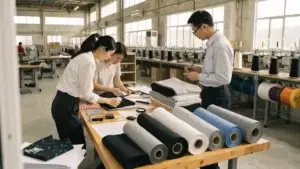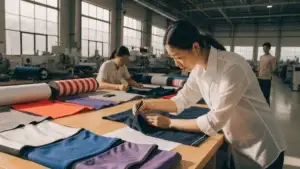
A Denver-based outdoor lifestyle brand once built their entire business on a simple, highly effective private label strategy. They sourced premium, factory-developed hoodies and sweatpants from a reliable manufacturer, stripped the factory's generic labels, and rebranded every piece with their own custom labels, hangtags, and packaging. The garments were identical in construction to products sold by other brands from the same factory, but the Denver brand's storytelling, branding, and customer experience allowed them to sell at a 140% price premium. The strategy worked beautifully for three years. In the fourth year, a wholesale account discovered the same unbranded hoodie on a B2B platform, recognized the garment construction, and accused the brand of "selling generic imports at a markup." The brand had not executed their private label strategy flawlessly. They had simply swapped labels. They had added no custom design modifications, no exclusive fabric development, and no protective contractual language. Their "brand" was a label sewn into a commodity, and the market had discovered the truth.
To flawlessly execute a private label rebranding strategy for imported wholesale garments, the brand must implement a five-layer approach: Layer One, negotiate an "Exclusive Style Modification Agreement" with the factory that legally prohibits the factory from selling the same garment or the brand's modified version to any other client; Layer Two, introduce at least two custom design modifications—such as a proprietary fabric weight, a unique trim specification, or a custom-developed color—that make the garment physically impossible to source identically from any other supplier; Layer Three, execute a complete, high-quality label and trim replacement package including a custom woven neck label, a branded hangtag with the brand's story, custom-engraved hardware, and a personalized care label; Layer Four, create a branded packaging and unboxing experience that transforms the anonymous import into a premium branded product; and Layer Five, register the brand's trademark with US Customs and Border Protection to prevent unauthorized grey market imports.
At Shanghai Fumao, I work with private label brands across multiple categories. The brands that succeed over the long term are not the ones who simply sew their label into a stock garment. They are the ones who modify the garment to make it exclusively theirs, protect it legally, and wrap it in a brand experience that makes the garment feel custom-developed, not resold.
Why Is an "Exclusive Style Modification Agreement" the Legal Foundation Without Which a Private Label Strategy Collapses?
A San Diego-based activewear brand once built a successful private label line around a factory's stock legging design, modified with the brand's custom logo print and a signature waistband color. The brand sold the leggings to boutique fitness studios across the country. In the third season, a competitor brand appeared on the market selling the exact same legging—same fabric, same fit, same construction—with a different logo. The factory had accepted the competitor's order and simply changed the print file. The San Diego brand had no exclusive agreement. The factory had not breached any contract, because the contract had never prohibited the factory from selling the modified style to other clients. The brand's "signature" legging had become a commodity available to anyone with a purchase order.
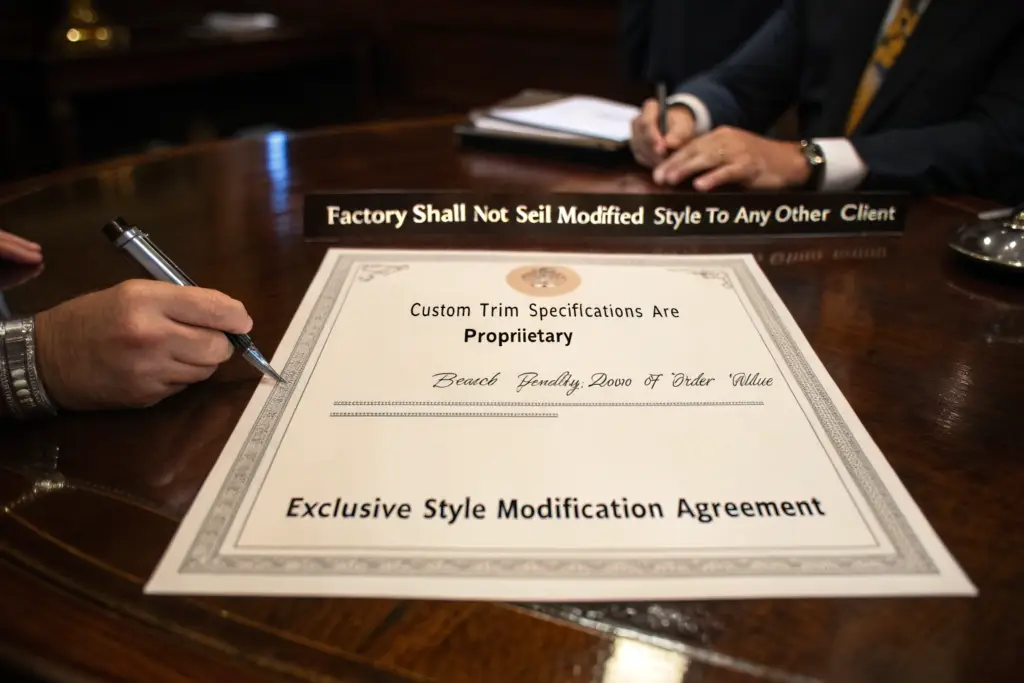
An Exclusive Style Modification Agreement is the legal foundation of a private label strategy because it contractually binds the factory to recognize that the brand's specific combination of design modifications—even if applied to a factory-developed base style—constitutes the brand's proprietary intellectual property, and the factory is legally prohibited from producing the same modified style, using the same custom trims, or applying the same design modifications for any other client, with a specified liquidated damages penalty for breach that is financially painful enough to deter violation.
Without an exclusive agreement, the factory views the brand's modified garment as the factory's own base garment with some client-requested changes. The factory believes it has the right to sell the base garment and any modification of it to anyone. The Exclusive Style Modification Agreement shifts this understanding legally: the factory acknowledges that the specific combination of modifications the brand has made creates a proprietary product that is the brand's exclusive intellectual property.
How Does "Liquidated Damages of 200% of Order Value" Create a Financial Deterrent That a Simple "Exclusivity Promise" Does Not?
A verbal promise of exclusivity is unenforceable. A liquidated damages clause that specifies a penalty of 200% of the infringed order's value creates a specific, calculable, and financially devastating consequence for breach. The factory owner, considering whether to accept a competitor's order, calculates the potential penalty and decides that the risk is not worth the revenue.
Why Must the "Exclusive Modification Agreement" List the "Specific Custom Components" by Name and Specification?
A vague agreement that says "the factory will not sell the brand's designs" is difficult to enforce. An agreement that lists the specific custom components—"YKK #5 matte black custom-engraved zipper pull with Brand X logo, per attached Hardware Specimen Card"—provides a specific, physical reference that is clearly identifiable as the brand's proprietary component.
What Specific "Custom Design Modifications" Transform a Stock Garment Into a Proprietary Product That Cannot Be Identically Sourced Elsewhere?
A New York menswear brand once executed a private label strategy using a factory's standard Oxford shirt with only a label change. The brand added their woven label, packaged the shirt beautifully, and sold it at a premium price. A customer purchased the shirt, liked it, and searched online for the fabric content code printed on the care label. The search led directly to the factory's B2B listing for the identical stock shirt, available for $14.50 per unit in wholesale quantities. The customer posted this discovery on Reddit. The thread went viral. The brand was publicly exposed as selling a stock factory garment with a label markup. The brand's reputation never recovered.
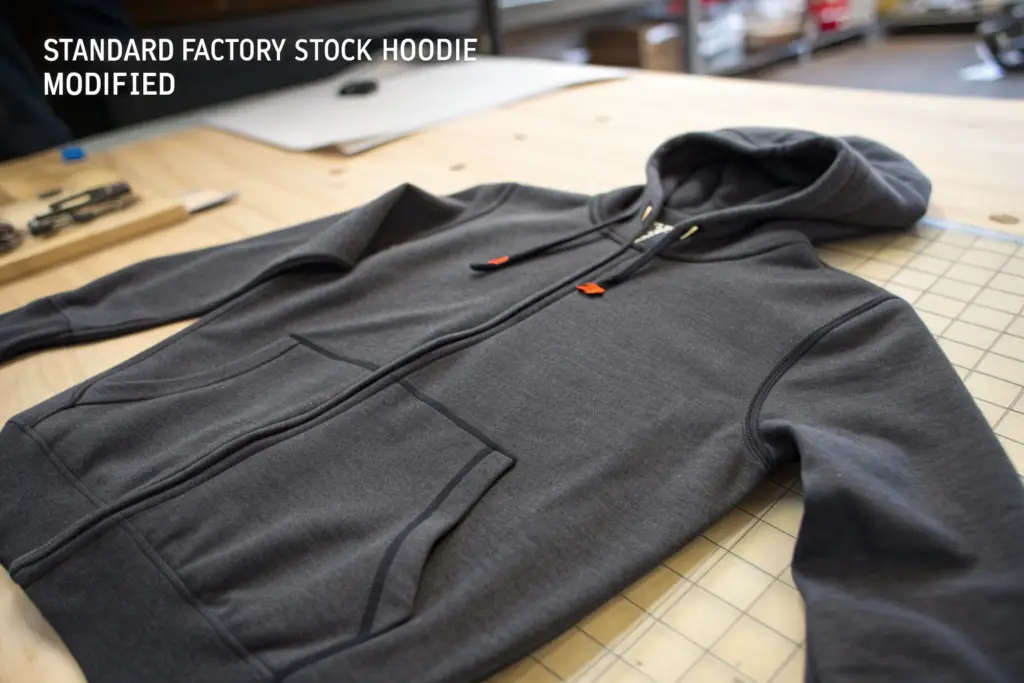
To transform a stock garment into a proprietary product, the brand must introduce at least two custom design modifications that are physically integral to the garment and cannot be easily removed or replicated: a custom-developed fabric weight or blend that the factory produces exclusively for the brand, a proprietary garment dye color developed through the brand's own lab dip process, a modified silhouette detail such as a custom pocket shape, a unique seam construction, or an exclusive rib knit density, and custom-branded hardware components—zipper pulls, buttons, drawstring aglets—that are physically engraved or molded with the brand's logo.
A label can be removed. A hangtag can be discarded. A polybag can be replaced. These are surface-level branding elements that do not alter the garment itself. A custom fabric weight, a proprietary dye color, a modified pocket shape, or a custom-engraved zipper pull is physically part of the garment. It cannot be removed without damaging the garment. It makes the garment uniquely traceable to the brand, even without a label.
How Does a "Custom-Developed Fabric Weight" Create a Permanent, Unremovable Product Differentiator?
If the factory's standard hoodie uses a 350 GSM French terry, and the brand develops a proprietary 420 GSM French terry that only the brand orders, the garment is physically, materially different from any stock product. Even if the label is removed, the fabric weight is distinctive and cannot be replicated without access to the brand's exclusive fabric development.
Why Are "Custom-Engraved Metal Hardware Components" the Most Tamper-Proof Brand Identifier?
A custom-engraved zipper pull with the brand's logo, a button with the brand's monogram, or a metal aglet with a laser-etched brand mark are permanently attached to the garment and physically bear the brand's identity. They cannot be removed and replaced without cutting the garment, and the custom engraving cannot be erased. They function as a permanent, physical brand identifier.
How Do You Execute a "Complete Label and Trim Replacement Package" That Communicates Premium Brand Quality, Not Generic Import?
A Portland-based sustainable brand once executed a private label strategy with beautiful custom woven labels. The labels were perfect—soft, detailed, premium. The rest of the trim package was an afterthought. The care label was a generic, scratchy satin with mismatched care symbols. The hangtag was a cheap, flimsy cardstock with an off-center print. The zipper was a generic, unbranded metal pull. The customer, who had been drawn in by the beautiful neck label and the compelling brand story, discovered the cheap, generic trims and felt deceived. The inconsistency between the beautiful label and the cheap trims communicated "markup on a generic import" rather than "premium private label brand."
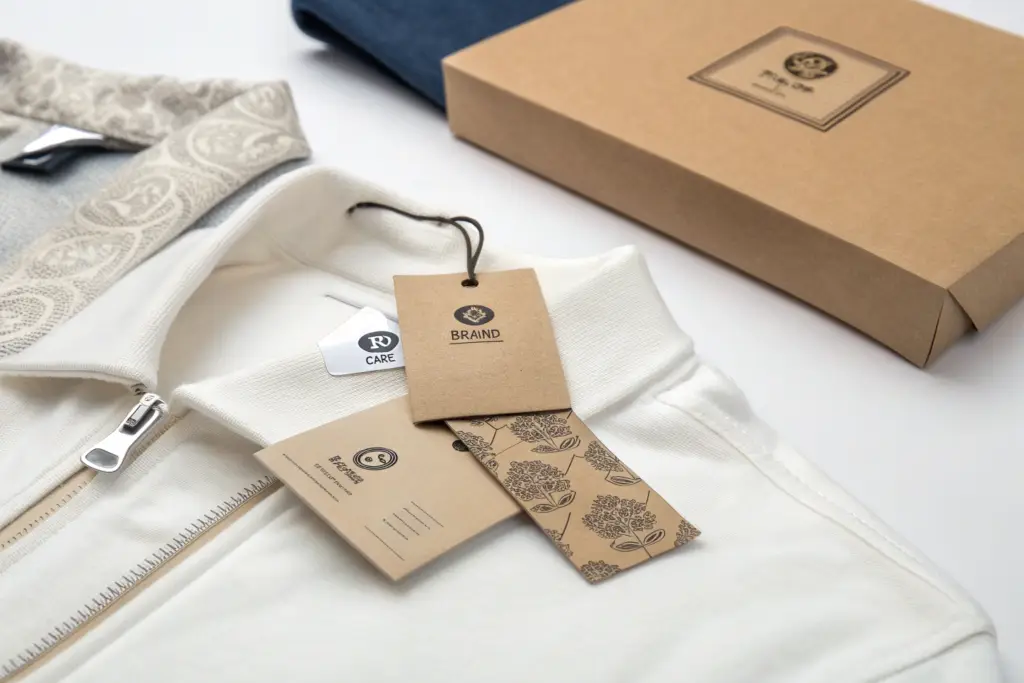
A complete label and trim replacement package communicates premium brand quality by ensuring that every customer-facing component—the woven neck label, the care label, the hangtag, the internal side-seam label, the zipper pull, the buttons, the drawstring aglets, and the polybag—is custom-designed, uses premium materials, carries consistent branding, and is attached with the same level of craftsmanship as a fully custom-developed garment, so the customer's tactile and visual experience at every touchpoint is one of cohesive, premium quality.
The customer's quality perception is formed by the cumulative experience of every component they touch. A beautiful neck label paired with a cheap hangtag creates cognitive dissonance. The customer may not consciously identify the hangtag as the problem, but they feel that something is "off" about the garment's quality. A cohesive, premium trim package eliminates this dissonance and creates a seamless perception of quality.
How Does a "Damask Woven Label" Differ From a "Satin Printed Label" in Terms of Perceived Premium Quality?
A damask woven label uses fine yarns woven together to create the text and logo, producing a label with deep, tactile texture, a soft hand feel, and a subtle sheen that reads as luxurious. A satin printed label is a flat, smooth surface with the logo printed on top, lacking texture and depth. The damask label communicates premium craftsmanship; the printed label communicates cost-cutting.
Why Should the "Internal Side-Seam Label" Include the Garment's Style Name and a Small Brand Narrative?
An internal label that simply says "MADE IN CHINA" and an RN number is a compliance document. A label that says "THE TRAIL JACKET - DESIGNED IN PORTLAND, OREGON - BUILT FOR THE LONG HAUL" tells a story. The customer discovers this hidden narrative while dressing and feels a deeper connection to the brand. This small piece of storytelling real estate is frequently overlooked by brands that treat labels as purely functional.
How Does "Branded Packaging and Unboxing Experience" Transform an Imported Wholesale Garment Into a Premium Branded Product?
A Nashville-based lifestyle brand once executed a private label strategy with a beautiful garment and premium labels. The garment was folded into a clear polybag, placed in a generic brown shipping box, and sent to the customer. The product was premium. The delivery experience was utilitarian. The customer received a beautiful garment in a package that felt like an Amazon order. No emotion. No sharing. No brand connection. A competitor brand shipped a similar garment in a custom-branded box with tissue paper, a personalized note, and a small gift. Their customers posted unboxing videos on social media, creating organic brand content that reached tens of thousands of potential customers.
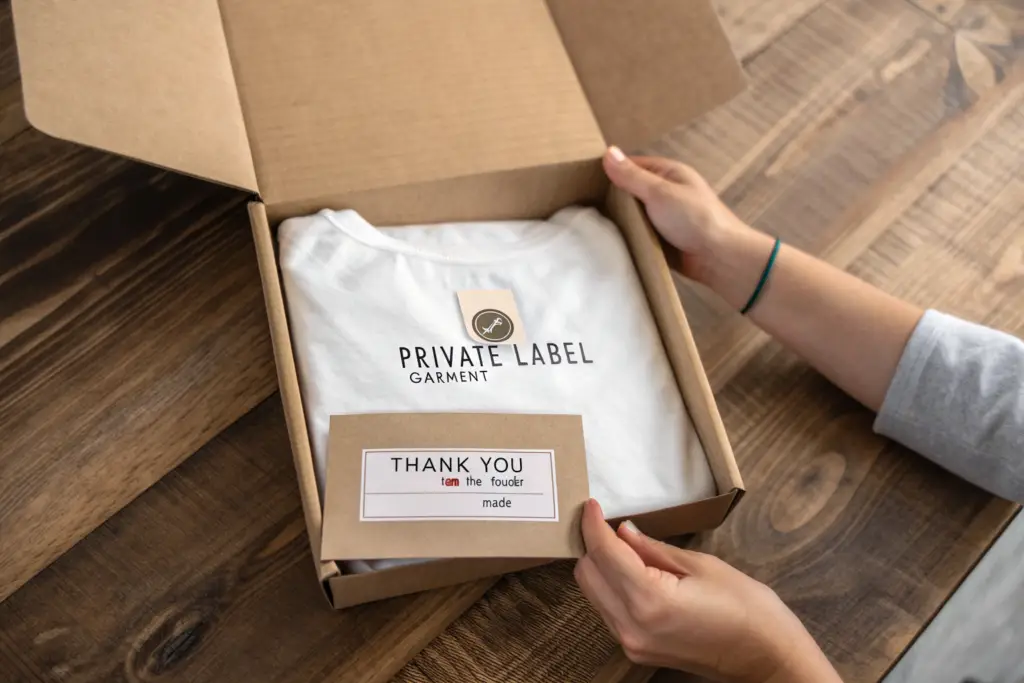
Branded packaging and unboxing experience transforms an imported wholesale garment into a premium branded product by wrapping the garment in a multi-sensory brand moment—the visual beauty of the custom box and tissue paper, the tactile pleasure of unfolding a thoughtfully packaged garment, the emotional connection of a personalized note, and the intellectual engagement of a brand story card—that elevates the customer's perception of the garment from "I bought a piece of clothing" to "I experienced this brand."
The packaging is the first physical interaction the customer has with the brand. A clear polybag communicates "warehouse." A custom-branded box with thoughtful details communicates "we care about every aspect of your experience." The garment inside is identical in both scenarios, but the customer's perception of the garment's value is dramatically different.
How Does a "Brand Story Card" Inside the Packaging Justify the Premium Price of a Private Label Garment?
The card tells the story of how the brand discovered the factory, how the fabric was developed, and why the specific construction details were chosen. The customer reads this story and understands the value behind the product. The story transforms the garment from an anonymous import into a curated, intentional product.
Why Should the "Tissue Paper and Box" Use Recyclable, Sustainable Materials to Align With the Brand Values of Modern Consumers?
A premium brand that wraps its garment in non-recyclable, plastic-heavy packaging contradicts the sustainability values that many modern consumers hold. Recyclable kraft paper, biodegradable tissue, and natural fiber ties align the packaging with the values of the customer, reinforcing the brand's integrity.
How Does "CBP Trademark Recordation" Protect the Private Label Brand From Grey Market Imports?
A Miami-based private label brand once discovered their exact garments—complete with their custom labels—being sold on a major e-commerce platform by an unauthorized seller at a 40% discount. The factory had produced an overrun of the brand's order and sold the excess units, complete with the brand's labels, to a grey market liquidator. The brand had no CBP trademark recordation. The grey market goods entered the US legally because CBP had no flag in their system for the brand's trademark. The brand's wholesale accounts, seeing the discounted product online, demanded price concessions. The brand lost control of their own pricing.
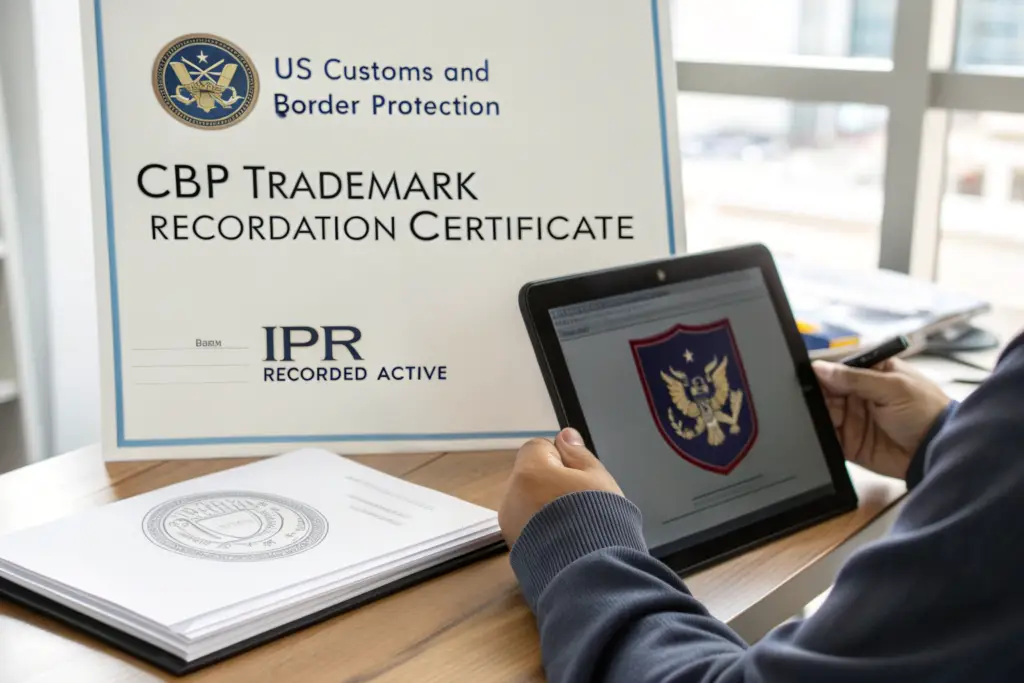
CBP trademark recordation protects the private label brand from grey market imports by entering the brand's registered US trademark into the CBP IPR search database, which trains customs officers to recognize the brand's identifiers and authorizes them to proactively seize, detain, and destroy any imported merchandise bearing the brand's trademark that is shipped by an entity not listed as an authorized licensee, creating a physical enforcement barrier at the US border.
A factory overrun, an unauthorized production run, or a grey market reseller can ship branded goods into the US. Without CBP trademark recordation, these goods clear customs without issue. With recordation, the brand's trademark is flagged in the CBP screening system, and any shipment of goods bearing that trademark by an unauthorized importer is subject to seizure at the port. This is the brand's first and strongest line of defense against unauthorized distribution of its private label products.
How Does the "CBP e-Recordation Portal" Allow a Brand to Record Its Trademark in Under Two Weeks?
The brand files an electronic application through the CBP IPR e-Recordation portal, providing the US trademark registration number, images of the trademark as it appears on the goods, and a list of authorized manufacturers and importers. The recordation is typically processed within one to two weeks and remains active for the life of the trademark registration.
Why Must the "Authorized Manufacturer List" on the CBP Recordation Be Updated When the Brand Changes Factories?
If the brand switches production to a new factory but does not update the CBP recordation, the new factory's shipments will be flagged as unauthorized and may be seized. The brand must update the authorized manufacturer list with CBP whenever a new manufacturing partner is engaged.
Conclusion
A flawless private label rebranding strategy for imported wholesale garments requires transforming an anonymous factory garment into a legally protected, physically unique, premium-branded product. The Exclusive Style Modification Agreement legally prohibits the factory from selling the brand's modified style to competitors. The custom design modifications—fabric weight, dye color, silhouette details, branded hardware—make the garment physically impossible to source identically from any other supplier. The complete label and trim replacement package ensures every customer touchpoint communicates premium quality and brand cohesion. The branded packaging and unboxing experience elevate the garment from a commodity purchase to a brand experience. The CBP trademark recordation provides enforceable border protection against unauthorized grey market imports.
At Shanghai Fumao, I work with private label brands to implement all five layers of this strategy. I sign Exclusive Style Modification Agreements that protect my clients' proprietary designs. I develop custom fabric weights, exclusive dye colors, and custom-branded hardware that differentiate my clients' products. I provide a complete premium label and trim package, including damask woven labels, custom hangtags, and branded packaging. I advise my clients on CBP trademark recordation and ensure that their goods are shipped with the correct authorization documentation.
If you are a brand buyer looking to execute a private label strategy that goes beyond a simple label swap, and you want a manufacturing partner who will protect your brand's exclusivity, develop custom modifications, and deliver a complete premium rebranding package, contact my Business Director, Elaine. She can share our Exclusive Style Modification Agreement template, our custom label and trim sample kit, and our custom fabric development capabilities. Reach Elaine at: elaine@fumaoclothing.com. Build a brand, not just a label sewn into a stock garment.