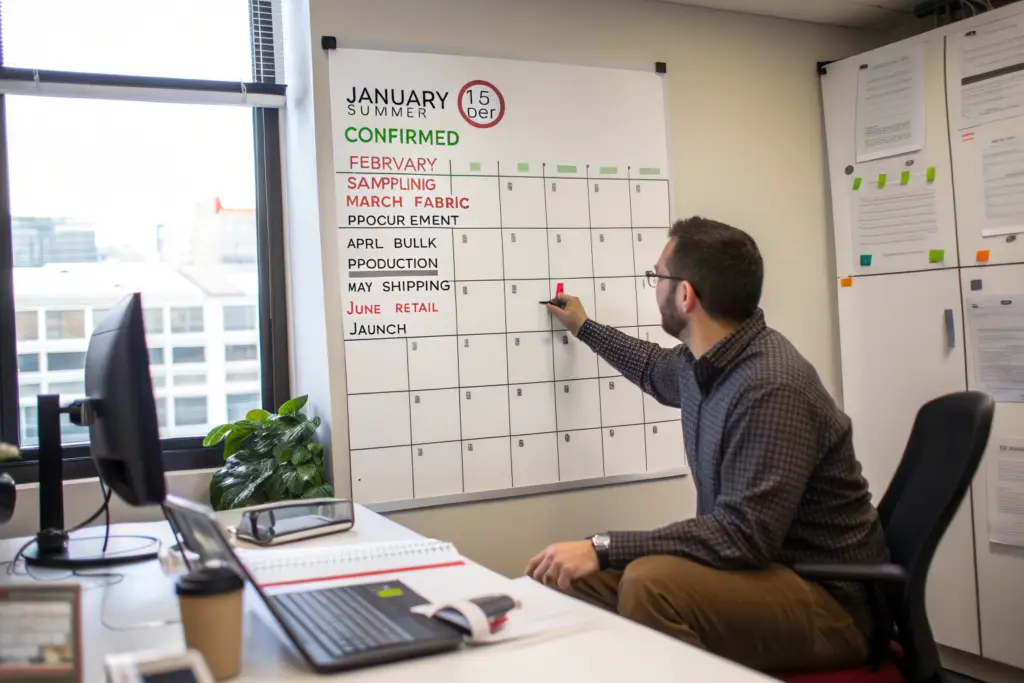
A Miami-based resort wear brand once decided, in late April, to develop a new Summer linen collection for a June retail launch. The brand's founder believed that a six-week timeline was sufficient for a simple linen shirt and dress collection. She called her factory. The factory's production capacity for May and June had been fully booked since February by brands that had confirmed their Summer orders months earlier. The greige linen fabric she needed was sold out at the mill, with the next production run scheduled for June—arriving after her retail launch date. The dye house was running at full capacity and could not accept new orders. The vessel space for a late May sailing was gone. The collection that was supposed to launch in June arrived in late July. The Summer selling season was two-thirds over. The brand lost $140,000 in expected revenue, not because the garments were poorly designed or the factory was unreliable, but because the order was placed after every critical resource—factory capacity, fabric inventory, dye house slots, and vessel space—had already been allocated to brands that planned ahead.
Brands should confirm Summer garment orders ahead of May because the Summer production and logistics supply chain operates on a four-to-five-month lead time, where each critical resource—factory production line capacity, greige fabric inventory at mills, dye house processing slots, and ocean freight vessel space—is a finite, exhaustible asset that is allocated on a first-confirmed, first-served basis, and by April, the brands that confirmed their orders in January and February have already consumed the available capacity, inventory, dye slots, and vessel bookings, leaving late-confirming brands with whatever residual capacity remains, extended lead times, premium expediting surcharges, and a high probability of missing the June-to-August Summer retail selling window entirely.
At Shanghai Fumao, I begin discussing Summer production schedules with my brand partners in November of the previous year. Tech packs are finalized in December. Orders are confirmed in January. Fabric is reserved in February. Bulk production runs from March through April. Goods ship in May. They arrive at US wholesale accounts in early June, exactly when the Summer selling season begins. This timeline is not a preference; it is the physical reality of the global apparel supply chain.
Why Is "Factory Production Line Capacity" Fully Booked by February for the Summer Season?
A Portland-based activewear brand once called their factory in late March to place a Summer order for 4,000 units. The brand had worked with this factory for two seasons and assumed their status as a "regular client" guaranteed them production capacity. The factory's project manager gently explained that all five production lines were fully booked through May with orders confirmed in January and February by other regular clients who had planned ahead. The brand could have their order produced in June, arriving in July. The brand had not lost their status. They had lost the race for a finite resource: sewing time.
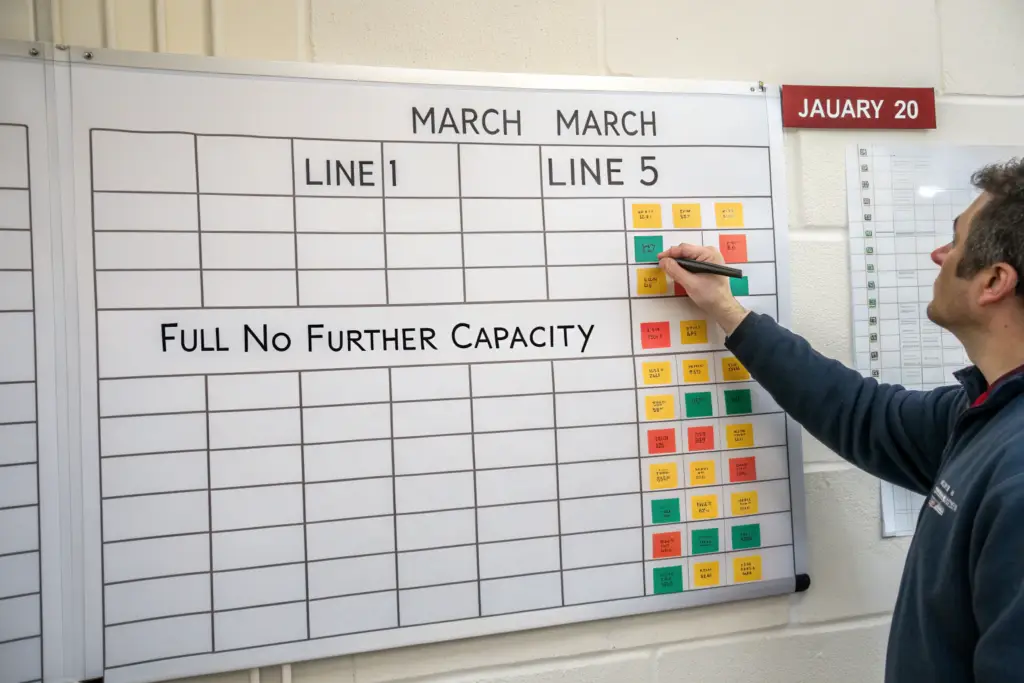
Factory production line capacity for the Summer season is fully booked by February because a garment factory has a fixed, finite number of production lines, each capable of producing a specific maximum weekly output, and the total available sewing hours from January through April represent the entire production capacity that can be delivered in time for the Summer selling window, and experienced brands that operate on disciplined seasonal calendars reserve their production slots in January and February, consuming the available capacity before less-prepared brands even begin their sourcing conversations.
A factory's five production lines can produce approximately 20,000 units per week at full capacity. The total capacity from January through April is approximately 320,000 units. This is not a number that expands to accommodate late orders. When the capacity is booked, it is gone. The brand that calls in January gets a confirmed production slot. The brand that calls in March gets an apology and a June production date.
How Does a "Reserved Production Slot" Differ From a "Verbal Capacity Promise" When a Factory Is Fully Booked?
A reserved production slot is a specific, named production line allocated to a specific brand for a specific block of calendar weeks, confirmed with a signed purchase order and a deposit payment. A verbal capacity promise—"Don't worry, we will have capacity for you"—is a hope expressed by a sales representative who does not control the production schedule. When the schedule fills up, the verbal promise evaporates.
Why Does "Late Order Placement" Force the Factory to Choose Between Refusing the Order or Accepting It and Risking Late Delivery?
The factory owner faces a choice: refuse the order and lose the revenue, or accept the order knowing that the production schedule is already at 100% of capacity and that something will inevitably be delayed. An ethical factory refuses the order. A desperate factory accepts the order, over-promises, and delivers late. The brand suffers either way.
How Does "Greige Fabric Inventory Depletion" at Mills Create a Raw Material Bottleneck for Summer Orders Placed After March?
A San Diego-based surf brand once finalized their Summer collection designs in late March and sent the fabric specifications to their factory. The factory contacted the mill to order the required 3,500 meters of a specific 140 GSM cotton-linen blend. The mill responded that the fabric was out of stock. The greige inventory had been purchased by brands that confirmed their orders in January and February. The next production run of that specific blend would be completed in early May, and the finished dyed fabric would not be available until late May. The brand's production could not start until June. The Summer selling window would be missed. The fabric the brand needed existed, but it belonged to other brands that had reserved it months earlier.
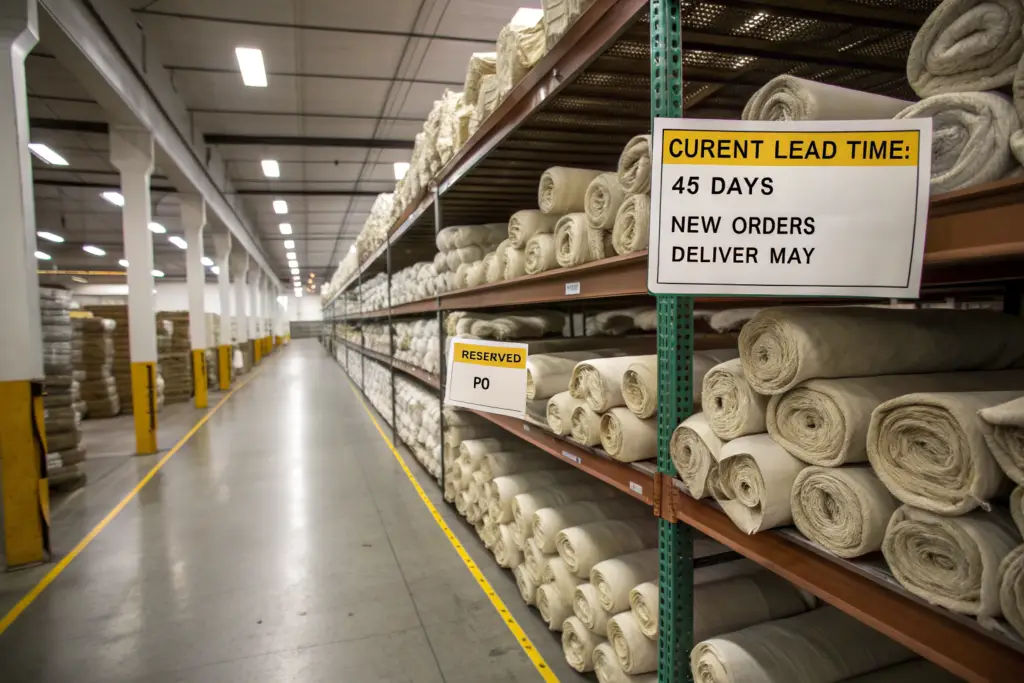
Greige fabric inventory at mills is substantially depleted by March because the mills that produce the popular Summer fabric qualities—lightweight cotton jerseys, linen blends, cotton voiles, and rayon challis—produce these seasonal qualities in limited production runs during the winter months, and brands that confirm their orders in January and February reserve the available greige inventory with their purchase orders, meaning that by March, the most desirable Summer fabric qualities are either physically sold out or available only on extended lead times of 30-45 days, pushing the fabric delivery date past the point where the Summer production and shipping window can be met.
Fabric mills do not maintain infinite inventory of every quality and color. They produce seasonal qualities in planned production runs based on anticipated demand. The Summer-weight fabrics are produced in December through February. The brands that place their orders during this window secure the fabric. The brands that wait until March find that the fabric they want is already in a warehouse with another brand's name on it.
How Does a "Greige Fabric Reservation Agreement" Signed in January Guarantee Material Availability in April?
The brand signs a reservation agreement with the factory, and the factory places a corresponding reservation with the mill, physically allocating a specific quantity of greige fabric to the brand's PO number. The fabric sits in the mill's warehouse with the brand's name on it. When the brand's production window opens in April, the fabric is immediately available.
Why Are "Specialty Summer Fabric Qualities" Like Linen Blends and Cotton Voile Particularly Vulnerable to Early Depletion?
These are seasonal, not year-round, fabric qualities. Mills produce them in limited quantities specifically for the Summer season, and they do not maintain year-round inventory. Once the seasonal production run is sold, it is gone until the following year.
How Does "Ocean Freight Vessel Space Pre-Booking" Determine Whether Summer Goods Arrive in June or August?
A New York-based Summer dress brand once confirmed their production order in late April and assumed that shipping was a simple, last-step process that could be arranged quickly. The factory completed production in mid-May. The logistics coordinator attempted to book vessel space for a late May sailing. Every vessel on the transpacific route was fully booked with cargo from brands that had reserved their space in February and March. The earliest available vessel slot was mid-June, arriving in the US in early July. The Summer selling window was half over. The brand had not budgeted for air freight, which would have cost an additional $18,000. The goods sailed in June and arrived in July.
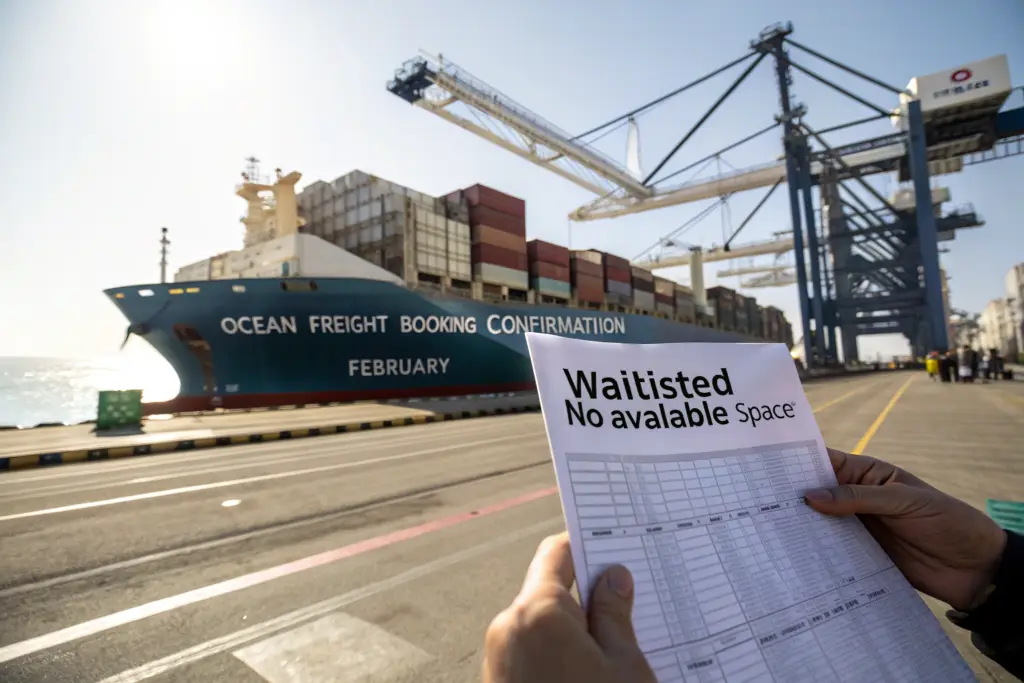
Ocean freight vessel space for the peak Summer shipping period is pre-booked by experienced brands between January and March because the global ocean freight market operates on a finite supply of vessel capacity, and the May-through-July period—when Summer goods must ship to arrive in time for the retail season—is the peak demand period for all industries, not just apparel, and vessel space is allocated on a first-booked, first-served basis, meaning that brands that wait until April or May to book their freight find that the vessels are fully booked and their goods are either waitlisted for a later sailing that misses the retail window or must be air-freighted at a premium cost that destroys the season's margin.
A container vessel has a fixed number of slots. When they are booked, they are booked. The brand that confirms its freight booking in February has a confirmed space on a May vessel. The brand that calls the forwarder in late April discovers that the May vessels were fully booked two months ago. The choice is a June vessel—arriving in July—or air freight at a cost that consumes the profit margin.
How Does a "Pre-Booked Vessel Space Agreement" Signed in February Differ From a "Spot Rate Booking" Attempted in April?
A pre-booked agreement secures a specific vessel, a specific sailing date, and a fixed rate, guaranteed by contract. A spot rate booking is a request for any available space at whatever price the market demands at that moment. In April, when demand peaks, spot rates are significantly higher than pre-booked rates, and availability is uncertain.
Why Does "Peak Season Surcharge Application" Disproportionately Impact Late-Booking Brands?
Ocean carriers apply Peak Season Surcharges during the high-demand May-through-July period. Brands that booked in February often locked in rates before the surcharge was applied. Brands that book in April or May pay the base rate plus the surcharge, adding a significant unbudgeted cost.
What "Dye House Capacity Saturation" Occurs in March Through May That Delays Late-Confirmed Orders?
A Charleston-based coastal brand once approved their final seasonal lab dips in early April and sent the fabric to the dye house for their order of 3,000 units in four colors. The dye house responded that their processing queue was fully committed through the end of April. Every dye vessel was scheduled with color lots for brands that had approved their lab dips in February and March. The earliest the brand's fabric could enter the dye bath was May 5th. The dyeing would be complete by May 15th. Production could not start until May 20th. The delay cascaded through the entire timeline.
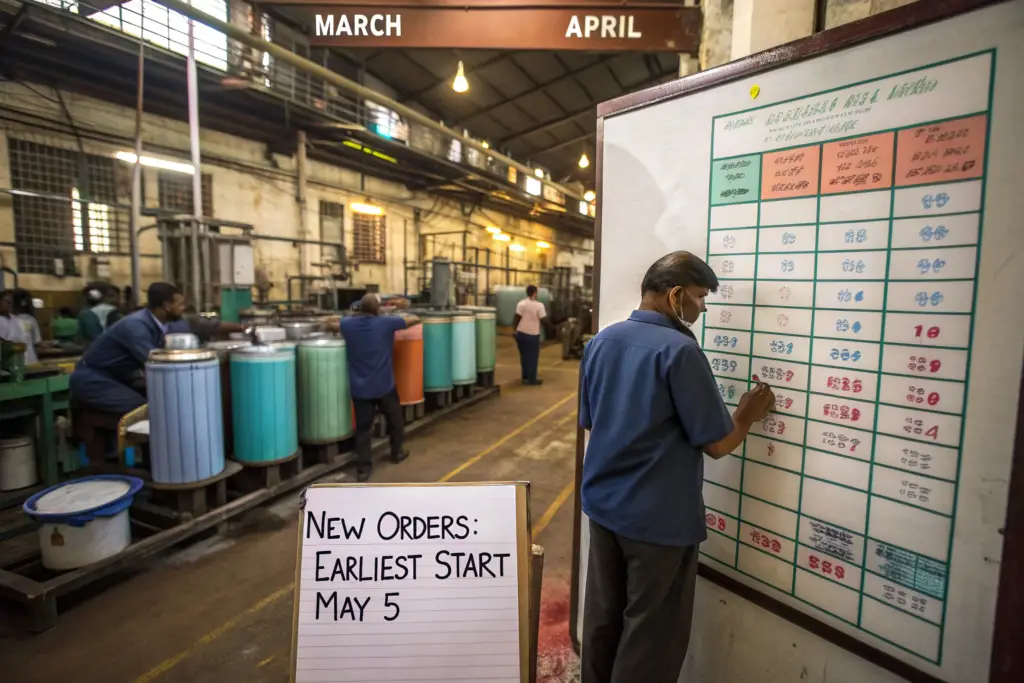
Dye house capacity becomes saturated between March and May because every brand producing for the Summer season requires their custom seasonal colors to be dyed during this exact window, and dye houses have a fixed number of industrial dyeing vessels that can process a limited number of color lots per day, and brands that approve their lab dips and submit their fabric in January and February secure the early, on-schedule dye slots, while brands that approve their lab dips in March or April join the back of a long queue, pushing their fabric delivery into May and their production start into late May or June.
A dye house operates a finite number of dyeing machines, each capable of processing a specific weight of fabric per cycle. The total daily capacity is fixed. During the March-to-May peak, every dye machine is running continuously, and the queue of orders waiting for an available machine extends for weeks. A brand that submits fabric in January is at the front of the queue. A brand that submits in April is at the back.
How Does "Pre-Booked Dye House Capacity" Linked to a Fabric Reservation Secure Both the Raw Material and the Processing Slot?
The factory reserves not only the greige fabric from the mill but also a specific dye processing window at the dye house, with a confirmed start date. The fabric and the dye slot are reserved as a package, ensuring that when the fabric is ready, the dyeing capacity is available.
Why Does "Late Lab Dip Approval" in April Create a Compound Delay That Pushes Production Into June?
The lab dip approval is the trigger that releases the fabric to the dye house. If the lab dip is not approved until April, the fabric cannot enter the dye queue until April. By then, the dye house is saturated, and the dyeing is delayed into May, pushing bulk production into June, and shipping into July. The late lab dip approval alone can add four to six weeks to the total timeline.
Conclusion
Confirming Summer garment orders ahead of May is not an act of excessive caution. It is the recognition that the global apparel supply chain is a sequence of finite, exhaustible resources—factory sewing hours, greige fabric inventory, dye house processing slots, and ocean freight vessel space—each of which is allocated on a first-confirmed, first-served basis. The brands that confirm their orders in January and February secure their production capacity, reserve their fabric, book their dye slots, and lock in their freight. The brands that wait until March or April find that every resource they need has already been consumed by competitors who planned ahead. The result is not just a late delivery. The result is a compressed or missed Summer selling window, markdown pressure, wholesale order cancellations, and a season's revenue that falls far short of the brand's financial plan.
At Shanghai Fumao, I begin discussing Summer production with my brand partners in November. Tech packs are finalized by December. Orders are confirmed in January. Greige fabric is reserved in February. Bulk production runs from March through April. Goods ship in May and arrive in early June. This timeline is the physical reality of the supply chain. It cannot be compressed without sacrificing quality, incurring premium expediting costs, or missing the retail window entirely.
If you are a brand buyer planning your Summer collection and you want to secure your production capacity, fabric inventory, dye slots, and freight space before the seasonal rush consumes them, contact my Business Director, Elaine. She can provide a detailed production timeline for your specific order, confirm our available production capacity for the Summer season, and initiate the fabric reservation and freight pre-booking process. Reach Elaine at: elaine@fumaoclothing.com. Confirm your Summer order in Winter, and sell it with confidence in June.