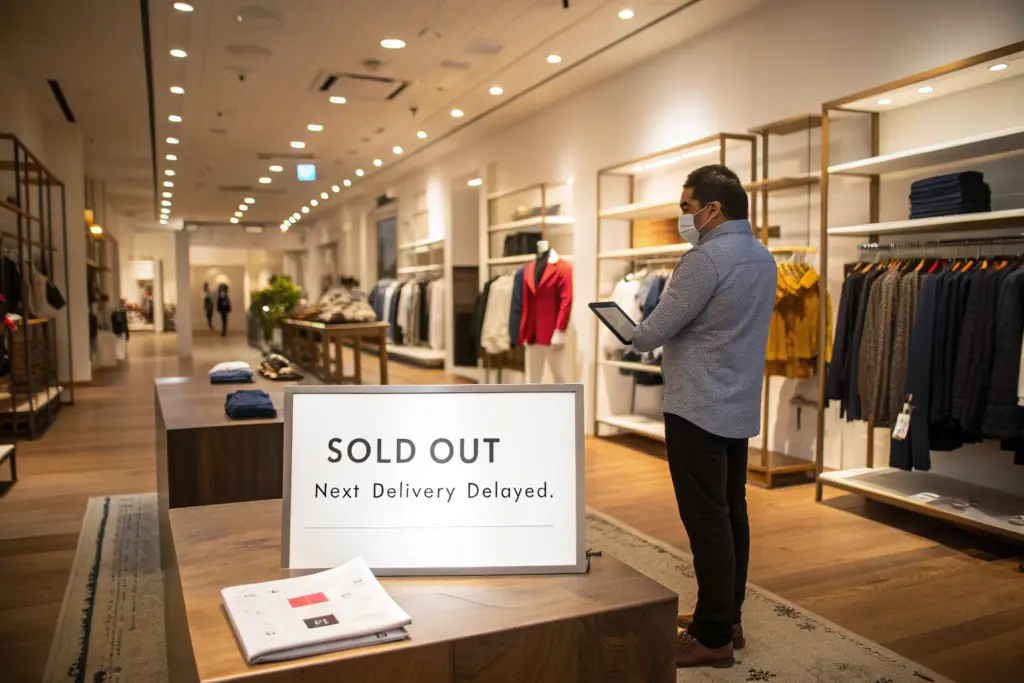
Two years ago, a fast-growing Chicago-based streetwear brand placed their largest ever wholesale order—$180,000 worth of custom hoodies, tees, and sweatpants for the back-to-school season. The factory promised a September 1st delivery. The goods arrived on October 17th. The brand lost $340,000 in confirmed wholesale orders that season. But the destruction did not stop there. Two major department store chains, having been burned by the late delivery, cancelled their Spring orders. The brand's cash flow, which had been modeled on the $340,000 in expected receivables, collapsed. They could not pay for the next season's production. The brand, which had been growing at 40% year-over-year, was out of business within fourteen months. The factory's delivery delay was the single proximate cause. The garments were beautiful. The sell-through on the units that did arrive was strong. The brand's destruction was not caused by a bad product, a weak market, or a flawed design. It was caused by a container that sat at a port for three extra weeks.
Delayed international clothing shipments completely destroy retail brand profitability because the apparel retail business operates on a rigid, seasonal calendar with narrow, non-negotiable selling windows, and a delay of even two to three weeks causes a catastrophic cascade: the goods miss the wholesale delivery window and wholesale orders are cancelled outright; the goods that do arrive compete against early markdowns from on-time competitors, compressing the full-price selling period and forcing deeper, margin-destroying discounts; the brand's cash flow, which was modeled on the expected wholesale receivables, is disrupted, preventing payment for the next season's production; and the wholesale accounts, who track vendor delivery performance metrics, downgrade or delist the brand, destroying not just the current season's revenue but the future season's access to retail distribution channels.
At Shanghai Fumao, I have watched brands succeed and fail based almost entirely on their factory's delivery reliability. A beautiful garment that arrives four weeks late is a clearance liability. An average garment that arrives on week one of the selling season captures the full-price window. The difference is the delivery date.
Why Does a "Two-Week Delay" Erase 40-60% of a Season's Full-Price Selling Window?
A Boston-based collegiate apparel brand once planned their Fall collection delivery for September 1st, which gave them a full six-week selling window before the November markdown period began. The factory's shipment was delayed by exactly fourteen days, arriving on September 15th. The brand lost two weeks of the six-week full-price window—33% of the planned selling period. But the actual revenue impact was far worse than 33%. The first two weeks of a retail season typically generate 40-60% of the total season's full-price sales, because the most motivated, highest-intent customers buy early, and the wholesale accounts give premium floor placement to fresh, newly arrived inventory. The brand had missed the highest-revenue weeks of the entire season.
A two-week delay erases 40-60% of a season's full-price selling window because the first two to three weeks of any retail season capture the highest concentration of high-intent, full-price customers who are shopping specifically for the new season's merchandise, and the wholesale accounts allocate their best floor placement, window displays, and marketing support to the brands whose goods are present and merchandised on day one of the season, meaning that a brand whose goods arrive in week three has already missed the peak revenue weeks and is now competing for residual demand against competitors who have been on the floor since day one.
The apparel retail demand curve is not flat. It spikes sharply at the beginning of the season, driven by customers who have been waiting for the new collection and wholesale accounts who plan their floor sets around specific launch dates. A brand that misses the spike captures the trailing, lower-revenue tail of the curve. The revenue difference between "present on day one" and "present on day fifteen" is not proportional to the time lost; it is disproportionately concentrated in the early days.
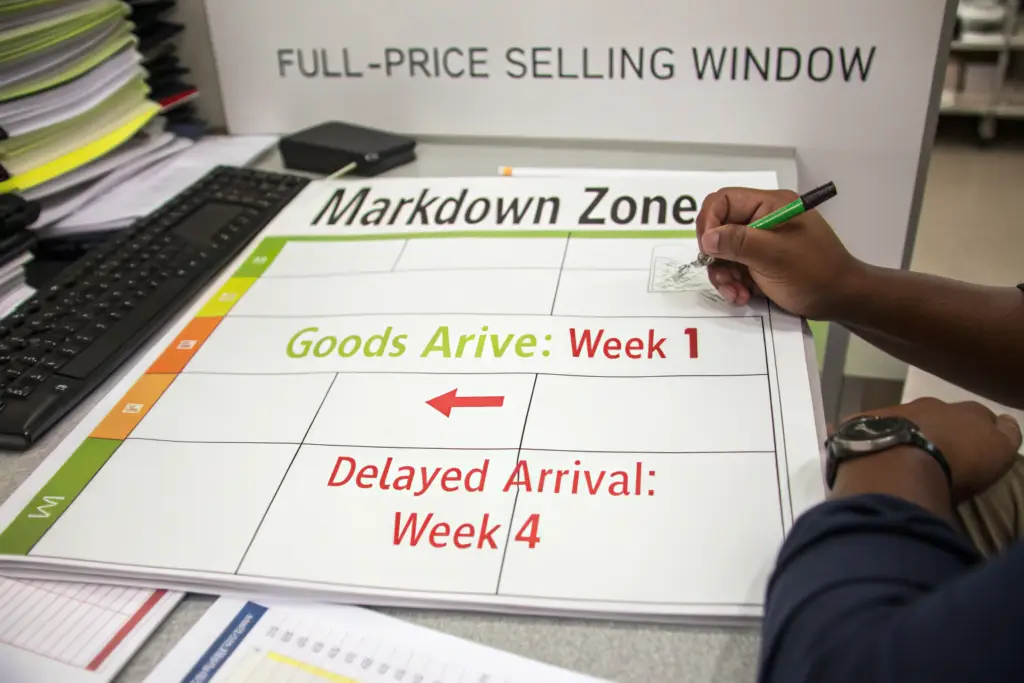
How Does a "Retail Floor Set Calendar" Determine the Absolute, Non-Negotiable Delivery Deadline for Wholesale Brands?
Major department stores and specialty chains plan their floor sets months in advance. They allocate specific floor space, window displays, and marketing assets to specific dates. If a brand's goods are not in the store's distribution center by the floor set date, the space allocated to that brand goes to a competitor whose goods are present. The brand's order is cancelled, not postponed.
Why Does "Lost Early-Season Wholesale Placement" Reduce Full-Price Sell-Through by an Additional 15-25%?
Even if the goods arrive in week three and are accepted by the retailer, they are now placed in less prominent floor locations—the back of the store, lower shelves, less trafficked zones—because the premium floor space has already been allocated to competitors. The reduced visibility further depresses full-price sell-through, compounding the revenue loss from the delayed arrival.
How Do "Wholesale Order Cancellations" Turn a Late Shipment Into a Permanent Revenue Loss That Exceeds the Order Value?
A Portland-based outdoor apparel brand once had a shipment delayed by three weeks due to a blank sailing. The goods were destined for twelve independent specialty retail accounts. Ten of the twelve retailers cancelled their orders outright. The retailers, small independent shops with limited shelf space and tight seasonal budgets, could not afford to wait three weeks for inventory that they should have been selling already. They filled their shelves with a competitor's product. The brand did not just lose the revenue from those ten cancelled orders. They lost the shelf placement for the entire season, and two of the retailers never placed another order with the brand, having concluded that the brand was an unreliable supplier.
Wholesale order cancellations turn a late shipment into a permanent revenue loss that exceeds the order value because a cancelled wholesale order represents not just the immediate lost revenue on that specific order, but the permanent loss of the shelf placement, the customer traffic, and the brand visibility that those wholesale accounts would have provided for the entire season, and the wholesale buyer, having been forced to fill the shelf space with a competitor's product, may permanently reallocate that shelf space to the competitor for future seasons, meaning the revenue from that wholesale account is not postponed—it is destroyed and may never return.
A wholesale account is a recurring revenue asset. Each year, the retailer places orders for multiple seasons. When a late delivery causes a cancellation, the brand is not just losing one season's order. It is risking the permanent loss of a recurring revenue stream that, over multiple seasons, could represent ten to twenty times the value of the single cancelled order.
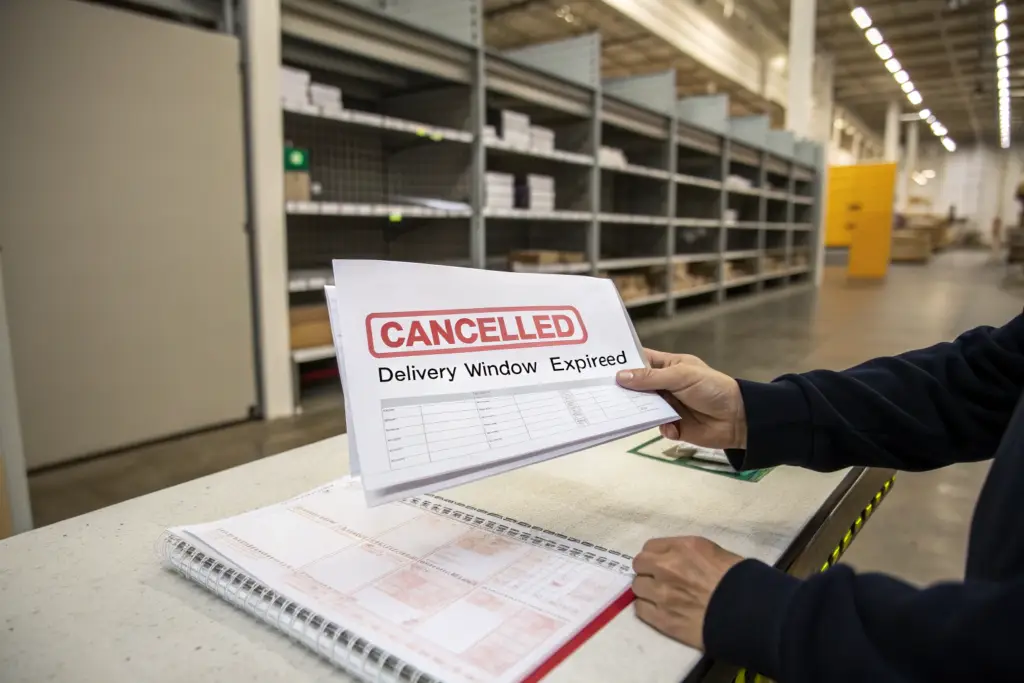
How Does a "Retailer Vendor Scorecard" Track Delivery Performance, and What Score Triggers Delisting?
Major retailers maintain automated vendor scorecards that track on-time delivery percentage, fill rate, and quality acceptance rate. A vendor whose on-time delivery drops below a threshold—often 90-95%—is automatically flagged for review. Repeated late deliveries can trigger a formal vendor delisting, where the brand is permanently removed from the retailer's approved vendor list.
Why Is "Losing a Wholesale Account" a Far Greater Long-Term Financial Loss Than the Value of the Single Cancelled Order?
A wholesale account that places $30,000 in orders per season, across two seasons per year, represents $60,000 in annual revenue. Over a five-year relationship, that single account is worth $300,000. Losing the account over a late delivery that affected a single $30,000 order is a tenfold magnification of the loss.
Why Does "Clearance Markdown Depth" Increase by 25-40% for Late-Arriving Goods That Miss the Peak Selling Window?
A Denver-based winter accessories brand once had their shipment of cashmere beanies and scarves arrive in mid-November instead of early October. The goods were beautiful, high-quality, and trend-right. But by mid-November, the competitors who had arrived on time in October had already captured the early-season gift shoppers. The brand's wholesale accounts, needing to clear inventory before the post-holiday lull, began marking down the late-arriving goods almost immediately. The beanies that were priced at $48 full-price sold at an average of $26. The scarves priced at $88 sold at an average of $48. The gross margin, which should have been 62%, was compressed to 18%. The shipment was not a financial loss on paper, but the margin destruction converted a profitable season into a break-even exercise.
Clearance markdown depth increases by 25-40% for late-arriving goods because the goods miss the high-intent, full-price customer traffic of the early season and arrive during a period when competitors' on-time inventory is already beginning to be marked down, forcing the brand to match or exceed competitor markdowns to clear inventory before the end of the season, and the compressed selling window means the brand has fewer weeks to sell the same quantity of goods at full price, requiring deeper, faster markdowns to achieve the sell-through necessary to avoid carrying inventory into the next season at an additional warehousing cost.
The markdown math is unforgiving. A brand that planned to sell 80% of units at full price and 20% at 40% off now must sell 40% of units at full price, 30% at 30% off, and 30% at 60% off because the full-price selling window was cut in half. The average selling price drops dramatically, and the gross margin that was modeled in the brand's financial plan evaporates.
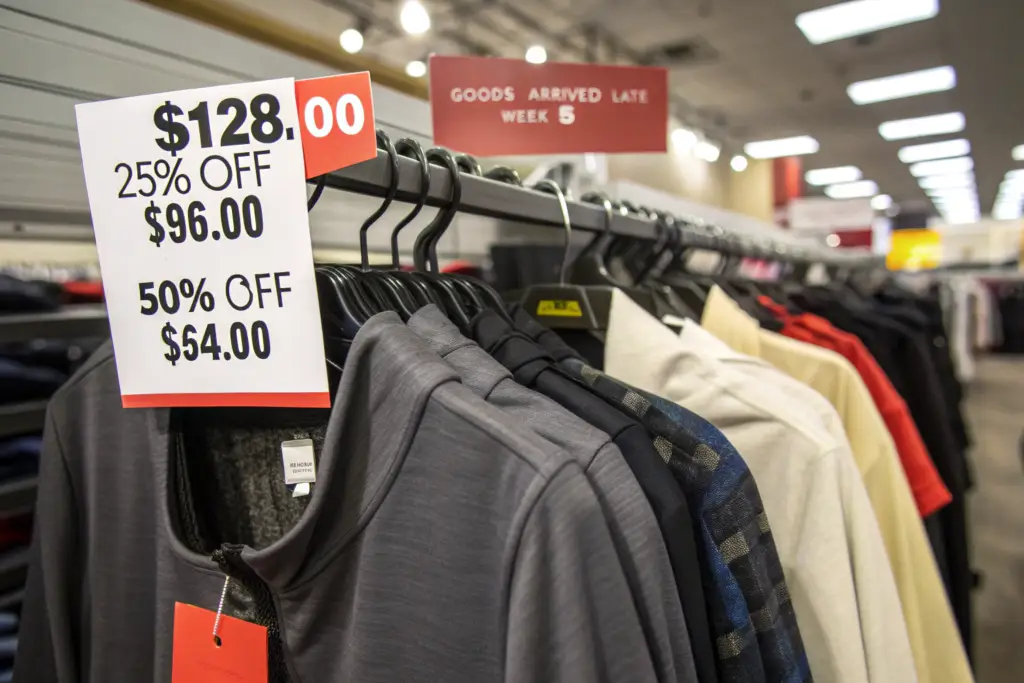
How Does "Competitor Markdown Pressure" Force a Late-Arriving Brand to Match Discounts They Never Planned?
If the three competitors who arrived on time have already sold 60% of their inventory at full price and are beginning to offer 25% off to clear the remaining units, a late-arriving brand with 100% of their inventory still in stock must match the 25% discount immediately, despite having sold zero units at full price.
Why Does "Warehouse Carry Cost" for Unsold Late-Season Inventory Add an Additional 2-4% to the Total Cost?
Inventory that does not sell before the end of the season must be stored in a warehouse, incurring monthly storage fees, until the following year or until it is liquidated. For a brand that misses the peak selling window and is left with significant unsold inventory, the warehousing cost further erodes the already-compressed margin.
How Does "Cash Flow Disruption" From Delayed Receivables Prevent the Brand From Funding the Next Season's Production?
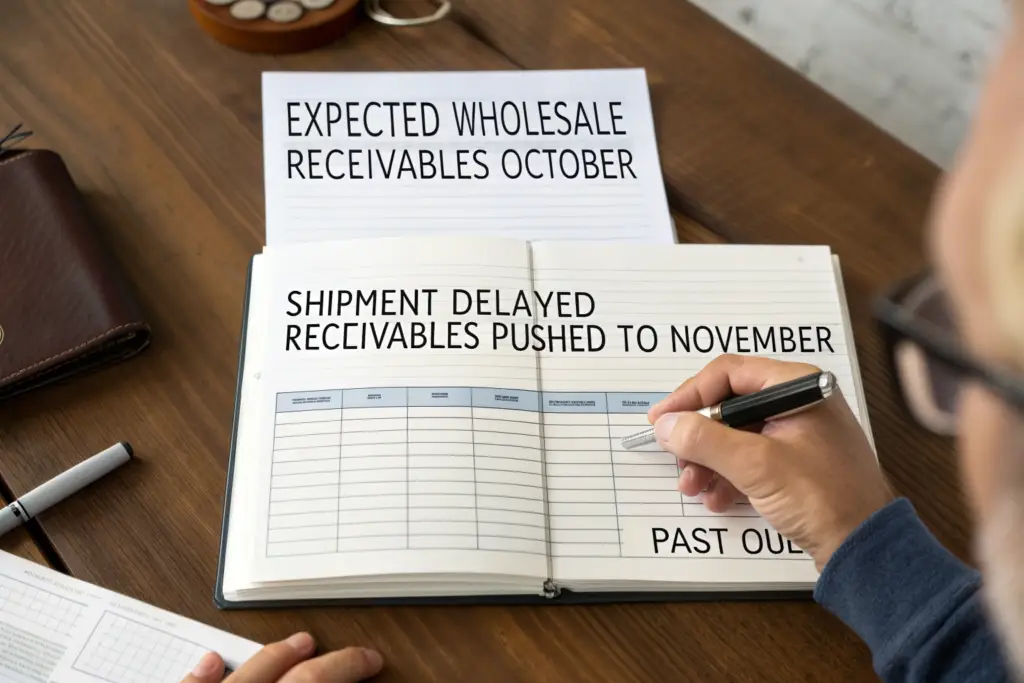
A Nashville-based lifestyle brand once modeled their entire cash flow around receiving $120,000 in wholesale payments by October 15th. The shipment was delayed by three weeks, arriving in early November. The wholesale accounts, who pay net-30 from the date of delivery, did not remit payment until early December. The brand had a $45,000 deposit due to the factory for the Spring season's production on November 1st. They did not have the cash. They missed the deposit deadline. The factory, which had reserved production capacity for the brand, released the capacity to another client. The Spring season's production was delayed by four weeks, and the cycle of late deliveries, missed selling windows, and compressed margins repeated itself.
Cash flow disruption from delayed receivables prevents the brand from funding the next season's production because the brand's working capital cycle depends on receiving payment for the current season's goods in time to pay the deposit on the next season's production, and a delay in the current season's deliveries cascades into a delay in the next season's deposit payment, which causes the factory to release reserved production capacity to other clients, delaying the next season's deliveries, creating a self-reinforcing cycle of late shipments, compressed margins, and deteriorating cash flow that can trap a growing brand in a permanent state of financial distress.
An apparel brand is a cash flow machine. Cash flows out to the factory for production. Cash flows in from wholesale accounts after delivery. The timing of these flows must be synchronized. A delivery delay breaks the synchronization. The cash flows out on schedule, but the cash does not flow back on schedule. The gap between the outflow and the inflow must be bridged by the brand's working capital, and a brand that is growing rapidly often has no buffer of working capital to bridge the gap.
How Does "Net-30 Payment Terms From the Delivery Date" Amplify the Cash Flow Impact of a Three-Week Delay?
The wholesale account pays 30 days after the goods are delivered. A three-week delivery delay pushes the payment receipt back by three weeks, plus the 30-day payment term begins from the new, later delivery date. The total delay in cash receipt is three weeks longer than the delivery delay itself.
Why Does "Losing Factory Production Capacity for the Next Season" Turn a Current-Season Problem Into a Multi-Season Crisis?
When the brand misses the deposit deadline, the factory releases the reserved production line to another client. The brand must now wait for new capacity to become available, which may be months later. The next season's deliveries are now also at risk of being late, perpetuating the cycle.
Conclusion
Delayed international clothing shipments destroy retail brand profitability not through a single, isolated cost, but through a cascading sequence of compounding financial damage. The first two to three weeks of a retail season capture the highest concentration of full-price demand, and missing those weeks erases 40-60% of the planned full-price revenue. Wholesale accounts cancel orders when delivery windows are missed, and the lost revenue from a cancelled order is multiplied tenfold by the permanent loss of the recurring wholesale relationship. The compressed selling window forces deeper, faster markdowns, compressing gross margins by 25-40%. The disrupted cash flow from delayed wholesale receivables prevents the brand from funding the next season's production, creating a self-reinforcing cycle of late deliveries. The factory's delivery date is not a logistics metric; it is the foundation upon which the brand's entire financial model rests.
At Shanghai Fumao, my production planning system, my project management methodology, and my DDP logistics service are all designed around a single, non-negotiable commitment: the delivery date. I build production schedules backward from the brand's retail floor set date. I pre-book vessel space 45 days before sailing. I pre-clear customs while the vessel is in transit. I do not treat the delivery date as an estimate. I treat it as a contract.
If you are a brand buyer who has been burned by late deliveries and you want a manufacturing partner whose entire operational system is built to guarantee the delivery date your financial model depends on, contact my Business Director, Elaine. She can walk you through our reverse-calendar production planning, our vessel pre-booking protocol, and our in-transit pre-clearance process. Reach Elaine at: elaine@fumaoclothing.com. Your season's profitability depends on the date the goods arrive. Choose a factory that treats that date as sacred.