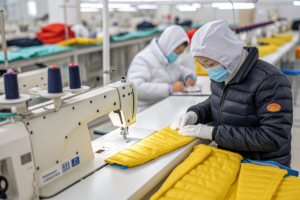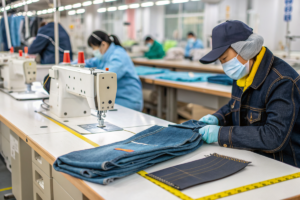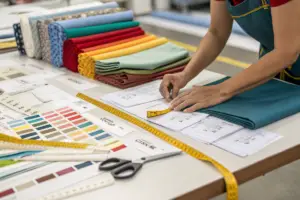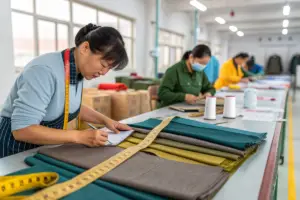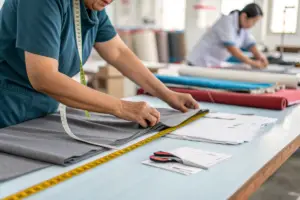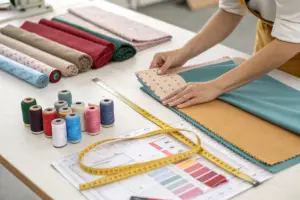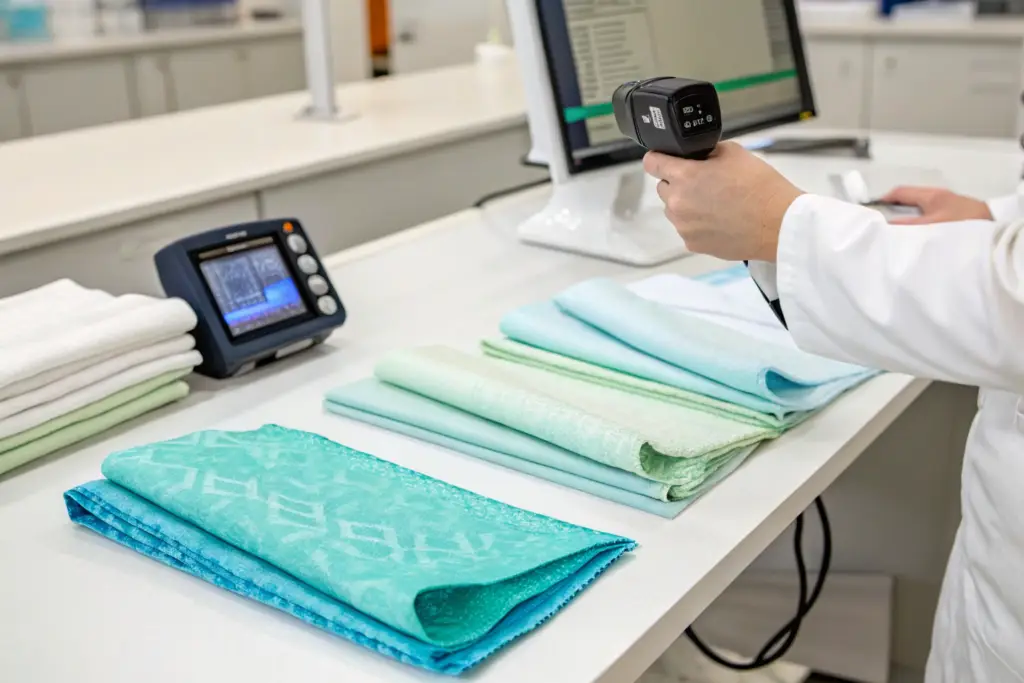
A Houston-based golf apparel brand once launched a line of "cooling" polo shirts that became the most returned product in their company's history. The shirts were made from 100% cotton pique—a classic golf shirt fabric that the brand had used for decades. The marketing campaign promised "all-day cooling comfort in the summer heat." On the golf course in 98-degree Texas humidity, the cotton absorbed sweat, became saturated, clung to the skin, and created a hot, wet, suffocating layer. The shirts were beautifully constructed and perfectly styled, but the fabric was a thermal disaster. The brand had chosen a fabric that was traditionally used for Summer sports apparel but had never actually measured its cooling performance. Tradition had been mistaken for technology.
To choose a high-quality cooling fabric for Summer clothes, you must evaluate the fabric against four specific, measurable performance criteria: a high Qmax thermal effusivity rating, measured in watts per square meter per Kelvin, which quantifies the fabric's ability to instantly draw heat away from the skin upon contact and create a cool touch sensation; a rapid moisture-wicking rate per AATCC 195 that spreads sweat into a thin, wide film for fast evaporation; a high air permeability CFM value per ASTM D737 of at least 60-80 CFM that allows body heat to escape through the fabric; and a lightweight construction of 100-160 GSM that minimizes the thermal insulation between the skin and the outside air.
At Shanghai Fumao, I source cooling fabrics from mills that provide the specific performance test data—the Qmax value, the wicking rate in millimeters, the CFM number, and the GSM weight. A fabric that feels cool to the touch in an air-conditioned showroom but traps heat on a Summer street is not a cooling fabric. The test data tells the truth.
Why Is "Qmax Thermal Effusivity" the Most Important Cooling Metric That Most Brands Have Never Heard Of?
An Austin-based performance apparel brand once sourced two different polyester fabrics for their Summer running singlets. Both were 130 GSM, both were lightweight, and both had similar mesh structures. One fabric consistently received customer feedback describing it as "instantly cool when you put it on." The other generated complaints about feeling "clammy and warm." The brand could not understand the difference. The two fabrics had nearly identical air permeability, moisture wicking, and GSM. The difference was in a metric the brand had never measured: Qmax thermal effusivity. The well-reviewed fabric had a Qmax of 0.19 W/cm². The poorly reviewed fabric had a Qmax of 0.11 W/cm². The higher Qmax fabric drew heat out of the skin on contact nearly twice as fast, creating the immediate "cool touch" sensation that the lower Qmax fabric could not provide.
Qmax thermal effusivity is the most important cooling metric that most brands have never heard of because it measures the instantaneous heat flux that occurs when a fabric first touches the skin—the "cool to the touch" sensation that the wearer experiences in the first second of contact—and a fabric with a Qmax above 0.15-0.18 W/cm² will feel noticeably cool upon contact, while a fabric with a Qmax below 0.10 W/cm² will feel neutral or warm, regardless of how lightweight or open-weave the fabric is, making Qmax the single best predictor of whether a customer will describe a Summer garment as "cooling" when they first try it on.
The physics is simple. When a fabric touches warm skin, heat flows from the skin into the fabric. The rate of that heat flow is the Qmax. A high Qmax fabric conducts heat away from the skin rapidly, creating an immediate sensation of coolness. A low Qmax fabric conducts heat slowly, and the skin remains warm. This sensation happens in less than a second, before any wicking or breathability has occurred. It is the first impression of cooling, and it sets the customer's entire perception of the garment.
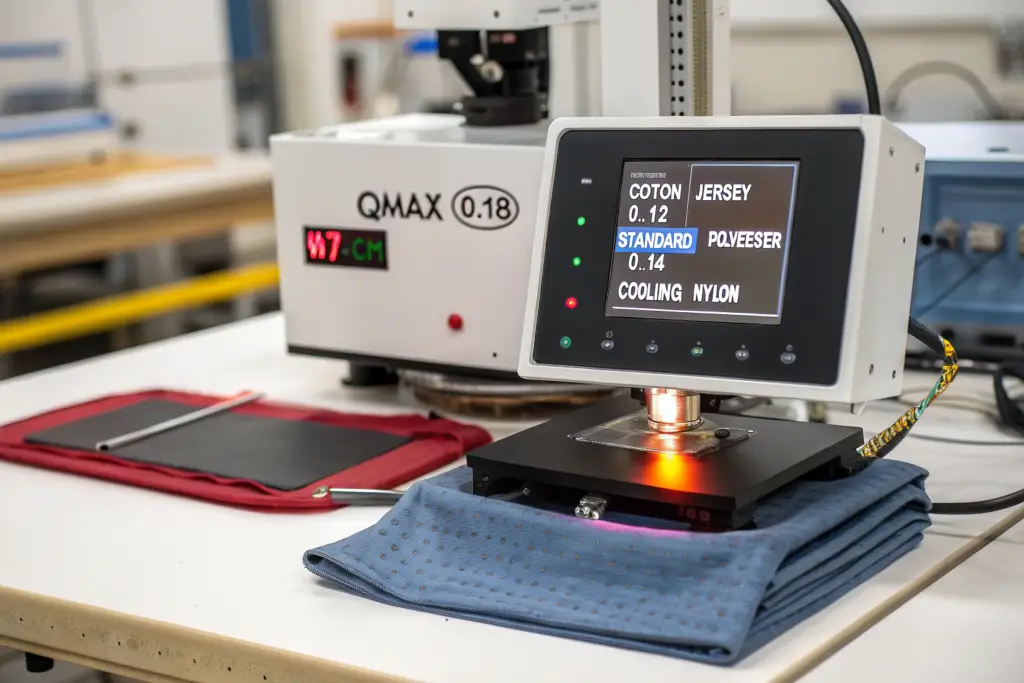
How Is Qmax Measured, and What Is the Difference Between a "Cool Touch" and a "Neutral Touch" Qmax Value?
The Qmax test uses a thermal touch tester that simulates a warm human fingertip touching the fabric. A heated sensor plate at skin temperature presses against the fabric sample, and the device measures the peak heat flux in the first 0.2 seconds of contact. A Qmax above 0.15 W/cm² is perceived as a cool touch. A Qmax between 0.10 and 0.15 is neutral. A Qmax below 0.10 is perceived as warm.
Why Does a "Nylon 6.6 Microfiber" Consistently Achieve Higher Qmax Values Than a Standard Polyester of the Same Weight and Construction?
Nylon 6.6 has a higher intrinsic thermal conductivity than standard polyester. Its molecular structure transfers heat more efficiently. When blended with a high-thermal-conductivity additive such as jade powder, ceramic particles, or xylitol during extrusion, the Qmax can be further elevated to 0.20 W/cm² or higher.
How Does "Moisture-Wicking Rate and Spreading Area" Determine Whether Sweat Evaporates or Pools on the Skin?
A Tampa-based fishing apparel brand once sourced a lightweight polyester fabric that felt pleasantly cool to the touch in the showroom. The Qmax was a respectable 0.17, and the fabric felt great during try-on. On the water, in the Florida sun, the shirts became a swamp. The fabric's moisture wicking was poor. Sweat did not spread into a thin film for evaporation; it pooled into heavy, saturated patches that clung to the skin and blocked any airflow through the fabric. The shirt that felt cool when dry became a hot, wet, suffocating layer when the wearer began to sweat. The brand had selected a fabric for its dry-touch cooling and had completely neglected its wet-state performance.
The moisture-wicking rate and spreading area determine whether sweat evaporates or pools because a fabric with a high wicking rate—measured per AATCC 195 as the distance a droplet of water travels along the fabric surface in a specified time, with 50mm in 10 minutes being a minimum standard for cooling fabrics—actively pulls liquid sweat away from the skin, spreads it into a thin, wide film with a large surface area, and accelerates evaporation, while a fabric with a low wicking rate allows sweat to remain in concentrated, saturated pools that block airflow, increase thermal insulation, and create the hot, clammy sensation that destroys the perceived cooling performance of the garment.
Cooling is a two-phase process. Phase one is the dry touch—the Qmax sensation when the garment is first put on. Phase two is the wet-state performance—what happens when the wearer begins to sweat. A fabric that performs well in phase one but fails in phase two will be described as cooling in the fitting room and suffocating on the street. The moisture management performance is phase two, and it must be measured, not assumed.
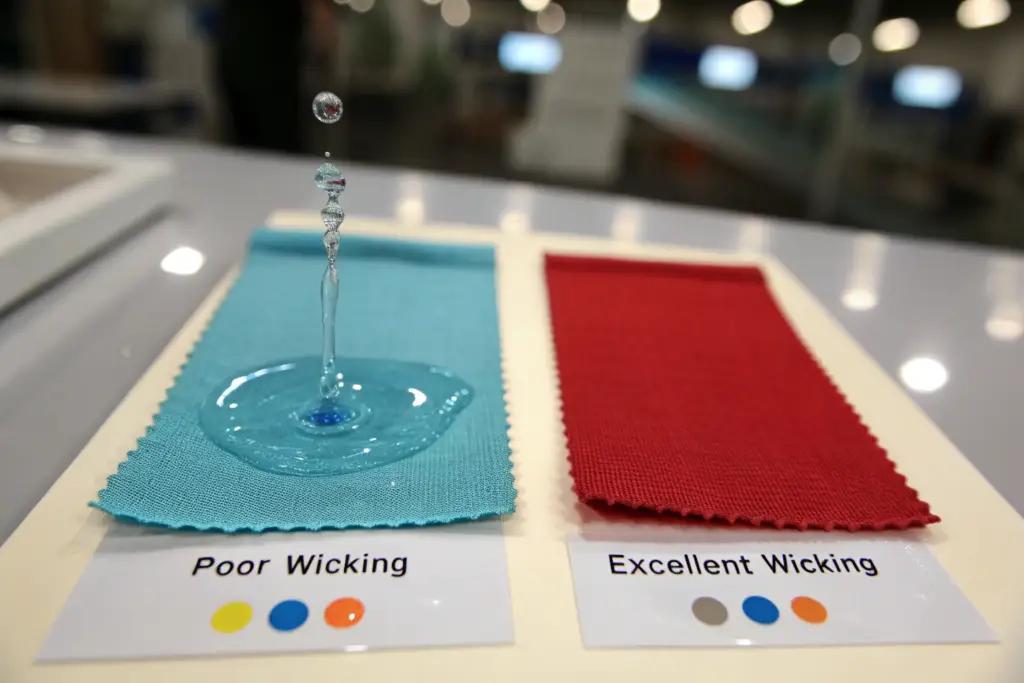
How Does a "Capillary-Channel Fiber Cross-Section" Accelerate the Wicking Rate Compared to a Round Polyester Fiber?
A round fiber has a smooth, cylindrical surface with limited surface area. A capillary-channel fiber—extruded with grooves, channels, or a multi-lobal cross-section such as a four-channel or a hollow core—increases the fiber's surface area and creates physical micro-channels along which liquid water is pulled rapidly by capillary action, spreading the sweat into a much thinner film over a much wider area.
Why Must "Wicking Rate" Be Tested After Multiple Wash Cycles, Not Just on New Fabric?
A fabric's wicking performance can degrade over repeated washing if the hydrophilic surface treatment or the capillary-channel fiber structure is damaged by detergent, heat, or mechanical agitation. A true cooling fabric should maintain at least 80% of its original wicking rate after 20 wash cycles.
What Specific "Fiber Blends and Finishes" Deliver a Sustained Cooling Effect Beyond the Initial Cool Touch?
A San Diego-based tennis apparel brand once sourced a fabric with a good initial cool touch, driven by a Qmax of 0.18. The fabric achieved this through a thin, smooth nylon microfiber construction. After fifteen minutes of active play, the cooling sensation faded, and the shirt felt neutral—neither cool nor warm, but not actively cooling. A competitor launched a shirt using a nylon fiber embedded with jade powder particles. The jade powder, a natural mineral with high thermal conductivity, continuously conducted heat away from the skin throughout the entire match, not just at the initial touch. The competitor's shirt was described as "staying cool all day," and the brand's shirt was described as "cool at first, then just okay."
Specific fiber blends and finishes deliver a sustained cooling effect beyond the initial cool touch by incorporating high-thermal-conductivity mineral additives—such as jade powder, ceramic microparticles, or xylitol—directly into the polymer matrix of the fiber during extrusion, or by applying a phase-change material finish that absorbs latent heat as the wearer's body temperature rises, creating a continuous, active cooling mechanism that persists throughout the entire wearing period, not just a transient cool-touch sensation that fades as the fabric reaches thermal equilibrium with the skin.
A high Qmax fabric feels cool on contact because it rapidly conducts heat away from the skin. But once the fabric reaches the same temperature as the skin, that initial cooling sensation stops. A fabric with embedded thermally conductive minerals continues to conduct heat through the fiber structure at a higher rate than standard fibers, maintaining a temperature gradient between the skin and the fabric surface for a longer period.
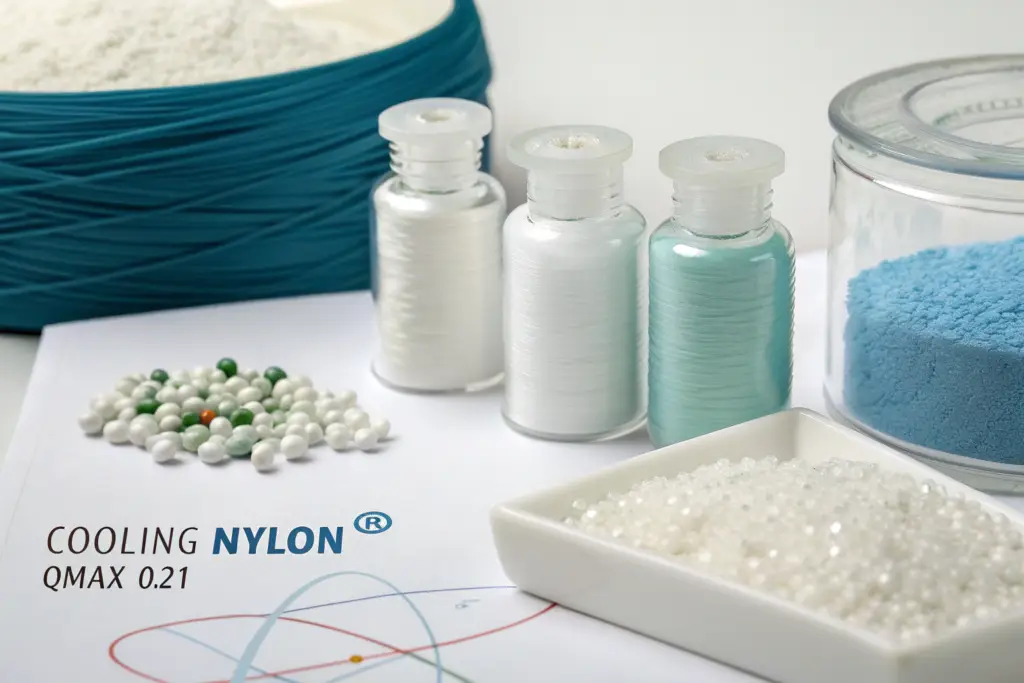
How Does "Jade Powder Embedded in Nylon Fiber" Differ From a "Surface-Applied Cooling Finish" in Terms of Wash Durability?
A surface-applied cooling finish is a chemical treatment applied to the finished fabric. It can degrade or wash off after 5-10 laundry cycles. Jade powder embedded into the nylon polymer during fiber extrusion is a permanent part of the fiber's molecular structure and remains effective for the life of the garment.
What Is a "Phase-Change Material Finish" and How Does It Actively Absorb Body Heat at a Specific Temperature Threshold?
A phase-change material is a microencapsulated substance—often a paraffin or a bio-based wax—that melts at a specific temperature, typically 28-32 degrees Celsius, which is slightly below skin temperature. As the wearer's skin heats up during activity, the PCM capsules absorb the excess heat to melt from solid to liquid, actively cooling the skin. When the wearer cools down, the PCM re-solidifies, ready to absorb heat again.
How Do You Verify a Factory's "Cooling Fabric" Claims With Independent Lab Test Data?
A Denver-based outdoor brand once accepted a factory's verbal claim that a fabric was "cooling fabric, very good quality." The factory provided a marketing brochure from the fabric mill that used the words "cool touch" and "breathable." No independent test data was provided. The fabric was sourced, the garments were produced, and the customer complaints about overheating began immediately. The brand sent a sample to an independent lab for testing after the fact. The Qmax was 0.09, the wicking rate was poor, and the air permeability was below 40 CFM. The fabric was not a cooling fabric by any objective measure. The brand had trusted a marketing brochure instead of a test report.
To verify a factory's cooling fabric claims, the brand must demand a third-party performance test report from an accredited laboratory—such as Intertek, SGS, or Bureau Veritas—that provides the specific, measured Qmax value per ASTM D7984, the wicking rate in millimeters per 10 minutes per AATCC 195, the air permeability in CFM per ASTM D737, and the fabric weight in GSM, all tested on the actual bulk production fabric lot, not on a pre-production sample, because a marketing brochure is a sales document and a factory's verbal assurance is a hope, while an independent lab report with specific numerical values is a verifiable fact.
A factory's fabric supplier provides a brochure that uses the word "cooling." The factory passes that word on to the brand. The brand puts "Cooling Technology" on the hangtag. The customer buys the garment, wears it on a hot day, and discovers that the word on the hangtag was not backed by any measurable performance. The only way to break this chain of unverified claims is to insert an independent laboratory test report between the factory's promise and the brand's marketing claim.
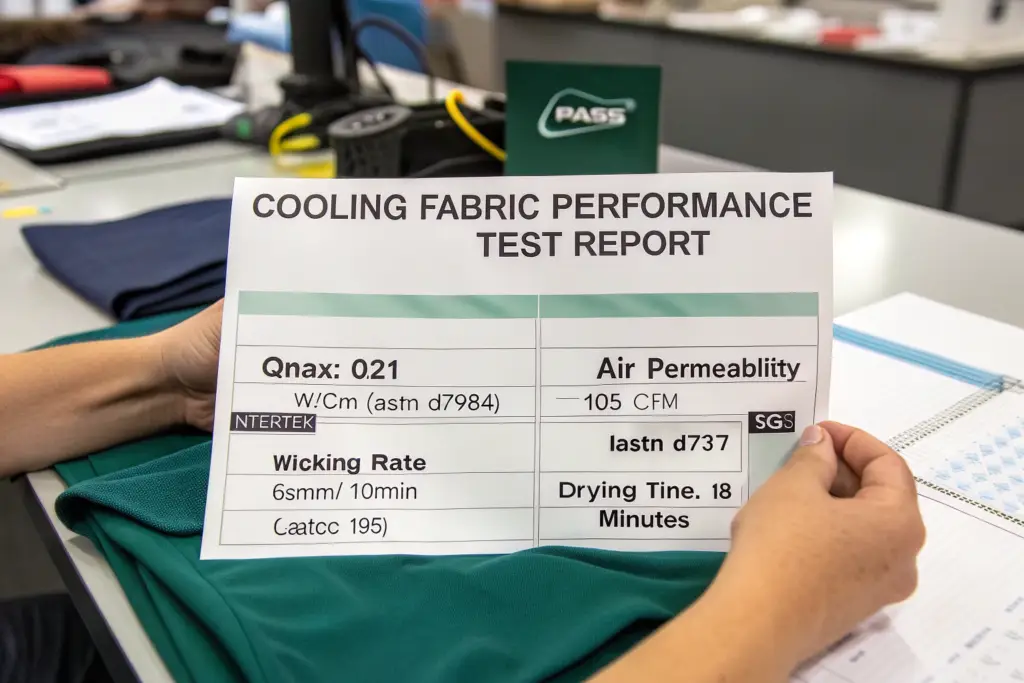
How Does a "Qmax Test Per ASTM D7984" Differ From a Factory's In-House "Cool Touch" Feeling Test?
The factory's in-house test is typically a subjective hand-touch evaluation: a technician places a hand on the fabric and reports that it feels cool. ASTM D7984 is an objective, instrumented test that measures the precise thermal effusivity in watts per square meter per Kelvin under controlled laboratory conditions. The first is an opinion. The second is a measurement.
Why Must the Test Report Reference the "Specific Bulk Fabric Lot Number" That Will Be Used for Production?
A factory can submit a specially prepared, high-performance sample for testing and then produce the bulk order with a different, lower-quality fabric. The test report must reference the specific bulk fabric lot number, and the brand should randomly pull a fabric sample from the bulk shipment and send it for a confirmation test before releasing the fabric to the cutting table.
Conclusion
Choosing a high-quality cooling fabric for Summer clothes requires moving beyond subjective hand-feel and marketing language into objective, measurable performance data. The Qmax thermal effusivity per ASTM D7984 quantifies the fabric's cool-touch sensation in watts per square meter per Kelvin, with values above 0.15 W/cm² delivering a noticeable initial cooling effect. The moisture-wicking rate per AATCC 195 measures how effectively the fabric spreads sweat into a thin evaporative film, preventing the hot, clammy saturation that destroys perceived cooling performance. The air permeability CFM per ASTM D737 ensures that body heat escapes through the fabric rather than being trapped against the skin. Embedded mineral additives such as jade powder or phase-change materials provide sustained, active cooling that persists beyond the initial cool touch. And an independent, third-party laboratory test report from an accredited lab is the only reliable verification that a factory's "cooling fabric" claim is backed by measurable physical performance.
At Shanghai Fumao, I require third-party Qmax, wicking, air permeability, and GSM test reports on every cooling fabric before it is released to my cutting tables. My fabric sourcing team works with mills that produce nylon 6.6 with jade powder additives, capillary-channel polyester, and phase-change material finishes, all supported by accredited lab data.
If you are a brand buyer developing a Summer collection and you want a manufacturing partner who verifies cooling fabric performance with independent lab test data, not marketing brochures, contact my Business Director, Elaine. She can share our cooling fabric performance specification template, our minimum Qmax and wicking rate thresholds, and sample accredited test reports from our fabric library. Reach Elaine at: elaine@fumaoclothing.com. Specify the Qmax, not the word "cooling."